John Locke (1632-
1704)
Founderof
Empiricism,Inventor
ofBlankSlate:No
innateideasnor
speculativeprinciples
We are not born with ideas. The
mind is a blank slate. There are
no imprints.
Neither ideas nor speculative
principles are innate.
Knowledge is created from
sensation and reflection.
The mind knows what truths are
and are not (to be or not to be)
from the senses and by
meditation of the past.
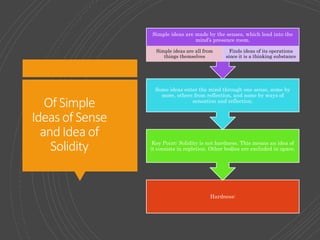
Of Simple
Ideas of Sense
and Idea of
Solidity
Hardness:
Key Point: Solidity is not hardness. This means an idea of
it consists in repletion. Other bodies are excluded in space.
Some ideas enter the mind through one sense, some by
more, others from reflection, and some by ways of
sensation and reflection.
Simple ideas are made by the senses, which lead into the
mind’s presence room.
Simple ideas are all from
things themselves
Finds ideas of its operations
since it is a thinking substance
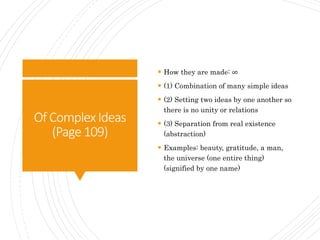
Of Complex Ideas
(Page 109)
 How they are made: ∞
 (1) Combination of many simple ideas
 (2) Setting two ideas by one another so
there is no unity or relations
 (3) Separation from real existence
(abstraction)
 Examples: beauty, gratitude, a man,
the universe (one entire thing)
(signified by one name)
Reductionof ComplexIdeas
Mind (page 110): Varies and
multiplies the objects of its
thoughts
1. Modes: Dependences on,
affections of substances (e.g.
triangle, gratitude, murder).
E.g. Theft: mixed mode (page
111)
•Variations: Combinations of the same
simple idea without the mixture of
another.
2. Substances: Compounded of
simple ideas of several kinds,
put together to make one
complex one, e.g. beauty,
which has a certain
composition of color and figure,
causing delight to the beholder
Ideas of Substances:
Combinations of simple ideas
as are taken to represent
particular things subsisting by
themselves.
3. Relations:
Somereasons
whythereare
noinnateideas
or principles
3. In practical instances, the measures must be taken
from the knowledge of the actions themselves, and the
rules of them, - abstracted from words, and antecedent
to the knowledge of names, what language soever he
chance to learn. (77-78).
2. General names cannot be understood but by
knowing particulars comprehended under them.
1. God does not create words of uncertain meaning.
Objections
“Innate principles may be corrupted” (20.)
“Innate principles of morality may, by
education, and custom, and the general
opinion of those amongst whom we converse,
be darkened and at last quite worn out of the
minds of men.”
Which assertion of theirs, if true, quite takes
away, the argument of universal consent, by
which this opinion of innate principles is
endeavored to be proved (78-79)
Contrary principles in the world (21.)
Universal
assent
Universal assent: What knowledge we all
aspire to know about.
Necessary concomitant of all innate truths
because the mind signifies mainly making
certain truths to be perceived.
“No proposition can be said to be in the mind
which it never yet knew, which it was never
yet conscious of.”
All true propositions that the mind can
assent to are in the mind, and “to be
imprinted” since not known propositions
imply the mind’s power of knowing it.
“And so the mind is of all truths it ever shall
know.” (Locke, An Essay Concerning Human
Understanding”,69, 5., Chapter I: No Innate
Speculative Principles)
Innate Truths
If there are such
truths, they are
discoverable
through the mind.
The mind has the
capacity to
understand what
they are if there be
any.
The mind’s powers
are not limited to
thinking.
Knowledge
It is in the mind, which knows what is or is not (to be or not
to be).
Argument
from
Assent
 It questions if innate ideas are real. Some
philosophers besides Locke have thought
they are but as we have read in the Essay,
Locke thinks there are no such kinds of ideas
in the mind, nor any speculative principles.
Operative
Faculties
The will (73. , 210): a
power to direct the
operative faculties to
motion or rest in
particular instances
Ideas of two kinds of
action: motion and
thinking (74., 212)
• Passions more than actions
(thought agents)
Relationof
Power and
Action
Thirdly: “The will or preference is determined by
something without itself” (29.)
Secondly: “Volition or willing, regarding only what is in our
power, is nothing but the preferring the doing of anything
to the not doing of it; action to rest, and contra” (28., 215)
It is nothing but the being pleased
more with the one than the other
“Substance has motion or thought and receives the
impression, whereby it is put into that action, purely from
without, and so acts merely by the capacity it has to
receive such an impression from some external agent; and
such a power is not properly an active power, but a mere
passive capacity in the subject.”
Groundsof Assent
Page 566: Propositions of
probability
1. Particular existence:
matter of fact (observation
 human testimony)
2. Conceiving things beyond
the discovery of our senses
(not capable of testimony)
Demonstration
(me and the
other)
 “All Englishmen affirm that it froze in
England in the last winter, I think a
man could almost as little doubt of it as
that seven and four are eleven.”
 Connection of math to experience
 Observational facts are as real as
mathematical truths since we shouldn’t
doubt either kind of idea.
Forms of
Argument
(Pages588-
589)
1. Argumentum ad
verecundiam: Back your
opinions with authority.
2. Argumentum ad
ignorantiam: force you to
submit your judgment, and
receive the opinion in debate.
Admit a proof or assign a
better.
3. Argumentum ad hominem:
Press a man with
consequences drawn from his
own principles or concessions.
4. Argumentum ad judicium:
Using of proofs drawn from
any of the foundations of
knowledge or probability.
•I don’t say you’re right. It doesn’t
prove you’re right. You don’t show
me that I’m wrong.
The diversity of arguments
develops Locke’s idea that
reason is a faculty.
This book
took Locke58
yearsto write
 He goes on to say: Men must think and know
for themselves. “Should make greater
progress in the discovery of rational and
contemplative knowledge in the consideration
of things themselves, and made use rather of
our own thoughts than other men’s to find it.”

JohnLocke.pptx

  • 1.
  • 2.
    Founderof Empiricism,Inventor ofBlankSlate:No innateideasnor speculativeprinciples We are notborn with ideas. The mind is a blank slate. There are no imprints. Neither ideas nor speculative principles are innate. Knowledge is created from sensation and reflection. The mind knows what truths are and are not (to be or not to be) from the senses and by meditation of the past.
  • 3.
    Of Simple Ideas ofSense and Idea of Solidity Hardness: Key Point: Solidity is not hardness. This means an idea of it consists in repletion. Other bodies are excluded in space. Some ideas enter the mind through one sense, some by more, others from reflection, and some by ways of sensation and reflection. Simple ideas are made by the senses, which lead into the mind’s presence room. Simple ideas are all from things themselves Finds ideas of its operations since it is a thinking substance
  • 4.
    Of Complex Ideas (Page109)  How they are made: ∞  (1) Combination of many simple ideas  (2) Setting two ideas by one another so there is no unity or relations  (3) Separation from real existence (abstraction)  Examples: beauty, gratitude, a man, the universe (one entire thing) (signified by one name)
  • 5.
    Reductionof ComplexIdeas Mind (page110): Varies and multiplies the objects of its thoughts 1. Modes: Dependences on, affections of substances (e.g. triangle, gratitude, murder). E.g. Theft: mixed mode (page 111) •Variations: Combinations of the same simple idea without the mixture of another. 2. Substances: Compounded of simple ideas of several kinds, put together to make one complex one, e.g. beauty, which has a certain composition of color and figure, causing delight to the beholder Ideas of Substances: Combinations of simple ideas as are taken to represent particular things subsisting by themselves. 3. Relations:
  • 6.
    Somereasons whythereare noinnateideas or principles 3. Inpractical instances, the measures must be taken from the knowledge of the actions themselves, and the rules of them, - abstracted from words, and antecedent to the knowledge of names, what language soever he chance to learn. (77-78). 2. General names cannot be understood but by knowing particulars comprehended under them. 1. God does not create words of uncertain meaning.
  • 7.
    Objections “Innate principles maybe corrupted” (20.) “Innate principles of morality may, by education, and custom, and the general opinion of those amongst whom we converse, be darkened and at last quite worn out of the minds of men.” Which assertion of theirs, if true, quite takes away, the argument of universal consent, by which this opinion of innate principles is endeavored to be proved (78-79) Contrary principles in the world (21.)
  • 8.
    Universal assent Universal assent: Whatknowledge we all aspire to know about. Necessary concomitant of all innate truths because the mind signifies mainly making certain truths to be perceived. “No proposition can be said to be in the mind which it never yet knew, which it was never yet conscious of.” All true propositions that the mind can assent to are in the mind, and “to be imprinted” since not known propositions imply the mind’s power of knowing it. “And so the mind is of all truths it ever shall know.” (Locke, An Essay Concerning Human Understanding”,69, 5., Chapter I: No Innate Speculative Principles)
  • 9.
    Innate Truths If thereare such truths, they are discoverable through the mind. The mind has the capacity to understand what they are if there be any. The mind’s powers are not limited to thinking.
  • 10.
    Knowledge It is inthe mind, which knows what is or is not (to be or not to be).
  • 11.
    Argument from Assent  It questionsif innate ideas are real. Some philosophers besides Locke have thought they are but as we have read in the Essay, Locke thinks there are no such kinds of ideas in the mind, nor any speculative principles.
  • 12.
    Operative Faculties The will (73., 210): a power to direct the operative faculties to motion or rest in particular instances Ideas of two kinds of action: motion and thinking (74., 212) • Passions more than actions (thought agents)
  • 13.
    Relationof Power and Action Thirdly: “Thewill or preference is determined by something without itself” (29.) Secondly: “Volition or willing, regarding only what is in our power, is nothing but the preferring the doing of anything to the not doing of it; action to rest, and contra” (28., 215) It is nothing but the being pleased more with the one than the other “Substance has motion or thought and receives the impression, whereby it is put into that action, purely from without, and so acts merely by the capacity it has to receive such an impression from some external agent; and such a power is not properly an active power, but a mere passive capacity in the subject.”
  • 14.
    Groundsof Assent Page 566:Propositions of probability 1. Particular existence: matter of fact (observation  human testimony) 2. Conceiving things beyond the discovery of our senses (not capable of testimony)
  • 15.
    Demonstration (me and the other) “All Englishmen affirm that it froze in England in the last winter, I think a man could almost as little doubt of it as that seven and four are eleven.”  Connection of math to experience  Observational facts are as real as mathematical truths since we shouldn’t doubt either kind of idea.
  • 16.
    Forms of Argument (Pages588- 589) 1. Argumentumad verecundiam: Back your opinions with authority. 2. Argumentum ad ignorantiam: force you to submit your judgment, and receive the opinion in debate. Admit a proof or assign a better. 3. Argumentum ad hominem: Press a man with consequences drawn from his own principles or concessions. 4. Argumentum ad judicium: Using of proofs drawn from any of the foundations of knowledge or probability. •I don’t say you’re right. It doesn’t prove you’re right. You don’t show me that I’m wrong. The diversity of arguments develops Locke’s idea that reason is a faculty.
  • 17.
    This book took Locke58 yearstowrite  He goes on to say: Men must think and know for themselves. “Should make greater progress in the discovery of rational and contemplative knowledge in the consideration of things themselves, and made use rather of our own thoughts than other men’s to find it.”

Editor's Notes

  • #3 In the 16th and 17th century, the Enlightenment was a time where intellectualism flourished and old ideas about physics were being replaced by new ones. Is matter real or is it an idea? Real (Not an idea in mind like Berkeley thought.)