POLITICAL PARTIES IN THE 
PHILIPPINES
Political parties in the Philippines are of 
diverse ideologies and are plentiful in 
number. Most of these parties do not have 
actual grassroots membership among 
ordinary voters but rather that of political 
figures and leaders.
What is a Political Party 
A group of people that is organized for 
the purpose of winning government 
power, by electoral or other means. 
Voluntary association of individuals 
who advocate certain principles or 
policies as superior to all others for 
the general conduct of government and 
which nominates and supports certain of its leaders as electoral 
candidates.
CHARACTERISTICS OF A 
POLITICAL PARTY: 
1. Has an organized structure with lines of 
authority and power distribution. 
2. Seek to attract popular support in the form of 
votes. 
3. Seeks political power directly thru electoral 
method 
4. Prepared to support a candidate and fight for 
victory in an election. (to gain power)
PARTY MEMBERSHIP 
means formal attachment to a political party, usually 
involving the assumption of obligations to the party and 
receiving privileges from the party. 
1. For patronage 
2. To get special treatment from the government 
3. To enhance their own career 
4. Economic benefit 
5. Personal gratification 
6. To have and to use an influence on the others 
7. Ideological fulfillment
Party Membership Rules: 
§ Usually require a person to apply formally for 
membership, and party officials can accept or 
reject the application (though in fact they are 
usually accepted). 
§ The person must at least pay annual dues 
and sometimes take an oath to support the 
party’s principles and candidates.
THE FUNCTIONS OF 
POLITICAL PARTIES 
1. Leadership Recruitment- The political party is still 
likely to be a structure that identifies potential leaders, 
brings them to public attention, and secures them the 
support necessary for taking public office. 
2. Coordinate policy across different branches of Gov’t 
3. Mobilize voters – get out the vote drives 
-President, Congress, local party cooperation 
to win elections. 
-Leaders stress party loyalty to proposed policies. 
4. Provide accountability- unintended side effect 
Used by voters to hold elected official accountable
THE FUNCTIONS OF 
POLITICAL PARTIES 
5. nominate candidates - by most 
common method today. 
6. contest election- “wage war” in the 
general election 
7. form governments- organized along 
party lines 
government appointments in executive
PRINCIPAL ACTIVITIES OF PARTIES 
1. Selecting Candidates 
Parties virtually monopolize nominations, 
which give them tremendous power to shape 
governments and policies. 
2. Election Campaigning 
Those professionals, hired by the 
candidates for substantial fees, organize high-tech 
campaigns that feature such up-to-date 
(and costly) techniques and raising money by 
computerized direct mail advertising.
PRINCIPAL ACTIVITIES OF PARTIES 
CONT.. 
3. Nominate Candidates—Recruit, choose, and present 
candidates for public office. 
4. Inform and Activate Supporters—Campaign, define 
issues, and criticize other candidates. 
5. Act as a Bonding Agent—Guarantee that their candidate 
is worthy of the office. 
6. Govern—Members of government act according to their 
partisanship, or firm allegiance to a party. 
7. Act as a Watchdog—Parties that are out of power keep a 
close eye on the actions of the party in power for a blunder 
to use against them in the next election.
POLICY FORMULATION 
The successful party finds out what people 
want and finds way to combine and address 
those demands. Specific policies inevitably 
begin to emerge in this process. 
1. Campaigning 
In today’s world of mass media, political consultants, 
and direct mail advertising, the parties still play a part in 
ensuring that voters are registered, that they know the 
differences among the candidates, and that they know 
when and where to vote on election day.
2. GOVERNING 
The leader of the party winning 
the most votes takes the top 
leadership role, works with the 
advice of a cabinet formed of 
his own party.
SOME PHILIPPINE 
POLITICAL PARTIES
NACIONALISTA 
PARTY
LIBERAL PARTY 
PARTIDO 
LIBERAL 
NG PILIPINAS
PWERSA NG MASANG 
PILIPINO 
Force of the Filipino Masses
L 
A 
K 
A 
S 
K 
A 
M 
P 
I 
CMD
MINOR PARTIES PLAY SEVERAL IMPORTANT ROLES: 
“SPOILER ROLE” 
MINOR PARTY CANDIDATES CAN PULL DECISIVE VOTES AWAY 
FROM ONE OF THE MAJOR PARTIES’ CANDIDATES, ESPECIALLY 
IF THE MINOR PARTY CANDIDATE IS FROM A SPLINTER PARTY. 
CRITIC 
MINOR PARTIES, ESPECIALLY SINGLE-ISSUE PARTIES, OFTEN 
TAKE STANDS ON AND DRAW ATTENTION TO CONTROVERSIAL 
ISSUES THAT THE MAJOR PARTIES WOULD PREFER TO IGNORE. 
INNOVATOR 
OFTEN, MINOR PARTIES WILL DRAW ATTENTION TO IMPORTANT 
ISSUES AND PROPOSE INNOVATIVE SOLUTIONS TO PROBLEMS. IF 
THESE PROPOSALS GAIN POPULAR SUPPORT, THEY ARE OFTEN 
INTEGRATED INTO THE PLATFORMS OF THE TWO MAJOR PARTIES.
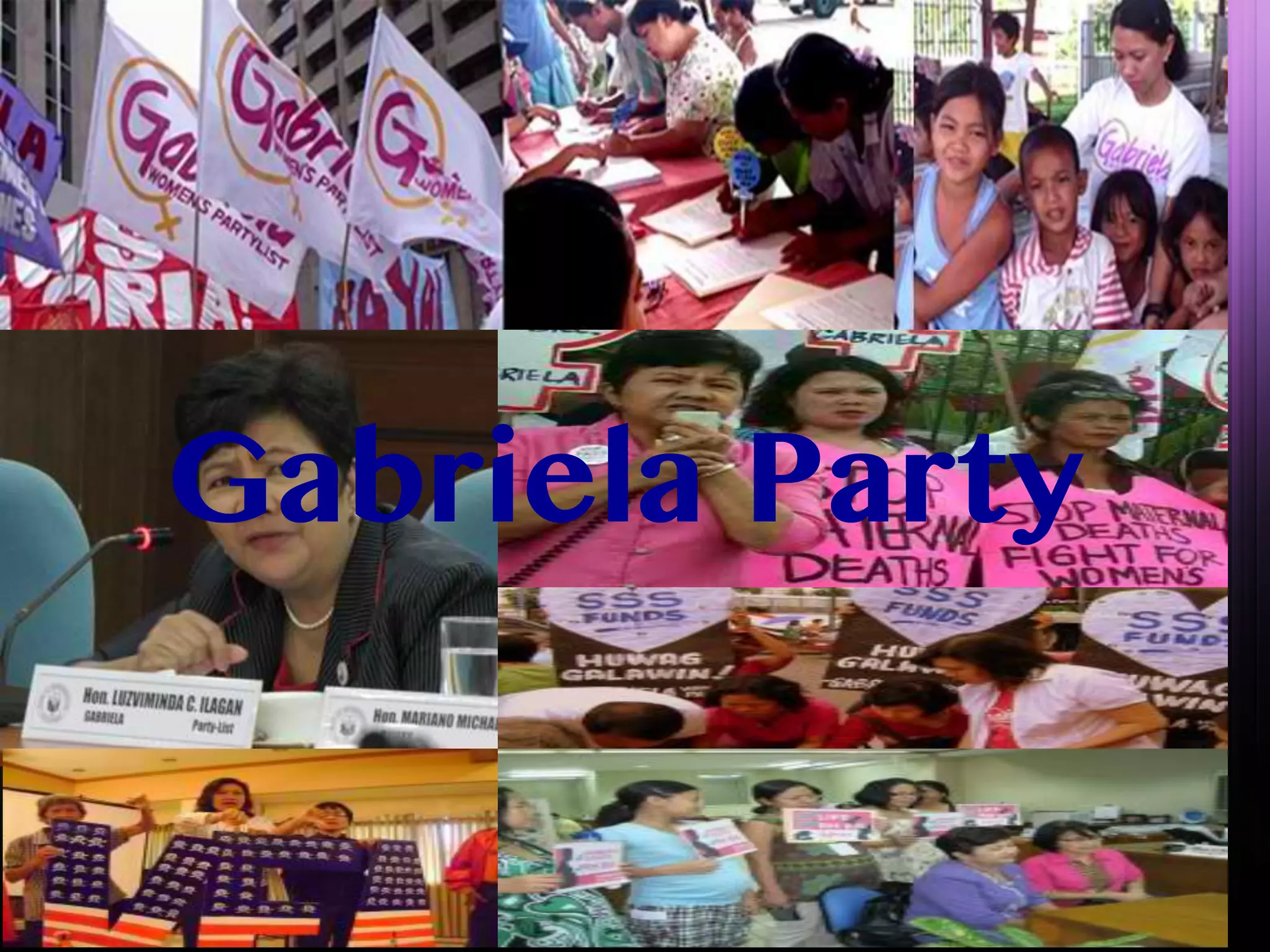
Gabriela Party
Anak mindanao 
Party
Philippine 
name 
! 
Parties Represented in Congress 
English name Abbr. Leader Founded International 
Seats in the 
lower house 
Seats in the 
upper house 
Notes 
Bagong 
Alyansang 
Makabayan 
New Patriotic 
Alliance 
Bayan 
Satur 
Ocampo 
1985 
International 
Newsletter 
7 / 292 
0 / 24 
Offshoot of the Communist 
Party of the Philippines 
Centrist Democratic Party of 
the Philippines 
CDP 
Rufus 
Rodriguez 
2012 none 
1 / 292 
0 / 24 
Offshoot of Lakas–Christian 
Muslim Democrats 
Kilusang 
Bagong 
Lipunan 
New Society 
Movement 
KBL 
Imelda 
Marcos 
1978 none 
1 / 292 
0 / 24 
Offshoot of the Nacionalista 
Party 
Laban ng 
Demokratik 
ong 
Pilipino 
Struggle of 
Democratic 
Filipinos 
LDP 
Edgardo 
Angara 
1998 
Centrist 
Democrat 
International 
2 / 292 
1 / 24 
Former member of Corazon 
Aquino's UNIDO (1986) 
Partido 
Demokratik 
o Pilipino- 
Lakas ng 
Bayan 
Philippine 
Democratic 
Party- 
People's 
Power 
PDP 
Laban 
Aquilino 
Pimentel III 
1982 none UNA 
1 / 24 
Former member of Corazon 
Aquino's UNIDO (1986) 
People's Reform Party PRP 
Miriam 
Defensor 
Santiago 
1991 none 
0 / 292 
1 / 24 
Pwersa ng 
Masang 
Pilipino 
Force of the 
Filipino 
Masses 
PMP 
Joseph 
Estrada 
1991 none See UNA
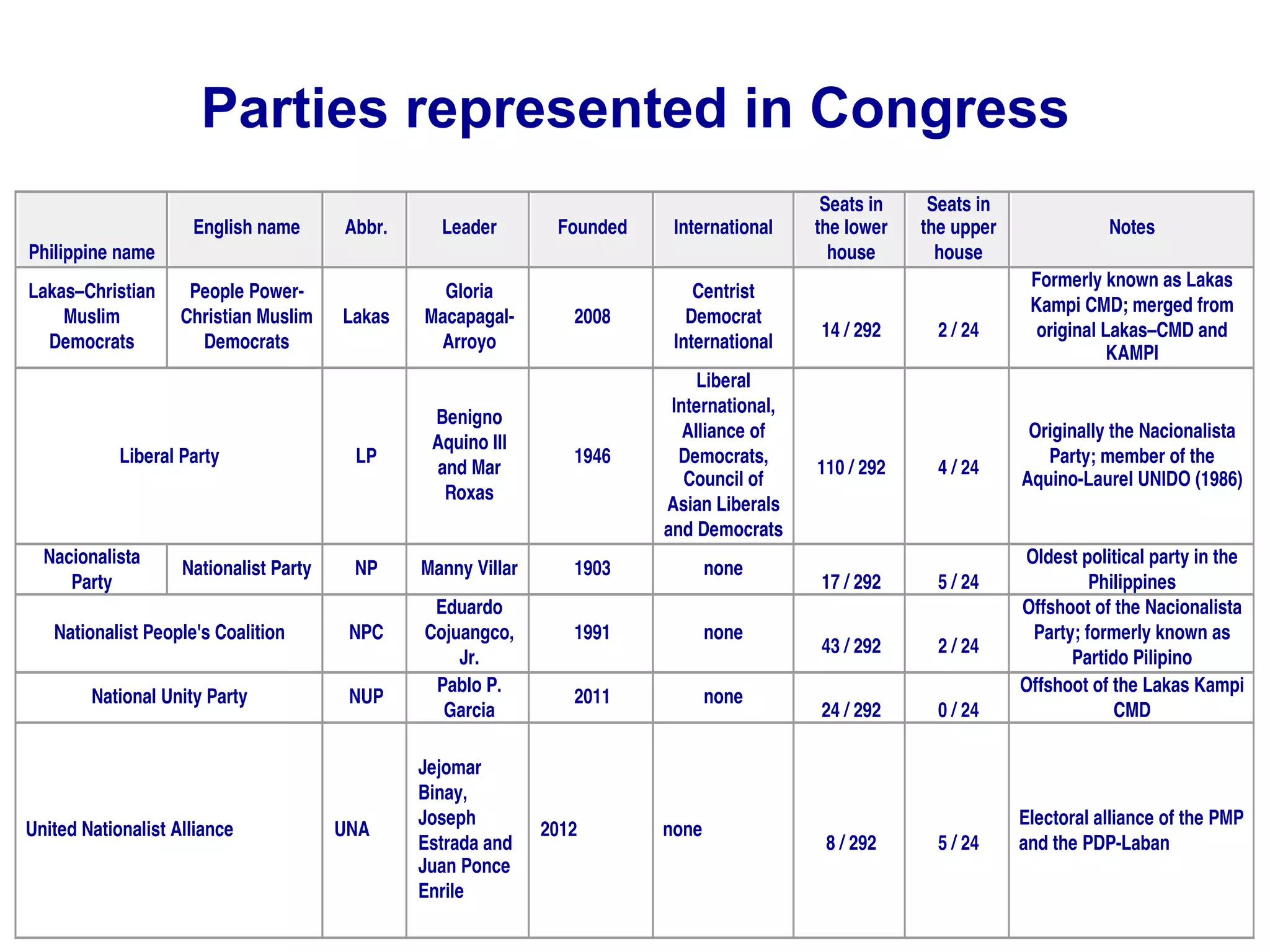
Parties represented in Congress 
Philippine name 
!! 
English name Abbr. Leader Founded International 
Seats in 
the lower 
house 
Seats in 
the upper 
house 
Notes 
Lakas–Christian 
Muslim 
Democrats 
People Power- 
Christian Muslim 
Democrats 
Lakas 
Gloria 
Macapagal- 
Arroyo 
2008 
Centrist 
Democrat 
International 
14 / 292 
2 / 24 
Formerly known as Lakas 
Kampi CMD; merged from 
original Lakas–CMD and 
KAMPI 
Liberal Party LP 
Benigno 
Aquino III 
and Mar 
Roxas 
1946 
Liberal 
International, 
Alliance of 
Democrats, 
Council of 
Asian Liberals 
and Democrats 
110 / 292 
4 / 24 
Originally the Nacionalista 
Party; member of the 
Aquino-Laurel UNIDO (1986) 
Nacionalista 
Party 
Nationalist Party NP Manny Villar 1903 none 
17 / 292 
5 / 24 
Oldest political party in the 
Philippines 
Nationalist People's Coalition NPC 
Eduardo 
Cojuangco, 
Jr. 
1991 none 
43 / 292 
2 / 24 
Offshoot of the Nacionalista 
Party; formerly known as 
Partido Pilipino 
National Unity Party NUP 
Pablo P. 
Garcia 
2011 none 
24 / 292 
0 / 24 
Offshoot of the Lakas Kampi 
CMD 
United Nationalist Alliance UNA 
Jejomar 
Binay, 
Joseph 
Estrada and 
Juan Ponce 
Enrile 
2012 none 
8 / 292 
5 / 24 
Electoral alliance of the PMP 
and the PDP-Laban
These parties won more than 2% of the vote 
Philippine 
name 
Party-lists represented in Congress 
English 
translation 
Abbr. #1 nominee 
Seats in the lower 
house (PL only) 
Notes 
1st Consumers Alliance for 
Rural Energy 
1-CARE 
Edgardo 
Masongsong 
2 / 58 
Abono Fertilizer Abono Conrado Estrella III 
2 / 58 
Advocacy for Teacher 
Empowerment Through Action, 
Cooperation and Harmony 
Towards Educational Reforms 
A TEACHER Mariano Piamonte, Jr. 
2 / 58 
Agricultural Sector Alliance of 
the Philippines 
AGAP Nicanor Miral Briones 
2 / 58 
Akbayan 
Citizens' 
Action Party 
Akbayan Walden Bello 
2 / 58 
Member of the Progressive 
Alliance; 
Consultative member of the 
Socialist International; 
Allied with Team PNoy 
Ako Bicol 
Political 
Party 
I am Bicol 
Political Party 
AKB 
Christopher Co or 
Emilio Ubaldo, Jr. 
2 / 58 
An Waray 
The Waray 
[people] 
An Waray 
Neil Benedict 
Montejo 
2 / 58 
Bayan Muna Nation First Bayan Muna Neri Colmenares 
2 / 58 
Member of the Bagong 
Alyansang Makabayan 
Buhay 
Hayaan 
Yumabong 
Life be 
Allowed to 
Prosper 
Buhay Michael Velarde, Jr. 
3 / 58 
Citizens' Battle Against 
Corruption 
CIBAC 
Sherwin Tugna or 
Luis Lokin, Jr. 
2 / 58 
Cooperative NATCCO Network 
Party 
Coop- 
NATCCO 
Cresente Paez 
2 / 58 
GABRIELA Women's Party GABRIELA Luzviminda Ilagan 
2 / 58 
Member of the Bagong 
Alyansang Makabayan 
Magdalo 
para sa 
Pilipino 
Cheer for 
Filipinos 
Magdalo Gary Alejano 
2 / 58 
OFW Family Club OFW Family Roy Señeres, Sr. 
2 / 58
Kinds of Party Systems 
1. The One- Party System 
2. The Two- Party System 
3. The Multi- Party System
The One- Party System 
¨ Only one party holds the power because 
it towers above the others or because it 
suppresses all other groups. 
¨ With two sub- types: 
¤ The one party democracy ( usually 
found in newly- independent states) 
¤ The Totalitarian Party in Communist 
states.
The Two- Party System 
a. The turn- over system 
b. The system wherein major political 
parties alternate with each other 
in the exercise of political power. 
¤ In the US- Democratic and Republican 
¤ In Britain- Conservative and Labour 
parties
The Advantages and 
Disadvantages 
ADVANTAGES DISADVANTAGES 
1. Ensures simplicity and 
stability in the change of 
government. 
2. Loosing party acts as “ 
loyal opposition” to force 
the party on power. 
3. Assures a measure of 
political unity 
¤ Allows a free interplay of 
opposing forces. 
¨ May decline into a 
m o n o t o n o u s 
p o l i t i c a l game 
wherein politicians 
yield to corruption 
and patronage of 
each other.
The Multi Party System 
More than two political parties fight in an election. 
¨ No single party gets the majority control of the 
power. 
¨ Leads to coalition of parties to secure a 
governing control of the government. 
¨ Transfer the consensus building on the floor of 
the Congress or the inner of chambers of 
government itself. 
¤ Rightist, leftist, center
¨ The Leftist- reform – minded party 
which seeks to change the existing 
conditions in the country. 
¨ The “Rightist” – conservative group 
which seeks to maintain the status quo 
in the country. 
¨ The Center Party has adopted policies 
which are mixture of both the left and 
right tendencies.
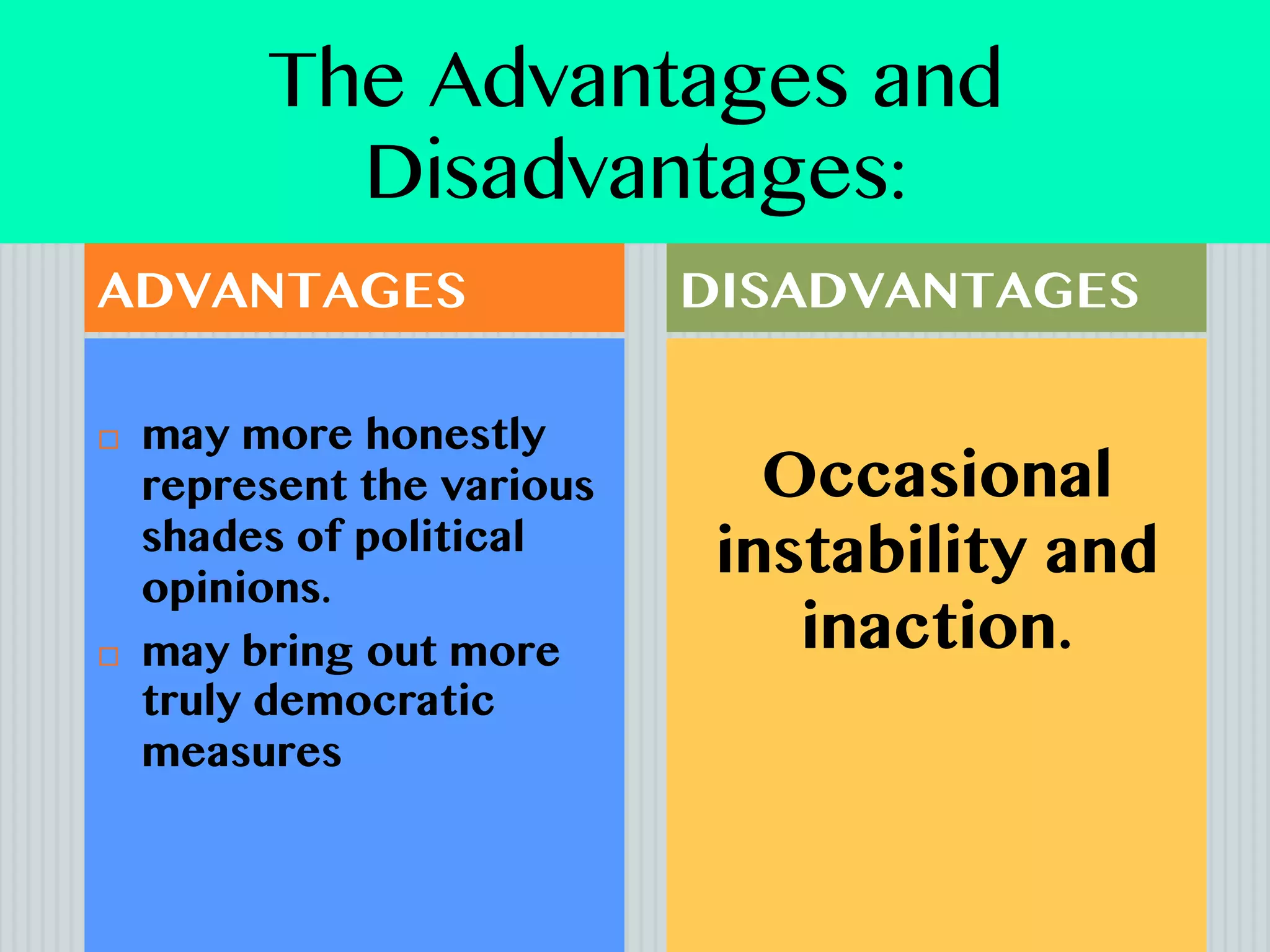
The Advantages and 
Disadvantages: 
ADVANTAGES DISADVANTAGES 
¨ may more honestly 
represent the various 
shades of political 
opinions. 
¨ may bring out more 
truly democratic 
measures 
Occasional 
instability and 
inaction.
Party Organization 
¨ Why do the major parties have a 
decentralized structure? 
¨ How does the national party machinery 
and the local party machinery operate? 
¨ What are the three components of the 
parties? 
¨ What are the future possibilities for the 
major parties?
The Decentralized Nature of 
the Parties 
Both of the major parties are highly 
decentralized and fragmented. 
WHY? 
1. The party out of power lacks a strong leader. 
2. The government system distributes powers 
widely, in turn causing the parties to be 
decentralized. 
3. The nominating process give way party members 
against one another because only one person can 
chosen to be the party’s presidential candidate.
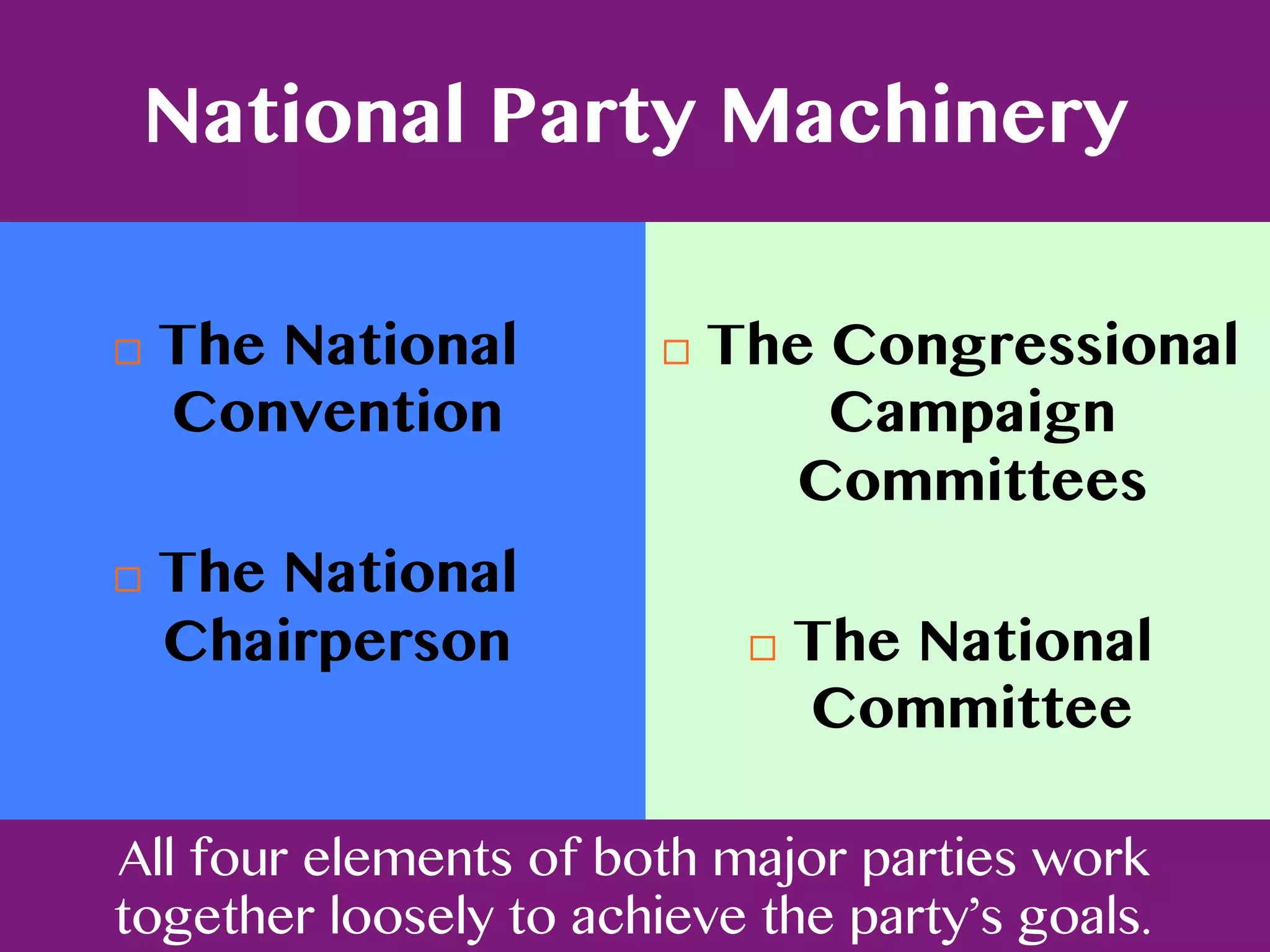
National Party Machinery 
¨ The National 
Convention 
¨ The National 
Chairperson 
¨ The Congressional 
Campaign 
Committees 
¨ The National 
Committee 
All four elements of both major parties work 
together loosely to achieve the party’s goals.
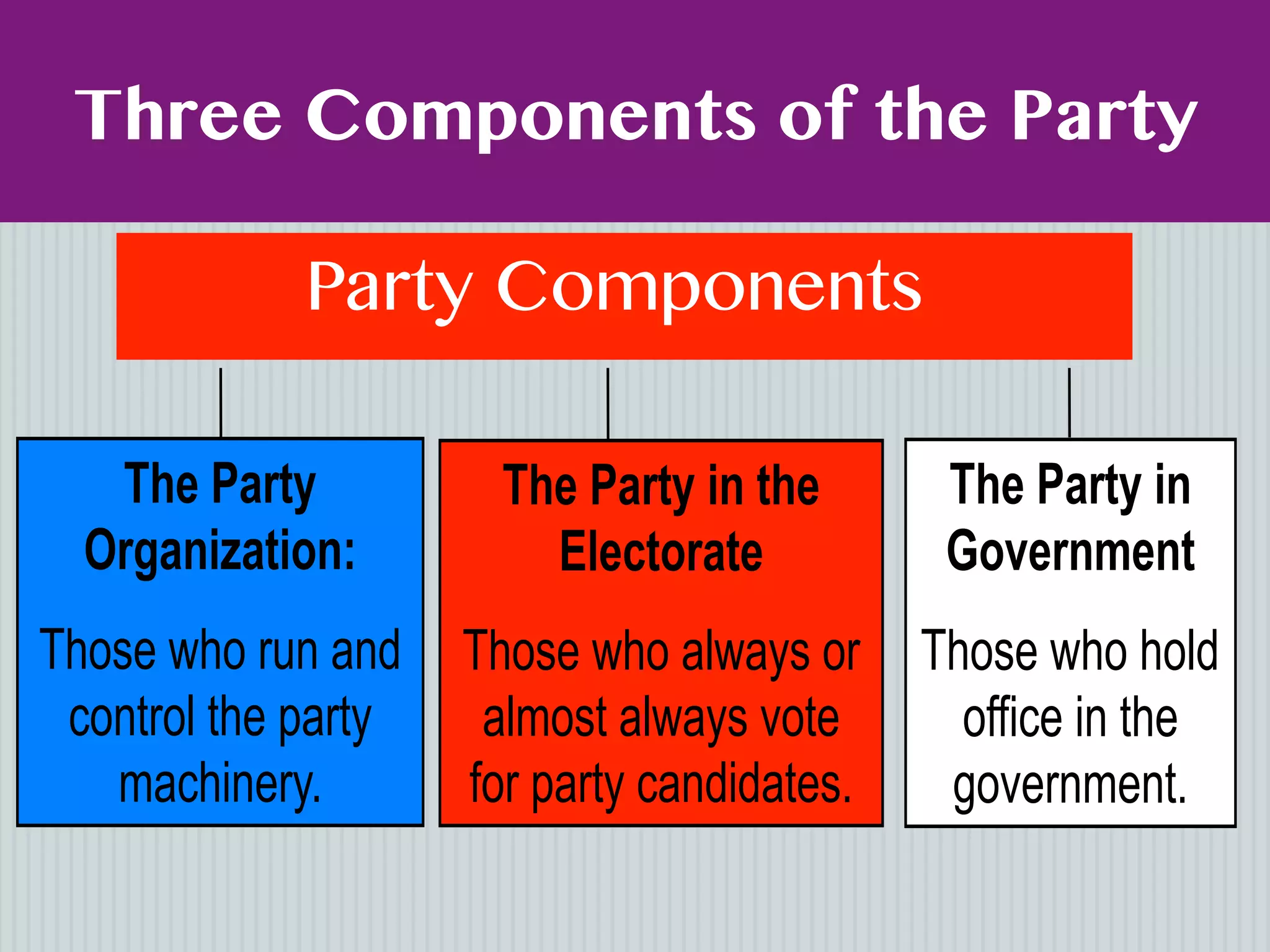
Three Components of the Party 
Party Components 
The Party in the 
Electorate 
Those who always or 
almost always vote 
for party candidates. 
The Party in 
Government 
Those who hold 
office in the 
government. 
The Party 
Organization: 
Those who run and 
control the party 
machinery.
Philippine Political Parties

Philippine Political Parties

  • 1.
    POLITICAL PARTIES INTHE PHILIPPINES
  • 2.
    Political parties inthe Philippines are of diverse ideologies and are plentiful in number. Most of these parties do not have actual grassroots membership among ordinary voters but rather that of political figures and leaders.
  • 3.
    What is aPolitical Party A group of people that is organized for the purpose of winning government power, by electoral or other means. Voluntary association of individuals who advocate certain principles or policies as superior to all others for the general conduct of government and which nominates and supports certain of its leaders as electoral candidates.
  • 4.
    CHARACTERISTICS OF A POLITICAL PARTY: 1. Has an organized structure with lines of authority and power distribution. 2. Seek to attract popular support in the form of votes. 3. Seeks political power directly thru electoral method 4. Prepared to support a candidate and fight for victory in an election. (to gain power)
  • 5.
    PARTY MEMBERSHIP meansformal attachment to a political party, usually involving the assumption of obligations to the party and receiving privileges from the party. 1. For patronage 2. To get special treatment from the government 3. To enhance their own career 4. Economic benefit 5. Personal gratification 6. To have and to use an influence on the others 7. Ideological fulfillment
  • 6.
    Party Membership Rules: § Usually require a person to apply formally for membership, and party officials can accept or reject the application (though in fact they are usually accepted). § The person must at least pay annual dues and sometimes take an oath to support the party’s principles and candidates.
  • 7.
    THE FUNCTIONS OF POLITICAL PARTIES 1. Leadership Recruitment- The political party is still likely to be a structure that identifies potential leaders, brings them to public attention, and secures them the support necessary for taking public office. 2. Coordinate policy across different branches of Gov’t 3. Mobilize voters – get out the vote drives -President, Congress, local party cooperation to win elections. -Leaders stress party loyalty to proposed policies. 4. Provide accountability- unintended side effect Used by voters to hold elected official accountable
  • 8.
    THE FUNCTIONS OF POLITICAL PARTIES 5. nominate candidates - by most common method today. 6. contest election- “wage war” in the general election 7. form governments- organized along party lines government appointments in executive
  • 9.
    PRINCIPAL ACTIVITIES OFPARTIES 1. Selecting Candidates Parties virtually monopolize nominations, which give them tremendous power to shape governments and policies. 2. Election Campaigning Those professionals, hired by the candidates for substantial fees, organize high-tech campaigns that feature such up-to-date (and costly) techniques and raising money by computerized direct mail advertising.
  • 10.
    PRINCIPAL ACTIVITIES OFPARTIES CONT.. 3. Nominate Candidates—Recruit, choose, and present candidates for public office. 4. Inform and Activate Supporters—Campaign, define issues, and criticize other candidates. 5. Act as a Bonding Agent—Guarantee that their candidate is worthy of the office. 6. Govern—Members of government act according to their partisanship, or firm allegiance to a party. 7. Act as a Watchdog—Parties that are out of power keep a close eye on the actions of the party in power for a blunder to use against them in the next election.
  • 11.
    POLICY FORMULATION Thesuccessful party finds out what people want and finds way to combine and address those demands. Specific policies inevitably begin to emerge in this process. 1. Campaigning In today’s world of mass media, political consultants, and direct mail advertising, the parties still play a part in ensuring that voters are registered, that they know the differences among the candidates, and that they know when and where to vote on election day.
  • 12.
    2. GOVERNING Theleader of the party winning the most votes takes the top leadership role, works with the advice of a cabinet formed of his own party.
  • 13.
  • 16.
  • 17.
    LIBERAL PARTY PARTIDO LIBERAL NG PILIPINAS
  • 18.
    PWERSA NG MASANG PILIPINO Force of the Filipino Masses
  • 19.
    L A K A S K A M P I CMD
  • 22.
    MINOR PARTIES PLAYSEVERAL IMPORTANT ROLES: “SPOILER ROLE” MINOR PARTY CANDIDATES CAN PULL DECISIVE VOTES AWAY FROM ONE OF THE MAJOR PARTIES’ CANDIDATES, ESPECIALLY IF THE MINOR PARTY CANDIDATE IS FROM A SPLINTER PARTY. CRITIC MINOR PARTIES, ESPECIALLY SINGLE-ISSUE PARTIES, OFTEN TAKE STANDS ON AND DRAW ATTENTION TO CONTROVERSIAL ISSUES THAT THE MAJOR PARTIES WOULD PREFER TO IGNORE. INNOVATOR OFTEN, MINOR PARTIES WILL DRAW ATTENTION TO IMPORTANT ISSUES AND PROPOSE INNOVATIVE SOLUTIONS TO PROBLEMS. IF THESE PROPOSALS GAIN POPULAR SUPPORT, THEY ARE OFTEN INTEGRATED INTO THE PLATFORMS OF THE TWO MAJOR PARTIES.
  • 24.
  • 25.
  • 27.
    Philippine name ! Parties Represented in Congress English name Abbr. Leader Founded International Seats in the lower house Seats in the upper house Notes Bagong Alyansang Makabayan New Patriotic Alliance Bayan Satur Ocampo 1985 International Newsletter 7 / 292 0 / 24 Offshoot of the Communist Party of the Philippines Centrist Democratic Party of the Philippines CDP Rufus Rodriguez 2012 none 1 / 292 0 / 24 Offshoot of Lakas–Christian Muslim Democrats Kilusang Bagong Lipunan New Society Movement KBL Imelda Marcos 1978 none 1 / 292 0 / 24 Offshoot of the Nacionalista Party Laban ng Demokratik ong Pilipino Struggle of Democratic Filipinos LDP Edgardo Angara 1998 Centrist Democrat International 2 / 292 1 / 24 Former member of Corazon Aquino's UNIDO (1986) Partido Demokratik o Pilipino- Lakas ng Bayan Philippine Democratic Party- People's Power PDP Laban Aquilino Pimentel III 1982 none UNA 1 / 24 Former member of Corazon Aquino's UNIDO (1986) People's Reform Party PRP Miriam Defensor Santiago 1991 none 0 / 292 1 / 24 Pwersa ng Masang Pilipino Force of the Filipino Masses PMP Joseph Estrada 1991 none See UNA
  • 28.
    Parties represented inCongress Philippine name !! English name Abbr. Leader Founded International Seats in the lower house Seats in the upper house Notes Lakas–Christian Muslim Democrats People Power- Christian Muslim Democrats Lakas Gloria Macapagal- Arroyo 2008 Centrist Democrat International 14 / 292 2 / 24 Formerly known as Lakas Kampi CMD; merged from original Lakas–CMD and KAMPI Liberal Party LP Benigno Aquino III and Mar Roxas 1946 Liberal International, Alliance of Democrats, Council of Asian Liberals and Democrats 110 / 292 4 / 24 Originally the Nacionalista Party; member of the Aquino-Laurel UNIDO (1986) Nacionalista Party Nationalist Party NP Manny Villar 1903 none 17 / 292 5 / 24 Oldest political party in the Philippines Nationalist People's Coalition NPC Eduardo Cojuangco, Jr. 1991 none 43 / 292 2 / 24 Offshoot of the Nacionalista Party; formerly known as Partido Pilipino National Unity Party NUP Pablo P. Garcia 2011 none 24 / 292 0 / 24 Offshoot of the Lakas Kampi CMD United Nationalist Alliance UNA Jejomar Binay, Joseph Estrada and Juan Ponce Enrile 2012 none 8 / 292 5 / 24 Electoral alliance of the PMP and the PDP-Laban
  • 29.
    These parties wonmore than 2% of the vote Philippine name Party-lists represented in Congress English translation Abbr. #1 nominee Seats in the lower house (PL only) Notes 1st Consumers Alliance for Rural Energy 1-CARE Edgardo Masongsong 2 / 58 Abono Fertilizer Abono Conrado Estrella III 2 / 58 Advocacy for Teacher Empowerment Through Action, Cooperation and Harmony Towards Educational Reforms A TEACHER Mariano Piamonte, Jr. 2 / 58 Agricultural Sector Alliance of the Philippines AGAP Nicanor Miral Briones 2 / 58 Akbayan Citizens' Action Party Akbayan Walden Bello 2 / 58 Member of the Progressive Alliance; Consultative member of the Socialist International; Allied with Team PNoy Ako Bicol Political Party I am Bicol Political Party AKB Christopher Co or Emilio Ubaldo, Jr. 2 / 58 An Waray The Waray [people] An Waray Neil Benedict Montejo 2 / 58 Bayan Muna Nation First Bayan Muna Neri Colmenares 2 / 58 Member of the Bagong Alyansang Makabayan Buhay Hayaan Yumabong Life be Allowed to Prosper Buhay Michael Velarde, Jr. 3 / 58 Citizens' Battle Against Corruption CIBAC Sherwin Tugna or Luis Lokin, Jr. 2 / 58 Cooperative NATCCO Network Party Coop- NATCCO Cresente Paez 2 / 58 GABRIELA Women's Party GABRIELA Luzviminda Ilagan 2 / 58 Member of the Bagong Alyansang Makabayan Magdalo para sa Pilipino Cheer for Filipinos Magdalo Gary Alejano 2 / 58 OFW Family Club OFW Family Roy Señeres, Sr. 2 / 58
  • 30.
    Kinds of PartySystems 1. The One- Party System 2. The Two- Party System 3. The Multi- Party System
  • 31.
    The One- PartySystem ¨ Only one party holds the power because it towers above the others or because it suppresses all other groups. ¨ With two sub- types: ¤ The one party democracy ( usually found in newly- independent states) ¤ The Totalitarian Party in Communist states.
  • 32.
    The Two- PartySystem a. The turn- over system b. The system wherein major political parties alternate with each other in the exercise of political power. ¤ In the US- Democratic and Republican ¤ In Britain- Conservative and Labour parties
  • 33.
    The Advantages and Disadvantages ADVANTAGES DISADVANTAGES 1. Ensures simplicity and stability in the change of government. 2. Loosing party acts as “ loyal opposition” to force the party on power. 3. Assures a measure of political unity ¤ Allows a free interplay of opposing forces. ¨ May decline into a m o n o t o n o u s p o l i t i c a l game wherein politicians yield to corruption and patronage of each other.
  • 34.
    The Multi PartySystem More than two political parties fight in an election. ¨ No single party gets the majority control of the power. ¨ Leads to coalition of parties to secure a governing control of the government. ¨ Transfer the consensus building on the floor of the Congress or the inner of chambers of government itself. ¤ Rightist, leftist, center
  • 35.
    ¨ The Leftist-reform – minded party which seeks to change the existing conditions in the country. ¨ The “Rightist” – conservative group which seeks to maintain the status quo in the country. ¨ The Center Party has adopted policies which are mixture of both the left and right tendencies.
  • 36.
    The Advantages and Disadvantages: ADVANTAGES DISADVANTAGES ¨ may more honestly represent the various shades of political opinions. ¨ may bring out more truly democratic measures Occasional instability and inaction.
  • 37.
    Party Organization ¨Why do the major parties have a decentralized structure? ¨ How does the national party machinery and the local party machinery operate? ¨ What are the three components of the parties? ¨ What are the future possibilities for the major parties?
  • 38.
    The Decentralized Natureof the Parties Both of the major parties are highly decentralized and fragmented. WHY? 1. The party out of power lacks a strong leader. 2. The government system distributes powers widely, in turn causing the parties to be decentralized. 3. The nominating process give way party members against one another because only one person can chosen to be the party’s presidential candidate.
  • 39.
    National Party Machinery ¨ The National Convention ¨ The National Chairperson ¨ The Congressional Campaign Committees ¨ The National Committee All four elements of both major parties work together loosely to achieve the party’s goals.
  • 40.
    Three Components ofthe Party Party Components The Party in the Electorate Those who always or almost always vote for party candidates. The Party in Government Those who hold office in the government. The Party Organization: Those who run and control the party machinery.