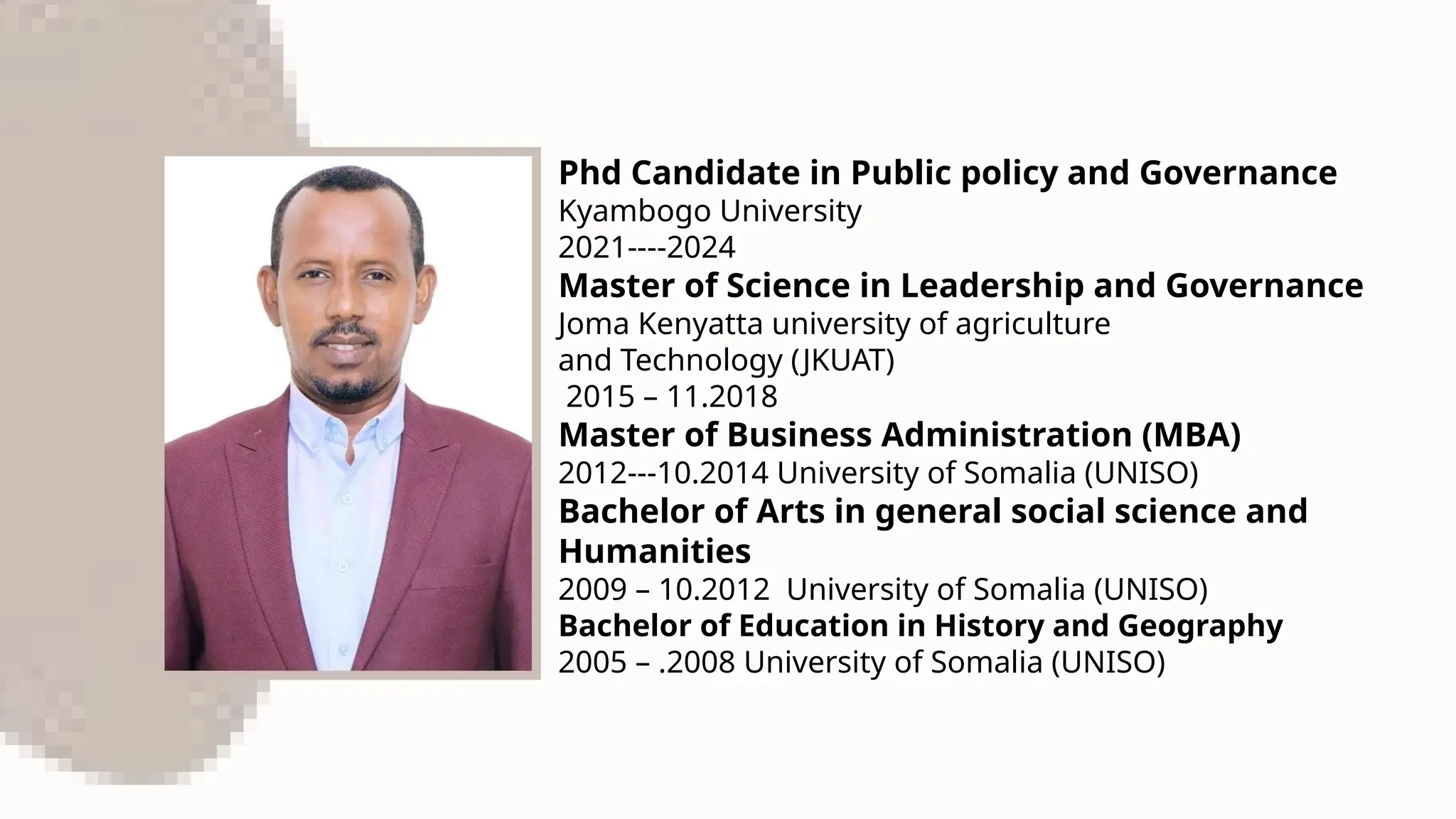
Phd Candidate inPublic policy and Governance
Kyambogo University
2021----2024
Master of Science in Leadership and Governance
Joma Kenyatta university of agriculture
and Technology (JKUAT)
2015 – 11.2018
Master of Business Administration (MBA)
2012---10.2014 University of Somalia (UNISO)
Bachelor of Arts in general social science and
Humanities
2009 – 10.2012 University of Somalia (UNISO)
Bachelor of Education in History and Geography
2005 – .2008 University of Somalia (UNISO)
2.
Understanding the PoliticalParty
Objectives
1. Political party.
2. Functions of political parties.
3. Types of political parties
4. Challenges facing political parties
5. Creating a successful political party
6. Political parties in some countries
7. Political Parties in Somalia 1955—1969
8. Leadership within Political Parties
9. The Role and Impact of Leadership of political party
3.
1. Political party
•Apolitical party is an organized group of individuals who
share common beliefs, values, and goals regarding
governance and public policy. Political parties seek to
influence government policy by getting their candidates
elected to public office. Bridge between People and
Government – Parties allow citizens to get their needs
and wishes heard by government
4.
2. Functions ofParty
• Representation: Political parties represent diverse groups and interests within society,
providing
a platform for various viewpoints and concerns.
• Mobilization: Parties mobilize voters, encouraging participation in elections and
political
processes, thereby enhancing democratic engagement.
• Recruitment and Training: They identify and support candidates for public office,
offering
training and resources to prepare them for political roles.
• Government Organization: In legislative bodies, parties organize the government by
forming
coalitions, establishing leadership roles, and facilitating cooperation among elected
officials.
• Social Integration: They promote political stability by integrating various segments of
society
5.
3.Types of Parties
•Mass parties – well organized, and strive for large and ideologically committed membership
• Cadre parties – weakly organized, based on a politically active elite, like the Republican and
Democratic parties
• Devotee parties – the party is built around one (usually charismatic) person, like the Nazis
and Hitler--Personalistic parties, such as Perón’s in Argentina, and Saddam’s Ba’ath Party, are
similar
--Personalistic parties don’t last much beyond their founders
Fluid Party Systems – typical of many new and unstable democracies, parties come and go,
and have no fixed structure
6.
4.The challenges facingpolitical party
Public Trust: Many voters have lost faith in political parties due to corruption
scandals, perceived ineffectiveness, or failure to represent constituents' interests.
Internal Conflicts Disagreements within parties over ideology or strategy can
lead to fragmentation and weaken overall effectiveness.
Changing Demographics Parties must adapt to a more diverse population with
varying needs and priorities, including younger voters with different values.
Urban vs. Rural Dynamics: Balancing interests between urban and rural
constituents can be challenging.
Leadership Challenges: Succession crises and leadership disputes can
destabilize party unity.
without Funding and Resources: Campaign Financing: Raising funds for
campaigns is increasingly challenging, especially for smaller parties.
7.
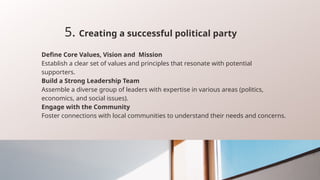
5. Creating asuccessful political party
Define Core Values, Vision and Mission
Establish a clear set of values and principles that resonate with potential
supporters.
Build a Strong Leadership Team
Assemble a diverse group of leaders with expertise in various areas (politics,
economics, and social issues).
Engage with the Community
Foster connections with local communities to understand their needs and concerns.
8.
Develop a ComprehensivePlatform
Create policies that address key issues (e.g., healthcare, education,
environment) and appeal to a broad audience.
Effective Communication Strategy
Utilize social media, traditional media, and community events to
disseminate the party's message.
9.
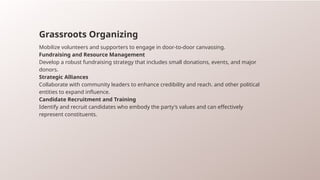
Grassroots Organizing
Mobilize volunteersand supporters to engage in door-to-door canvassing.
Fundraising and Resource Management
Develop a robust fundraising strategy that includes small donations, events, and major
donors.
Strategic Alliances
Collaborate with community leaders to enhance credibility and reach. and other political
entities to expand influence.
Candidate Recruitment and Training
Identify and recruit candidates who embody the party's values and can effectively
represent constituents.
10.
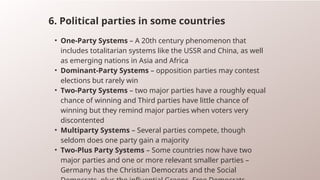
6. Political partiesin some countries
• One-Party Systems – A 20th century phenomenon that
includes totalitarian systems like the USSR and China, as well
as emerging nations in Asia and Africa
• Dominant-Party Systems – opposition parties may contest
elections but rarely win
• Two-Party Systems – two major parties have a roughly equal
chance of winning and Third parties have little chance of
winning but they remind major parties when voters very
discontented
• Multiparty Systems – Several parties compete, though
seldom does one party gain a majority
• Two-Plus Party Systems – Some countries now have two
major parties and one or more relevant smaller parties –
Germany has the Christian Democrats and the Social
11.
(1)Parliamentary elections wereheld in Italian Trust
Territory of Somaliland in February 1956.[1]
The Territorial Council had a total of 70 seats, of which 60 were
elected in 25 constituencies ranging in size from one to five seats.
The other ten seats were reserved for minority groups; four for
Italians, four for Arabs, one for Indians and one for Pakistanis.
Only men over the age of 21 were allowed to vote, whilst
candidates had to be at least 30, literate in both Arabic and
Roman alphabets, and have been resident in Somalia for at least a
year prior to the elections.[3]
The elections were direct in towns and municipalities, but indirect
in rural areas, where members were elected by 613 "shirs" (open
councils) between November 1955 and January 1956.
12.
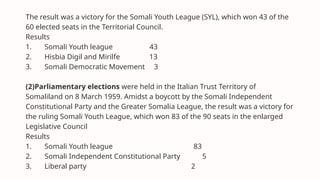
The result wasa victory for the Somali Youth League (SYL), which won 43 of the
60 elected seats in the Territorial Council.
Results
1. Somali Youth league 43
2. Hisbia Digil and Mirilfe 13
3. Somali Democratic Movement 3
(2)Parliamentary elections were held in the Italian Trust Territory of
Somaliland on 8 March 1959. Amidst a boycott by the Somali Independent
Constitutional Party and the Greater Somalia League, the result was a victory for
the ruling Somali Youth League, which won 83 of the 90 seats in the enlarged
Legislative Council
Results
1. Somali Youth league 83
2. Somali Independent Constitutional Party 5
3. Liberal party 2
13.
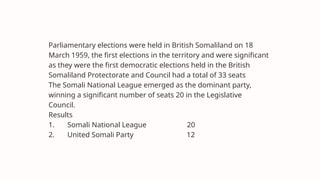
Parliamentary elections wereheld in British Somaliland on 18
March 1959, the first elections in the territory and were significant
as they were the first democratic elections held in the British
Somaliland Protectorate and Council had a total of 33 seats
The Somali National League emerged as the dominant party,
winning a significant number of seats 20 in the Legislative
Council.
Results
1. Somali National League 20
2. United Somali Party 12
14.
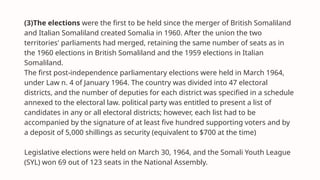
(3)The elections werethe first to be held since the merger of British Somaliland
and Italian Somaliland created Somalia in 1960. After the union the two
territories' parliaments had merged, retaining the same number of seats as in
the 1960 elections in British Somaliland and the 1959 elections in Italian
Somaliland.
The first post-independence parliamentary elections were held in March 1964,
under Law n. 4 of January 1964. The country was divided into 47 electoral
districts, and the number of deputies for each district was specified in a schedule
annexed to the electoral law. political party was entitled to present a list of
candidates in any or all electoral districts; however, each list had to be
accompanied by the signature of at least five hundred supporting voters and by
a deposit of 5,000 shillings as security (equivalent to $700 at the time)
Legislative elections were held on March 30, 1964, and the Somali Youth League
(SYL) won 69 out of 123 seats in the National Assembly.
15.
Results
1. Somali Youthleague 69
2. Somali National Congress 22
3. Somali Democratic Union 15
4. Somali Independent Constitutional Party 9
(4)Parliamentary elections were held in Somalia on 26 March 1969. A total
of 64 parties ran in the election, many of which had been formed shortly
beforehand.[1] The result was a victory for the Somali Youth League (SYL),
which won 73 of the 123 seats. In total, 27 parties won seats, but
immediately after the elections, most of the MPs for the smaller parties
joined the Somali Youth League. The SYL held 109 seats by the end of May,
in addition to being in a coalition with the Somali National Congress. This
gave the SYL control of 120 of the 123 seats.
16.
Political party leadershiprefers to the
individuals or groups within a political party
who hold significant authority and influence
over the party's direction, policies, and
strategies. This leadership typically includes:
Party Leaders
Executive Committees:
Legislative Leaders:.
Influence and Authority
17.
The Role ofLeadership in Political Parties
Vision and Direction
Setting goals and objectives for the party Strategic Decision-
Making.
Navigating political challenges Representation and
Advocacy
Representing party interests and values
Types of Leadership in Political Parties
Formal Leadership
Elected officials (e.g., party leaders, chairpersons)
Informal Leadership
Influential party members, activists
Collective Leadership
Leadership teams and committees
: Impact ofLeadership on Party Dynamics
Party Cohesion,
Role in unifying members and fostering loyalty
Electoral Success,
Influence on election outcomes and voter
engagement, Policy Development,
Shaping party platforms and legislative agendas
Case Studies
Successful Leadership Examples
Highlight specific leaders and their impact (e.g., Barack
Obama, Angela Merkel) Nelson Mandella,
Challenges Faced
20.
:Challenges in PoliticalLeadership
Internal Conflicts, Managing differing views within
the party
Public Trust and Credibility
Public Perception, Impact of media and public
opinion on leadership effectiveness
Adaptation to Change, Responding to societal
shifts and new political landscapes
Leading effectively during crises can enhance a
leader's reputation and trustworthiness. Discuss
instances of leadership failures (e.g., party splits,
loss of elections


![(1)Parliamentary elections were held in Italian Trust
Territory of Somaliland in February 1956.[1]
The Territorial Council had a total of 70 seats, of which 60 were
elected in 25 constituencies ranging in size from one to five seats.
The other ten seats were reserved for minority groups; four for
Italians, four for Arabs, one for Indians and one for Pakistanis.
Only men over the age of 21 were allowed to vote, whilst
candidates had to be at least 30, literate in both Arabic and
Roman alphabets, and have been resident in Somalia for at least a
year prior to the elections.[3]
The elections were direct in towns and municipalities, but indirect
in rural areas, where members were elected by 613 "shirs" (open
councils) between November 1955 and January 1956.](https://image.slidesharecdn.com/ahmedfoodcadepresentation-250525104243-3699baa4/85/Ahmed-Foodcade-Presentation-cantigate-pptx-11-320.jpg)
![Results
1. Somali Youth league 69
2. Somali National Congress 22
3. Somali Democratic Union 15
4. Somali Independent Constitutional Party 9
(4)Parliamentary elections were held in Somalia on 26 March 1969. A total
of 64 parties ran in the election, many of which had been formed shortly
beforehand.[1] The result was a victory for the Somali Youth League (SYL),
which won 73 of the 123 seats. In total, 27 parties won seats, but
immediately after the elections, most of the MPs for the smaller parties
joined the Somali Youth League. The SYL held 109 seats by the end of May,
in addition to being in a coalition with the Somali National Congress. This
gave the SYL control of 120 of the 123 seats.](https://image.slidesharecdn.com/ahmedfoodcadepresentation-250525104243-3699baa4/85/Ahmed-Foodcade-Presentation-cantigate-pptx-15-320.jpg)