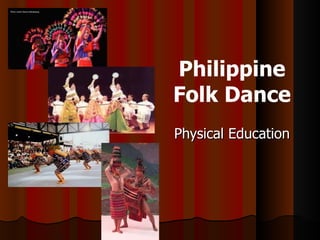
Philippine
Folk Dance
Physical Education
WHAT IS DANCE?


-   a form of
    expression of
    oneself through
    rhythmic movement
So, what is FOLK DANCE
- the oldest form of
  dance and the earliest
  form of communication
- the traditional dance of
  a given country which
  evolved naturally and
  spontaneously with
  everyday activities
e.g. occupations,
  customs, festivals,
  rituals
So, what is FOLK DANCE

   It is handed down
    from generation to
    generation

   It has more or less a
    fixed movement in
    their pattern, but
    may differ in various
    areas or provinces
5 Major Classifications of
     Philippine Folk Dances
l   Cordillera Dances
l   Spanish Influenced Dances
l   Muslim Dances
l   Tribal Dances
l   Rural Dances
Cordillera Dances
                                 Bontoc, Ifugao,
                                  Benguet, Apayo, &
                                  Kalinga tribes
                                 a people whose
                                  way of life existed
                                  long before any
   Dances reflects rituals       Spaniard or other
    which celebrate their         foreigners stepped
    daily lives - a good          foot on the
    harvest, health, peace,       Philippines
    war, and other               Gongs, ganza
    symbols of living
Cordillera Dances
                     Bontoc – “Pattong”


Kalinga – “Banga”
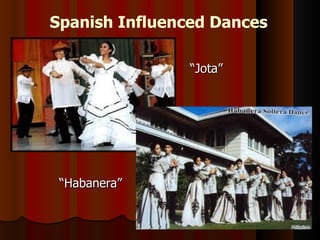
Spanish Influenced Dances
                           Philippine aristocrats
                            created Filipino
                            adaptations of
                            European dances
                           jotas, fandanggos,
                            mazurkas, waltzes
                           danced by young
   Dances reflects         socialites to the
    Christianity, and       stringed music of
    European art and        the rondalla
    culture
Spanish Influenced Dances

                “Jota”


 “Habanera”
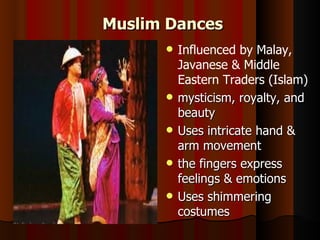
Muslim Dances
         Influenced by Malay,
          Javanese & Middle
          Eastern Traders (Islam)
         mysticism, royalty, and
          beauty
         Uses intricate hand &
          arm movement
         the fingers express
          feelings & emotions
         Uses shimmering
          costumes
Muslim Dances

                      Maranao – “Singkil”


Tausug – “Pangalay”
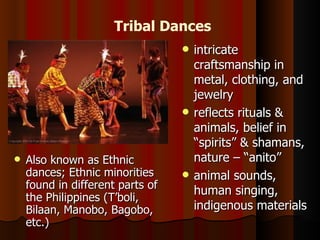
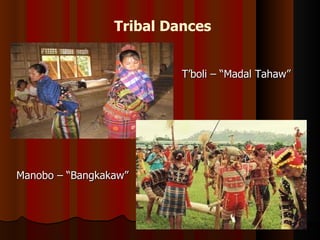
Tribal Dances
                                     intricate
                                      craftsmanship in
                                      metal, clothing, and
                                      jewelry
                                     reflects rituals &
                                      animals, belief in
                                      “spirits” & shamans,
   Also known as Ethnic              nature – “anito”
    dances; Ethnic minorities        animal sounds,
    found in different parts of
                                      human singing,
    the Philippines (T’boli,
    Bilaan, Manobo, Bagobo,           indigenous materials
    etc.)
Tribal Dances


                          T’boli – “Madal Tahaw”


Manobo – “Bangkakaw”
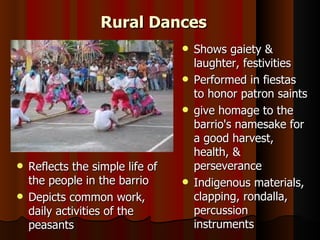
Rural Dances
                                 Shows gaiety &
                                  laughter, festivities
                                 Performed in fiestas
                                  to honor patron saints
                                 give homage to the
                                  barrio's namesake for
                                  a good harvest,
                                  health, &
 Reflects the simple life of     perseverance
  the people in the barrio       Indigenous materials,
 Depicts common work,            clapping, rondalla,
  daily activities of the         percussion
  peasants                        instruments
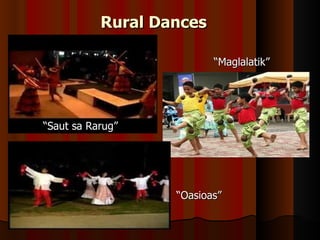
Rural Dances

                          “Maglalatik”


“Saut sa Rarug”


                   “Oasioas”
COSTUMES
    IN
PHILIPPINE
FOLK DANCE
Typical Spanish Elite


           Female:
                MARIA CLARA
           Male:
             Barong Tagalog &
             Black Pants
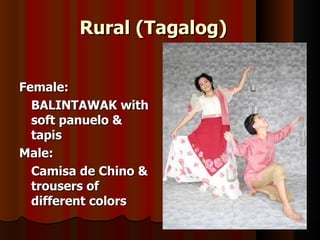
Rural (Tagalog)


Female:
  BALINTAWAK with
  soft panuelo &
  tapis
Male:
  Camisa de Chino &
  trousers of
  different colors
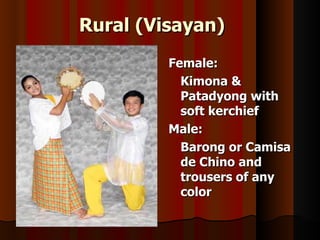
Rural (Visayan)
         Female:
           Kimona &
           Patadyong with
           soft kerchief
         Male:
           Barong or Camisa
           de Chino and
           trousers of any
           color
Cordillera/Tribal
Male:
- G-string, short
   jacket & shoulder
   band, feathered
   head dresses
 - “bahag”
Females:
- Hinabi na tela
   (hablon)
- Accessories (beads)
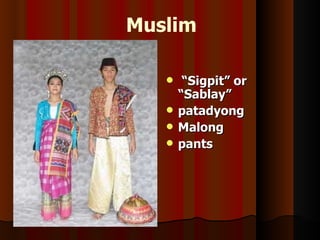
Muslim

       “Sigpit” or
       “Sablay”
      patadyong
      Malong
      pants
Rural (Ilocano)


“Chambra” – blouse
“Siesgo” – A-line
  skirt
REFERENCES
   2010. Catacutan, Allen. Fundamentals in Philippine Folk
    Dance + Filipino Cultural Communities. 5 October 2010.
    http://www.scribd.com/doc/38738236/Fundamentals-in-Philip

   2008. Philippine Folk Dance Society, Cultural Center of
    the Philippines. A Classic Collection of Philippine Folk
    Dances Series III, 28th National Folk Dance Workshop.
    19 – 23 May 2008

Phil folk dance_ppt

  • 1.
  • 2.
    WHAT IS DANCE? - a form of expression of oneself through rhythmic movement
  • 3.
    So, what isFOLK DANCE - the oldest form of dance and the earliest form of communication - the traditional dance of a given country which evolved naturally and spontaneously with everyday activities e.g. occupations, customs, festivals, rituals
  • 4.
    So, what isFOLK DANCE  It is handed down from generation to generation  It has more or less a fixed movement in their pattern, but may differ in various areas or provinces
  • 5.
    5 Major Classificationsof Philippine Folk Dances l Cordillera Dances l Spanish Influenced Dances l Muslim Dances l Tribal Dances l Rural Dances
  • 6.
    Cordillera Dances  Bontoc, Ifugao, Benguet, Apayo, & Kalinga tribes  a people whose way of life existed long before any  Dances reflects rituals Spaniard or other which celebrate their foreigners stepped daily lives - a good foot on the harvest, health, peace, Philippines war, and other  Gongs, ganza symbols of living
  • 7.
    Cordillera Dances Bontoc – “Pattong” Kalinga – “Banga”
  • 8.
    Spanish Influenced Dances  Philippine aristocrats created Filipino adaptations of European dances  jotas, fandanggos, mazurkas, waltzes  danced by young  Dances reflects socialites to the Christianity, and stringed music of European art and the rondalla culture
  • 9.
    Spanish Influenced Dances “Jota” “Habanera”
  • 10.
    Muslim Dances  Influenced by Malay, Javanese & Middle Eastern Traders (Islam)  mysticism, royalty, and beauty  Uses intricate hand & arm movement  the fingers express feelings & emotions  Uses shimmering costumes
  • 11.
    Muslim Dances Maranao – “Singkil” Tausug – “Pangalay”
  • 12.
    Tribal Dances  intricate craftsmanship in metal, clothing, and jewelry  reflects rituals & animals, belief in “spirits” & shamans,  Also known as Ethnic nature – “anito” dances; Ethnic minorities  animal sounds, found in different parts of human singing, the Philippines (T’boli, Bilaan, Manobo, Bagobo, indigenous materials etc.)
  • 13.
    Tribal Dances T’boli – “Madal Tahaw” Manobo – “Bangkakaw”
  • 14.
    Rural Dances  Shows gaiety & laughter, festivities  Performed in fiestas to honor patron saints  give homage to the barrio's namesake for a good harvest, health, &  Reflects the simple life of perseverance the people in the barrio  Indigenous materials,  Depicts common work, clapping, rondalla, daily activities of the percussion peasants instruments
  • 15.
    Rural Dances “Maglalatik” “Saut sa Rarug” “Oasioas”
  • 16.
    COSTUMES IN PHILIPPINE FOLK DANCE
  • 17.
    Typical Spanish Elite Female: MARIA CLARA Male: Barong Tagalog & Black Pants
  • 18.
    Rural (Tagalog) Female: BALINTAWAK with soft panuelo & tapis Male: Camisa de Chino & trousers of different colors
  • 19.
    Rural (Visayan) Female: Kimona & Patadyong with soft kerchief Male: Barong or Camisa de Chino and trousers of any color
  • 20.
    Cordillera/Tribal Male: - G-string, short jacket & shoulder band, feathered head dresses - “bahag” Females: - Hinabi na tela (hablon) - Accessories (beads)
  • 21.
    Muslim  “Sigpit” or “Sablay”  patadyong  Malong  pants
  • 22.
    Rural (Ilocano) “Chambra” –blouse “Siesgo” – A-line skirt
  • 23.
    REFERENCES  2010. Catacutan, Allen. Fundamentals in Philippine Folk Dance + Filipino Cultural Communities. 5 October 2010. http://www.scribd.com/doc/38738236/Fundamentals-in-Philip  2008. Philippine Folk Dance Society, Cultural Center of the Philippines. A Classic Collection of Philippine Folk Dances Series III, 28th National Folk Dance Workshop. 19 – 23 May 2008