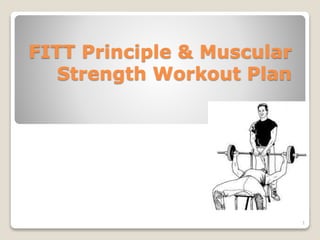
FITT Principle & Muscular 
Strength Workout Plan 
1
FITT: Your Exercise Prescription 
2 
Frequency: how often you work. 
Intensity: how hard you work. 
Time: the length of time, or duration, that you work. 
Type: the specific type or mode of activity you choose.
FITT Principle 
The first FITT factor is frequency. 
Factors to consider with Frequency: 
- Cardiovascular Conditioning 
- Your current fitness level 
3 
Term to Know 
Frequency 
Refers to the 
number of times 
per week you 
engage in 
physical activity 
or exercise.
FITT Principle 
The second FITT factor is 
intensity. 
Ways to determine Intensity: 
-Target Heart Rate Monitoring 
-Talk Test 
4 
Term to Know 
Intensity 
The difficulty or 
exertion level of 
your physical 
activity or 
exercise.
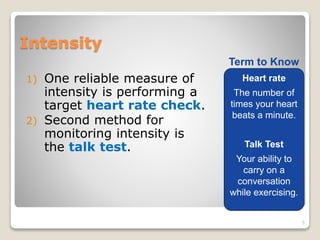
Intensity 
1) One reliable measure of 
intensity is performing a 
target heart rate check. 
2) Second method for 
monitoring intensity is 
the talk test. 
5 
Term to Know 
Heart rate 
The number of 
times your heart 
beats a minute. 
Talk Test 
Your ability to 
carry on a 
conversation 
while exercising.
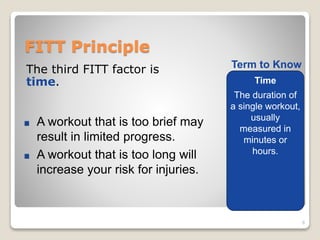
FITT Principle 
The third FITT factor is 
time. 
6 
Term to Know 
Time 
The duration of 
a single workout, 
usually 
measured in 
minutes or 
hours. 
A workout that is too brief may 
result in limited progress. 
A workout that is too long will 
increase your risk for injuries.
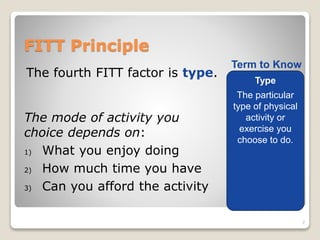
FITT Principle 
The fourth FITT factor is type. 
7 
Term to Know 
Type 
The particular 
type of physical 
activity or 
exercise you 
choose to do. 
The mode of activity you 
choice depends on: 
1) What you enjoy doing 
2) How much time you have 
3) Can you afford the activity
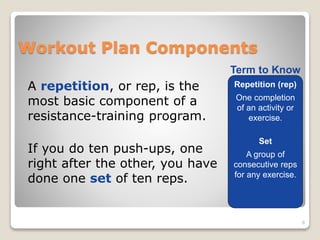
Workout Plan Components 
A repetition, or rep, is the 
most basic component of a 
resistance-training program. 
If you do ten push-ups, one 
right after the other, you have 
done one set of ten reps. 
8 
Term to Know 
Repetition (rep) 
One completion 
of an activity or 
exercise. 
Set 
A group of 
consecutive reps 
for any exercise.
Workout Plan Components 
To determine your training 
load, you must first 
determine your one-rep 
maximum (1RM). 
Reasons for testing 1RM: 
- Determining training load 
- Identify strengths/weaknesses 
- Helps keep track of your progress 
9 
Term to Know 
One-rep 
maximum (1RM) 
A measure of a 
lifter’s absolute 
muscular strength 
for any given 
exercise.
Workout Plan Components 
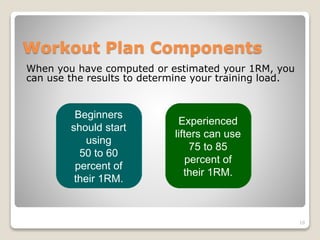
When you have computed or estimated your 1RM, you 
can use the results to determine your training load. 
10 
Beginners 
should start 
using 
50 to 60 
percent of 
their 1RM. 
Experienced 
lifters can use 
75 to 85 
percent of 
their 1RM.
Workout Plan Components 
Skeletal muscles work 
together to produce two 
complementary, or opposing, 
actions: contraction and 
extension. 
Terms to Know 
11 
Contraction 
The shortening of 
a muscle. 
Extension 
The stretching of a 
muscle.
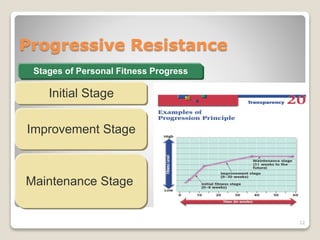
Progressive Resistance 
12 
Stages of Personal Fitness Progress 
Initial Stage 
Improvement Stage 
Maintenance Stage
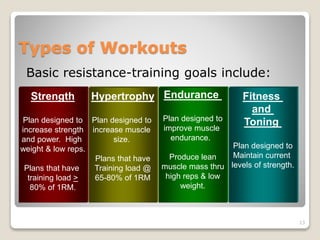
Types of Workouts 
Basic resistance-training goals include: 
13 
Strength 
Plan designed to 
increase strength 
and power. High 
weight & low reps. 
Plans that have 
training load > 
80% of 1RM. 
Hypertrophy 
Plan designed to 
increase muscle 
size. 
Plans that have 
Training load @ 
65-80% of 1RM 
Endurance 
Plan designed to 
improve muscle 
endurance. 
Produce lean 
muscle mass thru 
high reps & low 
weight. 
Fitness 
and 
Toning 
Plan designed to 
Maintain current 
levels of strength.

Fitt principle

  • 1.
    FITT Principle &Muscular Strength Workout Plan 1
  • 2.
    FITT: Your ExercisePrescription 2 Frequency: how often you work. Intensity: how hard you work. Time: the length of time, or duration, that you work. Type: the specific type or mode of activity you choose.
  • 3.
    FITT Principle Thefirst FITT factor is frequency. Factors to consider with Frequency: - Cardiovascular Conditioning - Your current fitness level 3 Term to Know Frequency Refers to the number of times per week you engage in physical activity or exercise.
  • 4.
    FITT Principle Thesecond FITT factor is intensity. Ways to determine Intensity: -Target Heart Rate Monitoring -Talk Test 4 Term to Know Intensity The difficulty or exertion level of your physical activity or exercise.
  • 5.
    Intensity 1) Onereliable measure of intensity is performing a target heart rate check. 2) Second method for monitoring intensity is the talk test. 5 Term to Know Heart rate The number of times your heart beats a minute. Talk Test Your ability to carry on a conversation while exercising.
  • 6.
    FITT Principle Thethird FITT factor is time. 6 Term to Know Time The duration of a single workout, usually measured in minutes or hours. A workout that is too brief may result in limited progress. A workout that is too long will increase your risk for injuries.
  • 7.
    FITT Principle Thefourth FITT factor is type. 7 Term to Know Type The particular type of physical activity or exercise you choose to do. The mode of activity you choice depends on: 1) What you enjoy doing 2) How much time you have 3) Can you afford the activity
  • 8.
    Workout Plan Components A repetition, or rep, is the most basic component of a resistance-training program. If you do ten push-ups, one right after the other, you have done one set of ten reps. 8 Term to Know Repetition (rep) One completion of an activity or exercise. Set A group of consecutive reps for any exercise.
  • 9.
    Workout Plan Components To determine your training load, you must first determine your one-rep maximum (1RM). Reasons for testing 1RM: - Determining training load - Identify strengths/weaknesses - Helps keep track of your progress 9 Term to Know One-rep maximum (1RM) A measure of a lifter’s absolute muscular strength for any given exercise.
  • 10.
    Workout Plan Components When you have computed or estimated your 1RM, you can use the results to determine your training load. 10 Beginners should start using 50 to 60 percent of their 1RM. Experienced lifters can use 75 to 85 percent of their 1RM.
  • 11.
    Workout Plan Components Skeletal muscles work together to produce two complementary, or opposing, actions: contraction and extension. Terms to Know 11 Contraction The shortening of a muscle. Extension The stretching of a muscle.
  • 12.
    Progressive Resistance 12 Stages of Personal Fitness Progress Initial Stage Improvement Stage Maintenance Stage
  • 13.
    Types of Workouts Basic resistance-training goals include: 13 Strength Plan designed to increase strength and power. High weight & low reps. Plans that have training load > 80% of 1RM. Hypertrophy Plan designed to increase muscle size. Plans that have Training load @ 65-80% of 1RM Endurance Plan designed to improve muscle endurance. Produce lean muscle mass thru high reps & low weight. Fitness and Toning Plan designed to Maintain current levels of strength.