Crossing a street without first
looking right and left
Swimming in a deep river
Crossing a street without first
looking right and left
Mechanics
•The class will silently read a story “The Fox in
the Wheel”.
•After reading, they will be grouped into two
teams.
•The leaders will do a “Jack N Poy” to
determine if what group will spin first.
•The leader will spin the wheel containing
questions.
• If any team member will responds to a
question incorrectly, a member of the other team
is given a chance to answer the question. As
long as the member, responding correctly, he/she
may continue to spin the wheel and answer more
questions from the game board.
• After all the questions on the board have been
answered correctly, the team with highest scores
win.
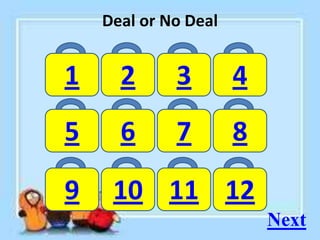
Deal or No Deal
1 2 3 4
5 6 7 8
9 10 11 12
Next
Where did the story
happen?
back
2 points
Who fell into the
well?
back
2 points
Why do you think the
goat believed the fox?
Explain.
back
4 points
Whom do you like
most, the goat or the
fox? Why?
back
4 points
How did the fox get out
of the well?
back
4 points
Why did the goat decide
to jump into the well?
back
4 points
If you were the fox,
would you do the same?
(cheating the goat) Why?
back
4 points
If you were the goat,
would you do the same?
(always follow the fox’
idea) Why?
back
4 points
When you read a selection,
look for important and
specific details. These
details give complete
picture of the story.
Elements of the Story
•Plot- the sequence of events that take
place in the story
•Setting-the time and place in which
the events of a story take places
•Characters-
Elements of the Story
•Plot- the sequence of events that take
place in the story
•Setting-the time and place in which
the events of a story take places
•Characters-
Elements of the Story
•Atmosphere-the general mood or
feeling of a story
•Point of View-who is narrating the
story
•Conflict-the central problem that
drives the action of the story.
Activity 1 Fill up the Story Map with significant details of “The Fox
in The Well”
Story Map
Title: ________________________
Characters: Main: ___________________________
Secondary:_______________________
Setting: Place: ______________________________
Time: ______________________________
Conflict/Problem:_______________________________
Goal: _____________________________________
Events:
1. _________________________
2. _________________________
3. _________________________
Direction: Read the “The Tame Bird and the Free Bird” .
After reading ,fill up the SWBS Chart meet the
details in the story “The Tame Bird and the Free Bird”
SWBS: The Plot Chart
Title: _____________________
Somebody
S-
Wanted
W-
But
B-
So
S-
________________
________________
________________
________________
S – characters
W – Wants of the
characters
B – challenges to
the characters
S – how the
problem was
solve
Setting Plot
Place:___________
Time:___________
Characters:_________
Situation:___________
Problem/Conflict:______
Turning Point:________
Conclusion:__________
Theme:___________
Evaluation
Fill up the following story map with significant details
of the dialogue Golden Keys.
BOKYA
You Lose Your Turn!
back

Noting details

  • 1.
    Crossing a streetwithout first looking right and left Swimming in a deep river Crossing a street without first looking right and left
  • 2.
    Mechanics •The class willsilently read a story “The Fox in the Wheel”. •After reading, they will be grouped into two teams. •The leaders will do a “Jack N Poy” to determine if what group will spin first. •The leader will spin the wheel containing questions.
  • 3.
    • If anyteam member will responds to a question incorrectly, a member of the other team is given a chance to answer the question. As long as the member, responding correctly, he/she may continue to spin the wheel and answer more questions from the game board. • After all the questions on the board have been answered correctly, the team with highest scores win.
  • 4.
    Deal or NoDeal 1 2 3 4 5 6 7 8 9 10 11 12 Next
  • 5.
    Where did thestory happen? back 2 points
  • 6.
    Who fell intothe well? back 2 points
  • 7.
    Why do youthink the goat believed the fox? Explain. back 4 points
  • 8.
    Whom do youlike most, the goat or the fox? Why? back 4 points
  • 9.
    How did thefox get out of the well? back 4 points
  • 10.
    Why did thegoat decide to jump into the well? back 4 points
  • 11.
    If you werethe fox, would you do the same? (cheating the goat) Why? back 4 points
  • 12.
    If you werethe goat, would you do the same? (always follow the fox’ idea) Why? back 4 points
  • 13.
    When you reada selection, look for important and specific details. These details give complete picture of the story.
  • 14.
    Elements of theStory •Plot- the sequence of events that take place in the story •Setting-the time and place in which the events of a story take places •Characters-
  • 15.
    Elements of theStory •Plot- the sequence of events that take place in the story •Setting-the time and place in which the events of a story take places •Characters-
  • 16.
    Elements of theStory •Atmosphere-the general mood or feeling of a story •Point of View-who is narrating the story •Conflict-the central problem that drives the action of the story.
  • 17.
    Activity 1 Fillup the Story Map with significant details of “The Fox in The Well” Story Map Title: ________________________ Characters: Main: ___________________________ Secondary:_______________________ Setting: Place: ______________________________ Time: ______________________________ Conflict/Problem:_______________________________ Goal: _____________________________________ Events: 1. _________________________ 2. _________________________ 3. _________________________
  • 18.
    Direction: Read the“The Tame Bird and the Free Bird” . After reading ,fill up the SWBS Chart meet the details in the story “The Tame Bird and the Free Bird” SWBS: The Plot Chart Title: _____________________ Somebody S- Wanted W- But B- So S- ________________ ________________ ________________ ________________ S – characters W – Wants of the characters B – challenges to the characters S – how the problem was solve
  • 19.
  • 20.