Let us Pray
Let’s review
The Singing Bee
Let’s Learn Together
Music and Dance is
Life
Paste It!
Bring me home
EVALUATION
Let
us
Pray!
MELC’s
relates the significance of arts
forms from the regions.
CAR11/12CAP-0c -e-8
promotes arts from the regions.
CAR11/12CAP-0c -e-9
OBJECTIVES
Determine the different examples of arts in every
region specifically music and dancing.
Describe the different examples of arts in every
region specifically music and dancing.
Explain the different art works from the different
region.
Sculpture
Painting
Pottery
Weaving
Architecture
PAUBAYA
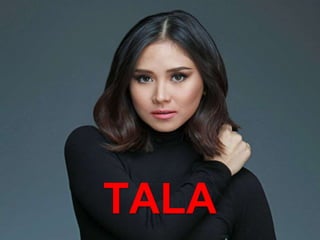
TALA
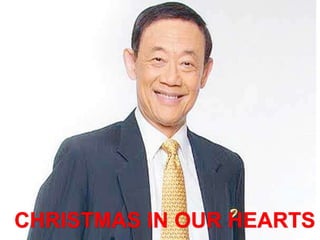
CHRISTMAS IN OUR HEARTS
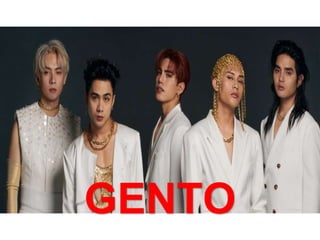
GENTO
KAPALARAN
Significance of Arts
from the Regions
MUSIC AND DANCE
Music
Pre-Spanish
According to the article written by
theperionsinphilippinemusic.blogs pot, Filipinos are
said to be musical peoples. In most cases, singing is
accompanied by dancing. They used bamboo canes,
palm leaves and bark of trees to write their songs and
a piece of sharp stick or iron for their pen. Even their
instruments were made of bamboo and wood which
indicated their primitiveness. Religious and social life
were the common functions of the ancient music.
Music in the pre-colonial times was used to connect
people, to bring people together.
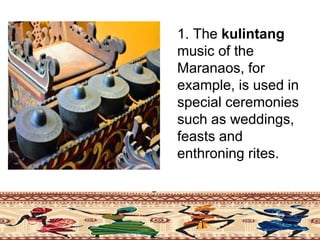
1. The kulintang
music of the
Maranaos, for
example, is used in
special ceremonies
such as weddings,
feasts and
enthroning rites.
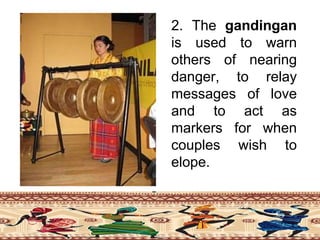
2. The gandingan
is used to warn
others of nearing
danger, to relay
messages of love
and to act as
markers for when
couples wish to
elope.
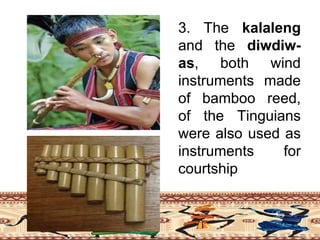
3. The kalaleng
and the diwdiw-
as, both wind
instruments made
of bamboo reed,
of the Tinguians
were also used as
instruments for
courtship
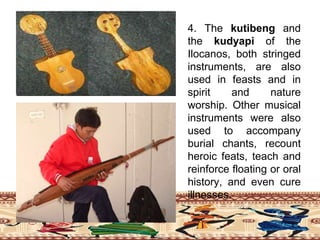
4. The kutibeng and
the kudyapi of the
Ilocanos, both stringed
instruments, are also
used in feasts and in
spirit and nature
worship. Other musical
instruments were also
used to accompany
burial chants, recount
heroic feats, teach and
reinforce floating or oral
history, and even cure
illnesses.
Spanish
• Spain ruled the Philippines for 333 years,
and Hispanic influence in Filipino culture
is ubiquitous. This influence can be easily
seen in folk and traditional music,
especially in the Tagalog and Visayan
regions, where Spanish influence was
greatest
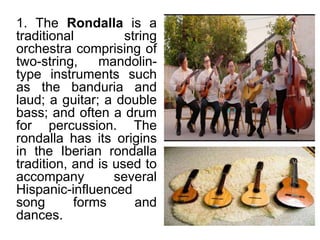
1. The Rondalla is a
traditional string
orchestra comprising of
two-string, mandolin-
type instruments such
as the banduria and
laud; a guitar; a double
bass; and often a drum
for percussion. The
rondalla has its origins
in the Iberian rondalla
tradition, and is used to
accompany several
Hispanic-influenced
song forms and
dances.
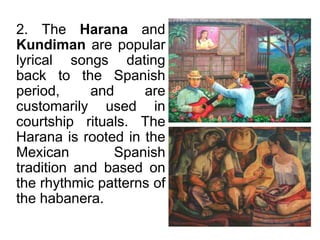
2. The Harana and
Kundiman are popular
lyrical songs dating
back to the Spanish
period, and are
customarily used in
courtship rituals. The
Harana is rooted in the
Mexican Spanish
tradition and based on
the rhythmic patterns of
the habanera.
American
• American music has also been influential in
the Philippines for artists and vice versa.
Though contributing to the evolution of
American music, large number of Filipino
Americans have a strong identity with culture
of the Philippines by participating or
organizing traditional dances and musical
performances.
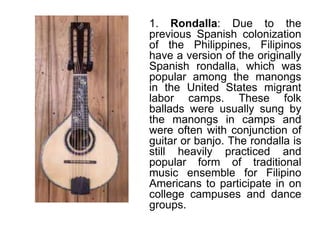
1. Rondalla: Due to the
previous Spanish colonization
of the Philippines, Filipinos
have a version of the originally
Spanish rondalla, which was
popular among the manongs
in the United States migrant
labor camps. These folk
ballads were usually sung by
the manongs in camps and
were often with conjunction of
guitar or banjo. The rondalla is
still heavily practiced and
popular form of traditional
music ensemble for Filipino
Americans to participate in on
college campuses and dance
groups.
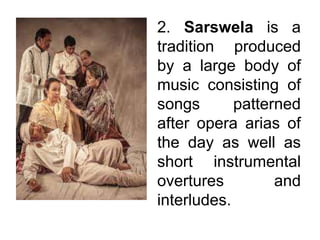
2. Sarswela is a
tradition produced
by a large body of
music consisting of
songs patterned
after opera arias of
the day as well as
short instrumental
overtures and
interludes.
American lifestyle and pop culture
gave rise to music created by
Filipinos using western pop forms.
Referred to as Pinoy pop, it
includes a wide range of forms:
folk songs, dance tunes, ballads,
Broadway type songs, rock’ n’ roll,
disco, jazz, and rap
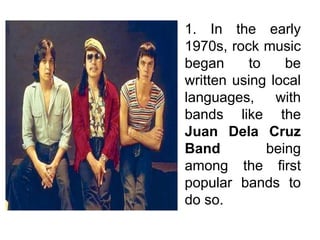
1. In the early
1970s, rock music
began to be
written using local
languages, with
bands like the
Juan Dela Cruz
Band being
among the first
popular bands to
do so.
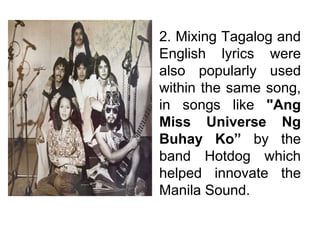
2. Mixing Tagalog and
English lyrics were
also popularly used
within the same song,
in songs like "Ang
Miss Universe Ng
Buhay Ko” by the
band Hotdog which
helped innovate the
Manila Sound.
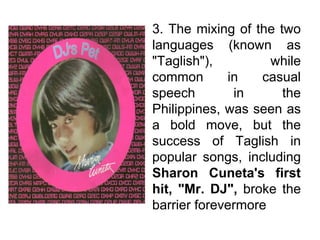
3. The mixing of the two
languages (known as
"Taglish"), while
common in casual
speech in the
Philippines, was seen as
a bold move, but the
success of Taglish in
popular songs, including
Sharon Cuneta's first
hit, "Mr. DJ", broke the
barrier forevermore
Contemporary Music
• According to Santos (2016), contemporary music
in the Philippines usually refers to compositions
that have adopted ideas and elements from
twentieth century art music in the West, as well as
the latest trends and musical styles in the
entertainment industry. The modern Filipino
repertoire consists of pieces that have been
written in twentieth century idioms that have
evolved out of such stylistic movements as
impressionism, expressionism, neo-classism, as
well as the so called avant-garde and New Music
Dance
Pre-Spanish to Present
• Philippines has many popular folk dances which
have evolved and changed as they have been
passed down from generation to generation.
Before the recorded history of the Philippines,
before Spanish conquistadors colonized and
Christianized the early Filipino people, from the
earliest occupation of this archipelago, the people
danced. Filipino danced to appease the Gods, to
curry favor from powerful spirits, to celebrate a
hunt or harvest, to mimic the exotic life forms
around them.
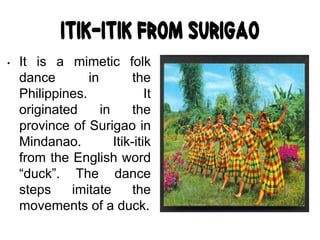
Itik-itik from Surigao
• It is a mimetic folk
dance in the
Philippines. It
originated in the
province of Surigao in
Mindanao. Itik-itik
from the English word
“duck”. The dance
steps imitate the
movements of a duck.
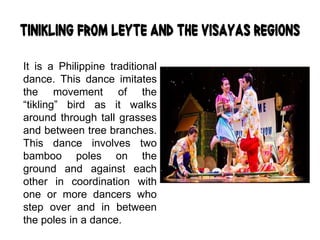
Tinikling from Leyte and the Visayas Regions
It is a Philippine traditional
dance. This dance imitates
the movement of the
“tikling” bird as it walks
around through tall grasses
and between tree branches.
This dance involves two
bamboo poles on the
ground and against each
other in coordination with
one or more dancers who
step over and in between
the poles in a dance.
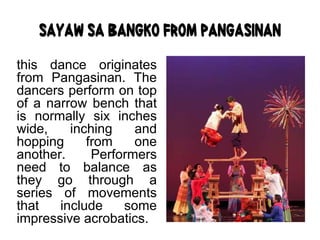
Sayaw sa Bangko from Pangasinan
this dance originates
from Pangasinan. The
dancers perform on top
of a narrow bench that
is normally six inches
wide, inching and
hopping from one
another. Performers
need to balance as
they go through a
series of movements
that include some
impressive acrobatics.
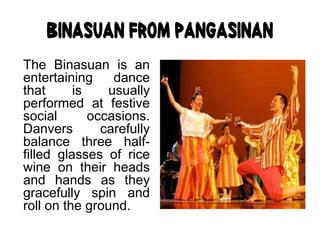
Binasuan from Pangasinan
The Binasuan is an
entertaining dance
that is usually
performed at festive
social occasions.
Danvers carefully
balance three half-
filled glasses of rice
wine on their heads
and hands as they
gracefully spin and
roll on the ground.
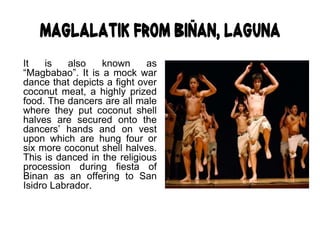
Maglalatik from Biñan, Laguna
It is also known as
“Magbabao”. It is a mock war
dance that depicts a fight over
coconut meat, a highly prized
food. The dancers are all male
where they put coconut shell
halves are secured onto the
dancers’ hands and on vest
upon which are hung four or
six more coconut shell halves.
This is danced in the religious
procession during fiesta of
Binan as an offering to San
Isidro Labrador.
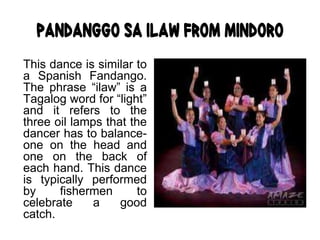
Pandanggo sa Ilaw from Mindoro
This dance is similar to
a Spanish Fandango.
The phrase “ilaw” is a
Tagalog word for “light”
and it refers to the
three oil lamps that the
dancer has to balance-
one on the head and
one on the back of
each hand. This dance
is typically performed
by fishermen to
celebrate a good
catch.
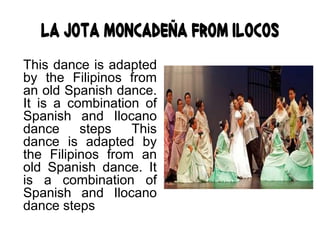
La Jota Moncadeña from Ilocos
This dance is adapted
by the Filipinos from
an old Spanish dance.
It is a combination of
Spanish and Ilocano
dance steps This
dance is adapted by
the Filipinos from an
old Spanish dance. It
is a combination of
Spanish and Ilocano
dance steps
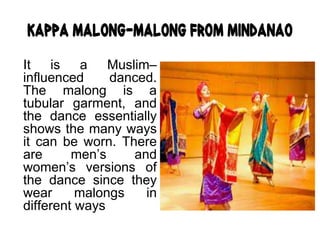
Kappa Malong-Malong from Mindanao
It is a Muslim–
influenced danced.
The malong is a
tubular garment, and
the dance essentially
shows the many ways
it can be worn. There
are men’s and
women’s versions of
the dance since they
wear malongs in
different ways
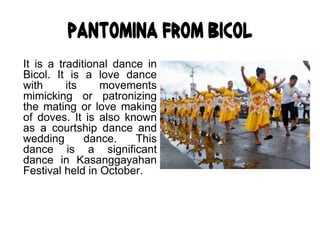
Pantomina from Bicol
It is a traditional dance in
Bicol. It is a love dance
with its movements
mimicking or patronizing
the mating or love making
of doves. It is also known
as a courtship dance and
wedding dance. This
dance is a significant
dance in Kasanggayahan
Festival held in October.
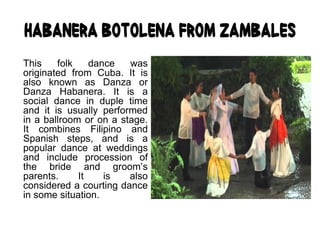
Habanera Botolena from Zambales
This folk dance was
originated from Cuba. It is
also known as Danza or
Danza Habanera. It is a
social dance in duple time
and it is usually performed
in a ballroom or on a stage.
It combines Filipino and
Spanish steps, and is a
popular dance at weddings
and include procession of
the bride and groom’s
parents. It is also
considered a courting dance
in some situation.
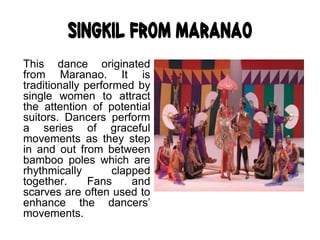
Singkil from Maranao
This dance originated
from Maranao. It is
traditionally performed by
single women to attract
the attention of potential
suitors. Dancers perform
a series of graceful
movements as they step
in and out from between
bamboo poles which are
rhythmically clapped
together. Fans and
scarves are often used to
enhance the dancers’
movements.
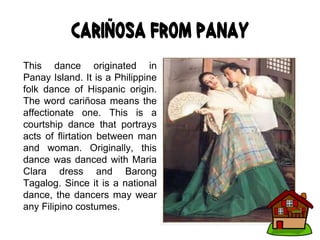
Cariñosa from Panay
This dance originated in
Panay Island. It is a Philippine
folk dance of Hispanic origin.
The word cariñosa means the
affectionate one. This is a
courtship dance that portrays
acts of flirtation between man
and woman. Originally, this
dance was danced with Maria
Clara dress and Barong
Tagalog. Since it is a national
dance, the dancers may wear
any Filipino costumes.
ACTIVITY
In a group of 4 Create or compose
at least 2 stanza of Song and add
some dance choreography. Present
it to the class.
ASSIGNMENT
Research at least 5 famous
Pilipino Artist and what are
their contribution in
Philippine Arts.
Presented by:
Sylvester D. Mata

Music and Dance.pptx

  • 2.
    Let us Pray Let’sreview The Singing Bee Let’s Learn Together Music and Dance is Life Paste It! Bring me home EVALUATION
  • 3.
  • 4.
    MELC’s relates the significanceof arts forms from the regions. CAR11/12CAP-0c -e-8 promotes arts from the regions. CAR11/12CAP-0c -e-9
  • 5.
    OBJECTIVES Determine the differentexamples of arts in every region specifically music and dancing. Describe the different examples of arts in every region specifically music and dancing. Explain the different art works from the different region.
  • 6.
  • 9.
  • 11.
  • 13.
  • 15.
  • 17.
  • 18.
    Significance of Arts fromthe Regions MUSIC AND DANCE
  • 19.
  • 20.
    Pre-Spanish According to thearticle written by theperionsinphilippinemusic.blogs pot, Filipinos are said to be musical peoples. In most cases, singing is accompanied by dancing. They used bamboo canes, palm leaves and bark of trees to write their songs and a piece of sharp stick or iron for their pen. Even their instruments were made of bamboo and wood which indicated their primitiveness. Religious and social life were the common functions of the ancient music. Music in the pre-colonial times was used to connect people, to bring people together.
  • 21.
    1. The kulintang musicof the Maranaos, for example, is used in special ceremonies such as weddings, feasts and enthroning rites.
  • 22.
    2. The gandingan isused to warn others of nearing danger, to relay messages of love and to act as markers for when couples wish to elope.
  • 23.
    3. The kalaleng andthe diwdiw- as, both wind instruments made of bamboo reed, of the Tinguians were also used as instruments for courtship
  • 24.
    4. The kutibengand the kudyapi of the Ilocanos, both stringed instruments, are also used in feasts and in spirit and nature worship. Other musical instruments were also used to accompany burial chants, recount heroic feats, teach and reinforce floating or oral history, and even cure illnesses.
  • 25.
    Spanish • Spain ruledthe Philippines for 333 years, and Hispanic influence in Filipino culture is ubiquitous. This influence can be easily seen in folk and traditional music, especially in the Tagalog and Visayan regions, where Spanish influence was greatest
  • 26.
    1. The Rondallais a traditional string orchestra comprising of two-string, mandolin- type instruments such as the banduria and laud; a guitar; a double bass; and often a drum for percussion. The rondalla has its origins in the Iberian rondalla tradition, and is used to accompany several Hispanic-influenced song forms and dances.
  • 27.
    2. The Haranaand Kundiman are popular lyrical songs dating back to the Spanish period, and are customarily used in courtship rituals. The Harana is rooted in the Mexican Spanish tradition and based on the rhythmic patterns of the habanera.
  • 28.
    American • American musichas also been influential in the Philippines for artists and vice versa. Though contributing to the evolution of American music, large number of Filipino Americans have a strong identity with culture of the Philippines by participating or organizing traditional dances and musical performances.
  • 29.
    1. Rondalla: Dueto the previous Spanish colonization of the Philippines, Filipinos have a version of the originally Spanish rondalla, which was popular among the manongs in the United States migrant labor camps. These folk ballads were usually sung by the manongs in camps and were often with conjunction of guitar or banjo. The rondalla is still heavily practiced and popular form of traditional music ensemble for Filipino Americans to participate in on college campuses and dance groups.
  • 30.
    2. Sarswela isa tradition produced by a large body of music consisting of songs patterned after opera arias of the day as well as short instrumental overtures and interludes.
  • 31.
    American lifestyle andpop culture gave rise to music created by Filipinos using western pop forms. Referred to as Pinoy pop, it includes a wide range of forms: folk songs, dance tunes, ballads, Broadway type songs, rock’ n’ roll, disco, jazz, and rap
  • 32.
    1. In theearly 1970s, rock music began to be written using local languages, with bands like the Juan Dela Cruz Band being among the first popular bands to do so.
  • 33.
    2. Mixing Tagalogand English lyrics were also popularly used within the same song, in songs like "Ang Miss Universe Ng Buhay Ko” by the band Hotdog which helped innovate the Manila Sound.
  • 34.
    3. The mixingof the two languages (known as "Taglish"), while common in casual speech in the Philippines, was seen as a bold move, but the success of Taglish in popular songs, including Sharon Cuneta's first hit, "Mr. DJ", broke the barrier forevermore
  • 35.
    Contemporary Music • Accordingto Santos (2016), contemporary music in the Philippines usually refers to compositions that have adopted ideas and elements from twentieth century art music in the West, as well as the latest trends and musical styles in the entertainment industry. The modern Filipino repertoire consists of pieces that have been written in twentieth century idioms that have evolved out of such stylistic movements as impressionism, expressionism, neo-classism, as well as the so called avant-garde and New Music
  • 36.
  • 37.
    Pre-Spanish to Present •Philippines has many popular folk dances which have evolved and changed as they have been passed down from generation to generation. Before the recorded history of the Philippines, before Spanish conquistadors colonized and Christianized the early Filipino people, from the earliest occupation of this archipelago, the people danced. Filipino danced to appease the Gods, to curry favor from powerful spirits, to celebrate a hunt or harvest, to mimic the exotic life forms around them.
  • 38.
    Itik-itik from Surigao •It is a mimetic folk dance in the Philippines. It originated in the province of Surigao in Mindanao. Itik-itik from the English word “duck”. The dance steps imitate the movements of a duck.
  • 39.
    Tinikling from Leyteand the Visayas Regions It is a Philippine traditional dance. This dance imitates the movement of the “tikling” bird as it walks around through tall grasses and between tree branches. This dance involves two bamboo poles on the ground and against each other in coordination with one or more dancers who step over and in between the poles in a dance.
  • 40.
    Sayaw sa Bangkofrom Pangasinan this dance originates from Pangasinan. The dancers perform on top of a narrow bench that is normally six inches wide, inching and hopping from one another. Performers need to balance as they go through a series of movements that include some impressive acrobatics.
  • 41.
    Binasuan from Pangasinan TheBinasuan is an entertaining dance that is usually performed at festive social occasions. Danvers carefully balance three half- filled glasses of rice wine on their heads and hands as they gracefully spin and roll on the ground.
  • 42.
    Maglalatik from Biñan,Laguna It is also known as “Magbabao”. It is a mock war dance that depicts a fight over coconut meat, a highly prized food. The dancers are all male where they put coconut shell halves are secured onto the dancers’ hands and on vest upon which are hung four or six more coconut shell halves. This is danced in the religious procession during fiesta of Binan as an offering to San Isidro Labrador.
  • 43.
    Pandanggo sa Ilawfrom Mindoro This dance is similar to a Spanish Fandango. The phrase “ilaw” is a Tagalog word for “light” and it refers to the three oil lamps that the dancer has to balance- one on the head and one on the back of each hand. This dance is typically performed by fishermen to celebrate a good catch.
  • 44.
    La Jota Moncadeñafrom Ilocos This dance is adapted by the Filipinos from an old Spanish dance. It is a combination of Spanish and Ilocano dance steps This dance is adapted by the Filipinos from an old Spanish dance. It is a combination of Spanish and Ilocano dance steps
  • 45.
    Kappa Malong-Malong fromMindanao It is a Muslim– influenced danced. The malong is a tubular garment, and the dance essentially shows the many ways it can be worn. There are men’s and women’s versions of the dance since they wear malongs in different ways
  • 46.
    Pantomina from Bicol Itis a traditional dance in Bicol. It is a love dance with its movements mimicking or patronizing the mating or love making of doves. It is also known as a courtship dance and wedding dance. This dance is a significant dance in Kasanggayahan Festival held in October.
  • 47.
    Habanera Botolena fromZambales This folk dance was originated from Cuba. It is also known as Danza or Danza Habanera. It is a social dance in duple time and it is usually performed in a ballroom or on a stage. It combines Filipino and Spanish steps, and is a popular dance at weddings and include procession of the bride and groom’s parents. It is also considered a courting dance in some situation.
  • 48.
    Singkil from Maranao Thisdance originated from Maranao. It is traditionally performed by single women to attract the attention of potential suitors. Dancers perform a series of graceful movements as they step in and out from between bamboo poles which are rhythmically clapped together. Fans and scarves are often used to enhance the dancers’ movements.
  • 49.
    Cariñosa from Panay Thisdance originated in Panay Island. It is a Philippine folk dance of Hispanic origin. The word cariñosa means the affectionate one. This is a courtship dance that portrays acts of flirtation between man and woman. Originally, this dance was danced with Maria Clara dress and Barong Tagalog. Since it is a national dance, the dancers may wear any Filipino costumes.
  • 51.
  • 52.
    In a groupof 4 Create or compose at least 2 stanza of Song and add some dance choreography. Present it to the class.
  • 53.
  • 54.
    Research at least5 famous Pilipino Artist and what are their contribution in Philippine Arts.
  • 55.