IN THIS UNIT
I. Nature and brief history of dance
II. Benefits of dance
III.Elements and characteristics of dance
IV.How to appreciate and evaluate a dance
performance
WHAT IS DANCE?
In its purest, most basic form, dance is art,
the art of body movement.
NATURE AND HISTORY OF DANCE
CHAPTER I
Nature of dance
Dance differs from athletics and other daily
activities because it focuses primarily on an
aesthetic or even entertaining experience.
Why do people dance?
I. To please the gods
II. To please others
III.To please themselves or self expression
IV. To build community
Brief history of dance
It is said that the first use of dance was as a
gesture in order to communicate.
Brief history of dance
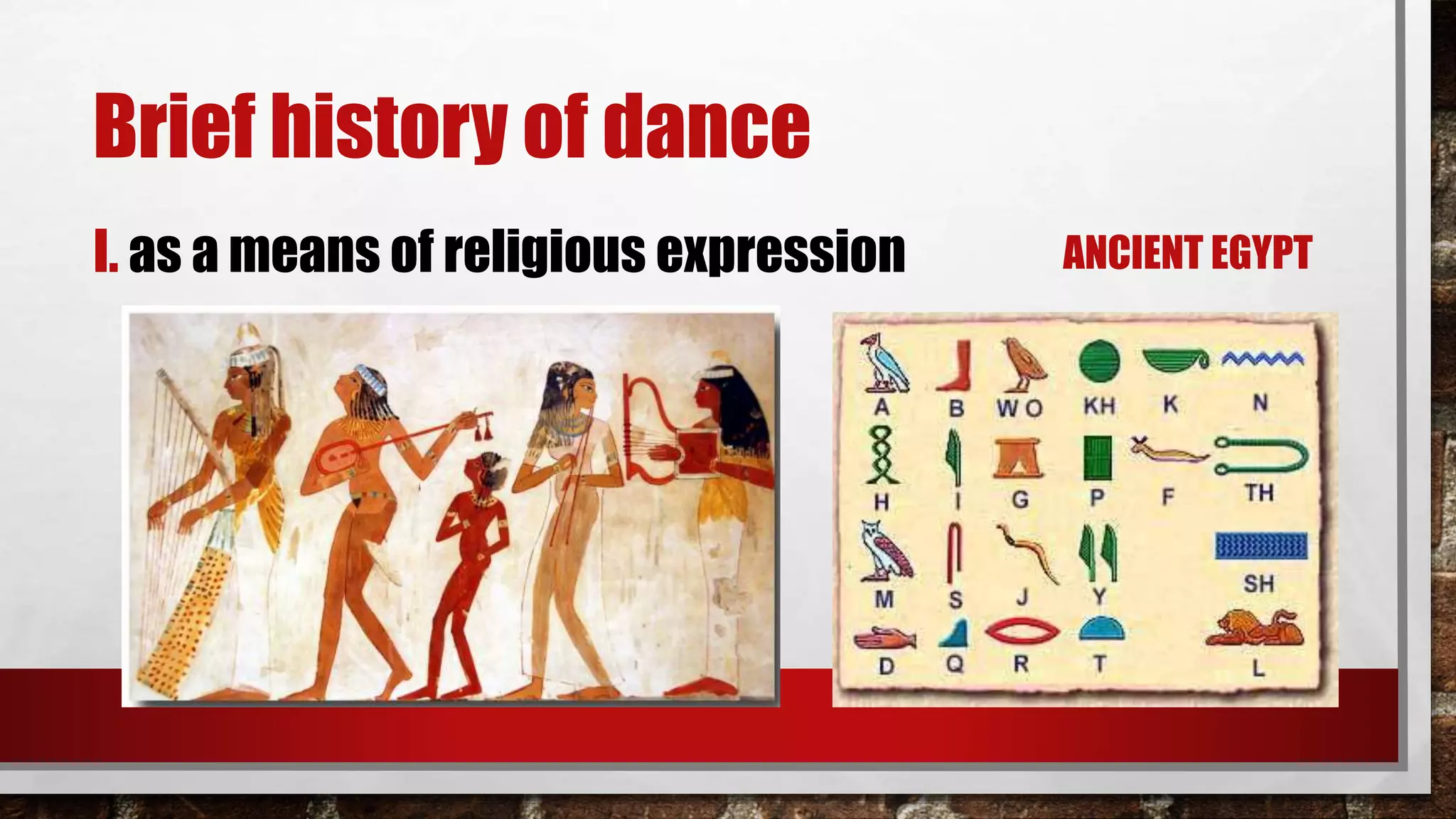
I. as a means of religious expression ANCIENT EGYPT
Brief history of dance
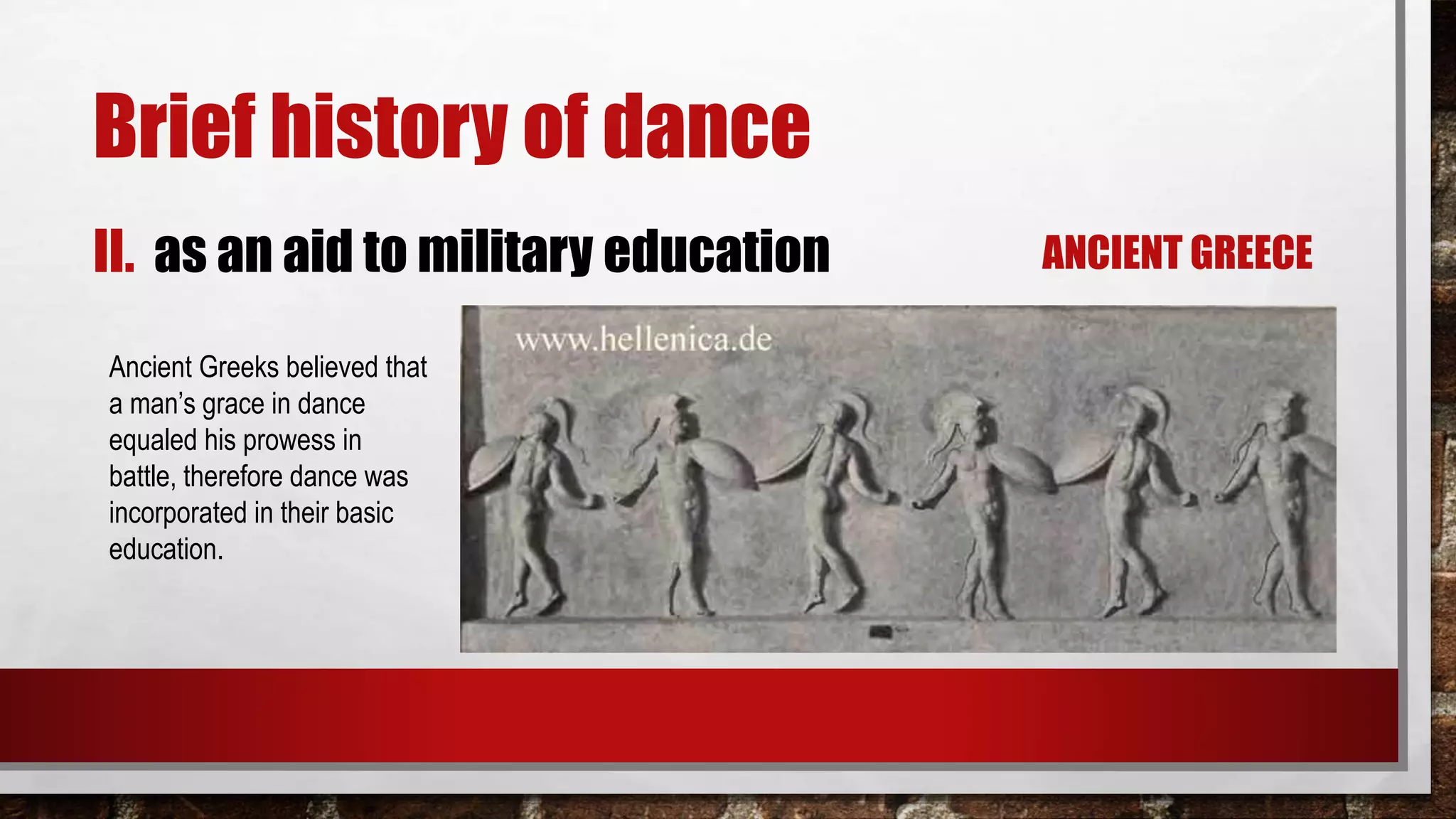
II. as an aid to military education ANCIENT GREECE
Ancient Greeks believed that
a man’s grace in dance
equaled his prowess in
battle, therefore dance was
incorporated in their basic
education.
Brief history of dance
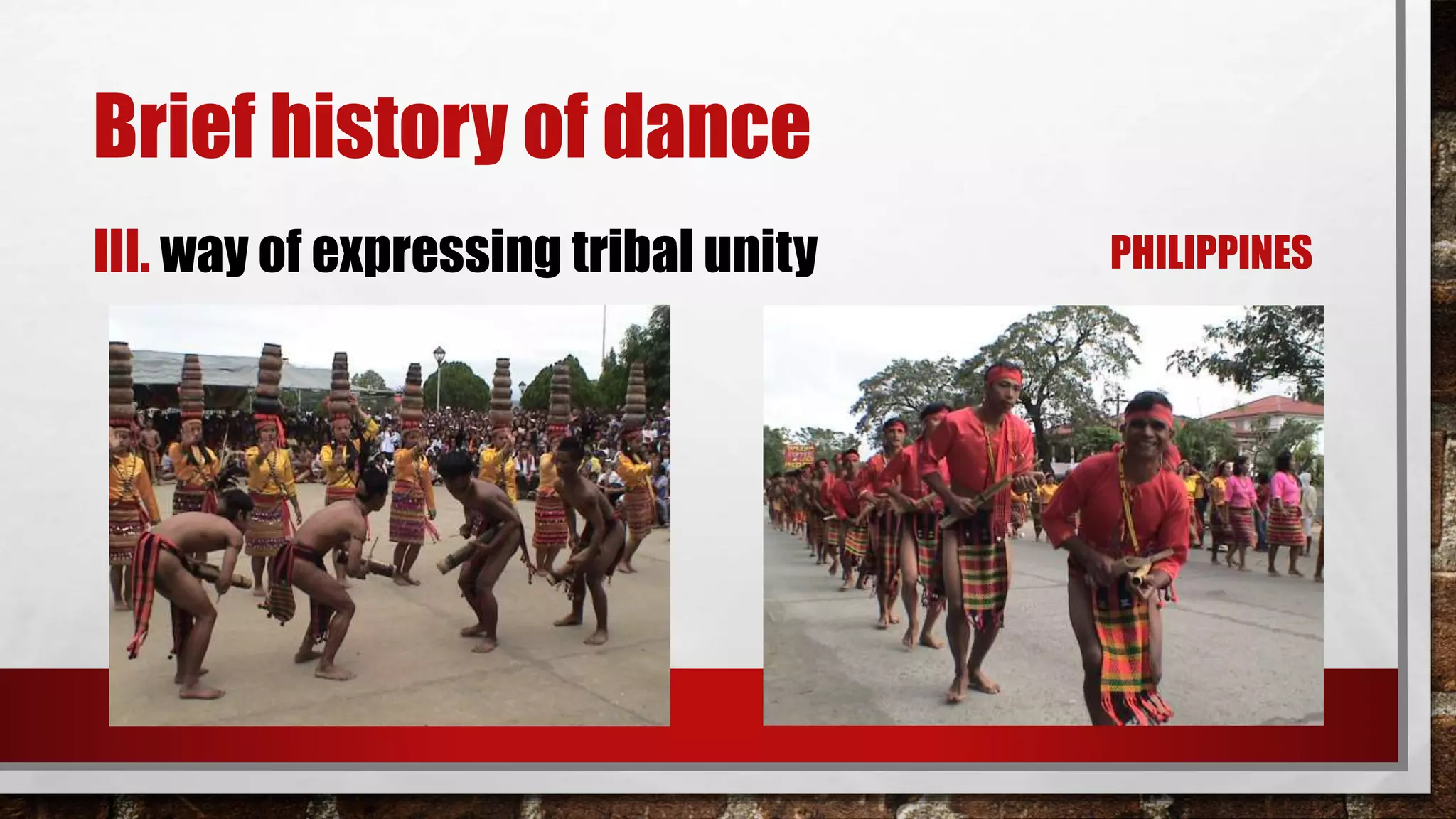
III. way of expressing tribal unity PHILIPPINES
Brief history of dance
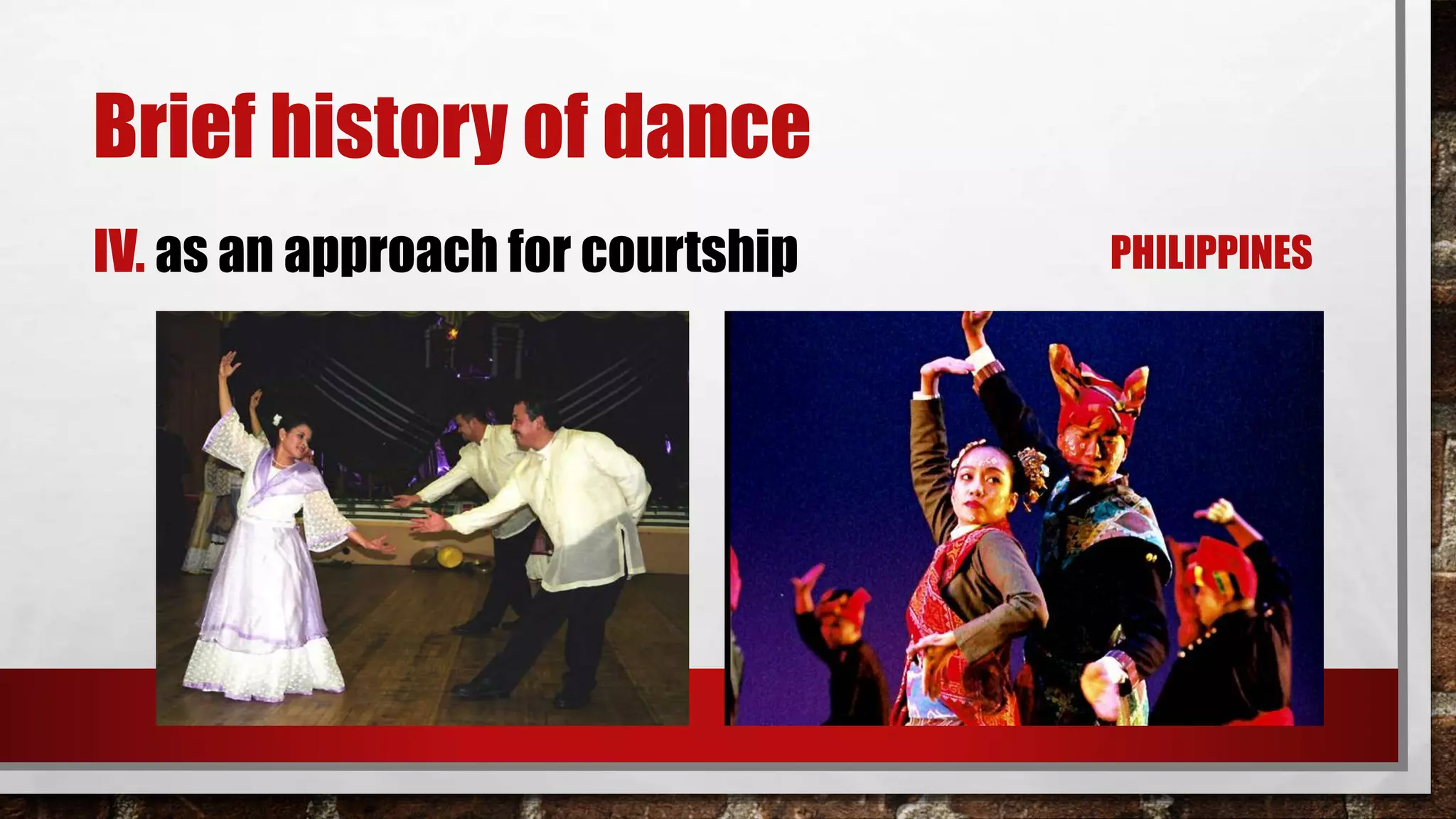
IV. as an approach for courtship PHILIPPINES
BENEFITS OF DANCE
WHAT IS DANCE FOR?
“Dance is fun! It lifts the spirit, strengthens the
body, and stimulates the mind.” – Wayne Sleep
MAIN BENEFITS OF DANCE
I. Physical
II. Mental/Emotional
III.Social
IV. Cultural
PHYSICAL BENEFITS OF DANCE
•develops muscular and cardiovascular endurance
•improves flexibility, coordination, balance, and body
composition
•enables joint mobility
•helps prevent osteoporosis
•lowers risk of cardiovascular diseases
MENTAL/EMOTIONAL BENEFITS OF DANCE
•helps keep the brain sharp
•decreases risk of dementia and Alzheimer’s disease
•decreases depressive symptoms
•increases self-esteem and improves body image
•aids in releasing emotional tension
SOCIAL BENEFITS OF DANCE
•gives sense of togetherness within a group
•encourages positive social interaction and
interpersonal relationship in a group
•contributes to the individual’s potential for
self-actualization in society
CULTURAL BENEFITS OF DANCE
•promotes cultural values
ELEMENTS OF DANCE
CHAPTER II
ELEMENTS OF DANCE
I. Space
II. Time
III. Energy
IV. Bodily Shapes
V. Group Shapes
SPACE
elements of dance
elements of dance: SPACE
- the area that the dance performers occupy
and where they move
- can be divided into four different aspects,
also known as spatial elements
elements of dance: SPACE
I. Direction
- The performers can go forward,
backward, diagonal, circular, and so on.
elements of dance: SPACE
II. Size
- Movements can be varied by doing
smaller or larger actions.
elements of dance: SPACE
III. Level
- Movements can be done in a high,
medium, and low level.
elements of dance: SPACE
IV. Focus
- Performers may change their focus by
looking at different directions .
elements of dance: SPACE
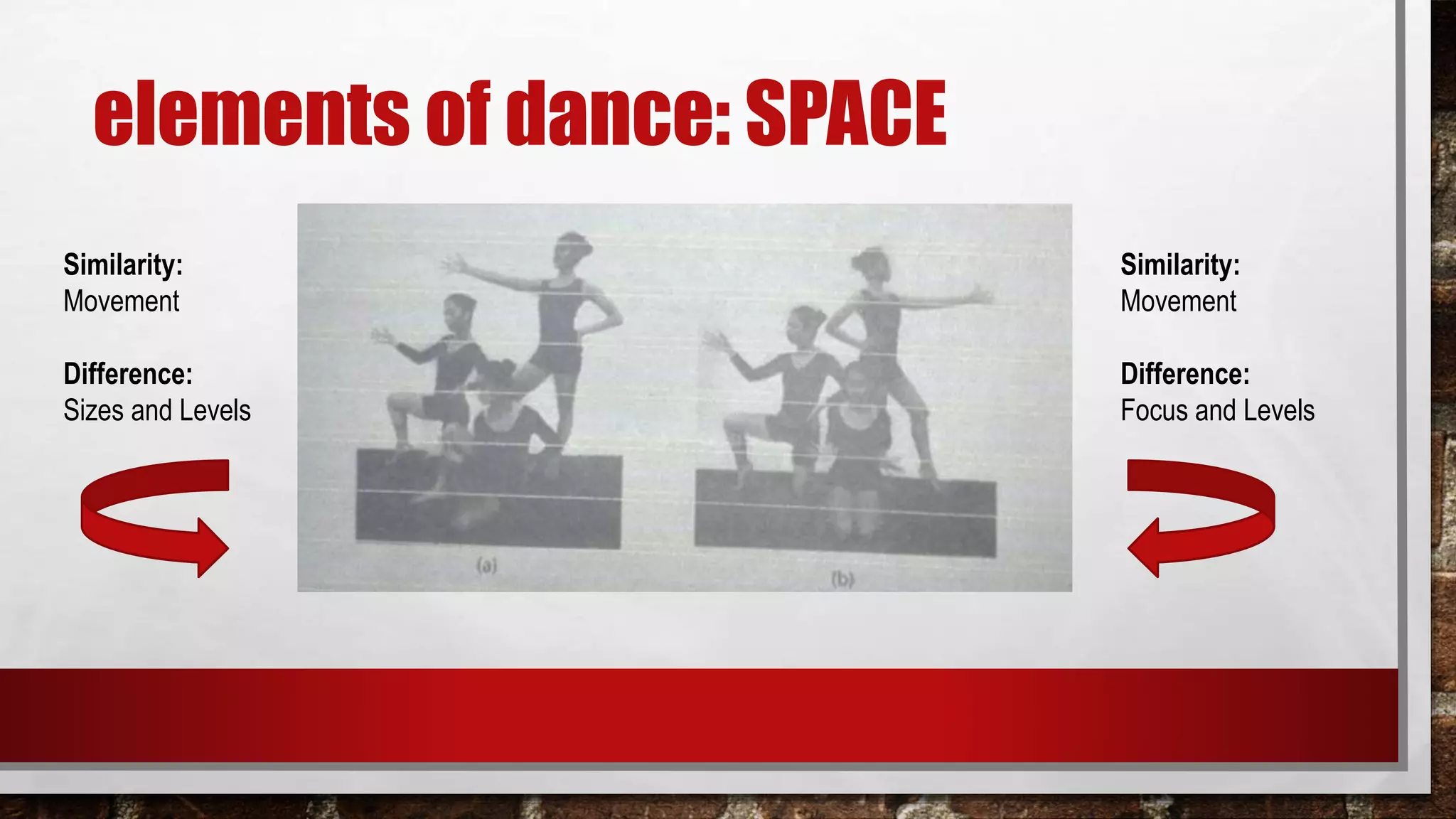
Similarity:
Movement
Difference:
Sizes and Levels
Similarity:
Movement
Difference:
Focus and Levels
TIMING
elements of dance
elements of dance: TIMING
The movements in timing can be executed in
varying tempo (speed). Performers move with tempo
of an underlying sound known as beat or pulse.
DANCE ENERGIES
elements of dance
elements of dance: DANCE ENERGIES
Movements are propelled by energy or force.
This force can either initiate or stop an action. Dance
uses different energies. Varied use of these
minimizes the monotony of the movements in the
performance.
SIX QUALITIES OF DANCE ENERGIES
I. Sustained
II. Percussive
III. Vibratory
IV. Swinging
V. Suspended
VI. Collapsing
qualities of dance energies: SUSTAINED
Movements are done smoothly, continuously,
and with flow and control. It does not have a clear
beginning and ending.
qualities of dance energies: PERCUSSIVE
Movements are explosive or sharp in contrast
with sustained movements. They are accented
with thrust of energy. They have a clear
beginning and ending.
qualities of dance energies: VIBRATORY
Movements consist of trembling or shaking. A
faster version of percussive movements that
produces a jittery effect.
qualities of dance energies: SWINGING
Movements trace a curved line or an arc in
space. The movements are relaxed and giving in
to gravity on the downward part of the motion,
followed by an upward application of energy.
qualities of dance energies: SUSPENDED
Movements are perched in space or hanging on
air. Holding a raised leg in any direction is an
example of a suspended movement.
qualities of dance energies: COLLAPSING
Movements are released in tension and
gradually or abruptly giving in to gravity, letting
the body descend to the floor. A slow collapse
can be described as a melting or oozing action in
a downward direction.
BODILY SHAPES
elements of dance
elements of dance: BODILY SHAPES
It refers to how the entire body is molded in
space or the configuration of body parts. The body
can be rounded, angular, or the combination of the
two. Other body shapes can be from wide to narrow
and from high to low. They can be symmetrical and
asymmetrical.
elements of dance: BODILY SHAPES
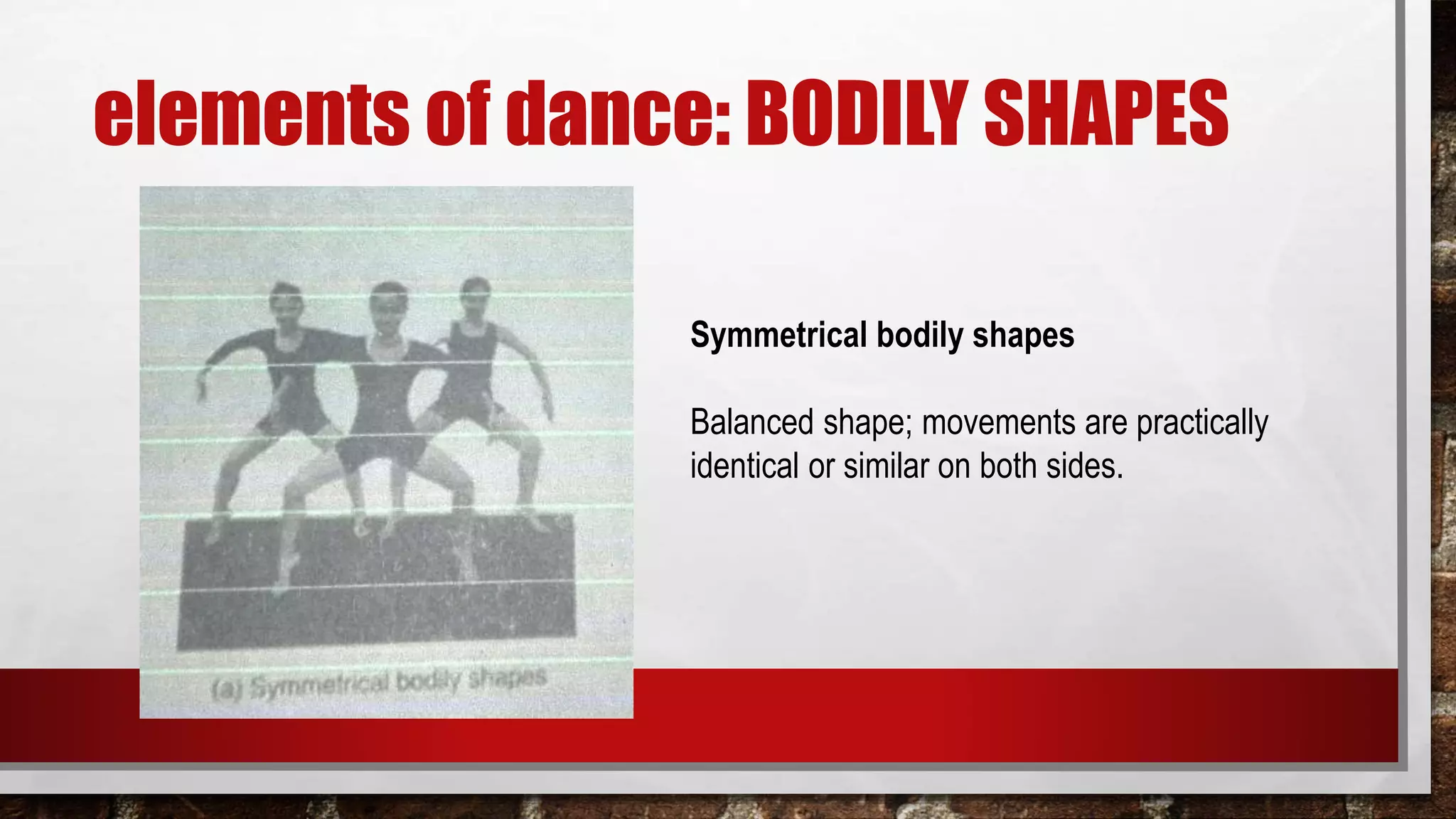
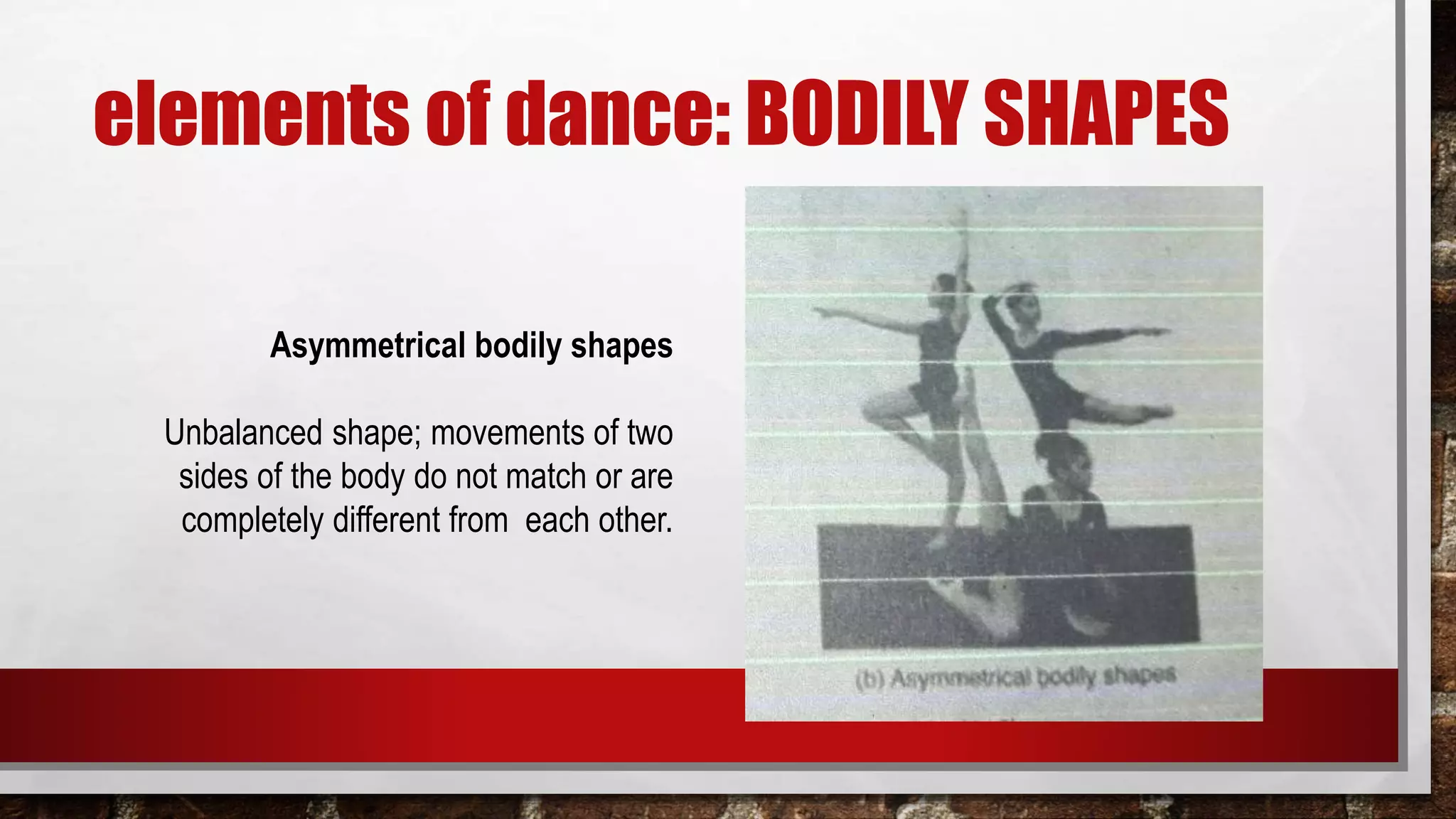
Symmetrical bodily shapes
Balanced shape; movements are practically
identical or similar on both sides.
elements of dance: BODILY SHAPES
Asymmetrical bodily shapes
Unbalanced shape; movements of two
sides of the body do not match or are
completely different from each other.
GROUP SHAPES
elements of dance
elements of dance: GROUP SHAPES
In this element, a group of dancers perform
movements in different group shapes/ they are
arranges in ways that are wide, narrow, rounded,
angular, symmetrical, or asymmetrical, and are
viewed together as a total picture or arrangement.
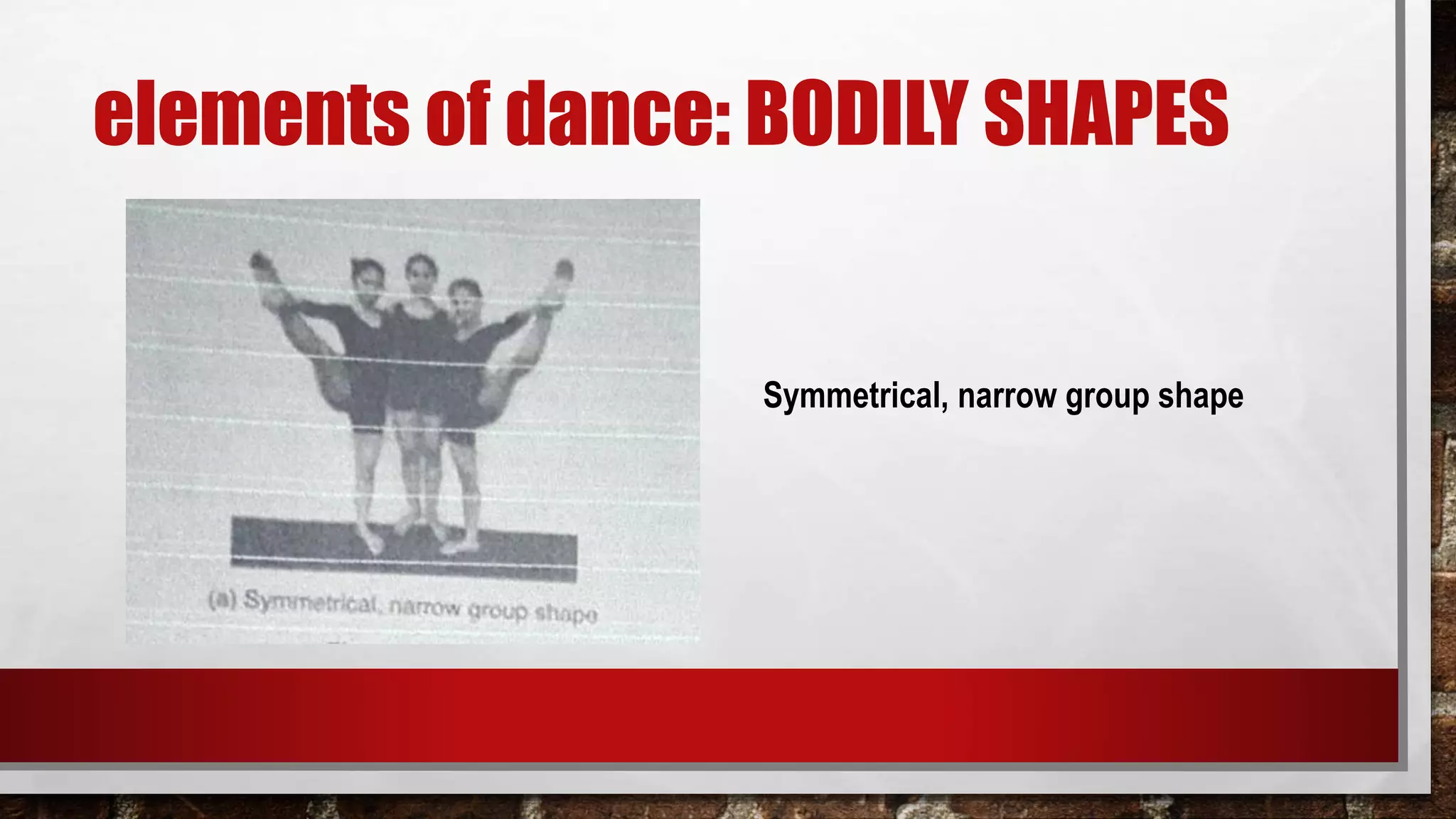
elements of dance: BODILY SHAPES
Symmetrical, narrow group shape
elements of dance: BODILY SHAPES
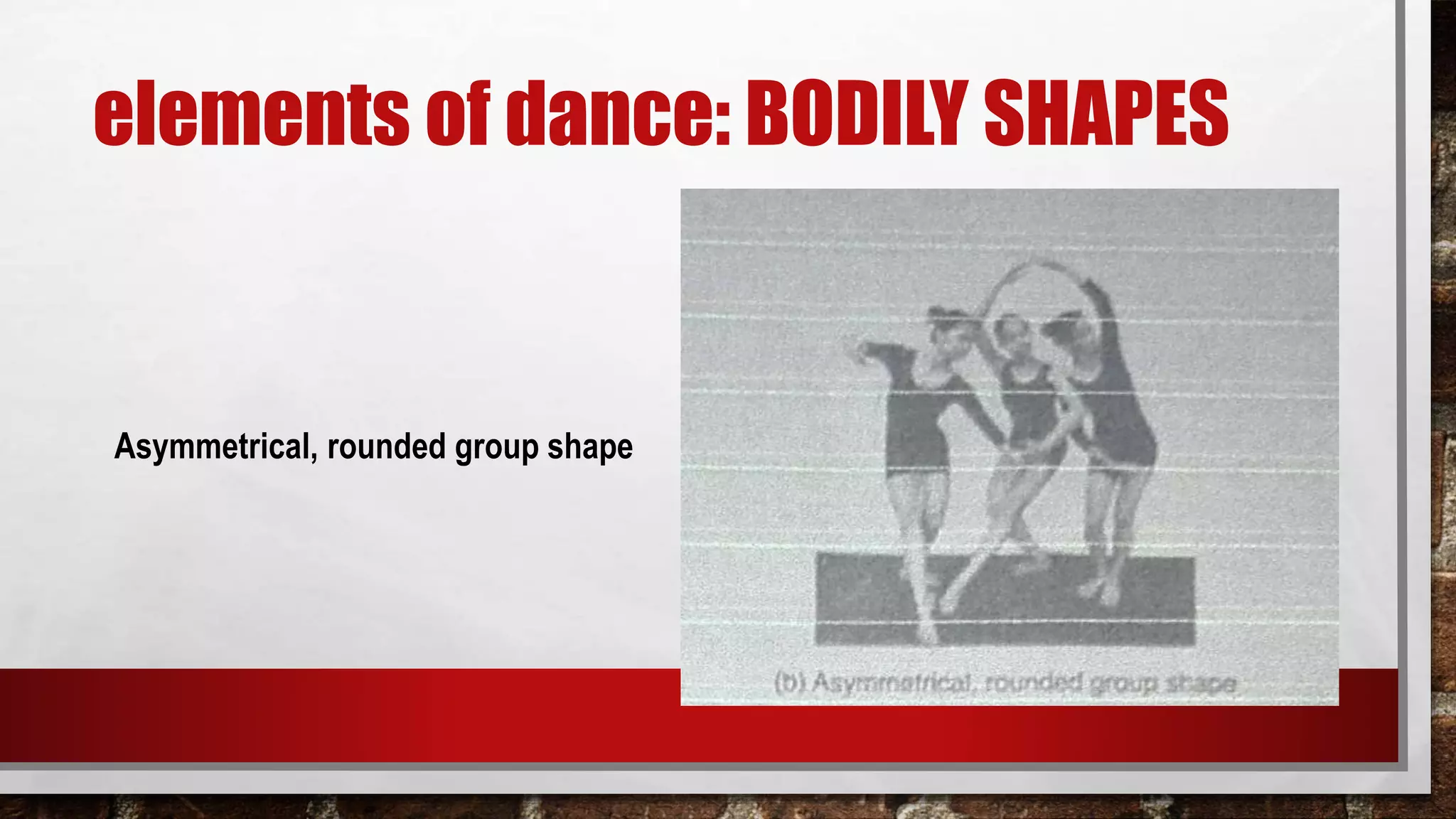
Asymmetrical, rounded group shape
DANCE APPRECIATION
AND COMPOSITION
CHAPTER III
What makes a good dance?
displays a significant meaning or conveys a message
lifts and transports the audience from their seats
has a beginning, middle, and end / conclusion
must have a shape or form for an effective choreography
Terms to understand
Form
Form is the instrument by which ideas and elements are arranged or combined into a logical
sequence which results in unity and consistency. It is the organizing factor of any dance composition.
Phrase
A phrase is the smallest unit of form in the whole dance. It can be related to a sentence in writing
compositions.
Motif
A single movement or a short phrase of movement that embodies the style and intention of the
dance is called a motif. A good dance contains this in order to be able to convey its meaning or intention to
the audience.
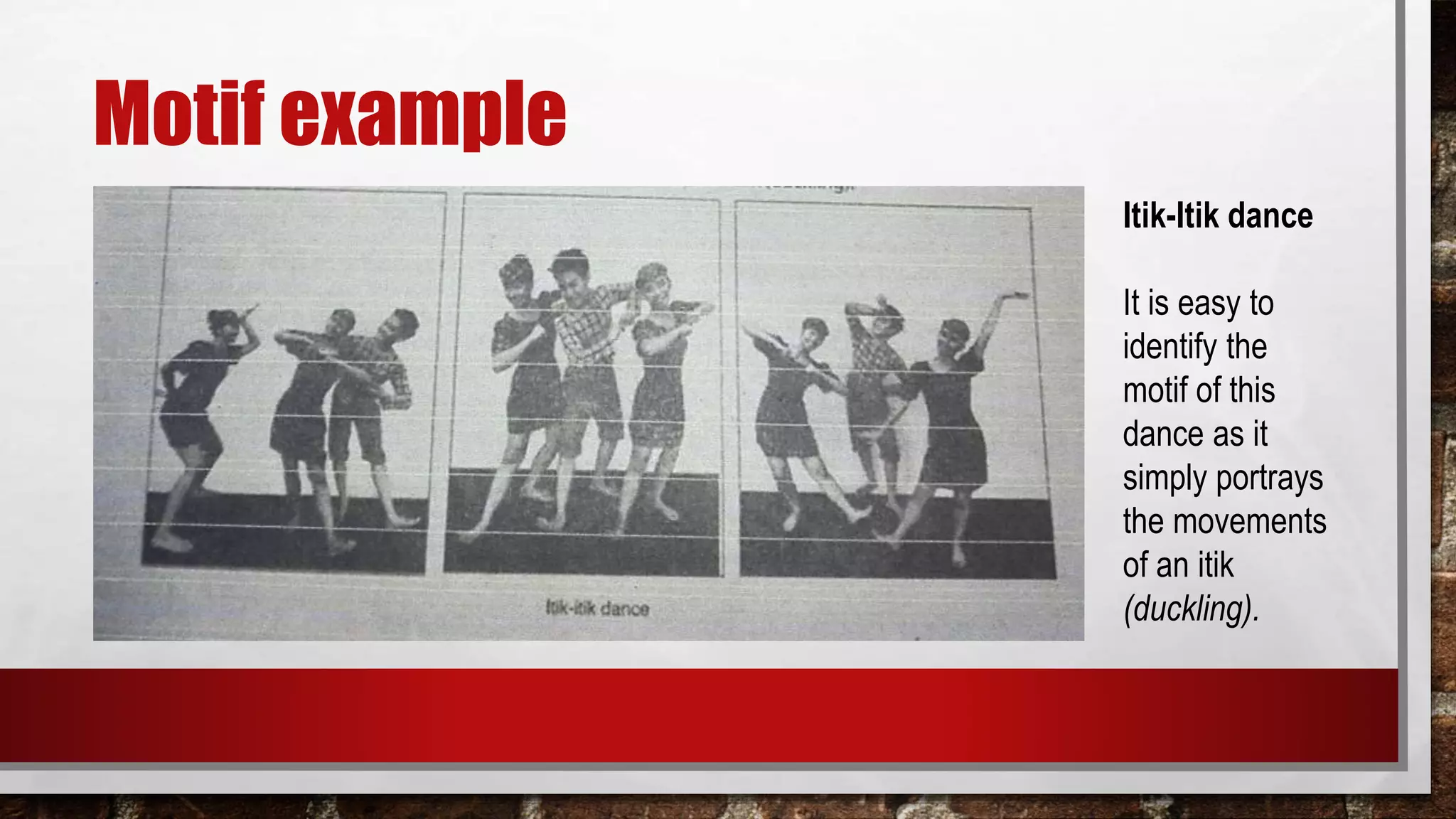
Motif example
Itik-Itik dance
It is easy to
identify the
motif of this
dance as it
simply portrays
the movements
of an itik
(duckling).
Like any superb tasting dish, a dance will
only be considered good if it has the right
ingredients. Whether it has a meaning or may be
presented abstractly, it must contain certain
qualities that make the choreography effective.
Characteristics of a good dance
I. Unity
II. Continuity and Development
III.Variety and Contrast
IV.Transition
V. Repetition
VI.Climax
UNITY
characteristics of a good dance
characteristics of a good dance: UNITY
The interconnected phrases of the dance
are coherent and flow smoothly together. The
movements fit together and each plays an
important role that contributes to the entirety of
a dance.
CONTINUITY AND DEVELOPMENT
characteristics of a good dance
characteristics of a good dance:
CONTINUITY AND DEVELOPMENT
The structure of the dance are organized
progressively, making each movement phrase
move naturally into the next. There is a continuous
development of the movement phrase and the
audience is swept along to the end.
VARIETY AND CONTRAST
characteristics of a good dance
characteristics of a good dance:
VARIETY AND CONTRAST
Variety and contrast in movement phrases
add excitement and flavor to the dance. Changing
the direction, use of energy, timing of a movement
phrase, and avoiding repeating them in the exact
way are ways to add variety to the dance.
TRANSITION
characteristics of a good dance
characteristics of a good dance:
TRANSITION
This is the link between movements, phrases,
and sections of the dance. It makes the logical
progression of the dance flow smoothly. Also, it is
vital because it keeps the unity and continuity of
the dance.
REPETITION
characteristics of a good dance
characteristics of a good dance:
REPETITION
Some phrases need to be repeated in
choreography so that the audience can see those
movements again and identify its significance.
Usually, when a certain phrase or a section of
choreography is repeated, it is the main message of
the dance.
CLIMAX
characteristics of a good dance
characteristics of a good dance: CLIMAX
This is where the apex of energy in the dance is
reached. It is similar to the climax in a story where a series
of events culminates. The climax may be a fast and enraged
blast of energy action, or it could fade away to a gentle and
quiet exit that marks the end of a particular story. The
music will often assist both the choreographer and the
audience when determining this point of development.
CHOREOGRAPHIC FORMS IN DANCE
I. Sequential
II.Contrapuntal
III.Episodic
IV.Other compositional forms
SEQUENTIAL FORMS
I. AB (two-part) form
II.ABA (three-part) form
III.Rondo Form (ABACA)
IV.Themes and variations form
CONTRAPUNTAL FORMS
I. Ground bass
II.Round or Canon
III.Fugue or Accumulation
IV.Suite
OTHER COMPOSITIONAL FORMS
I. Natural structures
II.Collage
III.Tableau
IV.Chance
EVALUATING A GOOD DANCE
How is the quality of a dance evaluated?
The success of any dance performance may
depend on who the evaluators are. Appreciation
on the importance of dance comes from the
points of view of the choreographer, the dancer,
or the audience.
Evaluators’ roles
Choreographer
They will evaluate a part of an ongoing process of developing a personal style which is
both spontaneous and organized.
Dancers
They will evaluate according to the specific demands that the performance places on
them.
Motif
They will evaluate according to the particular context of the dance.
MAKING A DANCE CRITIQUE
Stages in assessing a dance
Description
Here, the evaluator / critic notes down the composition of the dance in terms of the elements and
the characteristics of dance Examples of which are noting down the variation, unity, space, time, and so on.
Interpretation
Involves an appreciation of the ideas, content, images, and style contained within the dance.
Evaluation
Takes into consideration how effectively the features and context of the dance have been utilized
in the actual performance of the dancers to portray the content and quality of the dance.
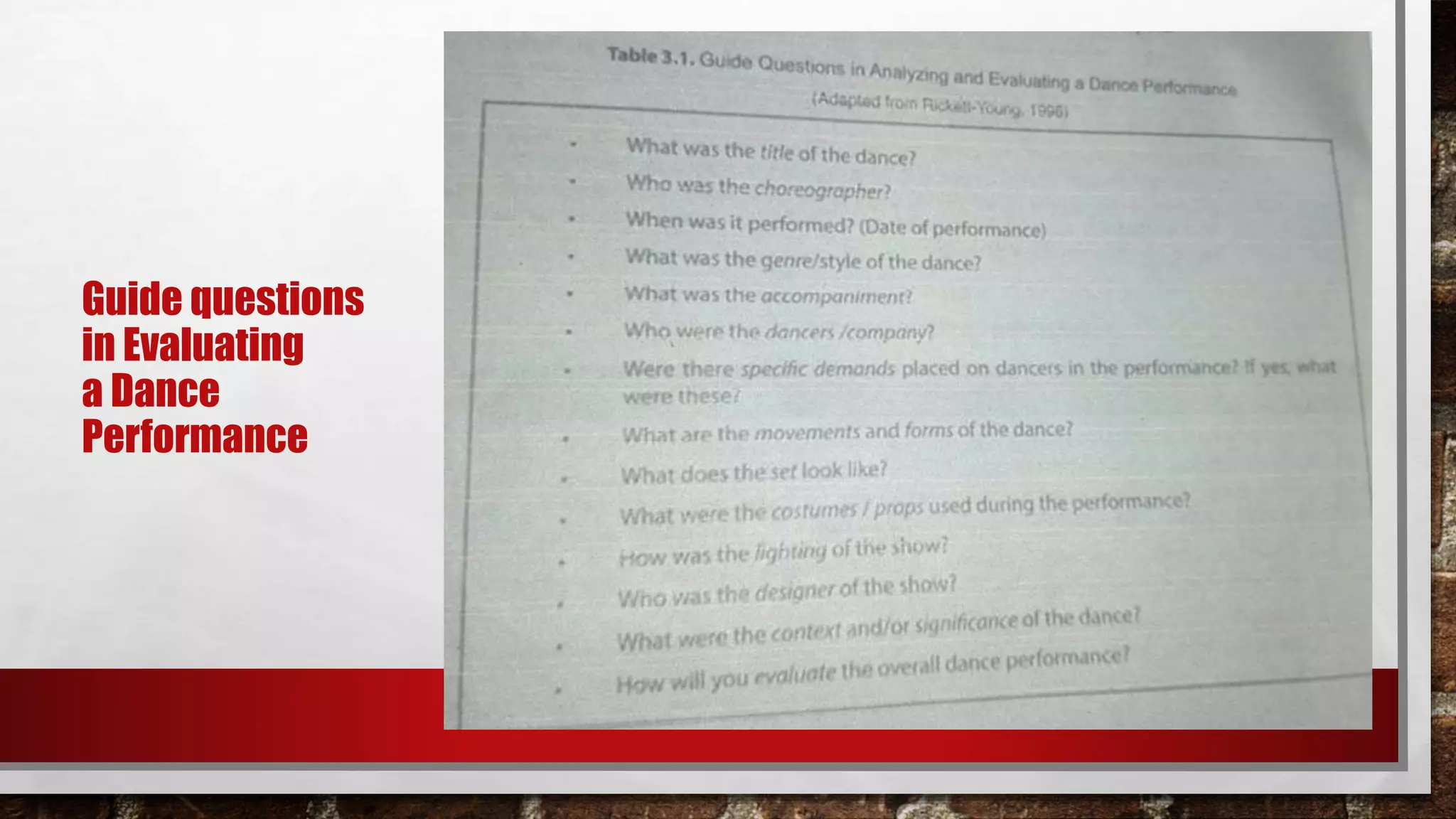
Guide questions
in Evaluating
a Dance
Performance
END

Introduction to Dance

  • 2.
    IN THIS UNIT I.Nature and brief history of dance II. Benefits of dance III.Elements and characteristics of dance IV.How to appreciate and evaluate a dance performance
  • 3.
    WHAT IS DANCE? Inits purest, most basic form, dance is art, the art of body movement.
  • 4.
    NATURE AND HISTORYOF DANCE CHAPTER I
  • 5.
    Nature of dance Dancediffers from athletics and other daily activities because it focuses primarily on an aesthetic or even entertaining experience.
  • 6.
    Why do peopledance? I. To please the gods II. To please others III.To please themselves or self expression IV. To build community
  • 7.
    Brief history ofdance It is said that the first use of dance was as a gesture in order to communicate.
  • 8.
    Brief history ofdance I. as a means of religious expression ANCIENT EGYPT
  • 9.
    Brief history ofdance II. as an aid to military education ANCIENT GREECE Ancient Greeks believed that a man’s grace in dance equaled his prowess in battle, therefore dance was incorporated in their basic education.
  • 10.
    Brief history ofdance III. way of expressing tribal unity PHILIPPINES
  • 11.
    Brief history ofdance IV. as an approach for courtship PHILIPPINES
  • 12.
  • 13.
    WHAT IS DANCEFOR? “Dance is fun! It lifts the spirit, strengthens the body, and stimulates the mind.” – Wayne Sleep
  • 14.
    MAIN BENEFITS OFDANCE I. Physical II. Mental/Emotional III.Social IV. Cultural
  • 15.
    PHYSICAL BENEFITS OFDANCE •develops muscular and cardiovascular endurance •improves flexibility, coordination, balance, and body composition •enables joint mobility •helps prevent osteoporosis •lowers risk of cardiovascular diseases
  • 16.
    MENTAL/EMOTIONAL BENEFITS OFDANCE •helps keep the brain sharp •decreases risk of dementia and Alzheimer’s disease •decreases depressive symptoms •increases self-esteem and improves body image •aids in releasing emotional tension
  • 17.
    SOCIAL BENEFITS OFDANCE •gives sense of togetherness within a group •encourages positive social interaction and interpersonal relationship in a group •contributes to the individual’s potential for self-actualization in society
  • 18.
    CULTURAL BENEFITS OFDANCE •promotes cultural values
  • 19.
  • 20.
    ELEMENTS OF DANCE I.Space II. Time III. Energy IV. Bodily Shapes V. Group Shapes
  • 21.
  • 22.
    elements of dance:SPACE - the area that the dance performers occupy and where they move - can be divided into four different aspects, also known as spatial elements
  • 23.
    elements of dance:SPACE I. Direction - The performers can go forward, backward, diagonal, circular, and so on.
  • 24.
    elements of dance:SPACE II. Size - Movements can be varied by doing smaller or larger actions.
  • 25.
    elements of dance:SPACE III. Level - Movements can be done in a high, medium, and low level.
  • 26.
    elements of dance:SPACE IV. Focus - Performers may change their focus by looking at different directions .
  • 27.
    elements of dance:SPACE Similarity: Movement Difference: Sizes and Levels Similarity: Movement Difference: Focus and Levels
  • 28.
  • 29.
    elements of dance:TIMING The movements in timing can be executed in varying tempo (speed). Performers move with tempo of an underlying sound known as beat or pulse.
  • 30.
  • 31.
    elements of dance:DANCE ENERGIES Movements are propelled by energy or force. This force can either initiate or stop an action. Dance uses different energies. Varied use of these minimizes the monotony of the movements in the performance.
  • 32.
    SIX QUALITIES OFDANCE ENERGIES I. Sustained II. Percussive III. Vibratory IV. Swinging V. Suspended VI. Collapsing
  • 33.
    qualities of danceenergies: SUSTAINED Movements are done smoothly, continuously, and with flow and control. It does not have a clear beginning and ending.
  • 34.
    qualities of danceenergies: PERCUSSIVE Movements are explosive or sharp in contrast with sustained movements. They are accented with thrust of energy. They have a clear beginning and ending.
  • 35.
    qualities of danceenergies: VIBRATORY Movements consist of trembling or shaking. A faster version of percussive movements that produces a jittery effect.
  • 36.
    qualities of danceenergies: SWINGING Movements trace a curved line or an arc in space. The movements are relaxed and giving in to gravity on the downward part of the motion, followed by an upward application of energy.
  • 37.
    qualities of danceenergies: SUSPENDED Movements are perched in space or hanging on air. Holding a raised leg in any direction is an example of a suspended movement.
  • 38.
    qualities of danceenergies: COLLAPSING Movements are released in tension and gradually or abruptly giving in to gravity, letting the body descend to the floor. A slow collapse can be described as a melting or oozing action in a downward direction.
  • 39.
  • 40.
    elements of dance:BODILY SHAPES It refers to how the entire body is molded in space or the configuration of body parts. The body can be rounded, angular, or the combination of the two. Other body shapes can be from wide to narrow and from high to low. They can be symmetrical and asymmetrical.
  • 41.
    elements of dance:BODILY SHAPES Symmetrical bodily shapes Balanced shape; movements are practically identical or similar on both sides.
  • 42.
    elements of dance:BODILY SHAPES Asymmetrical bodily shapes Unbalanced shape; movements of two sides of the body do not match or are completely different from each other.
  • 43.
  • 44.
    elements of dance:GROUP SHAPES In this element, a group of dancers perform movements in different group shapes/ they are arranges in ways that are wide, narrow, rounded, angular, symmetrical, or asymmetrical, and are viewed together as a total picture or arrangement.
  • 45.
    elements of dance:BODILY SHAPES Symmetrical, narrow group shape
  • 46.
    elements of dance:BODILY SHAPES Asymmetrical, rounded group shape
  • 47.
  • 48.
    What makes agood dance? displays a significant meaning or conveys a message lifts and transports the audience from their seats has a beginning, middle, and end / conclusion must have a shape or form for an effective choreography
  • 49.
    Terms to understand Form Formis the instrument by which ideas and elements are arranged or combined into a logical sequence which results in unity and consistency. It is the organizing factor of any dance composition. Phrase A phrase is the smallest unit of form in the whole dance. It can be related to a sentence in writing compositions. Motif A single movement or a short phrase of movement that embodies the style and intention of the dance is called a motif. A good dance contains this in order to be able to convey its meaning or intention to the audience.
  • 50.
    Motif example Itik-Itik dance Itis easy to identify the motif of this dance as it simply portrays the movements of an itik (duckling).
  • 51.
    Like any superbtasting dish, a dance will only be considered good if it has the right ingredients. Whether it has a meaning or may be presented abstractly, it must contain certain qualities that make the choreography effective.
  • 52.
    Characteristics of agood dance I. Unity II. Continuity and Development III.Variety and Contrast IV.Transition V. Repetition VI.Climax
  • 53.
  • 54.
    characteristics of agood dance: UNITY The interconnected phrases of the dance are coherent and flow smoothly together. The movements fit together and each plays an important role that contributes to the entirety of a dance.
  • 55.
  • 56.
    characteristics of agood dance: CONTINUITY AND DEVELOPMENT The structure of the dance are organized progressively, making each movement phrase move naturally into the next. There is a continuous development of the movement phrase and the audience is swept along to the end.
  • 57.
  • 58.
    characteristics of agood dance: VARIETY AND CONTRAST Variety and contrast in movement phrases add excitement and flavor to the dance. Changing the direction, use of energy, timing of a movement phrase, and avoiding repeating them in the exact way are ways to add variety to the dance.
  • 59.
  • 60.
    characteristics of agood dance: TRANSITION This is the link between movements, phrases, and sections of the dance. It makes the logical progression of the dance flow smoothly. Also, it is vital because it keeps the unity and continuity of the dance.
  • 61.
  • 62.
    characteristics of agood dance: REPETITION Some phrases need to be repeated in choreography so that the audience can see those movements again and identify its significance. Usually, when a certain phrase or a section of choreography is repeated, it is the main message of the dance.
  • 63.
  • 64.
    characteristics of agood dance: CLIMAX This is where the apex of energy in the dance is reached. It is similar to the climax in a story where a series of events culminates. The climax may be a fast and enraged blast of energy action, or it could fade away to a gentle and quiet exit that marks the end of a particular story. The music will often assist both the choreographer and the audience when determining this point of development.
  • 65.
  • 66.
    CHOREOGRAPHIC FORMS INDANCE I. Sequential II.Contrapuntal III.Episodic IV.Other compositional forms
  • 67.
    SEQUENTIAL FORMS I. AB(two-part) form II.ABA (three-part) form III.Rondo Form (ABACA) IV.Themes and variations form
  • 68.
    CONTRAPUNTAL FORMS I. Groundbass II.Round or Canon III.Fugue or Accumulation IV.Suite
  • 69.
    OTHER COMPOSITIONAL FORMS I.Natural structures II.Collage III.Tableau IV.Chance
  • 70.
  • 71.
    How is thequality of a dance evaluated? The success of any dance performance may depend on who the evaluators are. Appreciation on the importance of dance comes from the points of view of the choreographer, the dancer, or the audience.
  • 72.
    Evaluators’ roles Choreographer They willevaluate a part of an ongoing process of developing a personal style which is both spontaneous and organized. Dancers They will evaluate according to the specific demands that the performance places on them. Motif They will evaluate according to the particular context of the dance.
  • 73.
  • 74.
    Stages in assessinga dance Description Here, the evaluator / critic notes down the composition of the dance in terms of the elements and the characteristics of dance Examples of which are noting down the variation, unity, space, time, and so on. Interpretation Involves an appreciation of the ideas, content, images, and style contained within the dance. Evaluation Takes into consideration how effectively the features and context of the dance have been utilized in the actual performance of the dancers to portray the content and quality of the dance.
  • 75.
  • 76.