Presentation FM Anu Lehtoranta, Kilonpuisto school, Espoo
FM Nina Maunu, Saunalahti school, Espoo
Phenomenon based learning
What is it?
Why is it needed?
How is it used?
WHAT IS IT?
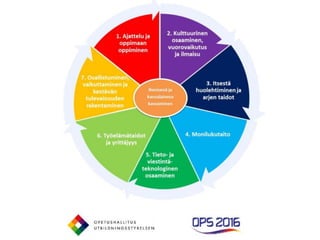
• Background: Developing pupil competences
• widely.
• It is phenomenon that is real/ it really exists
• No more scattered information/learning by heart
• Phenomena are looked in their real contexts – a
teacher doesn’t give themes, pupils find themselves
and what is his/hers interest crossing subject boundries
• Example at Finnish school
• htps://www.youtube.com/watch?v=4ipk3dWsrXE
Why is it needed?
Some examples
• Changing world---changing occupations
• Learning to think
• No ready answers
• Listening skills
• Social skills
• More friends
• Team work
• Evaluation self-evaluation, evaluating class mates
Why?
• Planning the project and scheduling together
with teacher
• Participation
• inquiry-based learning
• A pupils herself/himself looks for info, decides
which info is relevant, which is less important,
• Writes it down and weighs its value
• --- a joy of learning, motivation ( a pupil is in a
center not a teacher)
Why is it needed?
• Problem solving
• They learn to solve problems make solutions
themselves---occupations
www.visithelsinki.fi
Now it is your turn to start building up a
phenomenon based example--- a town
The Baltic Sea
• Before starting pupils have been studying a lot
of material on the Baltic Sea
• Subjects to combine: geography, English,
history, biology, social studies
• Pupils are discussing in the groups about the
Baltic Sea from different point of view (1-2
lessons), what have they discovered about
their topic and looking for information on the
computers
Themes according to subjects
• What comes to their mind when they learn about
the Baltic Sea and geography --- they sudy with a
geography teacher
• What comes to their mind when they learn about
the Baltic Sea and history --- they sudy with a
history teacher
• What comes to their mind when they learn about
the Baltic Sea and social science--- they sudy with
a social science teacher
The Baltic Sea-history-geography
• While studying they might for instance
discover erosion (geography) and erosion
(history)
• Erosion can be also combined with biology—
• Organism how they destroy land and builgings
• All can be demonstated in English
• Social science---costs etc….continue working…
Making groups
• Mother language
• Other languages
• Religion
• History
• Biology, geography
• Mathematics
• Physics
• Arts
• others
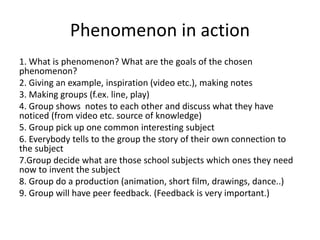
Phenomenon in action
1. What is phenomenon? What are the goals of the chosen
phenomenon?
2. Giving an example, inspiration (video etc.), making notes
3. Making groups (f.ex. line, play)
4. Group shows notes to each other and discuss what they have
noticed (from video etc. source of knowledge)
5. Group pick up one common interesting subject
6. Everybody tells to the group the story of their own connection to
the subject
7.Group decide what are those school subjects which ones they need
now to invent the subject
8. Group do a production (animation, short film, drawings, dance..)
9. Group will have peer feedback. (Feedback is very important.)
Links
• Wiki.eoppimiskeskus.fi
• Ilmiopohjaisuus.ning.com
• English: Developing pupil skills through eTwinning
(book)
• Books: FT Juho Norrena, Innostava koulun
muutos – Opas laaja-alaisen osaamisen
opetukseen

Phenomenon based learning

  • 1.
    Presentation FM AnuLehtoranta, Kilonpuisto school, Espoo FM Nina Maunu, Saunalahti school, Espoo Phenomenon based learning What is it? Why is it needed? How is it used?
  • 2.
    WHAT IS IT? •Background: Developing pupil competences • widely. • It is phenomenon that is real/ it really exists • No more scattered information/learning by heart • Phenomena are looked in their real contexts – a teacher doesn’t give themes, pupils find themselves and what is his/hers interest crossing subject boundries • Example at Finnish school • htps://www.youtube.com/watch?v=4ipk3dWsrXE
  • 4.
    Why is itneeded? Some examples • Changing world---changing occupations • Learning to think • No ready answers • Listening skills • Social skills • More friends • Team work • Evaluation self-evaluation, evaluating class mates
  • 5.
    Why? • Planning theproject and scheduling together with teacher • Participation • inquiry-based learning • A pupils herself/himself looks for info, decides which info is relevant, which is less important, • Writes it down and weighs its value • --- a joy of learning, motivation ( a pupil is in a center not a teacher)
  • 6.
    Why is itneeded? • Problem solving • They learn to solve problems make solutions themselves---occupations www.visithelsinki.fi Now it is your turn to start building up a phenomenon based example--- a town
  • 7.
    The Baltic Sea •Before starting pupils have been studying a lot of material on the Baltic Sea • Subjects to combine: geography, English, history, biology, social studies • Pupils are discussing in the groups about the Baltic Sea from different point of view (1-2 lessons), what have they discovered about their topic and looking for information on the computers
  • 8.
    Themes according tosubjects • What comes to their mind when they learn about the Baltic Sea and geography --- they sudy with a geography teacher • What comes to their mind when they learn about the Baltic Sea and history --- they sudy with a history teacher • What comes to their mind when they learn about the Baltic Sea and social science--- they sudy with a social science teacher
  • 9.
    The Baltic Sea-history-geography •While studying they might for instance discover erosion (geography) and erosion (history) • Erosion can be also combined with biology— • Organism how they destroy land and builgings • All can be demonstated in English • Social science---costs etc….continue working…
  • 10.
    Making groups • Motherlanguage • Other languages • Religion • History • Biology, geography • Mathematics • Physics • Arts • others
  • 11.
    Phenomenon in action 1.What is phenomenon? What are the goals of the chosen phenomenon? 2. Giving an example, inspiration (video etc.), making notes 3. Making groups (f.ex. line, play) 4. Group shows notes to each other and discuss what they have noticed (from video etc. source of knowledge) 5. Group pick up one common interesting subject 6. Everybody tells to the group the story of their own connection to the subject 7.Group decide what are those school subjects which ones they need now to invent the subject 8. Group do a production (animation, short film, drawings, dance..) 9. Group will have peer feedback. (Feedback is very important.)
  • 12.
    Links • Wiki.eoppimiskeskus.fi • Ilmiopohjaisuus.ning.com •English: Developing pupil skills through eTwinning (book) • Books: FT Juho Norrena, Innostava koulun muutos – Opas laaja-alaisen osaamisen opetukseen