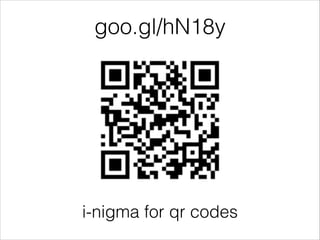
goo.gl/hN18y

i-nigma for qr codes
A Beginners Guide to “The Flipped Classroom” Model
George Phillip
5th and 6th Grade
Social Studies Teacher
TWITTER:

@phillige

EMAIL: gphillip@stanleyclark.org

WEBSITE: www.reversingsocialstudies.com
PHONE:

(574) 303-2758
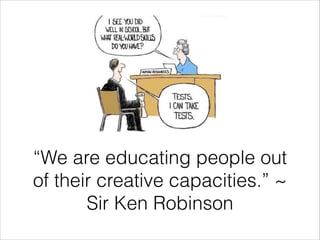
“We are educating people out
of their creative capacities.” ~
Sir Ken Robinson
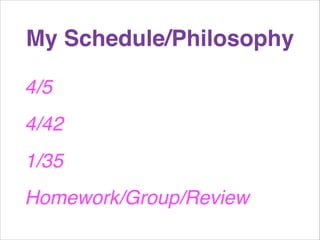
My Schedule/Philosophy
4/5!
4/42!
1/35!
Homework/Group/Review
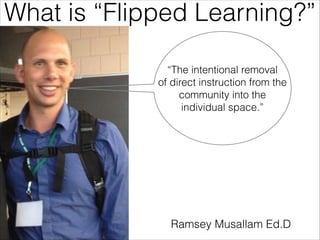
What is “Flipped Learning?”
“The intentional removal
of direct instruction from the
community into the
individual space.”

Ramsey Musallam Ed.D
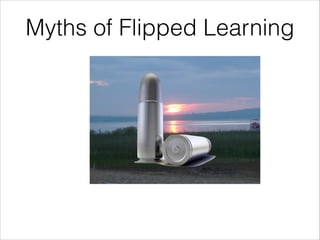
Myths of Flipped Learning

X
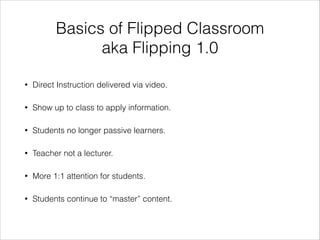
Basics of Flipped Classroom
aka Flipping 1.0
•

Direct Instruction delivered via video.

•

Show up to class to apply information.

•

Students no longer passive learners.

•

Teacher not a lecturer.

•

More 1:1 attention for students.

•

Students continue to “master” content.
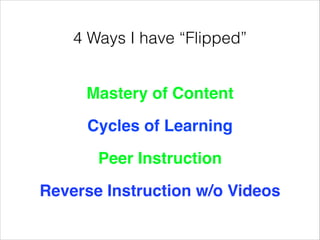
4 Ways I have “Flipped”
Mastery of Content!
Cycles of Learning!
Peer Instruction!
Reverse Instruction w/o Videos
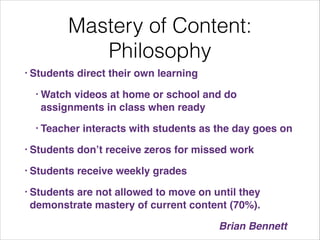
Mastery of Content:
Philosophy
• Students

direct their own learning !

• Watch

videos at home or school and do
assignments in class when ready!

• Teacher

interacts with students as the day goes on!

• Students

don’t receive zeros for missed work!

• Students

receive weekly grades!

• Students

are not allowed to move on until they
demonstrate mastery of current content (70%).!
! ! ! ! ! ! ! ! ! ! ! ! ! ! ! ! ! ! Brian Bennett
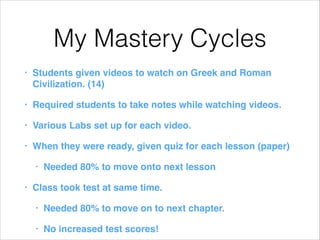
My Mastery Cycles
•

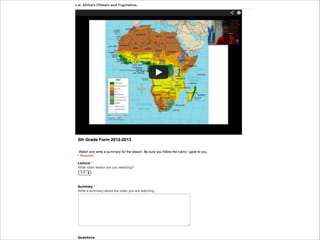
Students given videos to watch on Greek and Roman
Civilization. (14)!

•

Required students to take notes while watching videos.!

•

Various Labs set up for each video.!

•

When they were ready, given quiz for each lesson (paper)!
•

•

Needed 80% to move onto next lesson!

Class took test at same time. !
•

Needed 80% to move on to next chapter.!

•

No increased test scores!
Flipping 2.0
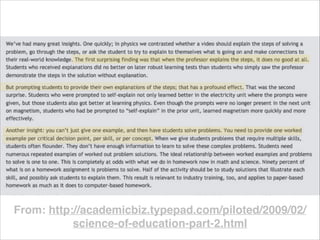
From: http://academicbiz.typepad.com/piloted/2009/02/
science-of-education-part-2.html
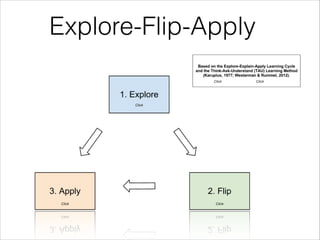
Explore-Flip-Apply
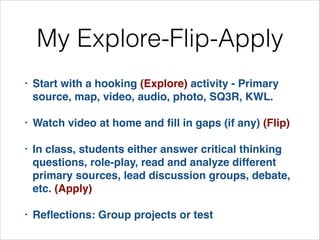
My Explore-Flip-Apply
•

Start with a hooking (Explore) activity - Primary
source, map, video, audio, photo, SQ3R, KWL. !

•

Watch video at home and fill in gaps (if any) (Flip)!

•

In class, students either answer critical thinking
questions, role-play, read and analyze different
primary sources, lead discussion groups, debate,
etc. (Apply)!

•

Reflections: Group projects or test
Brainstorm: What is going on in this video?
What can you tell me about Geography?
5 Themes of Geography
Project

•

Showed a video over farming

•

Brainstormed 5 themes of geography

•

Discussions over what theme/themes fall into farming
•

Watch vodcast over the 5 Themes of Geography and
take notes

•

Assign groups to a theme

•

Students then created an activity to explain their
theme to second graders
Dan Meyer
Dan Meyer
Dan Meyer
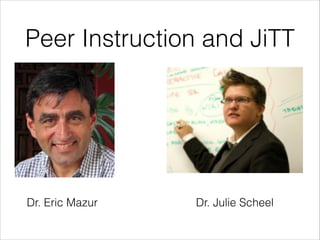
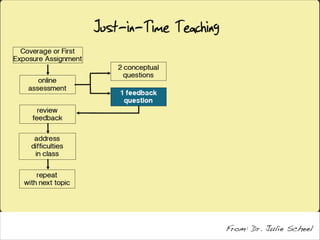
Peer Instruction and JiTT

Dr. Eric Mazur

Dr. Julie Scheel
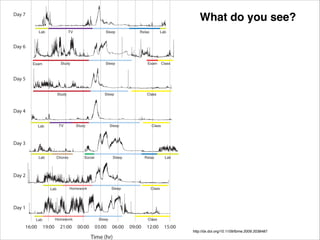
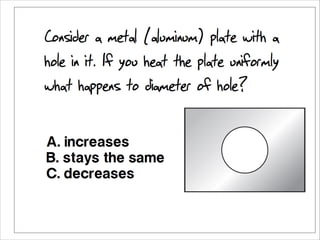
What do you see?

http://dx.doi.org/10.1109/tbme.2009.2038487
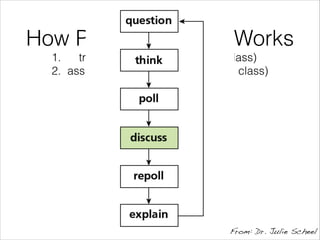
How Peer Instruction Works
1.
transfer of information (out of class)
2. assimilation of that information (in class)

From: Dr. Julie Scheel
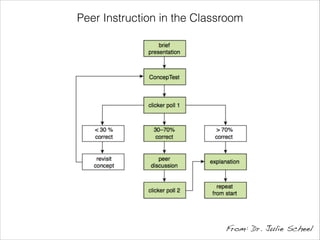
Peer Instruction in the Classroom

From: Dr. Julie Scheel
Inquiry-Based History (Reverse
Instruction w/o Videos)
• Having

your students do the work of historians in class.

• Primary/secondary

sources about an era/event.

• Analyze

past by creating meaning, synthesize
information and create their own understanding of past.

• Connection
• Allows

to current events.

students develop skills are essential to
democracy and building deeper understanding.
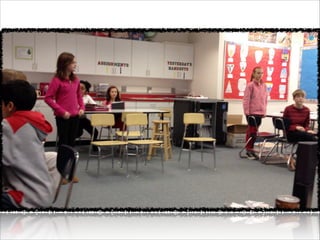
Fishbowl Example
• Meeting

of the Minds.!

• Divided

students based on academic ability.!

• Given

primary sources and readings about Legalism and
Confucianism. !

• Worked

in groups to digest information, research, and
summarize importance of governmental topics. Created a
conversation.!

• Each

group “meet in secret location” and discussed topics
relevant to ancient China. !

• Outside

groups taking notes and will reflect using Paper
Blogging concept.
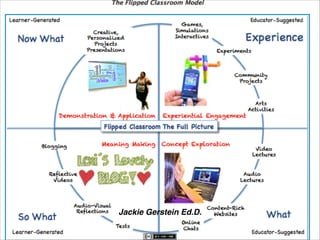
Jackie Gerstein Ed.D.
What Has Changed?
•

Class time:
•

60/40

•

90/10

•

Producers vs. consumers

•

Develop skills (21st Century Skills) for future
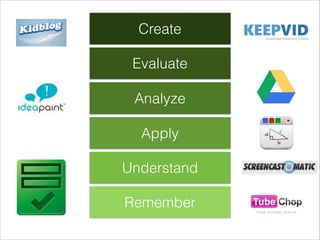
Create
Evaluate
Analyze
Apply
Understand
Remember
Helpful Websites/Blogs/Other
www.cyclesoflearning.com - Ramsey Musallam - @ramusallam
!
• www.thethinkingstick.com - Jeff Utecht - @jutecht
!
• http://usergeneratededucation.wordpress.com - Jackie Gerstein
Ed.D @jackiegerstein
!
• blog.mrmeyer.com - Dan Meyer - @ddmeyer
!
• http://fnoschese.wordpress.com/ - Frank Noschese - @fnoschese
!
• www.flippingwithkirch.blogspot.com - Crystal Kirch - @crystalkirch
!
• http://spanishflipping.blogspot.com - Heather Witten - @SraWitten
!
• #flipclass, #edchat, #isedchat
!
• Daniel Pink - The Flipped Manifesto - Free Download
•

Flipped instruction

  • 1.
  • 2.
    A Beginners Guideto “The Flipped Classroom” Model George Phillip 5th and 6th Grade Social Studies Teacher
  • 3.
  • 6.
    “We are educatingpeople out of their creative capacities.” ~ Sir Ken Robinson
  • 7.
  • 8.
    What is “FlippedLearning?” “The intentional removal of direct instruction from the community into the individual space.” Ramsey Musallam Ed.D
  • 9.
    Myths of FlippedLearning X
  • 10.
    Basics of FlippedClassroom aka Flipping 1.0 • Direct Instruction delivered via video. • Show up to class to apply information. • Students no longer passive learners. • Teacher not a lecturer. • More 1:1 attention for students. • Students continue to “master” content.
  • 11.
    4 Ways Ihave “Flipped” Mastery of Content! Cycles of Learning! Peer Instruction! Reverse Instruction w/o Videos
  • 12.
    Mastery of Content: Philosophy •Students direct their own learning ! • Watch videos at home or school and do assignments in class when ready! • Teacher interacts with students as the day goes on! • Students don’t receive zeros for missed work! • Students receive weekly grades! • Students are not allowed to move on until they demonstrate mastery of current content (70%).! ! ! ! ! ! ! ! ! ! ! ! ! ! ! ! ! ! ! Brian Bennett
  • 13.
    My Mastery Cycles • Studentsgiven videos to watch on Greek and Roman Civilization. (14)! • Required students to take notes while watching videos.! • Various Labs set up for each video.! • When they were ready, given quiz for each lesson (paper)! • • Needed 80% to move onto next lesson! Class took test at same time. ! • Needed 80% to move on to next chapter.! • No increased test scores!
  • 15.
  • 16.
  • 17.
  • 18.
    My Explore-Flip-Apply • Start witha hooking (Explore) activity - Primary source, map, video, audio, photo, SQ3R, KWL. ! • Watch video at home and fill in gaps (if any) (Flip)! • In class, students either answer critical thinking questions, role-play, read and analyze different primary sources, lead discussion groups, debate, etc. (Apply)! • Reflections: Group projects or test
  • 19.
    Brainstorm: What isgoing on in this video?
  • 20.
    What can youtell me about Geography?
  • 21.
    5 Themes ofGeography Project • Showed a video over farming • Brainstormed 5 themes of geography • Discussions over what theme/themes fall into farming
  • 22.
    • Watch vodcast overthe 5 Themes of Geography and take notes • Assign groups to a theme • Students then created an activity to explain their theme to second graders
  • 23.
  • 24.
  • 25.
  • 26.
    Peer Instruction andJiTT Dr. Eric Mazur Dr. Julie Scheel
  • 27.
    What do yousee? http://dx.doi.org/10.1109/tbme.2009.2038487
  • 28.
    How Peer InstructionWorks 1. transfer of information (out of class) 2. assimilation of that information (in class) From: Dr. Julie Scheel
  • 30.
  • 31.
    Peer Instruction inthe Classroom From: Dr. Julie Scheel
  • 32.
    Inquiry-Based History (Reverse Instructionw/o Videos) • Having your students do the work of historians in class. • Primary/secondary sources about an era/event. • Analyze past by creating meaning, synthesize information and create their own understanding of past. • Connection • Allows to current events. students develop skills are essential to democracy and building deeper understanding.
  • 33.
    Fishbowl Example • Meeting ofthe Minds.! • Divided students based on academic ability.! • Given primary sources and readings about Legalism and Confucianism. ! • Worked in groups to digest information, research, and summarize importance of governmental topics. Created a conversation.! • Each group “meet in secret location” and discussed topics relevant to ancient China. ! • Outside groups taking notes and will reflect using Paper Blogging concept.
  • 35.
  • 36.
    What Has Changed? • Classtime: • 60/40 • 90/10 • Producers vs. consumers • Develop skills (21st Century Skills) for future
  • 37.
  • 39.
    Helpful Websites/Blogs/Other www.cyclesoflearning.com -Ramsey Musallam - @ramusallam ! • www.thethinkingstick.com - Jeff Utecht - @jutecht ! • http://usergeneratededucation.wordpress.com - Jackie Gerstein Ed.D @jackiegerstein ! • blog.mrmeyer.com - Dan Meyer - @ddmeyer ! • http://fnoschese.wordpress.com/ - Frank Noschese - @fnoschese ! • www.flippingwithkirch.blogspot.com - Crystal Kirch - @crystalkirch ! • http://spanishflipping.blogspot.com - Heather Witten - @SraWitten ! • #flipclass, #edchat, #isedchat ! • Daniel Pink - The Flipped Manifesto - Free Download •