Name : RajatGarg
Project submitted
in the partial fulfilment
for the award of the degree of
Bachelor of Pharmacy (2018-2022)
2.
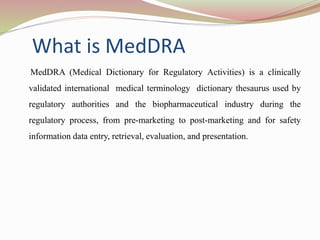
What is MedDRA
MedDRA(Medical Dictionary for Regulatory Activities) is a clinically
validated international medical terminology dictionary thesaurus used by
regulatory authorities and the biopharmaceutical industry during the
regulatory process, from pre-marketing to post-marketing and for safety
information data entry, retrieval, evaluation, and presentation.
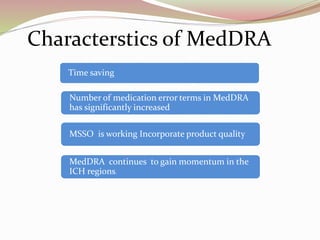
Time saving
Number ofmedication error terms in MedDRA
has significantly increased
MSSO is working Incorporate product quality
MedDRA continues to gain momentum in the
ICH regions.
Characterstics of MedDRA
5.
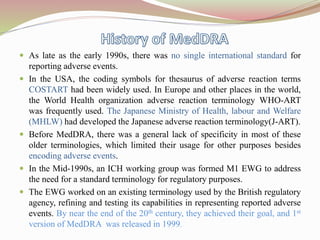
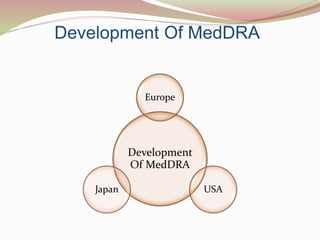
As lateas the early 1990s, there was no single international standard for
reporting adverse events.
In the USA, the coding symbols for thesaurus of adverse reaction terms
COSTART had been widely used. In Europe and other places in the world,
the World Health organization adverse reaction terminology WHO-ART
was frequently used. The Japanese Ministry of Health, labour and Welfare
(MHLW) had developed the Japanese adverse reaction terminology(J-ART).
Before MedDRA, there was a general lack of specificity in most of these
older terminologies, which limited their usage for other purposes besides
encoding adverse events.
In the Mid-1990s, an ICH working group was formed M1 EWG to address
the need for a standard terminology for regulatory purposes.
The EWG worked on an existing terminology used by the British regulatory
agency, refining and testing its capabilities in representing reported adverse
events. By near the end of the 20th century, they achieved their goal, and 1st
version of MedDRA was released in 1999.
6.
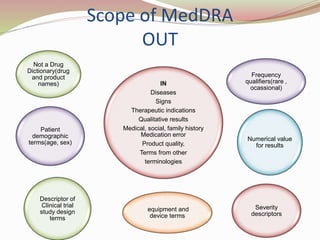
Scope of MedDRA
OUT
IN
Diseases
Signs
Therapeuticindications
Qualitative results
Medical, social, family history
Medication error
Product quality,
Terms from other
terminologies
Not a Drug
Dictionary(drug
and product
names)
Frequency
qualifiers(rare ,
ocassional)
Numerical value
for results
equipment and
device terms
Severity
descriptors
Descriptor of
Clinical trial
study design
terms
Patient
demographic
terms(age, sex)
7.
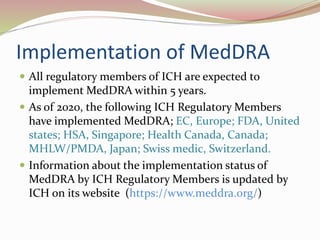
Implementation of MedDRA
All regulatory members of ICH are expected to
implement MedDRA within 5 years.
As of 2020, the following ICH Regulatory Members
have implemented MedDRA; EC, Europe; FDA, United
states; HSA, Singapore; Health Canada, Canada;
MHLW/PMDA, Japan; Swiss medic, Switzerland.
Information about the implementation status of
MedDRA by ICH Regulatory Members is updated by
ICH on its website (https://www.meddra.org/)
8.
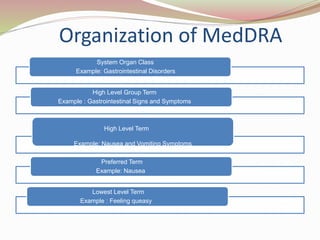
Organization of MedDRA
SystemOrgan Class
Example: Gastrointestinal Disorders
High Level Group Term
Example : Gastrointestinal Signs and Symptoms
High Level Term
Example: Nausea and Vomiting Symptoms
Preferred Term
Example: Nausea
Lowest Level Term
Example : Feeling queasy
Maintenance of MedDRA
MedDRA is hierarchical multi-axial, multilingual, regularly-updated,
and strictly maintained by the Maintenance and Support Services
Organization (MSSO
Application of MedDRA
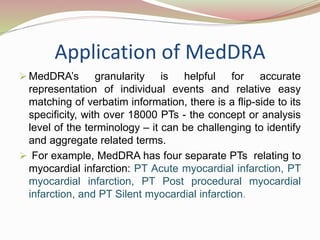
MedDRA’s granularity is helpful for accurate
representation of individual events and relative easy
matching of verbatim information, there is a flip-side to its
specificity, with over 18000 PTs - the concept or analysis
level of the terminology – it can be challenging to identify
and aggregate related terms.
For example, MedDRA has four separate PTs relating to
myocardial infarction: PT Acute myocardial infarction, PT
myocardial infarction, PT Post procedural myocardial
infarction, and PT Silent myocardial infarction.
13.
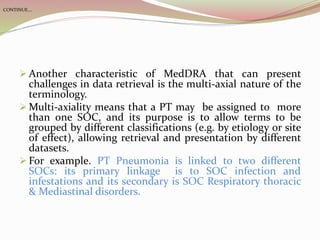
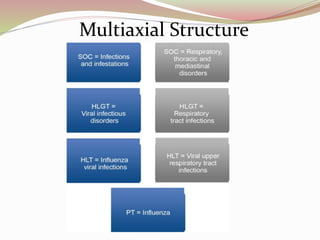
Another characteristicof MedDRA that can present
challenges in data retrieval is the multi-axial nature of the
terminology.
Multi-axiality means that a PT may be assigned to more
than one SOC, and its purpose is to allow terms to be
grouped by different classifications (e.g. by etiology or site
of effect), allowing retrieval and presentation by different
datasets.
For example. PT Pneumonia is linked to two different
SOCs: its primary linkage is to SOC infection and
infestations and its secondary is SOC Respiratory thoracic
& Mediastinal disorders.
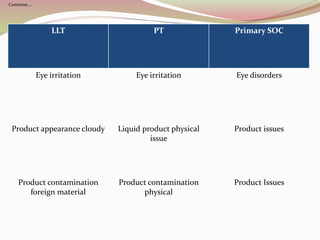
CONTINUE….
MedDRA Coding andcodes
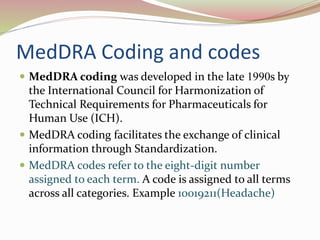
MedDRA coding was developed in the late 1990s by
the International Council for Harmonization of
Technical Requirements for Pharmaceuticals for
Human Use (ICH).
MedDRA coding facilitates the exchange of clinical
information through Standardization.
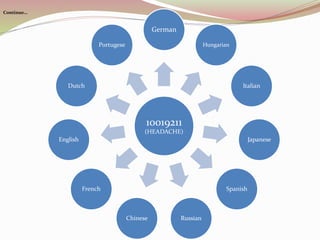
MedDRA codes refer to the eight-digit number
assigned to each term. A code is assigned to all terms
across all categories. Example 10019211(Headache)
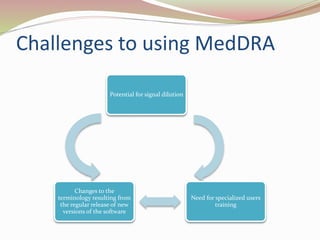
Challenges to usingMedDRA
Potential for signal dilution
Need for specialized users
training
Changes to the
terminology resulting from
the regular release of new
versions of the software
19.
Future prospective ofMedDRA
MedDRA will be a great place to start because the
definition of similar terms often differ only slightly.
As MedDRA continues to be refined by the
biopharmaceutical users, other parties have expresses
an interest using and refining MedDRA for related
users.
Recently, the number of medication error terms in
MedDRA has significantly increased as Regulatory
Authorities focus attention on these issues companies
that manufacture medical device.
20.
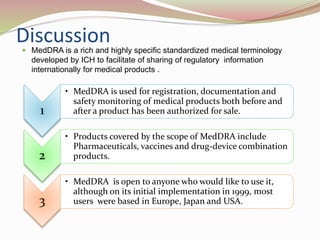
Discussion
MedDRA isa rich and highly specific standardized medical terminology
developed by ICH to facilitate of sharing of regulatory information
internationally for medical products .
1
• MedDRA is used for registration, documentation and
safety monitoring of medical products both before and
after a product has been authorized for sale.
2
• Products covered by the scope of MedDRA include
Pharmaceuticals, vaccines and drug-device combination
products.
3
• MedDRA is open to anyone who would like to use it,
although on its initial implementation in 1999, most
users were based in Europe, Japan and USA.
21.
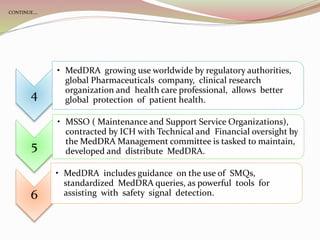
4
• MedDRA growinguse worldwide by regulatory authorities,
global Pharmaceuticals company, clinical research
organization and health care professional, allows better
global protection of patient health.
5
• MSSO ( Maintenance and Support Service Organizations),
contracted by ICH with Technical and Financial oversight by
the MedDRA Management committee is tasked to maintain,
developed and distribute MedDRA.
6
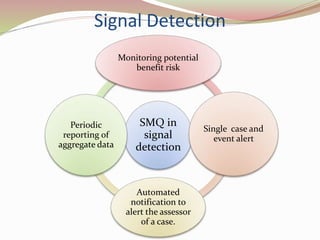
• MedDRA includes guidance on the use of SMQs,
standardized MedDRA queries, as powerful tools for
assisting with safety signal detection.
CONTINUE….
22.
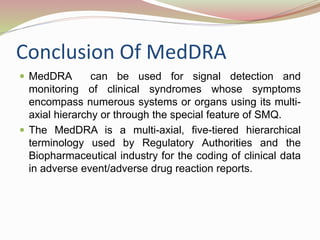
Conclusion Of MedDRA
MedDRA can be used for signal detection and
monitoring of clinical syndromes whose symptoms
encompass numerous systems or organs using its multi-
axial hierarchy or through the special feature of SMQ.
The MedDRA is a multi-axial, five-tiered hierarchical
terminology used by Regulatory Authorities and the
Biopharmaceutical industry for the coding of clinical data
in adverse event/adverse drug reaction reports.
23.
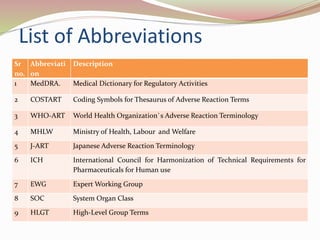
List of Abbreviations
Sr
no.
Abbreviati
on
Description
1MedDRA. Medical Dictionary for Regulatory Activities
2 COSTART Coding Symbols for Thesaurus of Adverse Reaction Terms
3 WHO-ART World Health Organization`s Adverse Reaction Terminology
4 MHLW Ministry of Health, Labour and Welfare
5 J-ART Japanese Adverse Reaction Terminology
6 ICH International Council for Harmonization of Technical Requirements for
Pharmaceuticals for Human use
7 EWG Expert Working Group
8 SOC System Organ Class
9 HLGT High-Level Group Terms
Editor's Notes
#6 USA used COSTART Europe used WHO-ART and Japan used MHLW which are help to encoding the adverse events.
In 1999 1st version of MedDRA was released.
#8 HAS =Heath Saving Account
PMDA = Pharmaceutical Medicine Device Agency
MHLW= Ministry, Health, Labour and Welfare