


PSUR: The TGA Approach
Dr Shabnam Sharan
PSUR Evaluation Lead
Risk Management Plan Evaluation Section
Pharmacovigilance and Special Access Branch
Australian Pharmacovigilance Regulatory Requirements and Risk
Management Plans Summit
27 March 2019
Canberra
What is a PSUR (or PBRER-Periodic Benefit-Risk Evaluation
Report)
• A Periodic Safety Update Report is a report submitted by
sponsors describing the worldwide safety experience with a
medicinal product at a defined time after its approval.
• The PSUR is an essential component of the lifecycle benefit-
risk management of a medicinal product.
• The PSUR is NOT an appropriate or alternative channel for
notification of Significant Safety Issues.
2
PSURs at the TGA
• The PSUR review process is evolving to emerge as an
integral part of the TGA’s Enhanced Vigilance Framework.
• This process intends to provide the necessary safety counter
balance, especially to early registrations of high priority
medicinal products which have a nascent safety profile at the
time of approval.
3
Outline
• PSUR requirements
• PSUR submission format
• PSUR review process
• PSUR in the Product Vigilance Framework
• Communicating with Sponsors
• What’s New?
4
PSUR requirements
5
TGA requirements for PSUR
• The TGA applies the requirement to submit PSUR as a condition of registration.
• PSURs are not required for all registered medicines. A risk-based approach is
used to determine the requirement, frequency and duration of PSUR submission
• PSUR submission is always required for provisional registration products, black
triangle products, biosimilars and for vaccines.
• PSUR submission may be required for other products for which the TGA
evaluates RMPs and on occasion in the absence of an RMP to assist in post-
market safety monitoring.
6
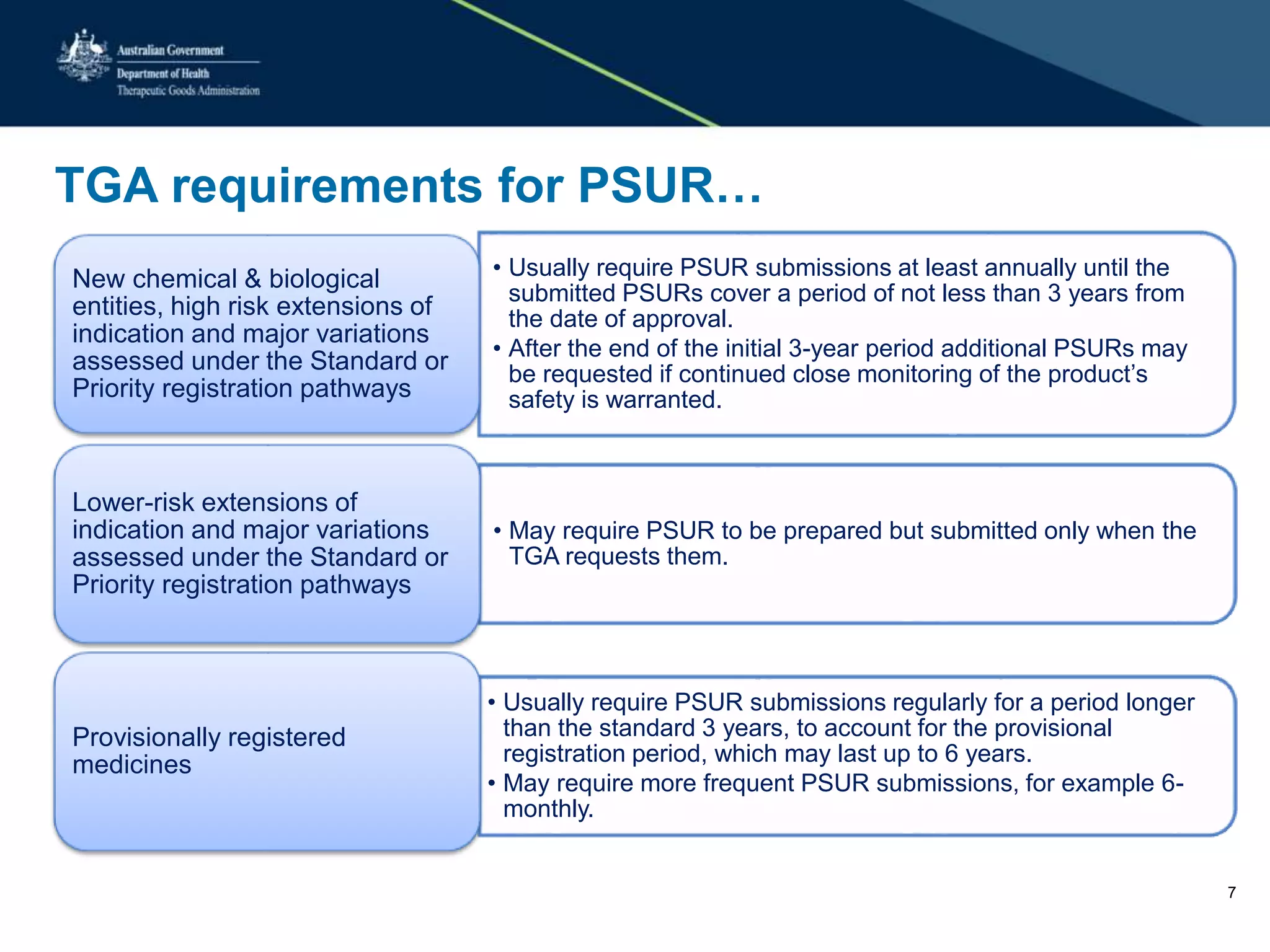
TGA requirements for PSUR…
• Usually require PSUR submissions at least annually until the
submitted PSURs cover a period of not less than 3 years from
the date of approval.
• After the end of the initial 3-year period additional PSURs may
be requested if continued close monitoring of the product’s
safety is warranted.
New chemical & biological
entities, high risk extensions of
indication and major variations
assessed under the Standard or
Priority registration pathways
• May require PSUR to be prepared but submitted only when the
TGA requests them.
Lower-risk extensions of
indication and major variations
assessed under the Standard or
Priority registration pathways
• Usually require PSUR submissions regularly for a period longer
than the standard 3 years, to account for the provisional
registration period, which may last up to 6 years.
• May require more frequent PSUR submissions, for example 6-
monthly.
Provisionally registered
medicines
7
PSUR submission format
8
PSUR submission format
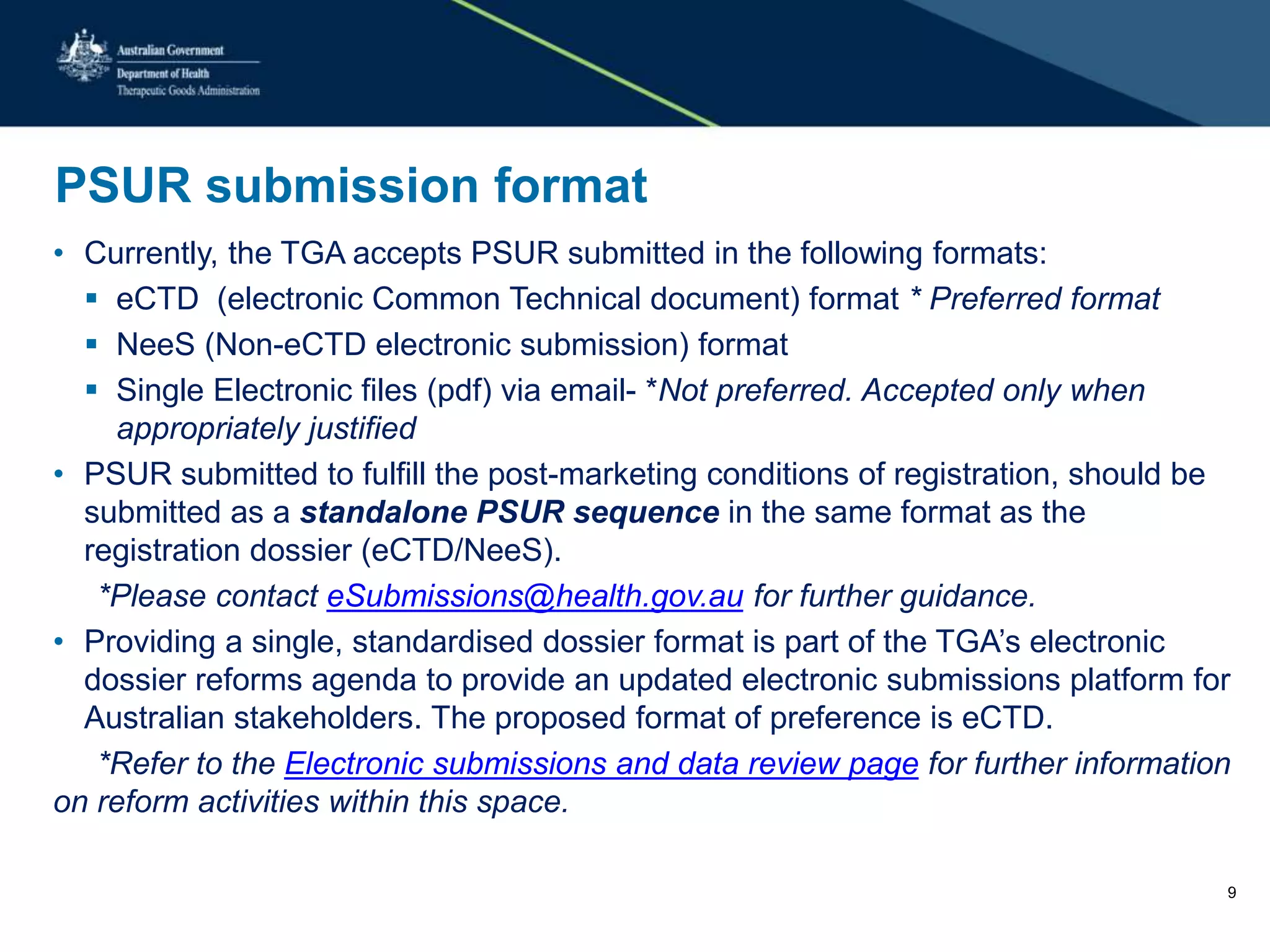
• Currently, the TGA accepts PSUR submitted in the following formats:
 eCTD (electronic Common Technical document) format * Preferred format
 NeeS (Non-eCTD electronic submission) format
 Single Electronic files (pdf) via email- *Not preferred. Accepted only when
appropriately justified
• PSUR submitted to fulfill the post-marketing conditions of registration, should be
submitted as a standalone PSUR sequence in the same format as the
registration dossier (eCTD/NeeS).
*Please contact eSubmissions@health.gov.au for further guidance.
• Providing a single, standardised dossier format is part of the TGA’s electronic
dossier reforms agenda to provide an updated electronic submissions platform for
Australian stakeholders. The proposed format of preference is eCTD.
*Refer to the Electronic submissions and data review page for further information
on reform activities within this space.
9
PSUR submission format
Time to start moving to eCTD?
Yes, please!
10
PSUR review process
11
PSUR review
The PSUR review team within the Risk Management Plan Evaluation Section tracks
and reviews all PSUR which have been submitted to fulfill the post-market
conditions of registrations.
• As with all other post-marketing safety related activities which are part of TGA’s
Enhanced Medicines Vigilance Framework, the PSURs are prioritised for review
using a risk-based approach, considering factors such as:
 How much do we know about the product and its safety profile?
 The product’s place in therapeutic strategy and phase of the product’s life
cycle.
 Nature of safety concerns associated with the product and their impact on
public health.
 What is the target population, is it changing/expanding?
 What is the context in which the medicine is used and are there safety
concerns specific to Australia?
12
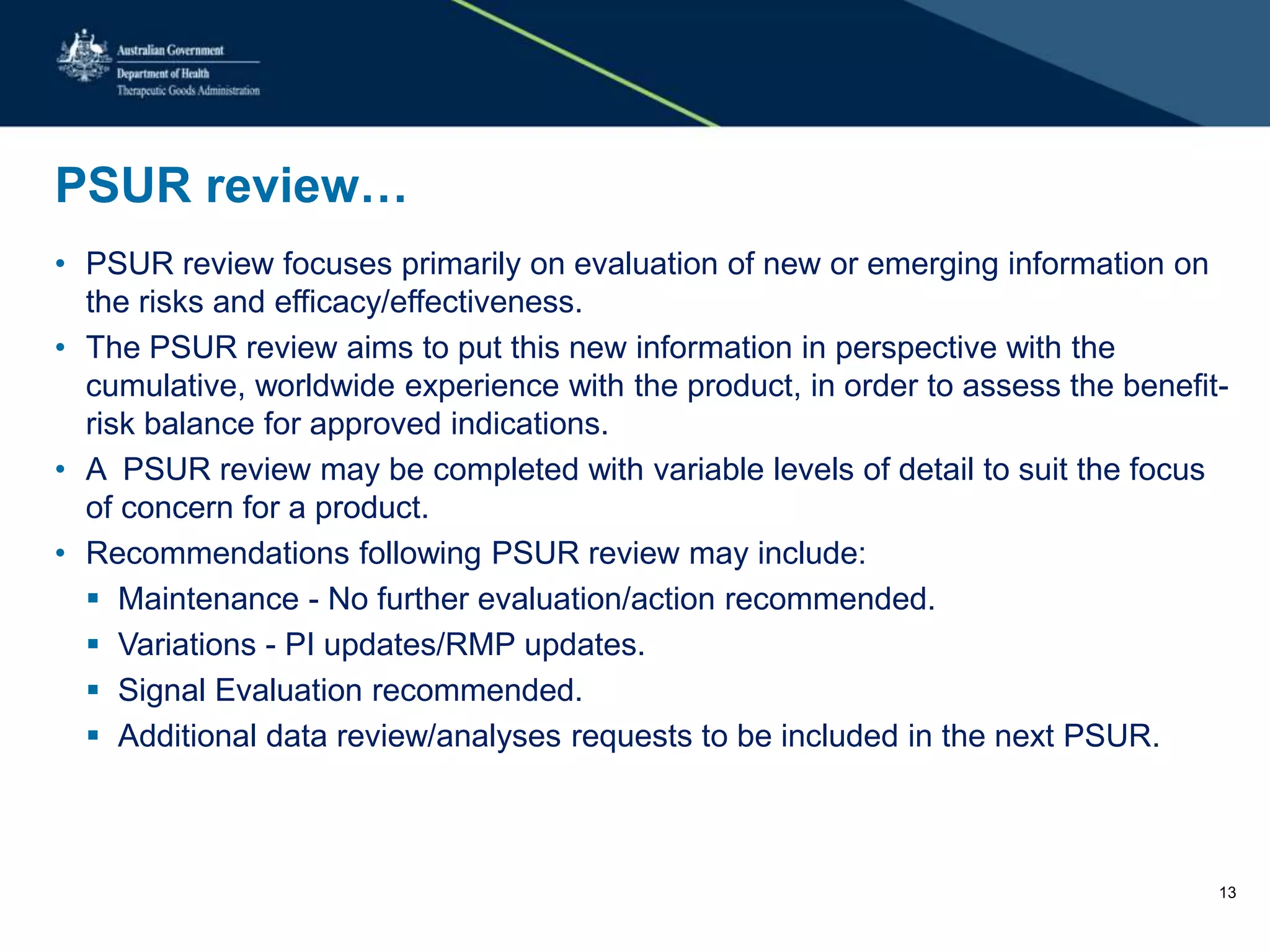
PSUR review…
• PSUR review focuses primarily on evaluation of new or emerging information on
the risks and efficacy/effectiveness.
• The PSUR review aims to put this new information in perspective with the
cumulative, worldwide experience with the product, in order to assess the benefit-
risk balance for approved indications.
• A PSUR review may be completed with variable levels of detail to suit the focus
of concern for a product.
• Recommendations following PSUR review may include:
 Maintenance - No further evaluation/action recommended.
 Variations - PI updates/RMP updates.
 Signal Evaluation recommended.
 Additional data review/analyses requests to be included in the next PSUR.
13
PSUR in the product vigilance framework
14
PSUR in the product vigilance framework
P
S
U
R
15
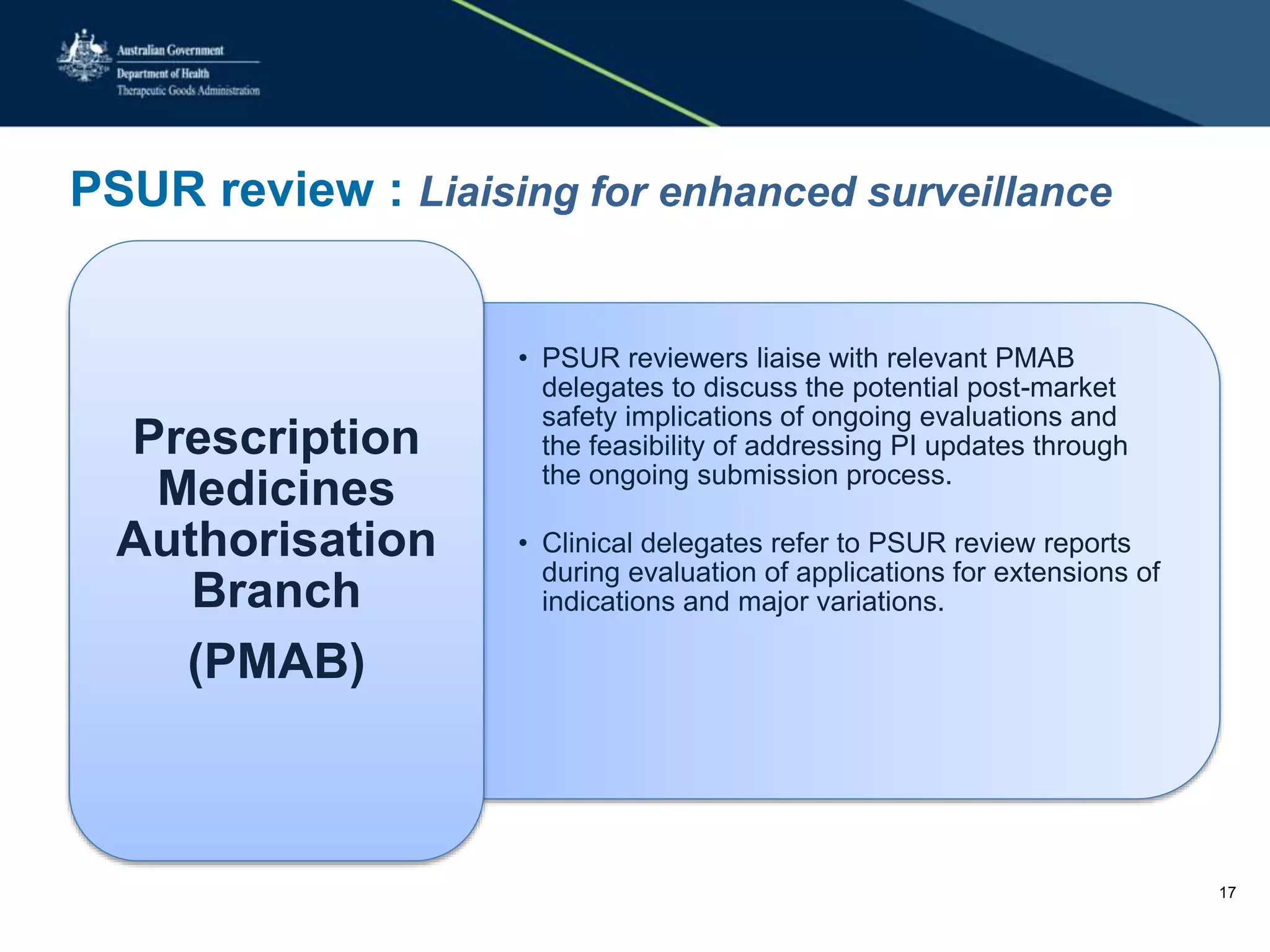
PSUR review : Liaising for enhanced surveillance
PSUR
REVIEW
PMAB
SIURMPES
16
PSUR review : Liaising for enhanced surveillance
• PSUR reviewers liaise with relevant PMAB
delegates to discuss the potential post-market
safety implications of ongoing evaluations and
the feasibility of addressing PI updates through
the ongoing submission process.
• Clinical delegates refer to PSUR review reports
during evaluation of applications for extensions of
indications and major variations.
Prescription
Medicines
Authorisation
Branch
(PMAB)
17
PSUR Review : Liaising for enhanced surveillance
• PSUR reviewers notify SIU and discuss potential
signals/safety issues identified on PSUR review.
These may be investigated further by SIU and
may warrant regulatory actions including PI
updates. Such PI updates are requested and
managed by SIU evaluators.
• SIU evaluators notify the PSUR review team of
significant safety issues and new safety signals
identified by SIU. This information has a
significant bearing on the prioritisation and review
process of current and future PSUR.
Signal
Investigation
Unit
(SIU)
18
PSUR review : Liaising for enhanced surveillance
Risk Management Plan Evaluation Section PV Inspection
-PSUR reviewers share RMP relevant
recommendations based on their review with
the RMP evaluation team.
(Example: Proposed changes to the Summary of
safety concerns, potential RMP updates ,
effectiveness of risk min activities, etc.)
-RMP evaluators identify and recommend safety
concerns to be additionally/specifically targeted
during PSUR review during RMP evaluations.
PSUR reviewers notify the PVIP team of
significant quality and/or potential compliance
issues identified during PSUR review. -The
information that PSUR reviewers in refer to the
PVIP team is then taken into account in risk-
based prioritisation for Pharmacovigilance
Inspections.
19
Communicating with Sponsors
20
What to expect as the Sponsor?
The PSUR reviewers will directly communicate with you to make the following types of
recommendations following PSUR review:
PI Update
We may recommend a PI update when:
-the safety issue or signal is identified based on
the PSUR reviews and there is sufficient evidence
within the PSUR data to warrant a PI change.
-further signal investigation by SIU is not
necessary to support the update.
Additional data/Monitoring
We may request:
-for additional safety data/signal analysis/review,
separately or within the next PSUR.
-to closely monitor and report on specific safety
topics within subsequent PSURs.
21
PI update recommendations
• If we identify a need to update the Product Information as a result of our PSUR
review, we will communicate this recommendation to you in writing.
• If you wish to provide additional information in response to our recommendation,
please ensure that you submit robust evidence in the form of additional relevant
data reviews or analysis and not simply a repetition of data reviews/analysis
already provided within the PSUR.
• Your response will be reviewed and when the PI changes are finalised, the PSUR
reviewer will request you to submit an application for an SRR (Safety Related
Request).
22
Requests for additional data/monitoring
• Based on PSUR review, we may, with a rationale, request you to closely monitor and report
on additional certain safety topics in the next PSUR along with the proposed risk
minimisation plan for the same, if necessary.
• If we disagree with your proposal to discontinue specific monitoring in the future PSURs,
then we will communicate to you regarding the recommendation to continue monitoring and
evaluation with a concise rationale for the same.
• We may also request you to provide the adequate level/quality of information and analysis
during the review when necessary.
23
What’s new for sponsors?
24
Recapitulating…
• Submitting a PSUR is not an alternative channel for notifying the TGA of a
significant safety issue and will not be considered a fulfilment of your
pharmacovigilance responsibilities as the sponsor, in this regard.
• PSUR are prioritised based on risk and regularly reviewed by the PSUR review
team of TGA.
• PI update and additional data/monitoring requests based on PSUR reviews
communicated to you directly by the PSUR reviewers.
• PSUR quality and compliance issues tracked and flagged to the PV inspection
program.
• Please submit PSURs as standalone sequences and start considering the move
to eCTD format for submissions.
• We are considering the need for further guidance for industry on PSUR.
25
THANK YOU!
26
Presentation: Periodic safety update reports

Presentation: Periodic safety update reports

  • 1.
    PSUR: The TGAApproach Dr Shabnam Sharan PSUR Evaluation Lead Risk Management Plan Evaluation Section Pharmacovigilance and Special Access Branch Australian Pharmacovigilance Regulatory Requirements and Risk Management Plans Summit 27 March 2019 Canberra
  • 2.
    What is aPSUR (or PBRER-Periodic Benefit-Risk Evaluation Report) • A Periodic Safety Update Report is a report submitted by sponsors describing the worldwide safety experience with a medicinal product at a defined time after its approval. • The PSUR is an essential component of the lifecycle benefit- risk management of a medicinal product. • The PSUR is NOT an appropriate or alternative channel for notification of Significant Safety Issues. 2
  • 3.
    PSURs at theTGA • The PSUR review process is evolving to emerge as an integral part of the TGA’s Enhanced Vigilance Framework. • This process intends to provide the necessary safety counter balance, especially to early registrations of high priority medicinal products which have a nascent safety profile at the time of approval. 3
  • 4.
    Outline • PSUR requirements •PSUR submission format • PSUR review process • PSUR in the Product Vigilance Framework • Communicating with Sponsors • What’s New? 4
  • 5.
  • 6.
    TGA requirements forPSUR • The TGA applies the requirement to submit PSUR as a condition of registration. • PSURs are not required for all registered medicines. A risk-based approach is used to determine the requirement, frequency and duration of PSUR submission • PSUR submission is always required for provisional registration products, black triangle products, biosimilars and for vaccines. • PSUR submission may be required for other products for which the TGA evaluates RMPs and on occasion in the absence of an RMP to assist in post- market safety monitoring. 6
  • 7.
    TGA requirements forPSUR… • Usually require PSUR submissions at least annually until the submitted PSURs cover a period of not less than 3 years from the date of approval. • After the end of the initial 3-year period additional PSURs may be requested if continued close monitoring of the product’s safety is warranted. New chemical & biological entities, high risk extensions of indication and major variations assessed under the Standard or Priority registration pathways • May require PSUR to be prepared but submitted only when the TGA requests them. Lower-risk extensions of indication and major variations assessed under the Standard or Priority registration pathways • Usually require PSUR submissions regularly for a period longer than the standard 3 years, to account for the provisional registration period, which may last up to 6 years. • May require more frequent PSUR submissions, for example 6- monthly. Provisionally registered medicines 7
  • 8.
  • 9.
    PSUR submission format •Currently, the TGA accepts PSUR submitted in the following formats:  eCTD (electronic Common Technical document) format * Preferred format  NeeS (Non-eCTD electronic submission) format  Single Electronic files (pdf) via email- *Not preferred. Accepted only when appropriately justified • PSUR submitted to fulfill the post-marketing conditions of registration, should be submitted as a standalone PSUR sequence in the same format as the registration dossier (eCTD/NeeS). *Please contact eSubmissions@health.gov.au for further guidance. • Providing a single, standardised dossier format is part of the TGA’s electronic dossier reforms agenda to provide an updated electronic submissions platform for Australian stakeholders. The proposed format of preference is eCTD. *Refer to the Electronic submissions and data review page for further information on reform activities within this space. 9
  • 10.
    PSUR submission format Timeto start moving to eCTD? Yes, please! 10
  • 11.
  • 12.
    PSUR review The PSURreview team within the Risk Management Plan Evaluation Section tracks and reviews all PSUR which have been submitted to fulfill the post-market conditions of registrations. • As with all other post-marketing safety related activities which are part of TGA’s Enhanced Medicines Vigilance Framework, the PSURs are prioritised for review using a risk-based approach, considering factors such as:  How much do we know about the product and its safety profile?  The product’s place in therapeutic strategy and phase of the product’s life cycle.  Nature of safety concerns associated with the product and their impact on public health.  What is the target population, is it changing/expanding?  What is the context in which the medicine is used and are there safety concerns specific to Australia? 12
  • 13.
    PSUR review… • PSURreview focuses primarily on evaluation of new or emerging information on the risks and efficacy/effectiveness. • The PSUR review aims to put this new information in perspective with the cumulative, worldwide experience with the product, in order to assess the benefit- risk balance for approved indications. • A PSUR review may be completed with variable levels of detail to suit the focus of concern for a product. • Recommendations following PSUR review may include:  Maintenance - No further evaluation/action recommended.  Variations - PI updates/RMP updates.  Signal Evaluation recommended.  Additional data review/analyses requests to be included in the next PSUR. 13
  • 14.
    PSUR in theproduct vigilance framework 14
  • 15.
    PSUR in theproduct vigilance framework P S U R 15
  • 16.
    PSUR review :Liaising for enhanced surveillance PSUR REVIEW PMAB SIURMPES 16
  • 17.
    PSUR review :Liaising for enhanced surveillance • PSUR reviewers liaise with relevant PMAB delegates to discuss the potential post-market safety implications of ongoing evaluations and the feasibility of addressing PI updates through the ongoing submission process. • Clinical delegates refer to PSUR review reports during evaluation of applications for extensions of indications and major variations. Prescription Medicines Authorisation Branch (PMAB) 17
  • 18.
    PSUR Review :Liaising for enhanced surveillance • PSUR reviewers notify SIU and discuss potential signals/safety issues identified on PSUR review. These may be investigated further by SIU and may warrant regulatory actions including PI updates. Such PI updates are requested and managed by SIU evaluators. • SIU evaluators notify the PSUR review team of significant safety issues and new safety signals identified by SIU. This information has a significant bearing on the prioritisation and review process of current and future PSUR. Signal Investigation Unit (SIU) 18
  • 19.
    PSUR review :Liaising for enhanced surveillance Risk Management Plan Evaluation Section PV Inspection -PSUR reviewers share RMP relevant recommendations based on their review with the RMP evaluation team. (Example: Proposed changes to the Summary of safety concerns, potential RMP updates , effectiveness of risk min activities, etc.) -RMP evaluators identify and recommend safety concerns to be additionally/specifically targeted during PSUR review during RMP evaluations. PSUR reviewers notify the PVIP team of significant quality and/or potential compliance issues identified during PSUR review. -The information that PSUR reviewers in refer to the PVIP team is then taken into account in risk- based prioritisation for Pharmacovigilance Inspections. 19
  • 20.
  • 21.
    What to expectas the Sponsor? The PSUR reviewers will directly communicate with you to make the following types of recommendations following PSUR review: PI Update We may recommend a PI update when: -the safety issue or signal is identified based on the PSUR reviews and there is sufficient evidence within the PSUR data to warrant a PI change. -further signal investigation by SIU is not necessary to support the update. Additional data/Monitoring We may request: -for additional safety data/signal analysis/review, separately or within the next PSUR. -to closely monitor and report on specific safety topics within subsequent PSURs. 21
  • 22.
    PI update recommendations •If we identify a need to update the Product Information as a result of our PSUR review, we will communicate this recommendation to you in writing. • If you wish to provide additional information in response to our recommendation, please ensure that you submit robust evidence in the form of additional relevant data reviews or analysis and not simply a repetition of data reviews/analysis already provided within the PSUR. • Your response will be reviewed and when the PI changes are finalised, the PSUR reviewer will request you to submit an application for an SRR (Safety Related Request). 22
  • 23.
    Requests for additionaldata/monitoring • Based on PSUR review, we may, with a rationale, request you to closely monitor and report on additional certain safety topics in the next PSUR along with the proposed risk minimisation plan for the same, if necessary. • If we disagree with your proposal to discontinue specific monitoring in the future PSURs, then we will communicate to you regarding the recommendation to continue monitoring and evaluation with a concise rationale for the same. • We may also request you to provide the adequate level/quality of information and analysis during the review when necessary. 23
  • 24.
    What’s new forsponsors? 24
  • 25.
    Recapitulating… • Submitting aPSUR is not an alternative channel for notifying the TGA of a significant safety issue and will not be considered a fulfilment of your pharmacovigilance responsibilities as the sponsor, in this regard. • PSUR are prioritised based on risk and regularly reviewed by the PSUR review team of TGA. • PI update and additional data/monitoring requests based on PSUR reviews communicated to you directly by the PSUR reviewers. • PSUR quality and compliance issues tracked and flagged to the PV inspection program. • Please submit PSURs as standalone sequences and start considering the move to eCTD format for submissions. • We are considering the need for further guidance for industry on PSUR. 25
  • 26.

Editor's Notes

  • #17 The PSUR review process is closely integrated with the all post-marketing safety related activities which are part of TGA’s Enhanced Medicines Vigilance Framework, mainly Signals Investigation, PMAB, RMP evaluation and the PV inspection program. Significant safety findings from each PSUR review are communicated to other relevant areas of TGA so that any required regulatory action can be coordinated. The PSUR review reports are maintained within TGA records management system and are accessible to TGA staff at any time.