
Alaa Fadhel Hassan (MSc. Pharmacology)
Al-Mahmoudiya General Hospital
Pharmacovigilance (PV) is defined as the science and
activities relating to the detection, assessment,
understanding and prevention of adverse effects or any other
drug-related problem.
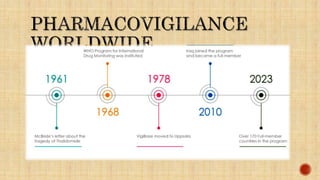
WHO established its program for International Drug
Monitoring (PIDM) in response to the thalidomide disaster
detected in 1961. Later with WHO Collaborating Centre for
International Drug Monitoring, Uppsala; promotes PV at the
country level. At July 2022, 170 countries were part of the
program.
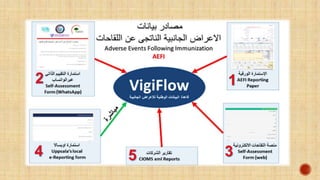
VigiBase® is the WHO global database of individual case
safety reports (ICSRs), that’s developed and maintained by
the Uppsala Monitoring Centre (UMC) on behalf of WHO
and its member countries. It consists of reports of adverse
drug reactions to medicines and vaccines received from
member countries since 1968. It is updated with incoming
case reports continuously.
Vigiflow® is a web-based ICSR management system that
is available for use by national pharmacovigilance centers.
It supports the collection, processing, and sharing of data
of ICSRs to facilitate effective data analysis.
 The Iraqi Pharmacovigilance center (IPhvC) has been
established at 2010, as part of the directorate of technical
affairs, Ministry of Health, when Iraq has been a full member
of the WHO drug monitoring program.
 It is mission: the collection and evaluation of information
on pharmaceutical products in Iraq with particular
reference to adverse reactions ADRs-(serious), decrease or
lack of effectiveness &/any medication errors, data analysis
and signals detection of both previously known and
unidentified ADRs, assessment of the drug reaction risk versus
its benefit, Communicating safety information to health
professionals and end-users & monitoring and measuring the
action impact.
IPhvC decisions could be locally made on whether changes
in the use of a medicine are needed, including:
product label change.
product withdrawal/ suspension.
dear healthcare professional letters & press statements.
medicines safety alerts & educational programs.
product restrictions (up-scheduling, limited packaging,
limiting prescribers, administerers, patient groups, etc.)
Response to a medicinal product that is noxious and
unintended, means that a causal relationship between a
medicinal product and an adverse event is at least a
reasonable possibility.
Adverse reactions may arise from the use of the product
within or outside the terms of the marketing authorization
or from occupational exposure, ex. (off-label use, overdose,
misuse, abuse, and medication error).
 Type A: augmented pharmacologic effects - dose dependent and
predictable (medicine actions).
 Type B: bizarre effects (idiosyncratic) - dose independent and
unpredictable (Patient reactions), characteristically occur in only a
minority of patients and display little or no dose relationship.
 Type C: chronic effects refer to situations where the use of a
medicine, often for unknown reasons, increases the frequency of a
"spontaneous" disease. They may be both serious and common (and
include malignant tumors).
 Type D: delayed effects (dose independent), carcinogenicity (e.g.,
immunosuppressants) & teratogenicity (e.g., fetal hydantoin syndrome).
 Type E: end-of-treatment effects & Type F: failure of therapy.
 Enhance pt. Rational, careful and safe use of all medical and
paramedical interventions.
 Support public health programs.
 Reduction of medicine-related problems leading to better treatment
outcomes (detection, assessment and communication of the risks and
benefits of drugs and communicate the findings in a timely manner),
that lead to the prevention of harm, maximization of benefits, &
understanding other issues that result of circumstances around drug use,
like: medication errors, healthcare system-related errors, quality defects,
substandard and falsified drugs.
 Improving patient confidence in professional practice, satisfaction for the
fulfillment of a moral and professional obligation.
 Access to feedback information on medicine-related reported problems.
ADRs have been shown to rank among the top 10
leading causes of mortality in some countries despite
the fact that most of the ADRs are preventable.
Suitable services to treat ADRs impose a high
financial burden on health care due to the hospital
care of patients with drug related problems.
Safety and efficacy surveillance of medicines has not
received the required attention.
 All health care professionals/workers, including clinicians, pharmacists,
dentists, nurses, traditional medicine practitioners.
 Marketing authorization holder, being primarily responsible for the
safety of their products, they are obligated to report serious adverse
drug reactions they receive about their Products to IPhvV. While the
Non-serious ADRs should be included in the periodic safety update
report.
 Consumers
 The adverse drug reaction report does not constitute an admission
that you or any other health professional or the drug contributed to
or caused the event in any way.
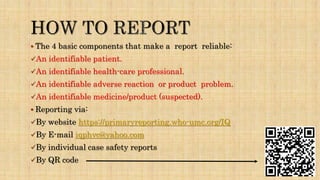
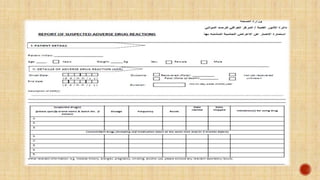
 The 4 basic components that make a report reliable:
An identifiable patient.
An identifiable health-care professional.
An identifiable adverse reaction or product problem.
An identifiable medicine/product (suspected).
 Reporting via:
By website https://primaryreporting.who-umc.org/IQ
By E-mail iqphvc@yahoo.com
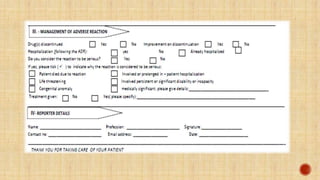
By individual case safety reports
By QR code
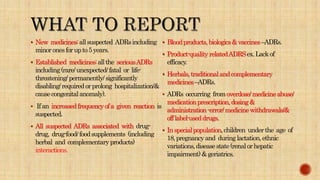
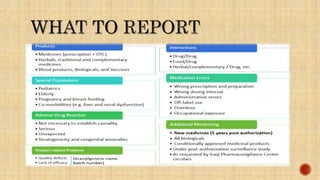
 New medicines:allsuspected ADRsincluding
minoronesforupto5years.
 Established medicines:allthe seriousADRs
including(rare/unexpected/fatal or life-
threatening/permanently/significantly
disabling/requiredorprolong hospitalization/&
causecongenitalanomaly).
 Ifan increasedfrequencyofa given reaction is
suspected.
 All suspected ADRs associated with drug-
drug, drug-food/foodsupplements (including
herbal and complementaryproducts)
interactions.
 Bloodproducts,biologics&vaccines–ADRs.
 Product-qualityrelatedADRSex.Lackof
efficacy.
 Herbals,traditionalandcomplementary
medicines–ADRs.
 ADRs occurring fromoverdose/medicineabuse/
medicationprescription,dosing&
administration-error/medicinewithdrawals/&
offlabel-useddrugs.
 Inspecialpopulation,children underthe age of
18,pregnancyand duringlactation,ethnic
variations,diseasestate(renalorhepatic
impairment)&geriatrics.
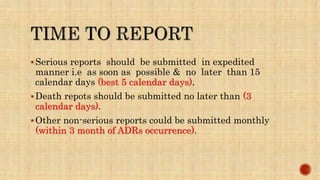
Serious reports should be submitted in expedited
manner i.e as soon as possible & no later than 15
calendar days (best 5 calendar days).
Death repots should be submitted no later than (3
calendar days).
Other non-serious reports could be submitted monthly
(within 3 month of ADRs occurrence).
 Reports are entered into the national database of ADRs and be analyzed
by expert reviewers regularly, so that validated ADRs reports be
uploaded to the global VigiBase® database, Uppsala Monitoring Center
(UMC).
 Well - completed and duly submitted ADR reported by you may
result in IPhvC regulatory decisions, national alert-warning & various
harm prevention activities.
 Report details’ are stored in a confidential database at the Iraqi
pharmacovigilance center [only & exclusively].
 Before any information on a specific adverse drug reaction is utilized or
communicated, the identities of the patient, the reporter, and any other
medical professionals listed on a report will be omitted.
 The ADR report will not be attributed to the reporter and will not imply
that the reporter or any other healthcare practitioner played a part in it in
any manner.
https://vigiflow.who-umc.org/
EX. OF OUR WORK
SO WHEN YOU SEE ADR
TELL ME
CALL ME
SEND EMAIL
WHENEVER YOU CAN
 WORLD HEALTH ORGANIZATION WEBSITE, ESSENTIAL MEDICINES AND HEALTH
PRODUCTS. LINK:
HTTPS://WWW.WHO.INT/MEDICINES/AREAS/QUALITY_SAFETY/SAFETY_EFFICACY/PHARMVI
GI/EN/
 IRAQI MINISTRY OF HEALTH, GUIDELINES FOR THE IRAQI PHARMACOVIGILANCE
SYSTEM (IPHVC) INDIV IDUAL CASE SAFTEY REPORT (ICSR) FOR HELTH CARE
PROFESSIONALS. 1ST EDITION 2012.
 IRAQI MINISTRY OF HEALTH, DIRECTORATE OF TECHNICAL AFFAIRS, PHARMACY
DEPARTMENT, IRAQI PHARMACOVIGILANCE CENTRE. INDIVIDUAL CASE SAFTEY REPORT
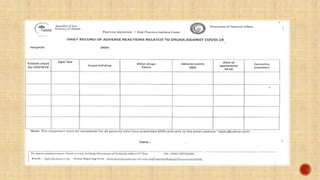
 IRAQI MINISTRY OF HEALTH, DIRECTORATE OF TECHNICAL AFFAIRS, PHARMACY
DEPARTMENT, IRAQI PHARMACOVIGILANCE CENTRE. DAILY RECORDS OF ADVERSE
REACTIONS RELATED TO DRUGS AGAINST COVID-19 REPORTS
 IRAQI MINISTRY OF HEALTH, DIRECTORATE OF TECHNICAL AFFAIRS, PHARMACY
DEPARTMENT, IRAQI PHARMACOVIGILANCE CENTRE. ADVERSE EVENTS AFTER
IMMUNIZATION REPORTS
 IRAQI MINISTRY OF HEALTH, DIRECTORATE OF TECHNICAL AFFAIRS, PHARMACY
DEPARTMENT, IRAQI PHARMACOVIGILANCE CENTRE. ADVERSE EVENTS FOLLOWING
IMMUNIZATION AEFI [PRESENTATION] 2021
 IRAQI MINISTRY OF HEALTH, DIRECTORATE OF TECHNICAL AFFAIRS, PHARMACY
DEPARTMENT, IRAQI PHARMACOVIGILANCE CENTRE. IRAQI PHARMACOVIGILANCE
GUIDELINES FOR HEALTHCARE PROFESSIONALS. EDITION 2024

IQ Pharmacovigilance system (updated).pptx

  • 1.
    Alaa Fadhel Hassan(MSc. Pharmacology) Al-Mahmoudiya General Hospital
  • 2.
    Pharmacovigilance (PV) isdefined as the science and activities relating to the detection, assessment, understanding and prevention of adverse effects or any other drug-related problem. WHO established its program for International Drug Monitoring (PIDM) in response to the thalidomide disaster detected in 1961. Later with WHO Collaborating Centre for International Drug Monitoring, Uppsala; promotes PV at the country level. At July 2022, 170 countries were part of the program.
  • 3.
    VigiBase® is theWHO global database of individual case safety reports (ICSRs), that’s developed and maintained by the Uppsala Monitoring Centre (UMC) on behalf of WHO and its member countries. It consists of reports of adverse drug reactions to medicines and vaccines received from member countries since 1968. It is updated with incoming case reports continuously. Vigiflow® is a web-based ICSR management system that is available for use by national pharmacovigilance centers. It supports the collection, processing, and sharing of data of ICSRs to facilitate effective data analysis.
  • 5.
     The IraqiPharmacovigilance center (IPhvC) has been established at 2010, as part of the directorate of technical affairs, Ministry of Health, when Iraq has been a full member of the WHO drug monitoring program.  It is mission: the collection and evaluation of information on pharmaceutical products in Iraq with particular reference to adverse reactions ADRs-(serious), decrease or lack of effectiveness &/any medication errors, data analysis and signals detection of both previously known and unidentified ADRs, assessment of the drug reaction risk versus its benefit, Communicating safety information to health professionals and end-users & monitoring and measuring the action impact.
  • 6.
    IPhvC decisions couldbe locally made on whether changes in the use of a medicine are needed, including: product label change. product withdrawal/ suspension. dear healthcare professional letters & press statements. medicines safety alerts & educational programs. product restrictions (up-scheduling, limited packaging, limiting prescribers, administerers, patient groups, etc.)
  • 7.
    Response to amedicinal product that is noxious and unintended, means that a causal relationship between a medicinal product and an adverse event is at least a reasonable possibility. Adverse reactions may arise from the use of the product within or outside the terms of the marketing authorization or from occupational exposure, ex. (off-label use, overdose, misuse, abuse, and medication error).
  • 8.
     Type A:augmented pharmacologic effects - dose dependent and predictable (medicine actions).  Type B: bizarre effects (idiosyncratic) - dose independent and unpredictable (Patient reactions), characteristically occur in only a minority of patients and display little or no dose relationship.  Type C: chronic effects refer to situations where the use of a medicine, often for unknown reasons, increases the frequency of a "spontaneous" disease. They may be both serious and common (and include malignant tumors).  Type D: delayed effects (dose independent), carcinogenicity (e.g., immunosuppressants) & teratogenicity (e.g., fetal hydantoin syndrome).  Type E: end-of-treatment effects & Type F: failure of therapy.
  • 9.
     Enhance pt.Rational, careful and safe use of all medical and paramedical interventions.  Support public health programs.  Reduction of medicine-related problems leading to better treatment outcomes (detection, assessment and communication of the risks and benefits of drugs and communicate the findings in a timely manner), that lead to the prevention of harm, maximization of benefits, & understanding other issues that result of circumstances around drug use, like: medication errors, healthcare system-related errors, quality defects, substandard and falsified drugs.  Improving patient confidence in professional practice, satisfaction for the fulfillment of a moral and professional obligation.  Access to feedback information on medicine-related reported problems.
  • 10.
    ADRs have beenshown to rank among the top 10 leading causes of mortality in some countries despite the fact that most of the ADRs are preventable. Suitable services to treat ADRs impose a high financial burden on health care due to the hospital care of patients with drug related problems. Safety and efficacy surveillance of medicines has not received the required attention.
  • 12.
     All healthcare professionals/workers, including clinicians, pharmacists, dentists, nurses, traditional medicine practitioners.  Marketing authorization holder, being primarily responsible for the safety of their products, they are obligated to report serious adverse drug reactions they receive about their Products to IPhvV. While the Non-serious ADRs should be included in the periodic safety update report.  Consumers  The adverse drug reaction report does not constitute an admission that you or any other health professional or the drug contributed to or caused the event in any way.
  • 13.
     The 4basic components that make a report reliable: An identifiable patient. An identifiable health-care professional. An identifiable adverse reaction or product problem. An identifiable medicine/product (suspected).  Reporting via: By website https://primaryreporting.who-umc.org/IQ By E-mail iqphvc@yahoo.com By individual case safety reports By QR code
  • 14.
     New medicines:allsuspectedADRsincluding minoronesforupto5years.  Established medicines:allthe seriousADRs including(rare/unexpected/fatal or life- threatening/permanently/significantly disabling/requiredorprolong hospitalization/& causecongenitalanomaly).  Ifan increasedfrequencyofa given reaction is suspected.  All suspected ADRs associated with drug- drug, drug-food/foodsupplements (including herbal and complementaryproducts) interactions.  Bloodproducts,biologics&vaccines–ADRs.  Product-qualityrelatedADRSex.Lackof efficacy.  Herbals,traditionalandcomplementary medicines–ADRs.  ADRs occurring fromoverdose/medicineabuse/ medicationprescription,dosing& administration-error/medicinewithdrawals/& offlabel-useddrugs.  Inspecialpopulation,children underthe age of 18,pregnancyand duringlactation,ethnic variations,diseasestate(renalorhepatic impairment)&geriatrics.
  • 16.
    Serious reports shouldbe submitted in expedited manner i.e as soon as possible & no later than 15 calendar days (best 5 calendar days). Death repots should be submitted no later than (3 calendar days). Other non-serious reports could be submitted monthly (within 3 month of ADRs occurrence).
  • 23.
     Reports areentered into the national database of ADRs and be analyzed by expert reviewers regularly, so that validated ADRs reports be uploaded to the global VigiBase® database, Uppsala Monitoring Center (UMC).  Well - completed and duly submitted ADR reported by you may result in IPhvC regulatory decisions, national alert-warning & various harm prevention activities.  Report details’ are stored in a confidential database at the Iraqi pharmacovigilance center [only & exclusively].  Before any information on a specific adverse drug reaction is utilized or communicated, the identities of the patient, the reporter, and any other medical professionals listed on a report will be omitted.  The ADR report will not be attributed to the reporter and will not imply that the reporter or any other healthcare practitioner played a part in it in any manner.
  • 24.
  • 25.
  • 26.
    SO WHEN YOUSEE ADR TELL ME CALL ME SEND EMAIL WHENEVER YOU CAN
  • 27.
     WORLD HEALTHORGANIZATION WEBSITE, ESSENTIAL MEDICINES AND HEALTH PRODUCTS. LINK: HTTPS://WWW.WHO.INT/MEDICINES/AREAS/QUALITY_SAFETY/SAFETY_EFFICACY/PHARMVI GI/EN/  IRAQI MINISTRY OF HEALTH, GUIDELINES FOR THE IRAQI PHARMACOVIGILANCE SYSTEM (IPHVC) INDIV IDUAL CASE SAFTEY REPORT (ICSR) FOR HELTH CARE PROFESSIONALS. 1ST EDITION 2012.  IRAQI MINISTRY OF HEALTH, DIRECTORATE OF TECHNICAL AFFAIRS, PHARMACY DEPARTMENT, IRAQI PHARMACOVIGILANCE CENTRE. INDIVIDUAL CASE SAFTEY REPORT  IRAQI MINISTRY OF HEALTH, DIRECTORATE OF TECHNICAL AFFAIRS, PHARMACY DEPARTMENT, IRAQI PHARMACOVIGILANCE CENTRE. DAILY RECORDS OF ADVERSE REACTIONS RELATED TO DRUGS AGAINST COVID-19 REPORTS  IRAQI MINISTRY OF HEALTH, DIRECTORATE OF TECHNICAL AFFAIRS, PHARMACY DEPARTMENT, IRAQI PHARMACOVIGILANCE CENTRE. ADVERSE EVENTS AFTER IMMUNIZATION REPORTS  IRAQI MINISTRY OF HEALTH, DIRECTORATE OF TECHNICAL AFFAIRS, PHARMACY DEPARTMENT, IRAQI PHARMACOVIGILANCE CENTRE. ADVERSE EVENTS FOLLOWING IMMUNIZATION AEFI [PRESENTATION] 2021  IRAQI MINISTRY OF HEALTH, DIRECTORATE OF TECHNICAL AFFAIRS, PHARMACY DEPARTMENT, IRAQI PHARMACOVIGILANCE CENTRE. IRAQI PHARMACOVIGILANCE GUIDELINES FOR HEALTHCARE PROFESSIONALS. EDITION 2024