SPONTANEOUS REPORTING
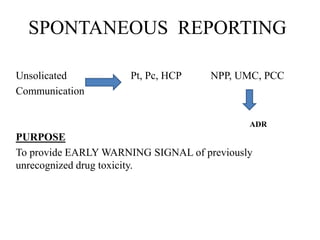
Unsolicated Pt, Pc, HCP NPP, UMC, PCC
Communication
PURPOSE
To provide EARLY WARNING SIGNAL of previously
unrecognized drug toxicity.
ADR
SPONTANEOUS REPORTING
SCHEME
 Health professional who are willing to
participate
 Simplicity in submission of report
 Prompt entry of reports onto a data base
 Follow up of serious reports
 Analytical tools detect signals
 Process for dealing with the signals
 Feed back of reporters
Pros
1.Covers the whole population Includes all
medicines
2.Continual monitoring throughout life- cycle of a
medicine
3.Detects signals of new, rare or serious ADRs
4.Most commonly used method & Easiest method
to establish
5.Relatively inexpensive
Cons
 Inherent under-reporting
 Captures only suspected ADRs
 Reporting bias-e.g. Seriousness, severity New
medicine. Advertising of product, Publicity of
specific ADR
 Difficult to detect delayed ADRs & ADRs
with high background incidence
Case series
A series of case-reports can deliver signs of an
association between a medicine and an adverse
event, but they are normally more valuable for
producing theories than for confirming a
relationship between medicine exposure and
outcome.
ACTIVE SURVEILLANCE
It pursues to determine the particular number
of adverse events through a constant pre-
organized process.
Method :- Follow up of pt who treated with a
drug is important.
Pt who fill prescription for a drug may be
asked to fill or complete a survey & give
permission to contact later.
SENTINEL SITES
 Sentinel- an indicator of the presence of disease.
 Active surveillance can be attained by revising
medical records or questioning patients and/or
physicians in a section of sentinel sites to
guarantee that comprehensive and precise data
on reported adverse events are collected from
these sites.
LIMITATIONS
 Small no.of patient
 augmented cost
DRUG EVENT REPORTING
i) Medicine event monitoring
 This is a process of active Pharmacovigilance surveillance.
 Studies using this process are cohort-based and prospective and
observational.
 For medication event monitoring, patients can be acknowledged from
electronic or automated health insurance claims.
 A single prescription or a series might be composed over the period of
monitoring.
 A follow-up questionnaire can then be sent to each prescribing physician
or patient at pre-specified intervals to acquire outcome data.
 Requests for data on patient demographics, indication for treatment,
duration of therapy, dosage, clinical events, reasons for termination
and applicable past history can be involved in the questionnaires.
 Limitations- the poor physician and patient reply rates.
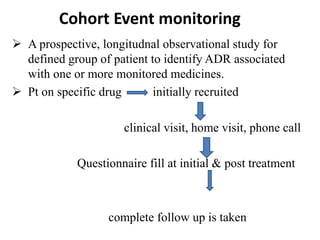
Cohort Event monitoring
 A prospective, longitudnal observational study for
defined group of patient to identify ADR associated
with one or more monitored medicines.
 Pt on specific drug initially recruited
clinical visit, home visit, phone call
Questionnaire fill at initial & post treatment
complete follow up is taken
 It records all clinical even not just suspected .
PROS
 Early detection of signals of unsuspected ADR
 Near complete profile of AE/ADR for medicine
of interest.
 Assessment of risk & identification of risk
factors.
 Drug comparision
 Preganancy outcome
 Death recorded
Cohort Event monitoring
CONS
 More labour intensive than SR
 More costly
 New to health professionals & PV centres.
 Training requires.
Registries
 A registry is a list of patients presenting with the identical
representative(s).
 This representative can be a disease (disease registry) or a
specific exposure (medicine registry).
 Disease registries, such as registries for blood dyscrasias, severe
cutaneous reactions, or congenital malformations can help to
gather data on medicine exposure and other factors related to a
clinical condition.
 Exposure (medicine) registries address populations exposed to
the medicines of interest to govern if a medicine has a distinct
influence on this group of patients. Some exposure (medicine)
registries address drug exposures in specific populations, such
as pregnant women.
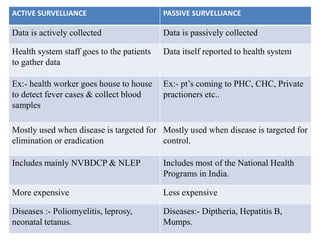
ACTIVE SURVELLIANCE PASSIVE SURVELLIANCE
Data is actively collected Data is passively collected
Health system staff goes to the patients
to gather data
Data itself reported to health system
Ex:- health worker goes house to house
to detect fever cases & collect blood
samples
Ex:- pt’s coming to PHC, CHC, Private
practioners etc..
Mostly used when disease is targeted for
elimination or eradication
Mostly used when disease is targeted for
control.
Includes mainly NVBDCP & NLEP Includes most of the National Health
Programs in India.
More expensive Less expensive
Diseases :- Poliomyelitis, leprosy,
neonatal tetanus.
Diseases:- Diptheria, Hepatitis B,
Mumps.
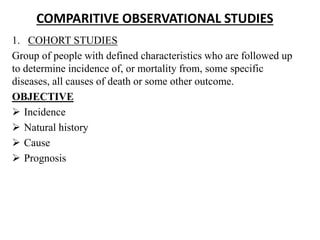
COMPARITIVE OBSERVATIONAL STUDIES
1. COHORT STUDIES
Group of people with defined characteristics who are followed up
to determine incidence of, or mortality from, some specific
diseases, all causes of death or some other outcome.
OBJECTIVE
 Incidence
 Natural history
 Cause
 Prognosis
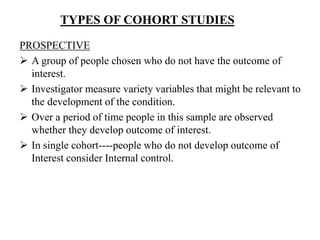
TYPES OF COHORT STUDIES
PROSPECTIVE
 A group of people chosen who do not have the outcome of
interest.
 Investigator measure variety variables that might be relevant to
the development of the condition.
 Over a period of time people in this sample are observed
whether they develop outcome of interest.
 In single cohort----people who do not develop outcome of
Interest consider Internal control.
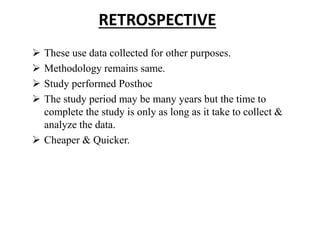
RETROSPECTIVE
 These use data collected for other purposes.
 Methodology remains same.
 Study performed Posthoc
 The study period may be many years but the time to
complete the study is only as long as it take to collect &
analyze the data.
 Cheaper & Quicker.
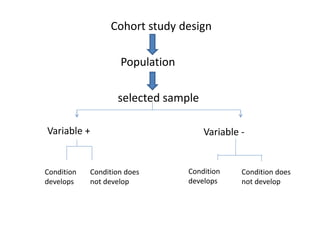
Cohort study design
Population
selected sample
Variable + Variable -
Condition
develops
Condition does
not develop
Condition
develops
Condition does
not develop
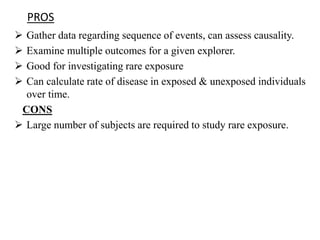
PROS
 Gather data regarding sequence of events, can assess causality.
 Examine multiple outcomes for a given explorer.
 Good for investigating rare exposure
 Can calculate rate of disease in exposed & unexposed individuals
over time.
CONS
 Large number of subjects are required to study rare exposure.
Post marketing surveillance informations

Post marketing surveillance informations

  • 2.
    SPONTANEOUS REPORTING Unsolicated Pt,Pc, HCP NPP, UMC, PCC Communication PURPOSE To provide EARLY WARNING SIGNAL of previously unrecognized drug toxicity. ADR
  • 3.
    SPONTANEOUS REPORTING SCHEME  Healthprofessional who are willing to participate  Simplicity in submission of report  Prompt entry of reports onto a data base  Follow up of serious reports  Analytical tools detect signals  Process for dealing with the signals  Feed back of reporters
  • 4.
    Pros 1.Covers the wholepopulation Includes all medicines 2.Continual monitoring throughout life- cycle of a medicine 3.Detects signals of new, rare or serious ADRs 4.Most commonly used method & Easiest method to establish 5.Relatively inexpensive
  • 5.
    Cons  Inherent under-reporting Captures only suspected ADRs  Reporting bias-e.g. Seriousness, severity New medicine. Advertising of product, Publicity of specific ADR  Difficult to detect delayed ADRs & ADRs with high background incidence
  • 6.
    Case series A seriesof case-reports can deliver signs of an association between a medicine and an adverse event, but they are normally more valuable for producing theories than for confirming a relationship between medicine exposure and outcome.
  • 7.
    ACTIVE SURVEILLANCE It pursuesto determine the particular number of adverse events through a constant pre- organized process. Method :- Follow up of pt who treated with a drug is important. Pt who fill prescription for a drug may be asked to fill or complete a survey & give permission to contact later.
  • 8.
    SENTINEL SITES  Sentinel-an indicator of the presence of disease.  Active surveillance can be attained by revising medical records or questioning patients and/or physicians in a section of sentinel sites to guarantee that comprehensive and precise data on reported adverse events are collected from these sites. LIMITATIONS  Small no.of patient  augmented cost
  • 9.
    DRUG EVENT REPORTING i)Medicine event monitoring  This is a process of active Pharmacovigilance surveillance.  Studies using this process are cohort-based and prospective and observational.  For medication event monitoring, patients can be acknowledged from electronic or automated health insurance claims.  A single prescription or a series might be composed over the period of monitoring.  A follow-up questionnaire can then be sent to each prescribing physician or patient at pre-specified intervals to acquire outcome data.  Requests for data on patient demographics, indication for treatment, duration of therapy, dosage, clinical events, reasons for termination and applicable past history can be involved in the questionnaires.  Limitations- the poor physician and patient reply rates.
  • 10.
    Cohort Event monitoring A prospective, longitudnal observational study for defined group of patient to identify ADR associated with one or more monitored medicines.  Pt on specific drug initially recruited clinical visit, home visit, phone call Questionnaire fill at initial & post treatment complete follow up is taken
  • 11.
     It recordsall clinical even not just suspected . PROS  Early detection of signals of unsuspected ADR  Near complete profile of AE/ADR for medicine of interest.  Assessment of risk & identification of risk factors.  Drug comparision  Preganancy outcome  Death recorded
  • 12.
    Cohort Event monitoring CONS More labour intensive than SR  More costly  New to health professionals & PV centres.  Training requires.
  • 13.
    Registries  A registryis a list of patients presenting with the identical representative(s).  This representative can be a disease (disease registry) or a specific exposure (medicine registry).  Disease registries, such as registries for blood dyscrasias, severe cutaneous reactions, or congenital malformations can help to gather data on medicine exposure and other factors related to a clinical condition.  Exposure (medicine) registries address populations exposed to the medicines of interest to govern if a medicine has a distinct influence on this group of patients. Some exposure (medicine) registries address drug exposures in specific populations, such as pregnant women.
  • 14.
    ACTIVE SURVELLIANCE PASSIVESURVELLIANCE Data is actively collected Data is passively collected Health system staff goes to the patients to gather data Data itself reported to health system Ex:- health worker goes house to house to detect fever cases & collect blood samples Ex:- pt’s coming to PHC, CHC, Private practioners etc.. Mostly used when disease is targeted for elimination or eradication Mostly used when disease is targeted for control. Includes mainly NVBDCP & NLEP Includes most of the National Health Programs in India. More expensive Less expensive Diseases :- Poliomyelitis, leprosy, neonatal tetanus. Diseases:- Diptheria, Hepatitis B, Mumps.
  • 15.
    COMPARITIVE OBSERVATIONAL STUDIES 1.COHORT STUDIES Group of people with defined characteristics who are followed up to determine incidence of, or mortality from, some specific diseases, all causes of death or some other outcome. OBJECTIVE  Incidence  Natural history  Cause  Prognosis
  • 16.
    TYPES OF COHORTSTUDIES PROSPECTIVE  A group of people chosen who do not have the outcome of interest.  Investigator measure variety variables that might be relevant to the development of the condition.  Over a period of time people in this sample are observed whether they develop outcome of interest.  In single cohort----people who do not develop outcome of Interest consider Internal control.
  • 17.
    RETROSPECTIVE  These usedata collected for other purposes.  Methodology remains same.  Study performed Posthoc  The study period may be many years but the time to complete the study is only as long as it take to collect & analyze the data.  Cheaper & Quicker.
  • 18.
    Cohort study design Population selectedsample Variable + Variable - Condition develops Condition does not develop Condition develops Condition does not develop
  • 19.
    PROS  Gather dataregarding sequence of events, can assess causality.  Examine multiple outcomes for a given explorer.  Good for investigating rare exposure  Can calculate rate of disease in exposed & unexposed individuals over time. CONS  Large number of subjects are required to study rare exposure.