PERIODIC SAFETY
UPDATE REPORTS
(PSUR)
PREPARED BY: SHITAL
WHAT IS PSUR
PERIODIC SAFETY UPDATE REPORTS (PSURS)
are pharmacovigilance documents intended to
provide an evaluation of the risk-benefit balance of a
medicinal product for submission by marketing
authorisation holders (MAHs) in the light of new or
changing information at defined time points during the
post-authorisation phase.
PBRER (PERIODIC BENEFIT RISK EVALUATION
REPORT) are referred to as PSUR since
OBJECTIVE OF PSUR
Examine whether new information is in accord with
previous knowledge of the benefit risk profile
 Summarises relevant new safety information that may
impact the benefit risk profile
Summarises any important new efficacy and effectiveness
information
Conduct an integrated Benefit/Risk evaluation
This evaluation of risk-benefit assessment should be
undertaken in the context of ongoing pharmacovigilance
and risk management:
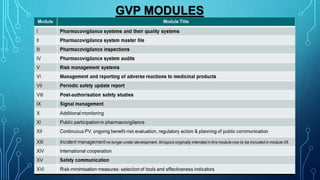
GVP MODULES
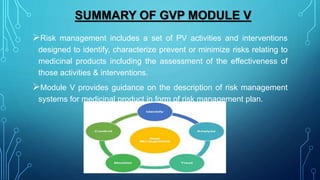
SUMMARY OF GVP MODULE V
Risk management includes a set of PV activities and interventions
designed to identify, characterize prevent or minimize risks relating to
medicinal products including the assessment of the effectiveness of
those activities & interventions.
Module V provides guidance on the description of risk management
systems for medicinal product in form of risk management plan.
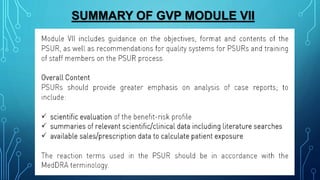
SUMMARY OF GVP MODULE VII
TIMELINE:
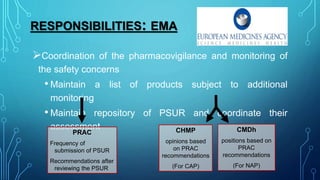
RESPONSIBILITIES: EMA
Coordination of the pharmacovigilance and monitoring of
the safety concerns
• Maintain a list of products subject to additional
monitoring
• Maintain repository of PSUR and coordinate their
assessment
PRAC
Frequency of
submission of PSUR
Recommendations after
reviewing the PSUR
CHMP
opinions based
on PRAC
recommendations
(For CAP)
CMDh
positions based on
PRAC
recommendations
(For NAP)
EU REFERENCE DATES LIST (EURD LIST)
REGULATORY NETWORK
GENERAL PRINCIPLES
General scope – presentation, analysis and evaluation of
new or changing safety data received during period covered
by the PSUR
ONE PSUR – ONE MAH – All elements of the data for the
product should be presented in separate sections and
included in a single PSUR
Products authorised to more than one MAH – Where a
product is authorised to more than one Marketing
Authorisation Holder, in the case of multiple applications,
submission of common PSURs is acceptable provided that
the products remain identical in all respects apart from their
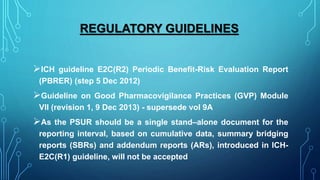
REGULATORY GUIDELINES
ICH guideline E2C(R2) Periodic Benefit-Risk Evaluation Report
(PBRER) (step 5 Dec 2012)
Guideline on Good Pharmacovigilance Practices (GVP) Module
VII (revision 1, 9 Dec 2013) - supersede vol 9A
As the PSUR should be a single stand–alone document for the
reporting interval, based on cumulative data, summary bridging
reports (SBRs) and addendum reports (ARs), introduced in ICH-
E2C(R1) guideline, will not be accepted
GOOD PHARMACOVIGILANCE PRACTICES
The good pharmacovigilance practice (GVP) guidelines came
into effect in July 2012 to facilitate the performance of
Pharmacovigilance (PV) in the EU.
The GVP guidelines are divided into 16 modules, each covering a
major process in PV. Module VII discusses changes to the format
and content of the PSUR.
There is no longer a routine requirement for PSURs for generic,
well established, homeopathic and herbal products (exceptions:
if a risk is identified or if there is a lack of information).
The European Medicines Agency (EMA) generates a list of EU
reference dates and frequency of
 submission. This list is displayed on the EMA web-portal and is
CONTENT OF PBRER/PSUR
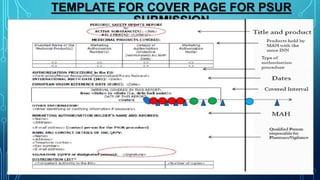
TEMPLATE FOR COVER PAGE FOR PSUR
SUBMISSION
CHANGES TO PSUR
The following are the important changes in the new format PSUR
(PBRER) based on ICH E2C (R2) compared to old format PSUR based
on ICH E2C (R1):
RISK-BENEFIT ANALYSES:
 Risk evaluation: signals (new, ongoing or closed), evaluation of risks and
new information, and effectiveness of risk minimization activities.
 Benefit evaluation: important baseline efficacy/effectiveness, evaluation of
efficacy/effectiveness and new information.
 Integrated risk-benefit analysis.
SUMMARY TABULATIONS
The detailed adverse drug reaction (ADR) line listings will be replaced by
more concise cumulative summary
tabulation of serious adverse events from clinical trials and cumulative and
interval summary tabulations of ADRs.
Modular approach: The PSUR now has a modular format, which is
intended to maximize efficiencies between different document types,
since the same modules can be used in different documents
PSUR vs. Development Safety Update Report (DSUR): These
documents share a number of common sections synchronization of
submission schedules for these documents should facilitate the use of
common text.
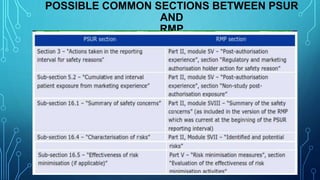
PSUR vs. Risk Management Plan (RMP): Certain PSUR and RMP
sections can be used interchangeably across reports.
Detailed analyses of cases for special populations: (e.g.
pregnant/lactating women; organ-impaired patients;
pediatric/elderly patients) is no longer required, unless being
assessed as a potential risk.
POSSIBLE COMMON SECTIONS BETWEEN PSUR
AND
RMP
PSUR

PSUR

  • 1.
  • 2.
    WHAT IS PSUR PERIODICSAFETY UPDATE REPORTS (PSURS) are pharmacovigilance documents intended to provide an evaluation of the risk-benefit balance of a medicinal product for submission by marketing authorisation holders (MAHs) in the light of new or changing information at defined time points during the post-authorisation phase. PBRER (PERIODIC BENEFIT RISK EVALUATION REPORT) are referred to as PSUR since
  • 3.
    OBJECTIVE OF PSUR Examinewhether new information is in accord with previous knowledge of the benefit risk profile  Summarises relevant new safety information that may impact the benefit risk profile Summarises any important new efficacy and effectiveness information Conduct an integrated Benefit/Risk evaluation This evaluation of risk-benefit assessment should be undertaken in the context of ongoing pharmacovigilance and risk management:
  • 4.
  • 5.
    SUMMARY OF GVPMODULE V Risk management includes a set of PV activities and interventions designed to identify, characterize prevent or minimize risks relating to medicinal products including the assessment of the effectiveness of those activities & interventions. Module V provides guidance on the description of risk management systems for medicinal product in form of risk management plan.
  • 6.
    SUMMARY OF GVPMODULE VII
  • 7.
  • 8.
    RESPONSIBILITIES: EMA Coordination ofthe pharmacovigilance and monitoring of the safety concerns • Maintain a list of products subject to additional monitoring • Maintain repository of PSUR and coordinate their assessment PRAC Frequency of submission of PSUR Recommendations after reviewing the PSUR CHMP opinions based on PRAC recommendations (For CAP) CMDh positions based on PRAC recommendations (For NAP)
  • 9.
    EU REFERENCE DATESLIST (EURD LIST) REGULATORY NETWORK
  • 10.
    GENERAL PRINCIPLES General scope– presentation, analysis and evaluation of new or changing safety data received during period covered by the PSUR ONE PSUR – ONE MAH – All elements of the data for the product should be presented in separate sections and included in a single PSUR Products authorised to more than one MAH – Where a product is authorised to more than one Marketing Authorisation Holder, in the case of multiple applications, submission of common PSURs is acceptable provided that the products remain identical in all respects apart from their
  • 11.
    REGULATORY GUIDELINES ICH guidelineE2C(R2) Periodic Benefit-Risk Evaluation Report (PBRER) (step 5 Dec 2012) Guideline on Good Pharmacovigilance Practices (GVP) Module VII (revision 1, 9 Dec 2013) - supersede vol 9A As the PSUR should be a single stand–alone document for the reporting interval, based on cumulative data, summary bridging reports (SBRs) and addendum reports (ARs), introduced in ICH- E2C(R1) guideline, will not be accepted
  • 12.
    GOOD PHARMACOVIGILANCE PRACTICES Thegood pharmacovigilance practice (GVP) guidelines came into effect in July 2012 to facilitate the performance of Pharmacovigilance (PV) in the EU. The GVP guidelines are divided into 16 modules, each covering a major process in PV. Module VII discusses changes to the format and content of the PSUR. There is no longer a routine requirement for PSURs for generic, well established, homeopathic and herbal products (exceptions: if a risk is identified or if there is a lack of information). The European Medicines Agency (EMA) generates a list of EU reference dates and frequency of  submission. This list is displayed on the EMA web-portal and is
  • 13.
  • 14.
    TEMPLATE FOR COVERPAGE FOR PSUR SUBMISSION
  • 15.
    CHANGES TO PSUR Thefollowing are the important changes in the new format PSUR (PBRER) based on ICH E2C (R2) compared to old format PSUR based on ICH E2C (R1): RISK-BENEFIT ANALYSES:  Risk evaluation: signals (new, ongoing or closed), evaluation of risks and new information, and effectiveness of risk minimization activities.  Benefit evaluation: important baseline efficacy/effectiveness, evaluation of efficacy/effectiveness and new information.  Integrated risk-benefit analysis. SUMMARY TABULATIONS The detailed adverse drug reaction (ADR) line listings will be replaced by more concise cumulative summary tabulation of serious adverse events from clinical trials and cumulative and interval summary tabulations of ADRs.
  • 16.
    Modular approach: ThePSUR now has a modular format, which is intended to maximize efficiencies between different document types, since the same modules can be used in different documents PSUR vs. Development Safety Update Report (DSUR): These documents share a number of common sections synchronization of submission schedules for these documents should facilitate the use of common text. PSUR vs. Risk Management Plan (RMP): Certain PSUR and RMP sections can be used interchangeably across reports. Detailed analyses of cases for special populations: (e.g. pregnant/lactating women; organ-impaired patients; pediatric/elderly patients) is no longer required, unless being assessed as a potential risk.
  • 17.
    POSSIBLE COMMON SECTIONSBETWEEN PSUR AND RMP