Experiment 2
To study various pharmacopoeia
References
• Indian Pharmacopoeia 2010, sixth edition,
published by The Indian Pharmacopoeia
Commission, Gaziabad,
• YAPAR, E. and ÖZDEMİRHAN, M., 2020. AN
OVERVIEW ON PHARMACOPOEIAS IN THE
WORLD AND MONOGRAPH ELABORATION
TECHNIQUES. Universal Journal of
Pharmaceutical Research
Pharmacopoeia
• It is a legal and official book for pharmaceutical drug
specifications issued by recognized authorities usually
appointed by the government of respective country.
• It sets standards and obligatory quality indice for drug, raw
materials and various pharmaceutical products
• The pharmacopoeia word is derived from 2 greek words
• Pharmakon – medicine/drug +poiein- to make = DRUG
MAKING
• This book contains directions for the identification of
samples and the preparation of compound medicnes
• The descriptions of individual drug/excipient or product is
called Monograph
Importance of pharmacopoeia
• To maintain the uniformity in standards as well as to
control the adulterated medicines, each country has its
own official book i.e Pharmacopoeia
• It is an important element to control the medicines
licensing and inspection processes.
• Plays a significant role in generic drug manufacturing,
contract research, production for export purpose .
• It is amended or updated time to time in the form of
addenda/supplement or new edition where monographs
of new drugs are added as well as outdated are deleted
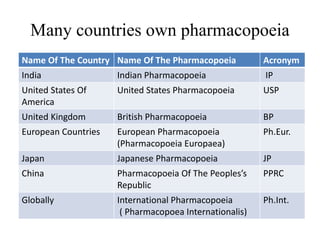
Many countries own pharmacopoeia
Name Of The Country Name Of The Pharmacopoeia Acronym
India Indian Pharmacopoeia IP
United States Of
America
United States Pharmacopoeia USP
United Kingdom British Pharmacopoeia BP
European Countries European Pharmacopoeia
(Pharmacopoeia Europaea)
Ph.Eur.
Japan Japanese Pharmacopoeia JP
China Pharmacopoeia Of The Peoples’s
Republic
PPRC
Globally International Pharmacopoeia
( Pharmacopoea Internationalis)
Ph.Int.
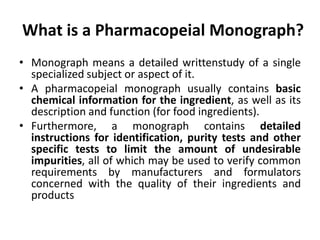
What is a Pharmacopeial Monograph?
• Monograph means a detailed writtenstudy of a single
specialized subject or aspect of it.
• A pharmacopeial monograph usually contains basic
chemical information for the ingredient, as well as its
description and function (for food ingredients).
• Furthermore, a monograph contains detailed
instructions for identification, purity tests and other
specific tests to limit the amount of undesirable
impurities, all of which may be used to verify common
requirements by manufacturers and formulators
concerned with the quality of their ingredients and
products
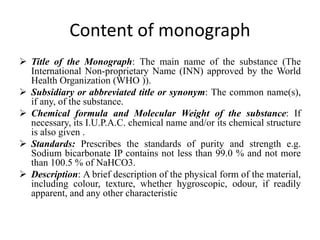
Content of monograph
 Title of the Monograph: The main name of the substance (The
International Non-proprietary Name (INN) approved by the World
Health Organization (WHO )).
 Subsidiary or abbreviated title or synonym: The common name(s),
if any, of the substance.
 Chemical formula and Molecular Weight of the substance: If
necessary, its I.U.P.A.C. chemical name and/or its chemical structure
is also given .
 Standards: Prescribes the standards of purity and strength e.g.
Sodium bicarbonate IP contains not less than 99.0 % and not more
than 100.5 % of NaHCO3.
 Description: A brief description of the physical form of the material,
including colour, texture, whether hygroscopic, odour, if readily
apparent, and any other characteristic
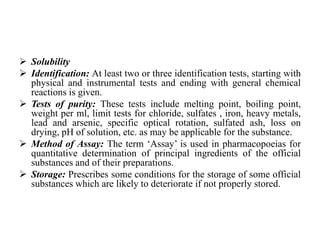
 Solubility
 Identification: At least two or three identification tests, starting with
physical and instrumental tests and ending with general chemical
reactions is given.
 Tests of purity: These tests include melting point, boiling point,
weight per ml, limit tests for chloride, sulfates , iron, heavy metals,
lead and arsenic, specific optical rotation, sulfated ash, loss on
drying, pH of solution, etc. as may be applicable for the substance.
 Method of Assay: The term ‘Assay’ is used in pharmacopoeias for
quantitative determination of principal ingredients of the official
substances and of their preparations.
 Storage: Prescribes some conditions for the storage of some official
substances which are likely to deteriorate if not properly stored.
Indian Pharmacopoeia (IP)
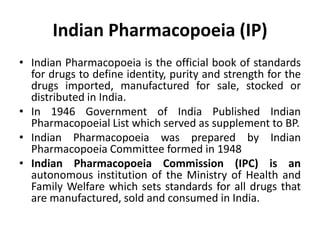
• Indian Pharmacopoeia is the official book of standards
for drugs to define identity, purity and strength for the
drugs imported, manufactured for sale, stocked or
distributed in India.
• In 1946 Government of India Published Indian
Pharmacopoeial List which served as supplement to BP.
• Indian Pharmacopoeia was prepared by Indian
Pharmacopoeia Committee formed in 1948
• Indian Pharmacopoeia Commission (IPC) is an
autonomous institution of the Ministry of Health and
Family Welfare which sets standards for all drugs that
are manufactured, sold and consumed in India.
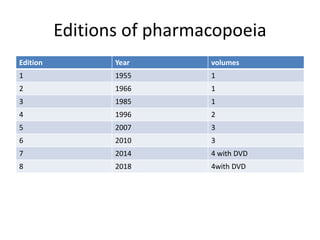
Editions of pharmacopoeia
Edition Year volumes
1 1955 1
2 1966 1
3 1985 1
4 1996 2
5 2007 3
6 2010 3
7 2014 4 with DVD
8 2018 4with DVD
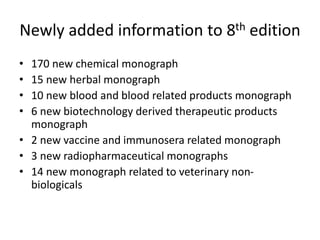
Newly added information to 8th edition
• 170 new chemical monograph
• 15 new herbal monograph
• 10 new blood and blood related products monograph
• 6 new biotechnology derived therapeutic products
monograph
• 2 new vaccine and immunosera related monograph
• 3 new radiopharmaceutical monographs
• 14 new monograph related to veterinary non-
biologicals
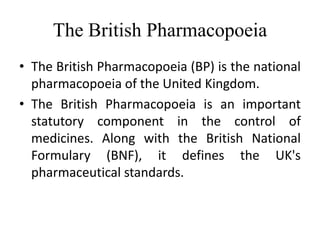
The British Pharmacopoeia
• The British Pharmacopoeia (BP) is the national
pharmacopoeia of the United Kingdom.
• The British Pharmacopoeia is an important
statutory component in the control of
medicines. Along with the British National
Formulary (BNF), it defines the UK's
pharmaceutical standards.
• The British Pharmacopoeia (B.P.) It was first published
in 1864.
• Since 1948, which is seventh edition of B.P. the new
edition of British Pharmacopoeia is published at
intervals of five years i.e. 1948, 1953, 1958, 1963,
1968, 1973.
• After 1973 the new edition was published in 1980 and
then in 1988, 1993, 1998, 2003, 2008.
• After 2008 the new edition was published every year.
• In addition to the publication of the pharmacopoeia, the
addendums are also published from time to time in
between two main editions.
• The BP contains monographs, which set out the
mandatory standards for active substances, excipients
and formulated preparations, together with General
Notices, Appendices (test methods, reagents, etc ) and
Reference Spectra
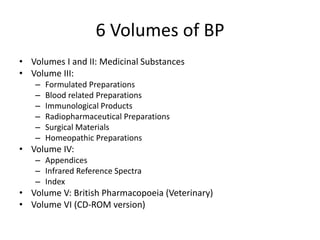
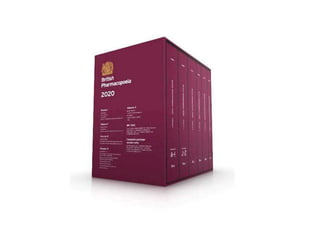
6 Volumes of BP
• Volumes I and II: Medicinal Substances
• Volume III:
– Formulated Preparations
– Blood related Preparations
– Immunological Products
– Radiopharmaceutical Preparations
– Surgical Materials
– Homeopathic Preparations
• Volume IV:
– Appendices
– Infrared Reference Spectra
– Index
• Volume V: British Pharmacopoeia (Veterinary)
• Volume VI (CD-ROM version)
United states pharmacopoeia
• The United States Pharmacopoeia and National Formulary
(USP-NF) is an official public standards–setting authority
for all prescription and over–the–counter medicines and
other health care products manufactured or sold in the
United States.
• USP also sets recognized standards for food ingredients and
dietary supplements.
• The United States Pharmacopoeia was originally published
in 1820 under the authority of the United States
Pharmacopoeial Convention and the National Formulary
was published in 1888 under the guidance of American
Pharmaceutical Association .
• In 1974 the National Formulary was purchased by the
United States Pharmacopoeial Convention and from 1980
onwards only one official book of drug standards was
published under the heading, The United States
Pharmacopoeia and The National Formulary (USP-NF).
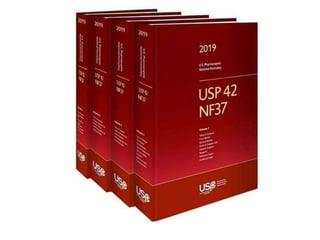
• The USP–NF is a three volume combination of
two official compendia, the United States
Pharmacopoeia (USP) and the National
Formulary (NF).
• Monographs for drug substances and
preparations are featured in the USP.
• Monographs for dietary supplements and
ingredients appear in a separate section of the
USP. Excipient monographs are in the NF.
• First edition of United state Pharmacopeia
was published on 15th December 1820 in
both Latin & English.
• From 1820 to 1942 it was published at Ten
years intervals.
• From 1942 to 2000 it was published at Five
years intervals.
• From 2002 it was published annually.
Volumes of USP
• Volumes USP is printed in three volumes.
– Volume I: General chapters
– Volume II & III: Contain monograph
International Pharmacopoeia
• The International Pharmacopoeia is published
by the WHO and is practically used in
developing countries.
• It was prepared to meet the international
uniformity and standardization of drugs.
• International Pharmacopoeia was first
published in 1951 in multilanguages ( English,
French, German, Japanese, etc.).
• Latest 8th edition was published in 2018.
Thank You

exp 2 NAYANY SHARMA.pptx

  • 1.
    Experiment 2 To studyvarious pharmacopoeia
  • 2.
    References • Indian Pharmacopoeia2010, sixth edition, published by The Indian Pharmacopoeia Commission, Gaziabad, • YAPAR, E. and ÖZDEMİRHAN, M., 2020. AN OVERVIEW ON PHARMACOPOEIAS IN THE WORLD AND MONOGRAPH ELABORATION TECHNIQUES. Universal Journal of Pharmaceutical Research
  • 3.
    Pharmacopoeia • It isa legal and official book for pharmaceutical drug specifications issued by recognized authorities usually appointed by the government of respective country. • It sets standards and obligatory quality indice for drug, raw materials and various pharmaceutical products • The pharmacopoeia word is derived from 2 greek words • Pharmakon – medicine/drug +poiein- to make = DRUG MAKING • This book contains directions for the identification of samples and the preparation of compound medicnes • The descriptions of individual drug/excipient or product is called Monograph
  • 4.
    Importance of pharmacopoeia •To maintain the uniformity in standards as well as to control the adulterated medicines, each country has its own official book i.e Pharmacopoeia • It is an important element to control the medicines licensing and inspection processes. • Plays a significant role in generic drug manufacturing, contract research, production for export purpose . • It is amended or updated time to time in the form of addenda/supplement or new edition where monographs of new drugs are added as well as outdated are deleted
  • 5.
    Many countries ownpharmacopoeia Name Of The Country Name Of The Pharmacopoeia Acronym India Indian Pharmacopoeia IP United States Of America United States Pharmacopoeia USP United Kingdom British Pharmacopoeia BP European Countries European Pharmacopoeia (Pharmacopoeia Europaea) Ph.Eur. Japan Japanese Pharmacopoeia JP China Pharmacopoeia Of The Peoples’s Republic PPRC Globally International Pharmacopoeia ( Pharmacopoea Internationalis) Ph.Int.
  • 6.
    What is aPharmacopeial Monograph? • Monograph means a detailed writtenstudy of a single specialized subject or aspect of it. • A pharmacopeial monograph usually contains basic chemical information for the ingredient, as well as its description and function (for food ingredients). • Furthermore, a monograph contains detailed instructions for identification, purity tests and other specific tests to limit the amount of undesirable impurities, all of which may be used to verify common requirements by manufacturers and formulators concerned with the quality of their ingredients and products
  • 7.
    Content of monograph Title of the Monograph: The main name of the substance (The International Non-proprietary Name (INN) approved by the World Health Organization (WHO )).  Subsidiary or abbreviated title or synonym: The common name(s), if any, of the substance.  Chemical formula and Molecular Weight of the substance: If necessary, its I.U.P.A.C. chemical name and/or its chemical structure is also given .  Standards: Prescribes the standards of purity and strength e.g. Sodium bicarbonate IP contains not less than 99.0 % and not more than 100.5 % of NaHCO3.  Description: A brief description of the physical form of the material, including colour, texture, whether hygroscopic, odour, if readily apparent, and any other characteristic
  • 8.
     Solubility  Identification:At least two or three identification tests, starting with physical and instrumental tests and ending with general chemical reactions is given.  Tests of purity: These tests include melting point, boiling point, weight per ml, limit tests for chloride, sulfates , iron, heavy metals, lead and arsenic, specific optical rotation, sulfated ash, loss on drying, pH of solution, etc. as may be applicable for the substance.  Method of Assay: The term ‘Assay’ is used in pharmacopoeias for quantitative determination of principal ingredients of the official substances and of their preparations.  Storage: Prescribes some conditions for the storage of some official substances which are likely to deteriorate if not properly stored.
  • 9.
    Indian Pharmacopoeia (IP) •Indian Pharmacopoeia is the official book of standards for drugs to define identity, purity and strength for the drugs imported, manufactured for sale, stocked or distributed in India. • In 1946 Government of India Published Indian Pharmacopoeial List which served as supplement to BP. • Indian Pharmacopoeia was prepared by Indian Pharmacopoeia Committee formed in 1948 • Indian Pharmacopoeia Commission (IPC) is an autonomous institution of the Ministry of Health and Family Welfare which sets standards for all drugs that are manufactured, sold and consumed in India.
  • 10.
    Editions of pharmacopoeia EditionYear volumes 1 1955 1 2 1966 1 3 1985 1 4 1996 2 5 2007 3 6 2010 3 7 2014 4 with DVD 8 2018 4with DVD
  • 11.
    Newly added informationto 8th edition • 170 new chemical monograph • 15 new herbal monograph • 10 new blood and blood related products monograph • 6 new biotechnology derived therapeutic products monograph • 2 new vaccine and immunosera related monograph • 3 new radiopharmaceutical monographs • 14 new monograph related to veterinary non- biologicals
  • 13.
    The British Pharmacopoeia •The British Pharmacopoeia (BP) is the national pharmacopoeia of the United Kingdom. • The British Pharmacopoeia is an important statutory component in the control of medicines. Along with the British National Formulary (BNF), it defines the UK's pharmaceutical standards.
  • 14.
    • The BritishPharmacopoeia (B.P.) It was first published in 1864. • Since 1948, which is seventh edition of B.P. the new edition of British Pharmacopoeia is published at intervals of five years i.e. 1948, 1953, 1958, 1963, 1968, 1973. • After 1973 the new edition was published in 1980 and then in 1988, 1993, 1998, 2003, 2008. • After 2008 the new edition was published every year. • In addition to the publication of the pharmacopoeia, the addendums are also published from time to time in between two main editions. • The BP contains monographs, which set out the mandatory standards for active substances, excipients and formulated preparations, together with General Notices, Appendices (test methods, reagents, etc ) and Reference Spectra
  • 15.
    6 Volumes ofBP • Volumes I and II: Medicinal Substances • Volume III: – Formulated Preparations – Blood related Preparations – Immunological Products – Radiopharmaceutical Preparations – Surgical Materials – Homeopathic Preparations • Volume IV: – Appendices – Infrared Reference Spectra – Index • Volume V: British Pharmacopoeia (Veterinary) • Volume VI (CD-ROM version)
  • 17.
    United states pharmacopoeia •The United States Pharmacopoeia and National Formulary (USP-NF) is an official public standards–setting authority for all prescription and over–the–counter medicines and other health care products manufactured or sold in the United States. • USP also sets recognized standards for food ingredients and dietary supplements. • The United States Pharmacopoeia was originally published in 1820 under the authority of the United States Pharmacopoeial Convention and the National Formulary was published in 1888 under the guidance of American Pharmaceutical Association . • In 1974 the National Formulary was purchased by the United States Pharmacopoeial Convention and from 1980 onwards only one official book of drug standards was published under the heading, The United States Pharmacopoeia and The National Formulary (USP-NF).
  • 18.
    • The USP–NFis a three volume combination of two official compendia, the United States Pharmacopoeia (USP) and the National Formulary (NF). • Monographs for drug substances and preparations are featured in the USP. • Monographs for dietary supplements and ingredients appear in a separate section of the USP. Excipient monographs are in the NF.
  • 19.
    • First editionof United state Pharmacopeia was published on 15th December 1820 in both Latin & English. • From 1820 to 1942 it was published at Ten years intervals. • From 1942 to 2000 it was published at Five years intervals. • From 2002 it was published annually.
  • 20.
    Volumes of USP •Volumes USP is printed in three volumes. – Volume I: General chapters – Volume II & III: Contain monograph
  • 22.
    International Pharmacopoeia • TheInternational Pharmacopoeia is published by the WHO and is practically used in developing countries. • It was prepared to meet the international uniformity and standardization of drugs. • International Pharmacopoeia was first published in 1951 in multilanguages ( English, French, German, Japanese, etc.). • Latest 8th edition was published in 2018.
  • 23.

Editor's Notes

  • #4 Indice: plural of index
  • #5 Addenda: an item of extra information that is added to something