DRUGS USED ON
URINARY SYSTEM
UNIT VI : Drugs used on urinary system
• Diuretics and antidiuretics
• Urinary antiseptics
• Cholinergic and anticholinergic drugs
• Acidifiers and alkalinizers
ANTIDIURETICS
DEFINITION
Antidiuretics are drugs that reduce urine
volume.
CLASSIFICATION
1. Antidiuretic Hormone( Vasopressin)
Vasopressin Analogues
• Desmopressin
• Lypressin
• Terlipressin
• Felypressin
2. Thiazide diuretics and Amiloride
3. Miscellaneous
Indomethacin, Chlorpropamide, Carbamazepine
ANTIDIURETIC HORMONE (ADH)
Synthesized in supraoptic and paraventricular nucleus of
Hypothalamus
Secreted by posterior pituitary
Secreted under physiological stimulus
Rise in plasma osmolarity and concentration of ECF
or fall in BP.
CONT…
• Osmoreceptors regulate the rate of their release.
• Human ADH is 8- Arginine-vasopressin, hence also called AVP.
• Can raise BP by constricting blood vessels, hence also called
vasopressin.
• Role in long term BP control by increasing the water reabsorption
from the collecting duct.
FACTORS AFFECTING ADH RELEASE
INCREASE ADH SECRETION
• Histamine
• Neuropeptide Y
• Angiotensin II
• Prostaglandins
• High dose Morphine
• Acetylcholine
DECREASE ADH SECRETION
• Ethanol
• GABA
• Atrial Natriuretic peptide
• Phenytoin
• Low dose Morphine
• Haloperidol
MECHANISM OF ACTION
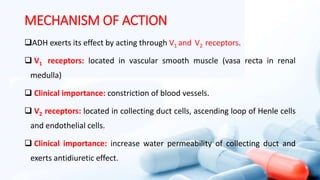
ADH exerts its effect by acting through V1 and V2 receptors.
 V1 receptors: located in vascular smooth muscle (vasa recta in renal
medulla)
 Clinical importance: constriction of blood vessels.
 V2 receptors: located in collecting duct cells, ascending loop of Henle cells
and endothelial cells.
 Clinical importance: increase water permeability of collecting duct and
exerts antidiuretic effect.
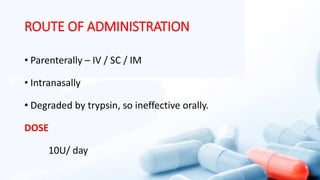
ROUTE OF ADMINISTRATION
• Parenterally – IV / SC / IM
• Intranasally
• Degraded by trypsin, so ineffective orally.
DOSE
10U/ day
VASOPRESSIN
ANALOGUES
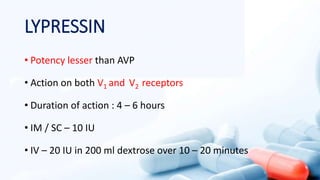
LYPRESSIN
• Potency lesser than AVP
• Action on both V1 and V2 receptors
• Duration of action : 4 – 6 hours
• IM / SC – 10 IU
• IV – 20 IU in 200 ml dextrose over 10 – 20 minutes
DESMOPRESSIN
• 10 – 12 times potent than vasopressin
• Selective receptor agonist
• Available in – intranasal, oral, SC and parenteral forms
• Orally : 0.1- 0.2 mg TID
• Parenterally : 2-4 µg/day in divided doses
• Intranasally : 10-40 µg/day in divided doses
pediatric : 5-10 µg HS
TERLIPRESSIN
• Synthetic prodrug of vasopressin
• Common indication – bleeding esophageal varices
• Dose - 2 mg IV
• May be repeated in a dose of 1-2 mg every 4-6 hours
INDICATIONS OF ADH AND VASOPRESSIN
ANALOGUES
• Diabetes insipidus :– highly effective in central and neurogenic diabetes
insipidus, ineffective in renal or nephrogenic diabetes insipidus.
• Nocturnal enuresis :- intranasal or oral at bed time controls primary
nocturia.
• Hemophilia and Von Willebrand disease :- AVP release Von Willebrand
factor and factor VIII, which are helpful in controlling bleeding.
• DESMOPRESSIN is drug of choice
Cont…
• Bleeding esophageal varices :- constricts mesenteric blood vessels
and reduce blood flow through the liver to varices, allowing clot
formation.
• TERLIPRESSIN is drug of choice
CONTRAINDICATION & PRECAUTIONS
Hypersensitivity
Impaired renal function
With ongoing diuretic
treatment
CV disease
Edema
Hypertension
Cystic fibrosis
Fluid and electrolyte
imbalance
Pregnancy and lactation
ADVERSE EFFECTS
• Local side effects
Nasal congestion, epistaxis and rhinitis.
• Systemic side effects
Headache, flushing, nausea urticaria, abdominal cramps, back
ache in females (due to uterine contraction) and hyponatremia.
VASOPRESSIN RECEPTOR ANTAGONISTS
• CONIVAPTAN
• TOLVAPTAN
CONIVAPTAN
• Antagonise action of vasopressin
• MOA : Antagonism of V1 and V2 receptors
• Use : managing hyponatremia in hospitalized patients
• Indications : SIADH, Congestive heart failure due to ADH excess
• Route : IV only
• Complications : infusion site reaction
TOLVAPTAN
• Similar to conivaptan
• More selective for vasopressin V2 receptors
• Can be given orally
THIAZIDE
DIURETICS,
AMILORIDE
THIAZIDE DIURETICS, AMILORIDE
• Paradoxically thiazides reduces urine volume in diabetes insipidus of
both pituitary and renal origin by an unknown mechanism.
• Hydrochlorothiazide 25-50 mg or equivalent dose of a longer acting
agent is commonly used.
• These are the only drugs effective in nephrogenic diabetes insipidus.
• Amiloride is the most preferred drug in lithium induced nephrogenic
diabetes insipidus.
MISCELLANEOUS
DRUGS
INDOMETHACIN
Reduces renal prostaglandin synthesis.
Used in combination with thiazide/amiloride in nephrogenic
diabetes insipidus.
Other NSAIDs are less active.
CHLORPROPAMIDE
An oral hypoglycemic
Sensitizes kidneys to ADH actions.
Acts by reducing urine formation at pituitary level.
CARBAMAZEPINE
Anticonvulsant agent.
Decreases urine volume in central or neurogenic diabetes
insipidus.
MOA : reducing urine formation at pituitary level.
Higher doses are needed for this effect.
Role of Nurses
• Assess for contraindications or cautions
• Monitor electrolyte imbalance.
• Monitor vital signs and B.P. regularly.
• Observe for sign of hypersensitivity reactions.
• Monitor laboratory values.
• Stop medication if hypertension exists.
URINARY ANTISEPTICS
DEFINITION
The orally administered antimicrobial agents which attain good
antibacterial concentration only in urine, with little or no systemic
antibacterial effects are called urinary antiseptics.
These drugs are excreted unchanged via renal route and are
useful mainly in lower UTI.
COMMONLY USED
URINARY ANTISEPTICS
NITROFURANTOIN
 Bacteriostatic (Bactericidal in high concentration)
 Effective against both Gram positive and Gram negative bacteria
 MOA : Not known
 Uses : A/c UTI, long term suppression of c/c UTI (single dose 100 mg HS),
Prophylaxis of UTI
 Dose : 50 – 100 mg Q6H
 ADR : nausea, vomiting, diarrhoea, allergic reactions
FLUROQUINOLONES
 Bactericidal
 MOA : Inhibits enzyme DNA gyrase in Gram negative micro organism
and topoisomerase IV in Gram positive micro organism cause
DNA damage
 ROUTE : oral / IV
 Food delays absorption
 INDICATIONS : Patients with UTIs, prostatitis and with indwelling catheters
COMMON DRUGS
Norfloxacin : 400 mg BD oral
Ofloxacin : 200 - 400 mg BD oral / 200 mg BD IV / 0.3% Eye drops
Ciprofloxacin : 250 - 750 mg BD oral / 100 - 200 mg BD IV /
0.3% Eye drops
Prulifloxacin : 600 mg OD oral
ADVERSE EFFECTS
Gastrointestinal : nausea, vomiting, bad taste, anorexia
CNS : head ache, anxiety, insomnia, restlessness, impairment in
concentration
Skin : rash, pruritis, photosensitivity, urticaria, swelling of lips
Tendinitis and tendon rupture : Risk higher in patients > 60 years and
those receiving corticosteroids.
CONTRA INDICATIONS
Pregnancy
Used with caution in children
Joint pain and swelling in some cases (Risk of cartilage damage)
CEPHALOSPORINS
• Cephalosporins are a group of semisynthetic antibiotics derived from
‘cephalosporin – C’ which is obtained from a fungus Cephalosporium.
• MOA :
Similar to penicillin.
Bactericidal in nature
Inhibit synthesis of cell wall
COMMON DRUGS USED
• Cefixime : 200 – 400 mg BD Oral
• Cefuroxime : Adult – 0.75 - 1.5 g IV / IM Q8H
Children – 30 - 100 mg / Kg/ day
• Ceftriaxone : 1- 2 g / IV / IM / days
• Ceftazidime : 0.5 – 2 g IV / IM every Q8H
ADVERSE REACTIONS
• Pain : after IM injection.
• Nephrotoxicity : if given with an aminoglycoside or loop diuretic.
• Diarrhoea : can occur with oral cephalosporins.
• Hypersensitivity reactions : most important. Rashes, angioedema and
anaphylaxis
• Neutropenia, Thrombocytopenia : leading to bleeding or disulfiram
like reaction with alcohol.
AMINOGLYCOSIDES
• Bactericidal in nature
• MOA : It enters bacterial cell wall and inhibit protein synthesis.(these
proteins are essential for bacterial replication)
• Indications : Gram negative bacillary infections (e.g. UTI, Septicaemia)
• Common drugs used :
 Gentamicin : 3-5 mg/Kg/day in 1-3 doses
 Amikacin : 15 mg/Kg/day in 1-3 doses
Cont…
• ADR:
 Ototoxicity : damage to both vestibular and auditory nerve causing
hearing loss, vertigo and tinnitus.
 Nephrotoxicity : Attain high concentration in renal cortex and dose
related changes occurs.
 Neuromuscular blockage : Reduce Ach and impair neuromuscular
transmission
 Other reactions ( rarely occurs) : Rashes, Haematological abnormalities
SULPHONAMIDES
Effective against pyogenic bacterial infections.
 MOA : Folic acid is essential for growth and multiplication of bacteria.
Sulphonamides inhibit folic acid formation.
 USES : Used in combination with trimethoprim ( Cotrimoxazole) in c/c
UTI.
CONT…
COTRIMOXAZOLE
[Trimethoprim + Sulfamethoxazole ( Sulphonamide)]
80 mg + 400 mg tab : 2 BD for 2 days then 1 BD for 5-7 days.
160 mg + 800 mg tab (DS) : 1 BD for 5-7 days.
Pediatric dose
20 mg + 100 mg tab : for 5-7 days.
40mg + 200 mg per 5 ml suspension for 5-7 days.
NURSE’S ROLES
Ensure that culture and sensitivity tests are performed before
therapy begins and are repeated.
Patient should be educated about the importance and proper
technique of urine sample collection.
Proper catheter care and nurse should keep a record of
catheterization.
Cont…
Encourage patient to drink lots of fluids (to promote flushing of
bladder and prevent urinary stasis).
Provide or assist with perineal hygiene to reduce risk of re-infection.
Monitor patient response to drug and relief of signs and symptoms.
Repeat culture and sensitivity for evaluation of effectiveness.
Check for adverse reactions.
CHOLINERGIC
AND
ANTICHOLINERGIC
DRUGS
CHOLINERGIC DRUGS (CHOLINOMIMETIC,
PARASYMPATHOMIMETIC)
The drugs which produce acetylcholine like actions on different organ
systems is known as cholinergic drugs.
The drugs either act by directly interacting cholinergic receptors
(cholinergic agonists e.g. Bethanechol) or increase availability of
acetylcholine by inhibiting cholinesterase enzymes. (anticholinesterases e.g.
Neostigmine)
MECHANISM OF ACTION
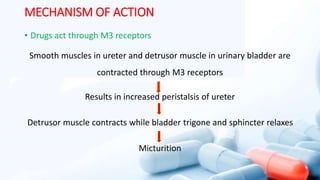
• Drugs act through M3 receptors
Smooth muscles in ureter and detrusor muscle in urinary bladder are
contracted through M3 receptors
Results in increased peristalsis of ureter
Detrusor muscle contracts while bladder trigone and sphincter relaxes
Micturition
COMMON DRUGS USED
Bethanechol
• It indicates micturition
• Indications : post operative and postpartum non-obstructive urinary
retention, neurogenic bladder.
• Dose : 10 – 50 mg orally / 2.5 – 5 mg SC
• Side effects : abdominal cramps, involuntary urination, vasodilation,
sweating, hypotension
Cont..
Neostigmine
• Dose : 0.5 – 1 mg SC
• Indications : Post operative urinary retention
• Contraindications: Organic obstruction in the urinary tract.
ANTICHOLINERGIC DRUGS (MUSCARINIC
RECEPTOR ANTAGONISTS / ATROPINIC /
PARA SYMPATHOLYTIC)
The drugs which block actions of acetylcholine on autonomic
effectors are known as anticholinergic drugs.
Mechanism of Action
• Anticholinergics have relaxant action on urinary bladder and ureter.
• It increases bladder capacity by decreasing tone of detrusor muscles
• Also controls detrusor hyperreflexia in patients suffering from
neurogenic bladder or enuresis.
COMMONLY USED DRUGS
• General antispasmodics : Dicyclomine, Valethamate
• Drugs acting specifically on urinary system : Oxybutynin, Flavoxate,
Tolterodine, Darifenacin, Solifenacin
Cont..
DICYCLOMINE
Direct smooth muscle relaxant action
Used in renal colic
Dose : 10 – 20 mg oral / IM (adult)
5 – 10 mg oral (children)
VALETHAMATE
Useful in urinary colic
Dose : 8 mg IM / 10 mg orally BD
Cont..
OXYBUTYNIN
Uses : vesical spasm, urinary frequency, neurogenic bladder and nocturnal
enuresis
Dose : 5 mg BD/TDS Orally (adult)
2.5 mg BD (children)
FLAVOXATE
Uses : Urinary frequency, urgency and dysuria associated with lower UTI
Dose : 200 mg TDS
Cont…
TOLTERODINE
Uses : over active bladder with urinary frequency and urgency.
Dose : 1 – 2 mg BD / 2 – 4 mg OD Orally
DARIFENACIN AND SOLIFENACIN
These drugs are also useful in bladder disorders
ADVERSE DRUG EFFECTS
Dry mouth, difficulty in swallowing and talking
Dry, flushed and hot skin, fever, scarlet rash
Difficulty in micturition, decreased bowel sounds
Dilated pupil, photophobia, blurring of near vision
Hypotension, palpitation, weak pulse, cardio vascular collapse with
respiratory depression
In severe poisoning, convulsions and coma may occur
NURSE’S ROLE
Assess for contraindications or cautions : known allergies.
Nurses should aware about the possible side effects of these drugs to
rightly identify the patients in whom drugs are contraindicated.
Administer oral drug on empty stomach to decrease nausea and
vomiting.
Monitor patient’s response closely including BP, urine output, cardiac
output etc.
Monitor for adverse reactions
ACIDIFIERS
AND
ALKALINIZERS
ACIDIFIERS AND ALKALINIZERS
Acidifiers and alkalinizers are the agents which are used or can
be used to acidify or alkalinize the urine, respectively as per
requirement.
MOA :
These drugs are given to alter the PH of blood(may be of short
time).
Cont…
• Drugs work better in acidic PH : Nitrofurantoin, Tetracycline,
Cloxacillin etc.
• Drugs work better in alkaline PH : Cephalosporins, Fluoroquinolones
Aminoglycoside etc.
ACIDIFIERS
• These are drugs which are used or can be used to acidify urine
whenever required.
• It will help the renal excretion of alkaline drugs.
• Ammonium chloride, Potassium chloride and ascorbic acid can be
used as acidifiers.
• It is rarely required practically.
ALKALINIZERS
• These are drugs which are used or can be used to alkalinize urine
whenever required for therapeutic purpose.
• It enhances renal excretion of alkaline drugs.
• Drugs used : Potassium citrate, Magnesium Citrate, Sodium citrate
and tricitrate solutions of these compounds.
MOA
After administration, these agents absorbed systematically and
increase the plasma bicarbonate levels, blood PH is raised. In severe
acidosis, the excess hydrogen ions are buffered and the clinical
manifestations of acidosis are reversed.
ROLE OF NURSES
• Assess for contraindications or cautions of drug use.
• Continuously monitor patient for any adverse effects.
• Encourage patient to drink lots of fluids to promote flushing of
bladder.
pharmacology - Urinary System.pptx

pharmacology - Urinary System.pptx

  • 1.
  • 3.
    UNIT VI :Drugs used on urinary system • Diuretics and antidiuretics • Urinary antiseptics • Cholinergic and anticholinergic drugs • Acidifiers and alkalinizers
  • 4.
  • 5.
    CLASSIFICATION 1. Antidiuretic Hormone(Vasopressin) Vasopressin Analogues • Desmopressin • Lypressin • Terlipressin • Felypressin 2. Thiazide diuretics and Amiloride 3. Miscellaneous Indomethacin, Chlorpropamide, Carbamazepine
  • 6.
    ANTIDIURETIC HORMONE (ADH) Synthesizedin supraoptic and paraventricular nucleus of Hypothalamus Secreted by posterior pituitary Secreted under physiological stimulus Rise in plasma osmolarity and concentration of ECF or fall in BP.
  • 7.
    CONT… • Osmoreceptors regulatethe rate of their release. • Human ADH is 8- Arginine-vasopressin, hence also called AVP. • Can raise BP by constricting blood vessels, hence also called vasopressin. • Role in long term BP control by increasing the water reabsorption from the collecting duct.
  • 8.
    FACTORS AFFECTING ADHRELEASE INCREASE ADH SECRETION • Histamine • Neuropeptide Y • Angiotensin II • Prostaglandins • High dose Morphine • Acetylcholine DECREASE ADH SECRETION • Ethanol • GABA • Atrial Natriuretic peptide • Phenytoin • Low dose Morphine • Haloperidol
  • 9.
    MECHANISM OF ACTION ADHexerts its effect by acting through V1 and V2 receptors.  V1 receptors: located in vascular smooth muscle (vasa recta in renal medulla)  Clinical importance: constriction of blood vessels.  V2 receptors: located in collecting duct cells, ascending loop of Henle cells and endothelial cells.  Clinical importance: increase water permeability of collecting duct and exerts antidiuretic effect.
  • 10.
    ROUTE OF ADMINISTRATION •Parenterally – IV / SC / IM • Intranasally • Degraded by trypsin, so ineffective orally. DOSE 10U/ day
  • 11.
  • 12.
    LYPRESSIN • Potency lesserthan AVP • Action on both V1 and V2 receptors • Duration of action : 4 – 6 hours • IM / SC – 10 IU • IV – 20 IU in 200 ml dextrose over 10 – 20 minutes
  • 13.
    DESMOPRESSIN • 10 –12 times potent than vasopressin • Selective receptor agonist • Available in – intranasal, oral, SC and parenteral forms • Orally : 0.1- 0.2 mg TID • Parenterally : 2-4 µg/day in divided doses • Intranasally : 10-40 µg/day in divided doses pediatric : 5-10 µg HS
  • 14.
    TERLIPRESSIN • Synthetic prodrugof vasopressin • Common indication – bleeding esophageal varices • Dose - 2 mg IV • May be repeated in a dose of 1-2 mg every 4-6 hours
  • 15.
    INDICATIONS OF ADHAND VASOPRESSIN ANALOGUES • Diabetes insipidus :– highly effective in central and neurogenic diabetes insipidus, ineffective in renal or nephrogenic diabetes insipidus. • Nocturnal enuresis :- intranasal or oral at bed time controls primary nocturia. • Hemophilia and Von Willebrand disease :- AVP release Von Willebrand factor and factor VIII, which are helpful in controlling bleeding. • DESMOPRESSIN is drug of choice
  • 16.
    Cont… • Bleeding esophagealvarices :- constricts mesenteric blood vessels and reduce blood flow through the liver to varices, allowing clot formation. • TERLIPRESSIN is drug of choice
  • 17.
    CONTRAINDICATION & PRECAUTIONS Hypersensitivity Impairedrenal function With ongoing diuretic treatment CV disease Edema Hypertension Cystic fibrosis Fluid and electrolyte imbalance Pregnancy and lactation
  • 18.
    ADVERSE EFFECTS • Localside effects Nasal congestion, epistaxis and rhinitis. • Systemic side effects Headache, flushing, nausea urticaria, abdominal cramps, back ache in females (due to uterine contraction) and hyponatremia.
  • 19.
    VASOPRESSIN RECEPTOR ANTAGONISTS •CONIVAPTAN • TOLVAPTAN
  • 20.
    CONIVAPTAN • Antagonise actionof vasopressin • MOA : Antagonism of V1 and V2 receptors • Use : managing hyponatremia in hospitalized patients • Indications : SIADH, Congestive heart failure due to ADH excess • Route : IV only • Complications : infusion site reaction
  • 21.
    TOLVAPTAN • Similar toconivaptan • More selective for vasopressin V2 receptors • Can be given orally
  • 22.
  • 23.
    THIAZIDE DIURETICS, AMILORIDE •Paradoxically thiazides reduces urine volume in diabetes insipidus of both pituitary and renal origin by an unknown mechanism. • Hydrochlorothiazide 25-50 mg or equivalent dose of a longer acting agent is commonly used. • These are the only drugs effective in nephrogenic diabetes insipidus. • Amiloride is the most preferred drug in lithium induced nephrogenic diabetes insipidus.
  • 24.
  • 25.
    INDOMETHACIN Reduces renal prostaglandinsynthesis. Used in combination with thiazide/amiloride in nephrogenic diabetes insipidus. Other NSAIDs are less active.
  • 26.
    CHLORPROPAMIDE An oral hypoglycemic Sensitizeskidneys to ADH actions. Acts by reducing urine formation at pituitary level.
  • 27.
    CARBAMAZEPINE Anticonvulsant agent. Decreases urinevolume in central or neurogenic diabetes insipidus. MOA : reducing urine formation at pituitary level. Higher doses are needed for this effect.
  • 28.
    Role of Nurses •Assess for contraindications or cautions • Monitor electrolyte imbalance. • Monitor vital signs and B.P. regularly. • Observe for sign of hypersensitivity reactions. • Monitor laboratory values. • Stop medication if hypertension exists.
  • 29.
    URINARY ANTISEPTICS DEFINITION The orallyadministered antimicrobial agents which attain good antibacterial concentration only in urine, with little or no systemic antibacterial effects are called urinary antiseptics. These drugs are excreted unchanged via renal route and are useful mainly in lower UTI.
  • 30.
  • 31.
    NITROFURANTOIN  Bacteriostatic (Bactericidalin high concentration)  Effective against both Gram positive and Gram negative bacteria  MOA : Not known  Uses : A/c UTI, long term suppression of c/c UTI (single dose 100 mg HS), Prophylaxis of UTI  Dose : 50 – 100 mg Q6H  ADR : nausea, vomiting, diarrhoea, allergic reactions
  • 32.
    FLUROQUINOLONES  Bactericidal  MOA: Inhibits enzyme DNA gyrase in Gram negative micro organism and topoisomerase IV in Gram positive micro organism cause DNA damage  ROUTE : oral / IV  Food delays absorption  INDICATIONS : Patients with UTIs, prostatitis and with indwelling catheters
  • 33.
    COMMON DRUGS Norfloxacin :400 mg BD oral Ofloxacin : 200 - 400 mg BD oral / 200 mg BD IV / 0.3% Eye drops Ciprofloxacin : 250 - 750 mg BD oral / 100 - 200 mg BD IV / 0.3% Eye drops Prulifloxacin : 600 mg OD oral
  • 34.
    ADVERSE EFFECTS Gastrointestinal :nausea, vomiting, bad taste, anorexia CNS : head ache, anxiety, insomnia, restlessness, impairment in concentration Skin : rash, pruritis, photosensitivity, urticaria, swelling of lips Tendinitis and tendon rupture : Risk higher in patients > 60 years and those receiving corticosteroids.
  • 35.
    CONTRA INDICATIONS Pregnancy Used withcaution in children Joint pain and swelling in some cases (Risk of cartilage damage)
  • 36.
    CEPHALOSPORINS • Cephalosporins area group of semisynthetic antibiotics derived from ‘cephalosporin – C’ which is obtained from a fungus Cephalosporium. • MOA : Similar to penicillin. Bactericidal in nature Inhibit synthesis of cell wall
  • 37.
    COMMON DRUGS USED •Cefixime : 200 – 400 mg BD Oral • Cefuroxime : Adult – 0.75 - 1.5 g IV / IM Q8H Children – 30 - 100 mg / Kg/ day • Ceftriaxone : 1- 2 g / IV / IM / days • Ceftazidime : 0.5 – 2 g IV / IM every Q8H
  • 38.
    ADVERSE REACTIONS • Pain: after IM injection. • Nephrotoxicity : if given with an aminoglycoside or loop diuretic. • Diarrhoea : can occur with oral cephalosporins. • Hypersensitivity reactions : most important. Rashes, angioedema and anaphylaxis • Neutropenia, Thrombocytopenia : leading to bleeding or disulfiram like reaction with alcohol.
  • 39.
    AMINOGLYCOSIDES • Bactericidal innature • MOA : It enters bacterial cell wall and inhibit protein synthesis.(these proteins are essential for bacterial replication) • Indications : Gram negative bacillary infections (e.g. UTI, Septicaemia) • Common drugs used :  Gentamicin : 3-5 mg/Kg/day in 1-3 doses  Amikacin : 15 mg/Kg/day in 1-3 doses
  • 40.
    Cont… • ADR:  Ototoxicity: damage to both vestibular and auditory nerve causing hearing loss, vertigo and tinnitus.  Nephrotoxicity : Attain high concentration in renal cortex and dose related changes occurs.  Neuromuscular blockage : Reduce Ach and impair neuromuscular transmission  Other reactions ( rarely occurs) : Rashes, Haematological abnormalities
  • 41.
    SULPHONAMIDES Effective against pyogenicbacterial infections.  MOA : Folic acid is essential for growth and multiplication of bacteria. Sulphonamides inhibit folic acid formation.  USES : Used in combination with trimethoprim ( Cotrimoxazole) in c/c UTI.
  • 42.
    CONT… COTRIMOXAZOLE [Trimethoprim + Sulfamethoxazole( Sulphonamide)] 80 mg + 400 mg tab : 2 BD for 2 days then 1 BD for 5-7 days. 160 mg + 800 mg tab (DS) : 1 BD for 5-7 days. Pediatric dose 20 mg + 100 mg tab : for 5-7 days. 40mg + 200 mg per 5 ml suspension for 5-7 days.
  • 43.
    NURSE’S ROLES Ensure thatculture and sensitivity tests are performed before therapy begins and are repeated. Patient should be educated about the importance and proper technique of urine sample collection. Proper catheter care and nurse should keep a record of catheterization.
  • 44.
    Cont… Encourage patient todrink lots of fluids (to promote flushing of bladder and prevent urinary stasis). Provide or assist with perineal hygiene to reduce risk of re-infection. Monitor patient response to drug and relief of signs and symptoms. Repeat culture and sensitivity for evaluation of effectiveness. Check for adverse reactions.
  • 45.
  • 46.
    CHOLINERGIC DRUGS (CHOLINOMIMETIC, PARASYMPATHOMIMETIC) Thedrugs which produce acetylcholine like actions on different organ systems is known as cholinergic drugs. The drugs either act by directly interacting cholinergic receptors (cholinergic agonists e.g. Bethanechol) or increase availability of acetylcholine by inhibiting cholinesterase enzymes. (anticholinesterases e.g. Neostigmine)
  • 47.
    MECHANISM OF ACTION •Drugs act through M3 receptors Smooth muscles in ureter and detrusor muscle in urinary bladder are contracted through M3 receptors Results in increased peristalsis of ureter Detrusor muscle contracts while bladder trigone and sphincter relaxes Micturition
  • 48.
    COMMON DRUGS USED Bethanechol •It indicates micturition • Indications : post operative and postpartum non-obstructive urinary retention, neurogenic bladder. • Dose : 10 – 50 mg orally / 2.5 – 5 mg SC • Side effects : abdominal cramps, involuntary urination, vasodilation, sweating, hypotension
  • 49.
    Cont.. Neostigmine • Dose :0.5 – 1 mg SC • Indications : Post operative urinary retention • Contraindications: Organic obstruction in the urinary tract.
  • 50.
    ANTICHOLINERGIC DRUGS (MUSCARINIC RECEPTORANTAGONISTS / ATROPINIC / PARA SYMPATHOLYTIC) The drugs which block actions of acetylcholine on autonomic effectors are known as anticholinergic drugs.
  • 51.
    Mechanism of Action •Anticholinergics have relaxant action on urinary bladder and ureter. • It increases bladder capacity by decreasing tone of detrusor muscles • Also controls detrusor hyperreflexia in patients suffering from neurogenic bladder or enuresis.
  • 52.
    COMMONLY USED DRUGS •General antispasmodics : Dicyclomine, Valethamate • Drugs acting specifically on urinary system : Oxybutynin, Flavoxate, Tolterodine, Darifenacin, Solifenacin
  • 53.
    Cont.. DICYCLOMINE Direct smooth musclerelaxant action Used in renal colic Dose : 10 – 20 mg oral / IM (adult) 5 – 10 mg oral (children) VALETHAMATE Useful in urinary colic Dose : 8 mg IM / 10 mg orally BD
  • 54.
    Cont.. OXYBUTYNIN Uses : vesicalspasm, urinary frequency, neurogenic bladder and nocturnal enuresis Dose : 5 mg BD/TDS Orally (adult) 2.5 mg BD (children) FLAVOXATE Uses : Urinary frequency, urgency and dysuria associated with lower UTI Dose : 200 mg TDS
  • 55.
    Cont… TOLTERODINE Uses : overactive bladder with urinary frequency and urgency. Dose : 1 – 2 mg BD / 2 – 4 mg OD Orally DARIFENACIN AND SOLIFENACIN These drugs are also useful in bladder disorders
  • 56.
    ADVERSE DRUG EFFECTS Drymouth, difficulty in swallowing and talking Dry, flushed and hot skin, fever, scarlet rash Difficulty in micturition, decreased bowel sounds Dilated pupil, photophobia, blurring of near vision Hypotension, palpitation, weak pulse, cardio vascular collapse with respiratory depression In severe poisoning, convulsions and coma may occur
  • 57.
    NURSE’S ROLE Assess forcontraindications or cautions : known allergies. Nurses should aware about the possible side effects of these drugs to rightly identify the patients in whom drugs are contraindicated. Administer oral drug on empty stomach to decrease nausea and vomiting. Monitor patient’s response closely including BP, urine output, cardiac output etc. Monitor for adverse reactions
  • 58.
  • 59.
    ACIDIFIERS AND ALKALINIZERS Acidifiersand alkalinizers are the agents which are used or can be used to acidify or alkalinize the urine, respectively as per requirement. MOA : These drugs are given to alter the PH of blood(may be of short time).
  • 60.
    Cont… • Drugs workbetter in acidic PH : Nitrofurantoin, Tetracycline, Cloxacillin etc. • Drugs work better in alkaline PH : Cephalosporins, Fluoroquinolones Aminoglycoside etc.
  • 61.
    ACIDIFIERS • These aredrugs which are used or can be used to acidify urine whenever required. • It will help the renal excretion of alkaline drugs. • Ammonium chloride, Potassium chloride and ascorbic acid can be used as acidifiers. • It is rarely required practically.
  • 62.
    ALKALINIZERS • These aredrugs which are used or can be used to alkalinize urine whenever required for therapeutic purpose. • It enhances renal excretion of alkaline drugs. • Drugs used : Potassium citrate, Magnesium Citrate, Sodium citrate and tricitrate solutions of these compounds.
  • 63.
    MOA After administration, theseagents absorbed systematically and increase the plasma bicarbonate levels, blood PH is raised. In severe acidosis, the excess hydrogen ions are buffered and the clinical manifestations of acidosis are reversed.
  • 64.
    ROLE OF NURSES •Assess for contraindications or cautions of drug use. • Continuously monitor patient for any adverse effects. • Encourage patient to drink lots of fluids to promote flushing of bladder.