Fundamentals of Pharmaceutical Chemistry
What is pharmaceutical chemistry ?
Pharmaceutical chemistry is the study of drugs and it
involves drug development, drug discovery, delivery,
absorption, metabolism and more.
Pharmaceutical Raw Materials?
Pharmaceutical raw materials are substances , chemicals,
extracts, substrate or element that are used for
manufacturing different types of drugs. Ex: Penicillin,
Ampicillin
Drying
• Drying is defined as removal of liquid from the materials by application of
heat and is accompanied by the transfer of liquid from a surface to an
unsaturated vapor state.
• Drying applies for the removal of a small amount of liquids from the
matters. Drying and evaporation are distinguished by the relative quantity
of liquid removed from the solid.
Purpose of drying:
1. Decrease the bacterial growth in solvent
2. For preparation of granules
3. Reduce the bulk weight
4. Dried product are more stable than moist one
Raw material sources
•Natural
•Synthetic
There are three major types of pharmaceutical raw
materials
•Active pharmaceutical ingredients (API)
•Excipients
•Raw material packaging
•API: API also known as bulk active is the ingredient in a pharmaceutical drug
that is biologically active and have the desired pharmacological effect on
living beings. Ex: Amlodipine bisilate, Paracetamol
•Excipients: They are pharmacologically inert substances that are used for
the proper delivery of drugs in their dosage form. Ex: Sorbitol , Aspartane
A brief classification of API on basis of
therapeutic effect
1. 1.Anti-allergic drugs : These are pharmaceutical drugs or medicine, used
to treat allergic reactions caused by foreign substances such as pollen,
dust,mite. Ex: Cetirizine HCl
2. Antihistamine: Also known as histamine antagonist that are used for
preventing and treating allergies, itching, hay fever etc. Ex: Loratadine
3. Antibiotics: These are are drugs used to stop or combat the growth of
harmful microorganism like bacteria within the body without harming it.
Also known as anti- effective drugs. Ex: Azythromycine
4. Anti-diabetics: Known as hypoglycemic agent, that are used for treating
diabetics by lowering glucose level in blood. Ex: Insuline , Metformine
5. Analgesics: These are used to relive pain. Ex: Diclofenac Na, Paracetamol
6. Anti- neoplastic agent : Used for restricting or hindering of neoplasm (
tumour) within the body. Ex: Bicalutamide
7. Anti cancer: These are used to kill cancer cell Within the body. Ex:
carboplatine , Cisplatine
8. Anti viral: Used for treating curing and controlling viral infections. Ex:
Acyclovir, Valacyclovir
9. Cardiovascular drug : These are given to patients suffering from heart and
related disorder. Ex: Losartane potassium
10. Cough Medicine: Drugs that are used for treating and curing cough
related syndromes. Ex: Cefixime
11. Anti fungal: Types of drug are crucial for treating, curing and preventing
skin ailments. Ex: Fluconazole , Terconazole
12. Sergical Drug: Used to temporarily lower sensation or induce
unconsciousness
Classification of Excipients
1. Anti adherent: Used to smoothen the surface of the tablet.
i) Magnesium stearate
2. Binder: binders hold the ingredients in a tablet together.
i) Manitol
3. Coating: i) Deterioration by moisture in the air
ii) Unpleasant tasting tablets
iii) Easier to swallow
iv) Unwanted colour
v) Odor masking
vi) Physical and chemical protection
vii) Protect the drug in the stomach. Eg. Synthetic polymers, shellac
4. Disintegrants: They ensure that when the tablet is in contact with water, it
rapidly breaks down into smaller fragments, facilitating dissolution.
Ex: Crosslinked polymers
5. Glidants:
6. Filters and diluents: Used to increase the volume of small tablets. The drug
become convenient for the consumer to use.
Ex: i) Lactose
ii) Sucrose
7. Flavours: To mask unpleasant tasting API. It may be synthetic or artificial.
Non toxic
Ex: i) Vanilla
8. Color:
9. Lubricant: To smooth/polish the tablet surface. Also to increase the flow
property in the machine.
i) Magnesium carbonate
10. Preservatives: For long durability of drugs.
i) Methyl paraben
11. Sorbent: Used for table/capsule moisture-proofing by limited fluid
sorbing in a dry state.
Ex: TiO2
12. Sweeteners: Ex: Sugar, Saccharine
Raw Material Procurement
•PD Product Development/ Research and Development design the new product
and inform the SCM supply chain management
•SCM identify the sources of raw materials and send them vendor questionnaire
•Suppliers fill the questionnaire and return with sufficient amount of sample (100
gm) for both the API and excipients
Also provide – Certificate of analysis (CoA)
- Material safety data sheet(MSDS)
- Stability data sheet (SDS)
- Drug master file DMF
- Good manufacturing practice (GMP)
•Quality Control QC The samples are received and send to the quality control
department for analysis. QC carried out the full test according to the
pharmacopeias and write down the comments.
•If all the test complies then the supplier is asked for sufficient amount sample to
carry out the PD trial and QC test.
•PD will justify the production feasibility with supplied sample and QC will carry
out 3 months study
•When the assessment of the questionnaire, PD trial report, Audit report are
positive then the SCM negotiate the financial term with the supplier
•Provisionally approved
•Qualify the suppliers as approved vendor after receiving three consecutive lots
with consistent quality.
Testing: A vast array of analyses on pharmaceutical raw materials
(api+excipients) to ensure the quality and safety comparing standard
specification.
According to GMP the specification must be written in precise terminology
with detailed test method.
Sample/Raw Material
Received
Sampled
Testing
Accepted Rejected
(Dispose)
To ensure the quality following parameters are tested in QC Laboratory.
1. Physical and chemical test:
a) Description: Colour/Odour/crystal/powder
b) Solubility
c) Identification : Compound to the standard material
All the properties should comply with the standard specification.
EPCRS (European pharmacopeia chemical reference substance)
(C) Identification:
i) Infra-red
ii) UV
iii) HPLC
iv) Melting point
v) Congealing point
vi) TLC
IR
Write down two spectroscopic methods for identifying raw materials.
Purity and quality:
Level of impurity potency (% of the substance present in the sample)
1. General completeness of solution, pH, specific rotation, nonvolatile, residue
on ignition loss on drying, water content, heavy metal.
2. Specific purity test: Ferric and Ferrous salt, peroxide, aldehyde, related
disintegrated product.
3. Specific Quality test: Particle size, crystallinity, polymeric forms.
4. Assay. a) Calculated either on anhydrous or hydrous basis
b) Total amount of sample (% unit)
2. Microbiological test: (I) Safety, potency, progenecity, sterility, anticeptic nature, toxicity
• Testing or assay of parcacetamol:
i) Description: White crystalline colourless powder,
Molecular formula > C8
H9
NO2
Molecular Wt- 151.16 g/mol
Structural formula >
p-hydroxy acetanilide
ii) Solubility: Sparingly soluble in water, freely soluble in alcohol, acetone,
and very slightly soluble in DCM
3. Identification:
a) IR-Absorption spectrum, spectra superimposed to reference substance
b) UV-absorption spectrum – 249 nm = Z max
c) FeCl3
test: (Ferric Chloride test) according to BP
d) Melting point: 168-172 C°
4. pH range 5.3-6.5
5. Water content: Not more than 0.5%
6. Residue on ignition : Not more than 0.1%
7. Chloride: Not more than 0.014%
8. Sulphate: Not more than 0.02%
9. Sulfide: Absent
10. Heavy metals: Not more than 0.001%
11. Free amino phenol: Not more than 0.005%
12. D-chloroacetamide: Not more than 0.001%
13. LOD: Not more than 0.5%
14. Assay – 99-101%
Pharmaceutical process
API+Excipient
Dispensing
Mixing
Milling
Grannulation
Drying
Blending
Compression
Coating
Packaging
•Dispensing: Dispensing is the first and critical step in pharmaceutical
manufacturing. During this step each ingredients are weighted
according to dose. The following factors are important
1. Wight accuracy
2. Dust control
3. HVAC (High vacuum air circulation)
4. Lot control
5. Material movement into and out of the dispensing should be
considered
•MIXING : Mixing is a defined process that tends to results in randomization
of dissimilar( size, colour, physical state differences) particles within a
system. This is to be distinguished from order system in which the particles
are arranged according to some interactive rules and thus follow a
repetitive pattern.
•Two types of mixing
1. Fluid /liquid mixing
2. Solid mixing
Quality of the instrument:
1. Physical properties of materials to be mixed
2. The economic consideration regarding the process
3. Cost of equipment and maintenance
4. Quality of the materials to be used
• MILLING: Milling is the mechanical process of reducing the particle size of
solids. By this process solid materials break into smaller pieces by grinding
and crushing.
• Milling involves the application of mechanical energy to physically
break down coarse particles to finer ones and is regarded as a
“top–down” approach in the production of fine particles. Fine drug
particulates are especially desired in formulations designed for
parenteral, respiratory and transdermal use.
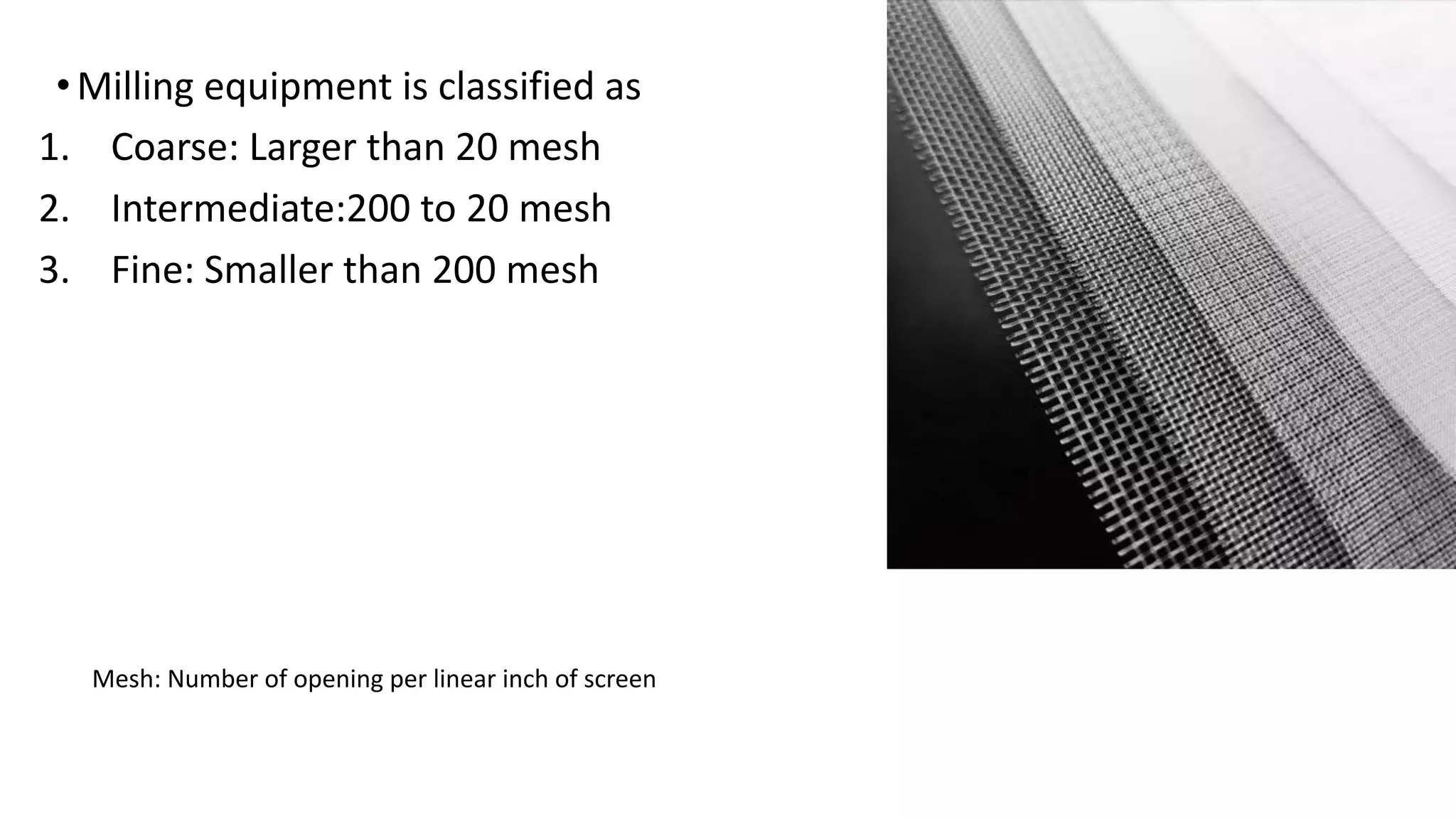
•Milling equipment is classified as
1. Coarse: Larger than 20 mesh
2. Intermediate:200 to 20 mesh
3. Fine: Smaller than 200 mesh
Mesh: Number of opening per linear inch of screen
Pharmaceutical application of milling
1. In milling specific surface area increases by size reduction hence increase the
therapeutic efficiency of medicinal compounds
2. The drying of wet masses are facilitated by milling.
3. The mixing and blending of several solid ingredients become easier if the
ingredients are in same in size.
4. Milling of ointment, cream and paste provides a smooth texture and better
appearance in addition to improve physical stability
5. Some factors should be considered in addition of standard adjustment of
milling process.
• Special atmosphere
• Temperature control
• Pre treatment
• Dual process milling compress milling
• Subsequent treatment
• Wet and dry milling
Drying
• Drying is defined as removal of liquid from the materials by application of heat and
is accompanied by the transfer of liquid from a surface to an unsaturated vapor
phase.
• Drying applies for removal of a small amount of liquids from matters. Drying and
evaporation are distinguished by the relative quantity of liquid removed from the
solid.
Purpose of drying
1. Decrease the bacterial growth in solvent
2. For the preparation of granules
3. Reduce the bulk weight
4. Dried products are more stable than moist one
Expression of Drying
•Wet- weight basis: LOD ( loss on drying): LOD is the loss of weight
expressed as percentage w/w resulting from water and any kind of
volatile matter that can be driven off under specific condition. LOD is
an expression of moisture content in wet weight basis.
• wt. of water in sample
LOD( %) =
total wt of wet sample
•Dry –weight basis: MC (Moisture content): the amount of water
present in sample is calculated on dry weight basis
wt. of water in sample
MC(%)=
total wt of dry sample
Difference of LOD and MC
•In LOD , sample is heated below its melting point in an oven and it
includes all volatile matter including water content and solvents like
alcohol
In MC only water is evaporated by Karl Fischer titration method.
• In LOD both bound and free water are evaporated
In MC free water is evaporated
•LOD values can vary from slightly above zero to slightly below 100.
But MC value vary from slightly above zero to infinity
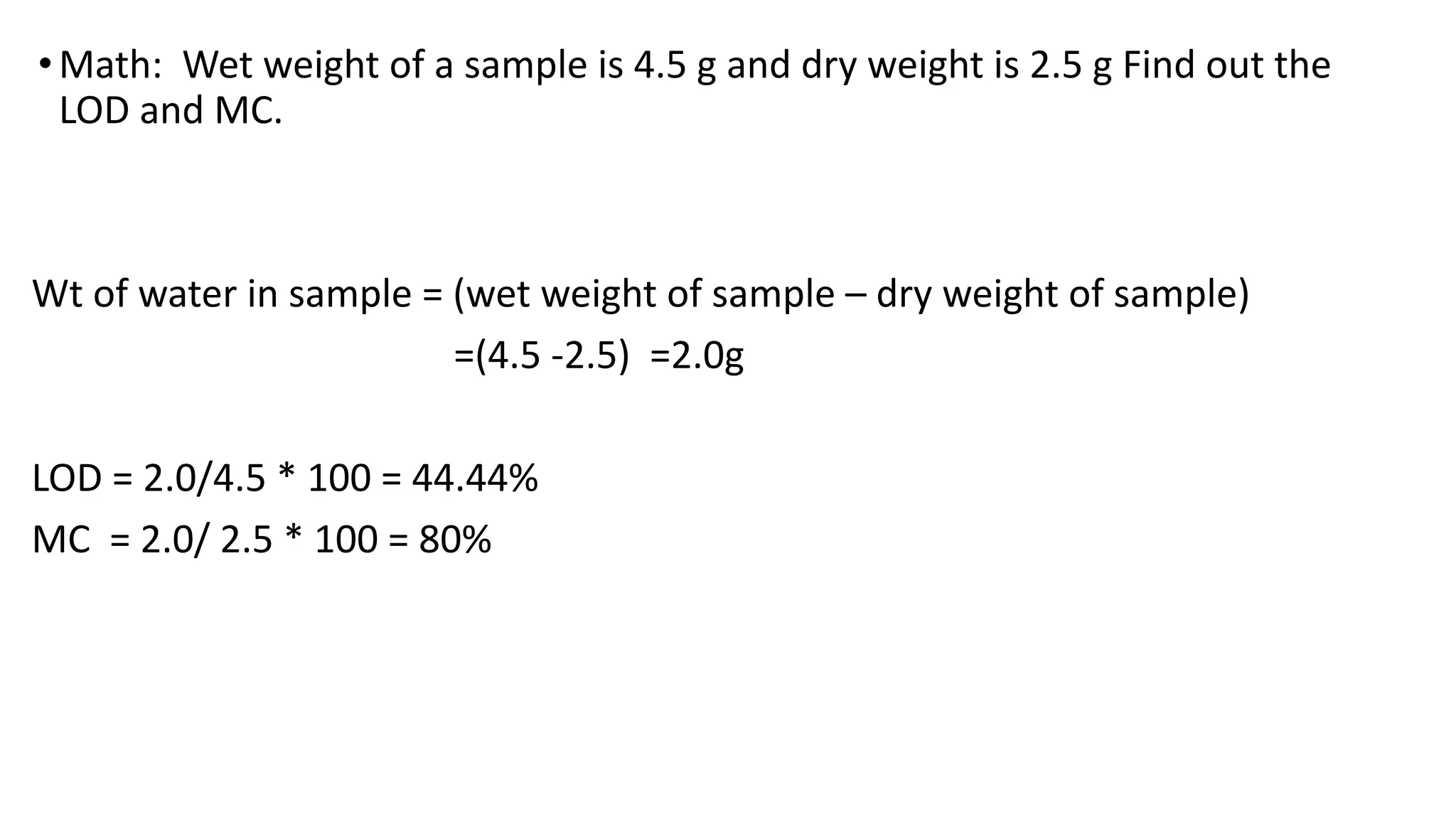
•Math: Wet weight of a sample is 4.5 g and dry weight is 2.5 g Find out the
LOD and MC.
Wt of water in sample = (wet weight of sample – dry weight of sample)
=(4.5 -2.5) =2.0g
LOD = 2.0/4.5 * 100 = 44.44%
MC = 2.0/ 2.5 * 100 = 80%
Granulation
• Granulation is the process in which particles of raw materials are made to adhere to
form larger granules in order to facilitate compression. granulation involves
agglomeration of fine particles into larger granules, typically of size range
between 0.2 and 4.0 mm depending on their subsequent use.
1. Dry granulation
2. Wet granulation
• Advantages
1. Ensure the higher distribution uniformity of drugs
2. Higher diffusion rate
3. Easy to compress
4. No introduction of heat
5. Continuous process
Blending
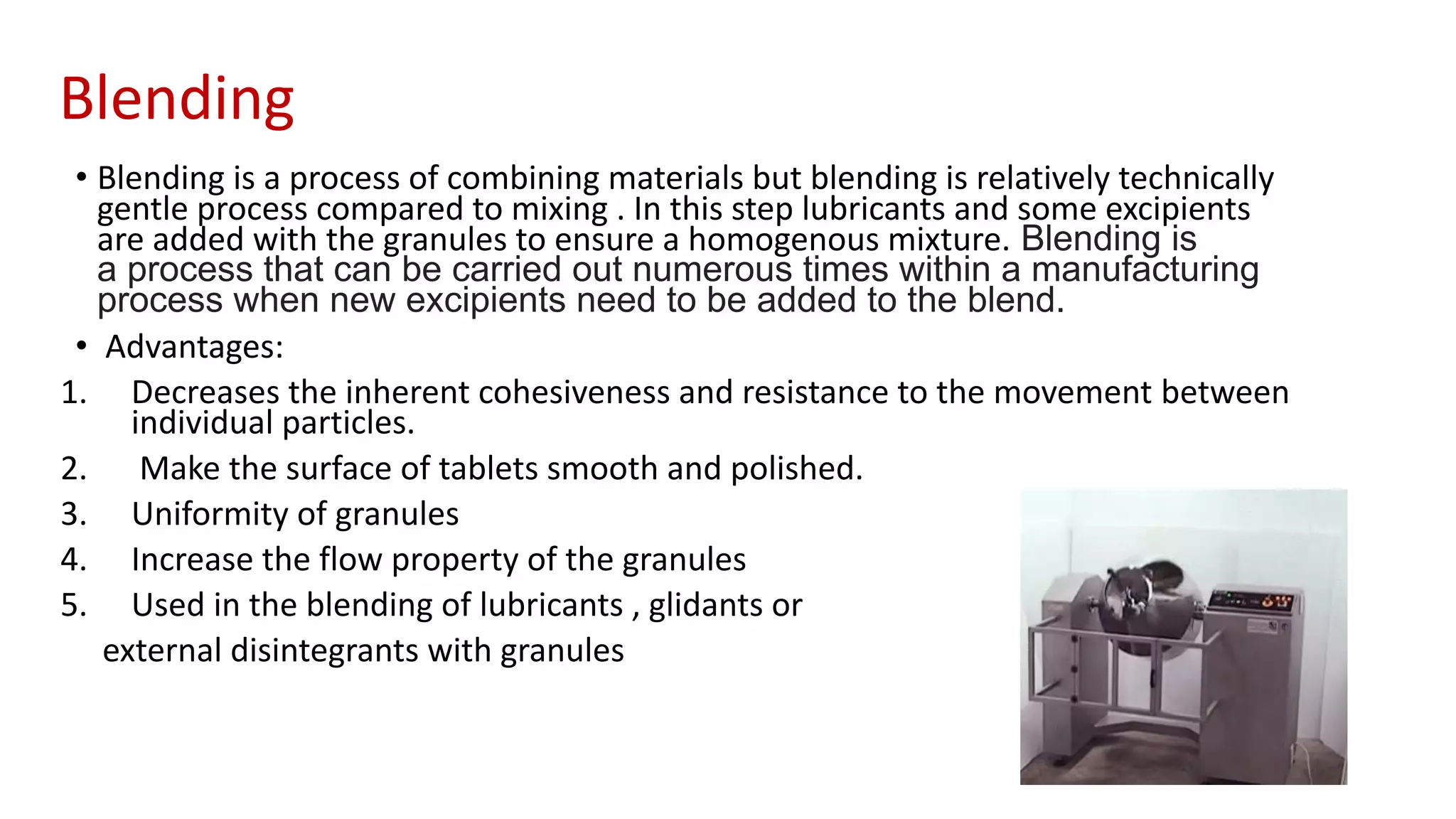
• Blending is a process of combining materials but blending is relatively technically
gentle process compared to mixing . In this step lubricants and some excipients
are added with the granules to ensure a homogenous mixture. Blending is
a process that can be carried out numerous times within a manufacturing
process when new excipients need to be added to the blend.
• Advantages:
1. Decreases the inherent cohesiveness and resistance to the movement between
individual particles.
2. Make the surface of tablets smooth and polished.
3. Uniformity of granules
4. Increase the flow property of the granules
5. Used in the blending of lubricants , glidants or
external disintegrants with granules
Compression and Consolidation
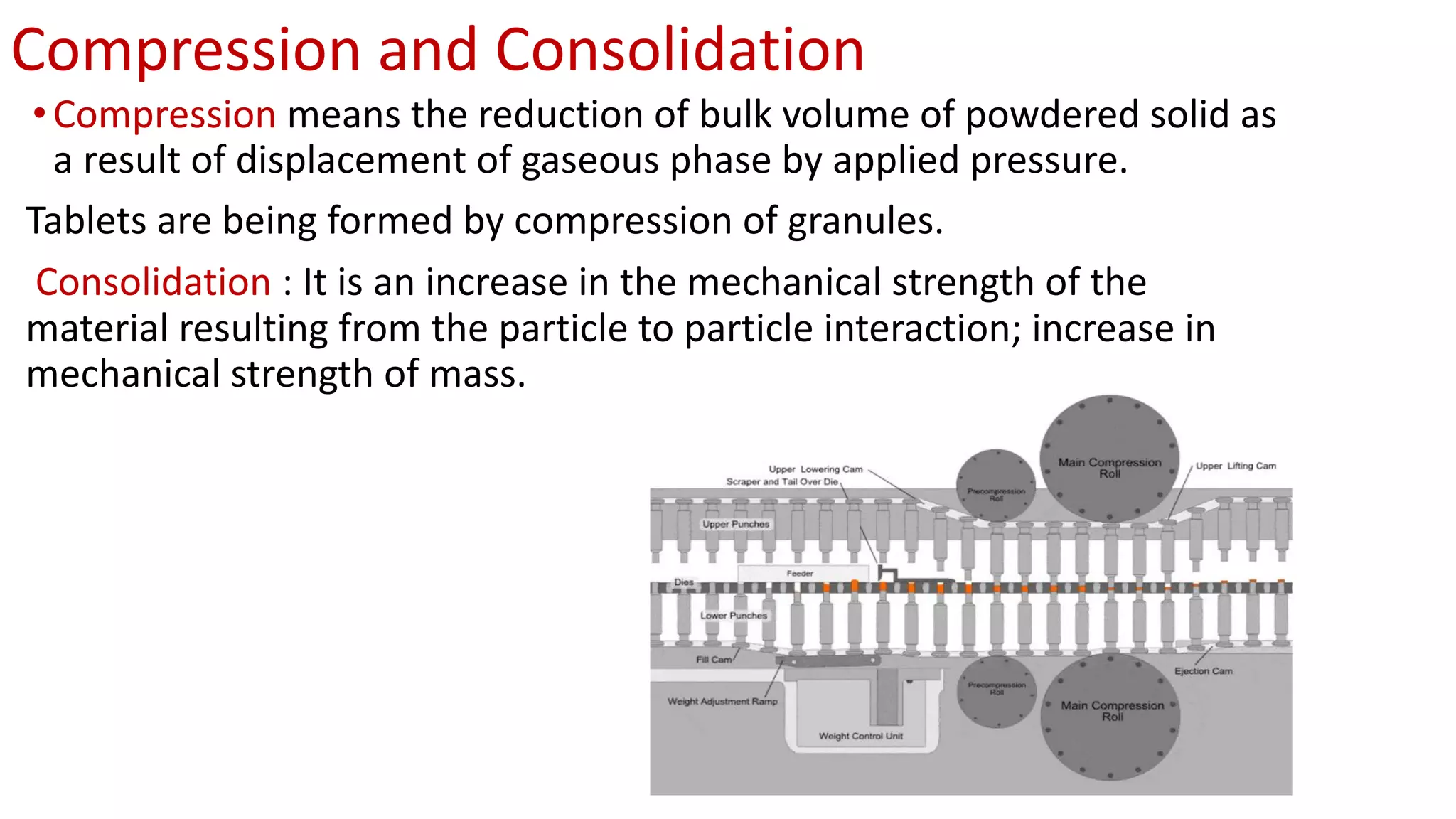
•Compression means the reduction of bulk volume of powdered solid as
a result of displacement of gaseous phase by applied pressure.
Tablets are being formed by compression of granules.
Consolidation : It is an increase in the mechanical strength of the
material resulting from the particle to particle interaction; increase in
mechanical strength of mass.
Mass-Volume relationships
• True Volume of the powder (Vt
): True volume is the total volume of the solid particles. It is a
volume of the particles excluding the inter and intra particulate spaces in a powder. Or it is volume of
powder itself .
• Granular Volume of the powder (Vg
): It is the cumulative volume occupied by the particles,
including all intraparticulate (but not interparticulate) voids. Or it is the volume of powder itself and
volume of intraparticulate spaces.
• Bulk Volume of the powder (Vb
): It is the total volume occupied by the entire powder mass under
the particular packing achieved during the measurement.
It comprises the true volume and inter and intra particulate voids.
• Relative volume (VR
): It is the ratio of the the volume, V of the sample under specific experimental
conditions, to the true volume Vt.
VR
= V / Vt
VR
tends to become unity as all air is eliminated from the mass during the compression process
Three terms are used to define the volume of powdered solid / Mass volume
relationship
Coating
Tablet coating is the last critical step in the tablet production.
Coating is a process of spreading a specific solution of a
substance over the surface of a tablet. Ex: propylene silicate,
Opaglos 6000.
Tablet coating is a process by which an essentially dry,
outer layer of coating material is applied to the surface of a
dosage form in order to confer specific benefits over
uncoated variety. Coatings may be applied to various oral
dosage forms such as particles, powders, granules,
crystals, pellets and tablets.
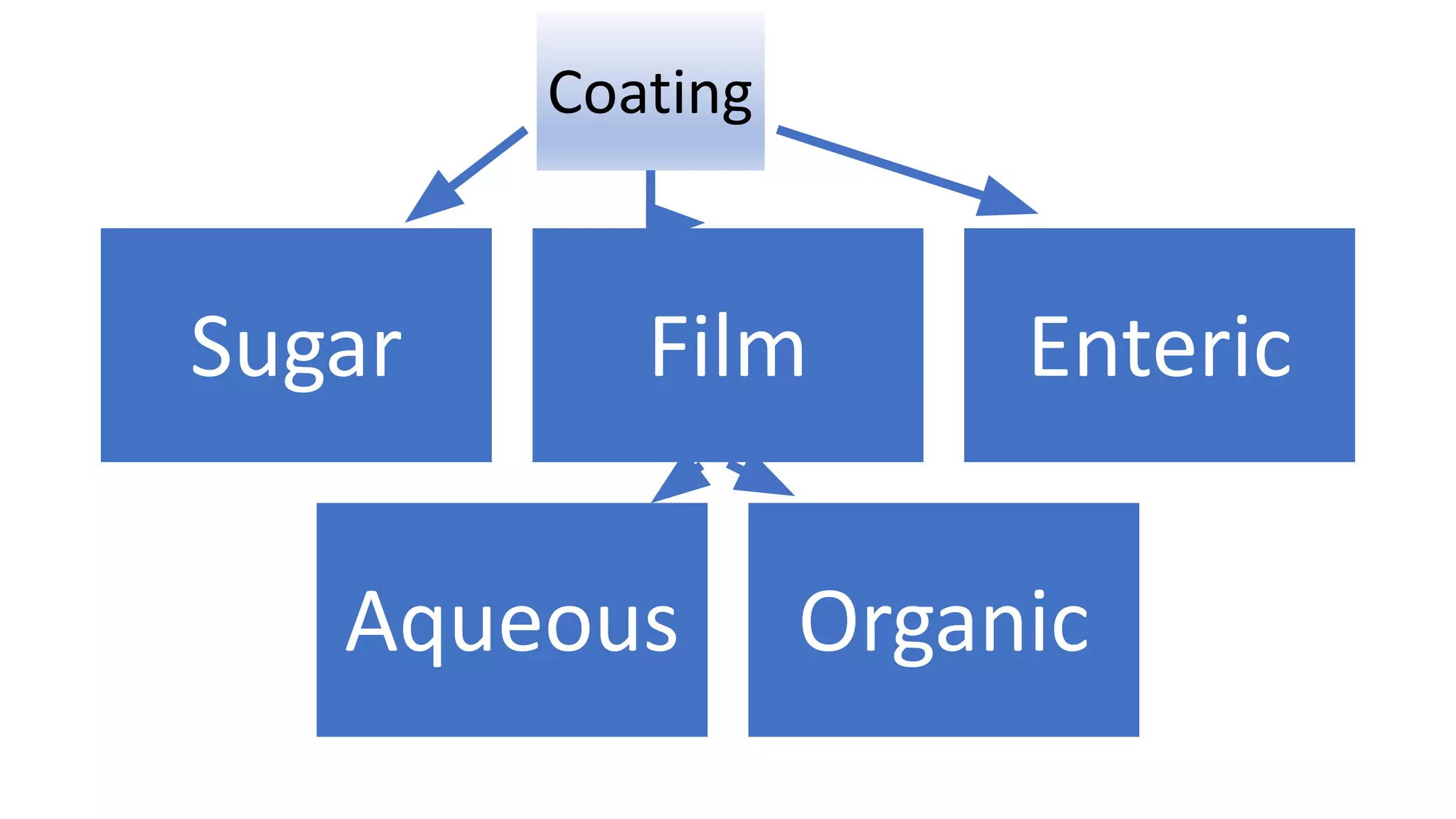
Sugar Film Enteric
Aqueous Organic
Coating
Packaging
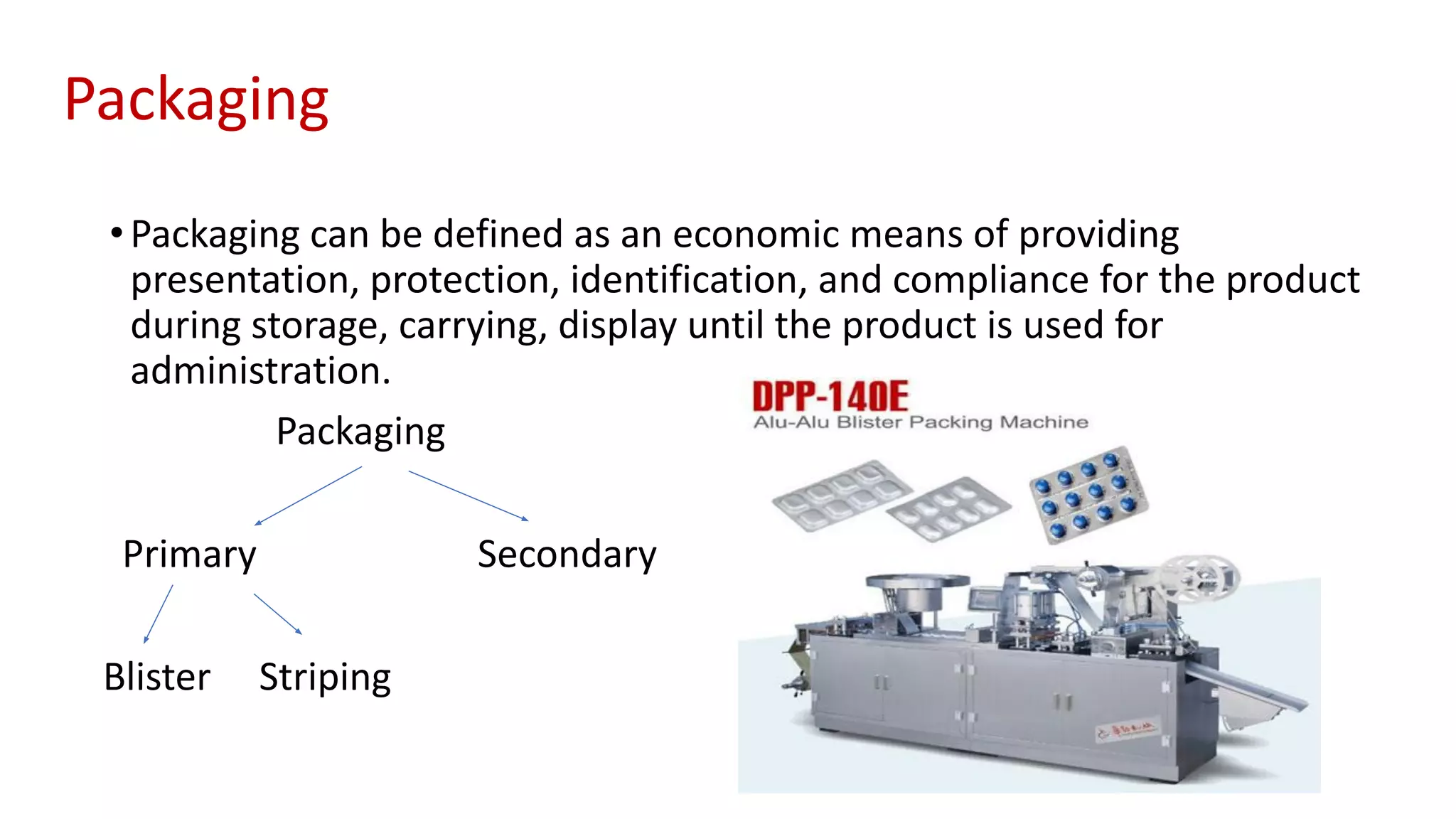
•Packaging can be defined as an economic means of providing
presentation, protection, identification, and compliance for the product
during storage, carrying, display until the product is used for
administration.
Packaging
Primary Secondary
Blister Striping

Chapter 1 - Fundamentals of Pharmaceutical Chemistry.pdf

  • 1.
    Fundamentals of PharmaceuticalChemistry What is pharmaceutical chemistry ? Pharmaceutical chemistry is the study of drugs and it involves drug development, drug discovery, delivery, absorption, metabolism and more. Pharmaceutical Raw Materials? Pharmaceutical raw materials are substances , chemicals, extracts, substrate or element that are used for manufacturing different types of drugs. Ex: Penicillin, Ampicillin
  • 2.
    Drying • Drying isdefined as removal of liquid from the materials by application of heat and is accompanied by the transfer of liquid from a surface to an unsaturated vapor state. • Drying applies for the removal of a small amount of liquids from the matters. Drying and evaporation are distinguished by the relative quantity of liquid removed from the solid. Purpose of drying: 1. Decrease the bacterial growth in solvent 2. For preparation of granules 3. Reduce the bulk weight 4. Dried product are more stable than moist one
  • 3.
    Raw material sources •Natural •Synthetic Thereare three major types of pharmaceutical raw materials •Active pharmaceutical ingredients (API) •Excipients •Raw material packaging
  • 4.
    •API: API alsoknown as bulk active is the ingredient in a pharmaceutical drug that is biologically active and have the desired pharmacological effect on living beings. Ex: Amlodipine bisilate, Paracetamol •Excipients: They are pharmacologically inert substances that are used for the proper delivery of drugs in their dosage form. Ex: Sorbitol , Aspartane
  • 5.
    A brief classificationof API on basis of therapeutic effect 1. 1.Anti-allergic drugs : These are pharmaceutical drugs or medicine, used to treat allergic reactions caused by foreign substances such as pollen, dust,mite. Ex: Cetirizine HCl 2. Antihistamine: Also known as histamine antagonist that are used for preventing and treating allergies, itching, hay fever etc. Ex: Loratadine 3. Antibiotics: These are are drugs used to stop or combat the growth of harmful microorganism like bacteria within the body without harming it. Also known as anti- effective drugs. Ex: Azythromycine 4. Anti-diabetics: Known as hypoglycemic agent, that are used for treating diabetics by lowering glucose level in blood. Ex: Insuline , Metformine 5. Analgesics: These are used to relive pain. Ex: Diclofenac Na, Paracetamol
  • 6.
    6. Anti- neoplasticagent : Used for restricting or hindering of neoplasm ( tumour) within the body. Ex: Bicalutamide 7. Anti cancer: These are used to kill cancer cell Within the body. Ex: carboplatine , Cisplatine 8. Anti viral: Used for treating curing and controlling viral infections. Ex: Acyclovir, Valacyclovir 9. Cardiovascular drug : These are given to patients suffering from heart and related disorder. Ex: Losartane potassium 10. Cough Medicine: Drugs that are used for treating and curing cough related syndromes. Ex: Cefixime 11. Anti fungal: Types of drug are crucial for treating, curing and preventing skin ailments. Ex: Fluconazole , Terconazole 12. Sergical Drug: Used to temporarily lower sensation or induce unconsciousness
  • 7.
    Classification of Excipients 1.Anti adherent: Used to smoothen the surface of the tablet. i) Magnesium stearate 2. Binder: binders hold the ingredients in a tablet together. i) Manitol 3. Coating: i) Deterioration by moisture in the air ii) Unpleasant tasting tablets iii) Easier to swallow iv) Unwanted colour v) Odor masking vi) Physical and chemical protection vii) Protect the drug in the stomach. Eg. Synthetic polymers, shellac
  • 8.
    4. Disintegrants: Theyensure that when the tablet is in contact with water, it rapidly breaks down into smaller fragments, facilitating dissolution. Ex: Crosslinked polymers 5. Glidants: 6. Filters and diluents: Used to increase the volume of small tablets. The drug become convenient for the consumer to use. Ex: i) Lactose ii) Sucrose 7. Flavours: To mask unpleasant tasting API. It may be synthetic or artificial. Non toxic Ex: i) Vanilla 8. Color:
  • 9.
    9. Lubricant: Tosmooth/polish the tablet surface. Also to increase the flow property in the machine. i) Magnesium carbonate 10. Preservatives: For long durability of drugs. i) Methyl paraben 11. Sorbent: Used for table/capsule moisture-proofing by limited fluid sorbing in a dry state. Ex: TiO2 12. Sweeteners: Ex: Sugar, Saccharine
  • 10.
    Raw Material Procurement •PDProduct Development/ Research and Development design the new product and inform the SCM supply chain management •SCM identify the sources of raw materials and send them vendor questionnaire •Suppliers fill the questionnaire and return with sufficient amount of sample (100 gm) for both the API and excipients Also provide – Certificate of analysis (CoA) - Material safety data sheet(MSDS) - Stability data sheet (SDS) - Drug master file DMF - Good manufacturing practice (GMP) •Quality Control QC The samples are received and send to the quality control department for analysis. QC carried out the full test according to the pharmacopeias and write down the comments.
  • 11.
    •If all thetest complies then the supplier is asked for sufficient amount sample to carry out the PD trial and QC test. •PD will justify the production feasibility with supplied sample and QC will carry out 3 months study •When the assessment of the questionnaire, PD trial report, Audit report are positive then the SCM negotiate the financial term with the supplier •Provisionally approved •Qualify the suppliers as approved vendor after receiving three consecutive lots with consistent quality.
  • 12.
    Testing: A vastarray of analyses on pharmaceutical raw materials (api+excipients) to ensure the quality and safety comparing standard specification. According to GMP the specification must be written in precise terminology with detailed test method. Sample/Raw Material Received Sampled Testing Accepted Rejected (Dispose)
  • 13.
    To ensure thequality following parameters are tested in QC Laboratory. 1. Physical and chemical test: a) Description: Colour/Odour/crystal/powder b) Solubility c) Identification : Compound to the standard material All the properties should comply with the standard specification. EPCRS (European pharmacopeia chemical reference substance)
  • 14.
    (C) Identification: i) Infra-red ii)UV iii) HPLC iv) Melting point v) Congealing point vi) TLC IR
  • 15.
    Write down twospectroscopic methods for identifying raw materials.
  • 17.
    Purity and quality: Levelof impurity potency (% of the substance present in the sample) 1. General completeness of solution, pH, specific rotation, nonvolatile, residue on ignition loss on drying, water content, heavy metal. 2. Specific purity test: Ferric and Ferrous salt, peroxide, aldehyde, related disintegrated product. 3. Specific Quality test: Particle size, crystallinity, polymeric forms. 4. Assay. a) Calculated either on anhydrous or hydrous basis b) Total amount of sample (% unit)
  • 18.
    2. Microbiological test:(I) Safety, potency, progenecity, sterility, anticeptic nature, toxicity • Testing or assay of parcacetamol: i) Description: White crystalline colourless powder, Molecular formula > C8 H9 NO2 Molecular Wt- 151.16 g/mol Structural formula > p-hydroxy acetanilide ii) Solubility: Sparingly soluble in water, freely soluble in alcohol, acetone, and very slightly soluble in DCM
  • 19.
    3. Identification: a) IR-Absorptionspectrum, spectra superimposed to reference substance b) UV-absorption spectrum – 249 nm = Z max c) FeCl3 test: (Ferric Chloride test) according to BP d) Melting point: 168-172 C°
  • 20.
    4. pH range5.3-6.5 5. Water content: Not more than 0.5% 6. Residue on ignition : Not more than 0.1% 7. Chloride: Not more than 0.014% 8. Sulphate: Not more than 0.02% 9. Sulfide: Absent 10. Heavy metals: Not more than 0.001% 11. Free amino phenol: Not more than 0.005% 12. D-chloroacetamide: Not more than 0.001% 13. LOD: Not more than 0.5% 14. Assay – 99-101%
  • 21.
  • 22.
    •Dispensing: Dispensing isthe first and critical step in pharmaceutical manufacturing. During this step each ingredients are weighted according to dose. The following factors are important 1. Wight accuracy 2. Dust control 3. HVAC (High vacuum air circulation) 4. Lot control 5. Material movement into and out of the dispensing should be considered
  • 23.
    •MIXING : Mixingis a defined process that tends to results in randomization of dissimilar( size, colour, physical state differences) particles within a system. This is to be distinguished from order system in which the particles are arranged according to some interactive rules and thus follow a repetitive pattern. •Two types of mixing 1. Fluid /liquid mixing 2. Solid mixing Quality of the instrument: 1. Physical properties of materials to be mixed 2. The economic consideration regarding the process 3. Cost of equipment and maintenance 4. Quality of the materials to be used
  • 24.
    • MILLING: Millingis the mechanical process of reducing the particle size of solids. By this process solid materials break into smaller pieces by grinding and crushing. • Milling involves the application of mechanical energy to physically break down coarse particles to finer ones and is regarded as a “top–down” approach in the production of fine particles. Fine drug particulates are especially desired in formulations designed for parenteral, respiratory and transdermal use.
  • 25.
    •Milling equipment isclassified as 1. Coarse: Larger than 20 mesh 2. Intermediate:200 to 20 mesh 3. Fine: Smaller than 200 mesh Mesh: Number of opening per linear inch of screen
  • 26.
    Pharmaceutical application ofmilling 1. In milling specific surface area increases by size reduction hence increase the therapeutic efficiency of medicinal compounds 2. The drying of wet masses are facilitated by milling. 3. The mixing and blending of several solid ingredients become easier if the ingredients are in same in size. 4. Milling of ointment, cream and paste provides a smooth texture and better appearance in addition to improve physical stability 5. Some factors should be considered in addition of standard adjustment of milling process. • Special atmosphere • Temperature control • Pre treatment • Dual process milling compress milling • Subsequent treatment • Wet and dry milling
  • 27.
    Drying • Drying isdefined as removal of liquid from the materials by application of heat and is accompanied by the transfer of liquid from a surface to an unsaturated vapor phase. • Drying applies for removal of a small amount of liquids from matters. Drying and evaporation are distinguished by the relative quantity of liquid removed from the solid. Purpose of drying 1. Decrease the bacterial growth in solvent 2. For the preparation of granules 3. Reduce the bulk weight 4. Dried products are more stable than moist one
  • 28.
    Expression of Drying •Wet-weight basis: LOD ( loss on drying): LOD is the loss of weight expressed as percentage w/w resulting from water and any kind of volatile matter that can be driven off under specific condition. LOD is an expression of moisture content in wet weight basis. • wt. of water in sample LOD( %) = total wt of wet sample •Dry –weight basis: MC (Moisture content): the amount of water present in sample is calculated on dry weight basis wt. of water in sample MC(%)= total wt of dry sample
  • 29.
    Difference of LODand MC •In LOD , sample is heated below its melting point in an oven and it includes all volatile matter including water content and solvents like alcohol In MC only water is evaporated by Karl Fischer titration method. • In LOD both bound and free water are evaporated In MC free water is evaporated •LOD values can vary from slightly above zero to slightly below 100. But MC value vary from slightly above zero to infinity
  • 30.
    •Math: Wet weightof a sample is 4.5 g and dry weight is 2.5 g Find out the LOD and MC. Wt of water in sample = (wet weight of sample – dry weight of sample) =(4.5 -2.5) =2.0g LOD = 2.0/4.5 * 100 = 44.44% MC = 2.0/ 2.5 * 100 = 80%
  • 31.
    Granulation • Granulation isthe process in which particles of raw materials are made to adhere to form larger granules in order to facilitate compression. granulation involves agglomeration of fine particles into larger granules, typically of size range between 0.2 and 4.0 mm depending on their subsequent use. 1. Dry granulation 2. Wet granulation • Advantages 1. Ensure the higher distribution uniformity of drugs 2. Higher diffusion rate 3. Easy to compress 4. No introduction of heat 5. Continuous process
  • 32.
    Blending • Blending isa process of combining materials but blending is relatively technically gentle process compared to mixing . In this step lubricants and some excipients are added with the granules to ensure a homogenous mixture. Blending is a process that can be carried out numerous times within a manufacturing process when new excipients need to be added to the blend. • Advantages: 1. Decreases the inherent cohesiveness and resistance to the movement between individual particles. 2. Make the surface of tablets smooth and polished. 3. Uniformity of granules 4. Increase the flow property of the granules 5. Used in the blending of lubricants , glidants or external disintegrants with granules
  • 33.
    Compression and Consolidation •Compressionmeans the reduction of bulk volume of powdered solid as a result of displacement of gaseous phase by applied pressure. Tablets are being formed by compression of granules. Consolidation : It is an increase in the mechanical strength of the material resulting from the particle to particle interaction; increase in mechanical strength of mass.
  • 34.
  • 35.
    • True Volumeof the powder (Vt ): True volume is the total volume of the solid particles. It is a volume of the particles excluding the inter and intra particulate spaces in a powder. Or it is volume of powder itself . • Granular Volume of the powder (Vg ): It is the cumulative volume occupied by the particles, including all intraparticulate (but not interparticulate) voids. Or it is the volume of powder itself and volume of intraparticulate spaces. • Bulk Volume of the powder (Vb ): It is the total volume occupied by the entire powder mass under the particular packing achieved during the measurement. It comprises the true volume and inter and intra particulate voids. • Relative volume (VR ): It is the ratio of the the volume, V of the sample under specific experimental conditions, to the true volume Vt. VR = V / Vt VR tends to become unity as all air is eliminated from the mass during the compression process Three terms are used to define the volume of powdered solid / Mass volume relationship
  • 36.
    Coating Tablet coating isthe last critical step in the tablet production. Coating is a process of spreading a specific solution of a substance over the surface of a tablet. Ex: propylene silicate, Opaglos 6000. Tablet coating is a process by which an essentially dry, outer layer of coating material is applied to the surface of a dosage form in order to confer specific benefits over uncoated variety. Coatings may be applied to various oral dosage forms such as particles, powders, granules, crystals, pellets and tablets.
  • 38.
  • 39.
    Packaging •Packaging can bedefined as an economic means of providing presentation, protection, identification, and compliance for the product during storage, carrying, display until the product is used for administration. Packaging Primary Secondary Blister Striping