pH STABILITY PROFILE
Presented by-
1.Sayali Pawar
2.Shweta Pansare
3.Akshada Salunkhe
4.Snehal Patil
5.Supriya Pawar
6.Sneha Shinde
02-08-2018
1
At VES College of Pharmacy, Chembur.
FACTORS AFFECTING REACTION RATE: pH
 pH of drug solution has a very dramatic effects on stability.
Stability is the extent to which a product retains the same properties
and characteristics that it possessed at the time of manufacture or
compounding within specified limits and throughout its period of
storage and use (i.e., its shelf-life).
 Just 1 pH unit shift will cause 10 fold change in Rate constant.
 Therefore, when drugs are formulated in solution it is essential to
construct pH versus rate profile so that optimum pH for stability can
be located.
02-08-2018
2
What is pH Rate profile?
 A pH-rate profile is a plot of log kobs (for acid - base - neutral
reaction) v/s pH.
 It is done by determining pH at which drug is most susceptible to
degradation and then formulated at different pH using buffers to
minimize degradation.
 Buffers are prepared to alter the pH.
02-08-2018
3
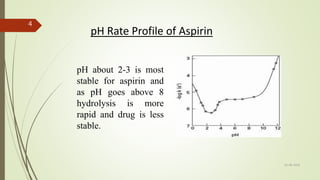
pH Rate Profile of Aspirin
pH about 2-3 is most
stable for aspirin and
as pH goes above 8
hydrolysis is more
rapid and drug is less
stable.
02-08-2018
4
 In pH rate profile, the reaction of each molecular species of drug
with hydrogen ion, water and hydroxide ion is analysed as a
function of pH.
 When the drug is non-ionizable in water it can degrade by three
hydrolytic pathways:
 If the proton source is hydronium (H+), the catalysis is termed
as Specific acid catalysis.
 If the drug is catalysed by both acid and base it is termed as
water hydrolysis.
 If the base is hydroxide (OH-), the catalysis is termed as
Specific base catalysis.
02-08-2018
5
-dc/dt = k1 [H+]c + k2 c + k3 [OH-]c …………….(1)
Rearranging the above equation,
-dc/c.dt = k1 [H+] + k2 + k3 [OH-]
(-dc/c.dt = kobs )
Therefore,
kobs = k1 [H+] + k2 + k3 [OH-]
k1 and k3 are second order constants
k2 is pseudo first order constant
02-08-2018
6
The pH v/s rate profile is constructed by one by one considering one
of the three kinetic terms predominanting.
When, k1 [H+] >>> k2 + k3 [OH-]
kobs = k1 [H+] and log kobs =log k1 – pH…… (2)
When, k2 >>> k1 [H+] + k3 [OH-]
kobs = k2 and log kobs =log k2 …… (3)
When, k3 [OH-] >>> k1 [H+] + k2
kobs = k3 [OH-] and log kobs =log k3 + pH…… (4)
02-08-2018
7
Equation 2, 3 and 4 can be plotted as shown in figure
02-08-2018
8
logkobs
pH
2
3
4 The lines are dotted to
indicate that position of
lines is not fixed and
depends on relative
magnitudes of rate
constant
 If the contribution of first and second term is larger than third
term, the pH rate profile shown below is obtained (acid catalysed)
02-08-2018
9
kobs = k1 [H+] + k2 + k3 [OH-]
 If the contribution of second and third term is larger than first
term, the pH rate profile shown below is obtained (base
catalyzed)
02-08-2018
10
 If the contribution of first and third terms are dominant then the
following V- type of profile is obtained (both acid and base
catalyzed)
02-08-2018
11
02-08-2018
12
If all the terms contribute equally then the U type of
profile is obtained
02-08-2018
13
02-08-2018
14
 The drug substances capable of undergoing ionization yield more complex pH
rate profiles.
 Expression for kobs may contain more than 3 terms.
 For e.g. Apparent degradation rate constant for a drug that is weak base will
depend on the ionization constant ka, of the conjugate acid of the weak base
and the concentration of hydronium ion and other species, as described by,
Where, kH+ and kOH- are the hydronium ion and hydroxide ion catalyzed rate
constant for ionized and non ionized drug respectively and kH2Oand k’ H2O are
H2O catalyzed rate constant for ionized and non ionized drug resp.
02-08-2018
15
….. (5)
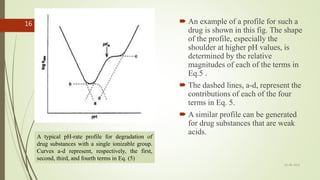
 An example of a profile for such a
drug is shown in this fig. The shape
of the profile, especially the
shoulder at higher pH values, is
determined by the relative
magnitudes of each of the terms in
Eq.5 .
 The dashed lines, a-d, represent the
contributions of each of the four
terms in Eq. 5.
 A similar profile can be generated
for drug substances that are weak
acids.
02-08-2018
16
A typical pH-rate profile for degradation of
drug substances with a single ionizable group.
Curves a-d represent, respectively, the first,
second, third, and fourth terms in Eq. (5)
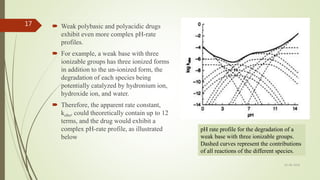
 Weak polybasic and polyacidic drugs
exhibit even more complex pH-rate
profiles.
 For example, a weak base with three
ionizable groups has three ionized forms
in addition to the un-ionized form, the
degradation of each species being
potentially catalyzed by hydronium ion,
hydroxide ion, and water.
 Therefore, the apparent rate constant,
kobs, could theoretically contain up to 12
terms, and the drug would exhibit a
complex pH-rate profile, as illustrated
below
02-08-2018
17
pH rate profile for the degradation of a
weak base with three ionizable groups.
Dashed curves represent the contributions
of all reactions of the different species.

pH stability profile

  • 1.
    pH STABILITY PROFILE Presentedby- 1.Sayali Pawar 2.Shweta Pansare 3.Akshada Salunkhe 4.Snehal Patil 5.Supriya Pawar 6.Sneha Shinde 02-08-2018 1 At VES College of Pharmacy, Chembur.
  • 2.
    FACTORS AFFECTING REACTIONRATE: pH  pH of drug solution has a very dramatic effects on stability. Stability is the extent to which a product retains the same properties and characteristics that it possessed at the time of manufacture or compounding within specified limits and throughout its period of storage and use (i.e., its shelf-life).  Just 1 pH unit shift will cause 10 fold change in Rate constant.  Therefore, when drugs are formulated in solution it is essential to construct pH versus rate profile so that optimum pH for stability can be located. 02-08-2018 2
  • 3.
    What is pHRate profile?  A pH-rate profile is a plot of log kobs (for acid - base - neutral reaction) v/s pH.  It is done by determining pH at which drug is most susceptible to degradation and then formulated at different pH using buffers to minimize degradation.  Buffers are prepared to alter the pH. 02-08-2018 3
  • 4.
    pH Rate Profileof Aspirin pH about 2-3 is most stable for aspirin and as pH goes above 8 hydrolysis is more rapid and drug is less stable. 02-08-2018 4
  • 5.
     In pHrate profile, the reaction of each molecular species of drug with hydrogen ion, water and hydroxide ion is analysed as a function of pH.  When the drug is non-ionizable in water it can degrade by three hydrolytic pathways:  If the proton source is hydronium (H+), the catalysis is termed as Specific acid catalysis.  If the drug is catalysed by both acid and base it is termed as water hydrolysis.  If the base is hydroxide (OH-), the catalysis is termed as Specific base catalysis. 02-08-2018 5
  • 6.
    -dc/dt = k1[H+]c + k2 c + k3 [OH-]c …………….(1) Rearranging the above equation, -dc/c.dt = k1 [H+] + k2 + k3 [OH-] (-dc/c.dt = kobs ) Therefore, kobs = k1 [H+] + k2 + k3 [OH-] k1 and k3 are second order constants k2 is pseudo first order constant 02-08-2018 6
  • 7.
    The pH v/srate profile is constructed by one by one considering one of the three kinetic terms predominanting. When, k1 [H+] >>> k2 + k3 [OH-] kobs = k1 [H+] and log kobs =log k1 – pH…… (2) When, k2 >>> k1 [H+] + k3 [OH-] kobs = k2 and log kobs =log k2 …… (3) When, k3 [OH-] >>> k1 [H+] + k2 kobs = k3 [OH-] and log kobs =log k3 + pH…… (4) 02-08-2018 7
  • 8.
    Equation 2, 3and 4 can be plotted as shown in figure 02-08-2018 8 logkobs pH 2 3 4 The lines are dotted to indicate that position of lines is not fixed and depends on relative magnitudes of rate constant
  • 9.
     If thecontribution of first and second term is larger than third term, the pH rate profile shown below is obtained (acid catalysed) 02-08-2018 9 kobs = k1 [H+] + k2 + k3 [OH-]
  • 10.
     If thecontribution of second and third term is larger than first term, the pH rate profile shown below is obtained (base catalyzed) 02-08-2018 10
  • 11.
     If thecontribution of first and third terms are dominant then the following V- type of profile is obtained (both acid and base catalyzed) 02-08-2018 11
  • 12.
  • 13.
    If all theterms contribute equally then the U type of profile is obtained 02-08-2018 13
  • 14.
  • 15.
     The drugsubstances capable of undergoing ionization yield more complex pH rate profiles.  Expression for kobs may contain more than 3 terms.  For e.g. Apparent degradation rate constant for a drug that is weak base will depend on the ionization constant ka, of the conjugate acid of the weak base and the concentration of hydronium ion and other species, as described by, Where, kH+ and kOH- are the hydronium ion and hydroxide ion catalyzed rate constant for ionized and non ionized drug respectively and kH2Oand k’ H2O are H2O catalyzed rate constant for ionized and non ionized drug resp. 02-08-2018 15 ….. (5)
  • 16.
     An exampleof a profile for such a drug is shown in this fig. The shape of the profile, especially the shoulder at higher pH values, is determined by the relative magnitudes of each of the terms in Eq.5 .  The dashed lines, a-d, represent the contributions of each of the four terms in Eq. 5.  A similar profile can be generated for drug substances that are weak acids. 02-08-2018 16 A typical pH-rate profile for degradation of drug substances with a single ionizable group. Curves a-d represent, respectively, the first, second, third, and fourth terms in Eq. (5)
  • 17.
     Weak polybasicand polyacidic drugs exhibit even more complex pH-rate profiles.  For example, a weak base with three ionizable groups has three ionized forms in addition to the un-ionized form, the degradation of each species being potentially catalyzed by hydronium ion, hydroxide ion, and water.  Therefore, the apparent rate constant, kobs, could theoretically contain up to 12 terms, and the drug would exhibit a complex pH-rate profile, as illustrated below 02-08-2018 17 pH rate profile for the degradation of a weak base with three ionizable groups. Dashed curves represent the contributions of all reactions of the different species.