Acids and Bases
Chapter 15
Copyright © The McGraw-Hill Companies, Inc. Permission required for reproduction or display.
Acids
Have a sour taste. Vinegar owes its taste to acetic acid. Citrus
fruits contain citric acid.
React with certain metals to produce hydrogen gas.
React with carbonates and bicarbonates to produce carbon
dioxide gas
Have a bitter taste.
Feel slippery. Many soaps contain bases.
Bases
4.3
Arrhenius acid is a substance that produces H+ (H3O+) in water
Arrhenius base is a substance that produces OH- in water
4.3
A Brønsted acid is a proton donor
A Brønsted base is a proton acceptor
acid
base acid base
15.1
acid
conjugate
base
base
conjugate
acid
O
H
H + O
H
H O
H
H H O
H
-
+
[ ] +
Acid-Base Properties of Water
H2O (l) H+ (aq) + OH- (aq)
H2O + H2O H3O+ + OH-
acid conjugate
base
base
conjugate
acid
15.2
autoionization of water
H2O (l) H+ (aq) + OH- (aq)
The Ion Product of Water
Kc =
[H+][OH-]
[H2O]
[H2O] = constant
Kc[H2O] = Kw = [H+][OH-]
The ion-product constant (Kw) is the product of the molar
concentrations of H+ and OH- ions at a particular temperature.
At 250C
Kw = [H+][OH-] = 1.0 x 10⁻¹⁴
[H+] = [OH-]
[H+] > [OH-]
[H+] < [OH-]
Solution Is
neutral
acidic
basic
15.2
What is the concentration of OH- ions in a HCl solution
whose hydrogen ion concentration is 1.3 M?
Kw = [H+][OH-] = 1.0 x 10⁻¹⁴
[H+] = 1.3 M
[OH-] =
Kw
[H+]
1 x 10-14
1.3
= = 7.7 x 10⁻¹⁵ M
15.2
pH – A Measure of Acidity
pH = -log [H+]
[H+] = [OH-]
[H+] > [OH-]
[H+] < [OH-]
Solution Is
neutral
acidic
basic
[H+] = 1 x 10⁻⁷
[H+] > 1 x 10⁻⁷
[H+] < 1 x 10⁻⁷
pH = 7
pH < 7
pH > 7
At 250C
pH [H+]
15.3
15.3
pOH = -log [OH-]
[H+][OH-] = Kw = 1.0 x 10⁻¹⁴
-log [H+] – log [OH-] = 14.00
pH + pOH = 14.00
The pH of rainwater collected in a certain region of the
northeastern United States on a particular day was 4.82.
What is the H+ ion concentration of the rainwater?
pH = -log [H+]
[H+] = 10-pH = 10-4.82 = 1.5 x 10⁻⁵ M
The OH- ion concentration of a blood sample is 2.5 x 10⁻⁷ M.
What is the pH of the blood?
pH + pOH = 14.00
pOH = -log [OH-] = -log (2.5 x 10⁻⁷) = 6.60
pH = 14.00 – pOH = 14.00 – 6.60 = 7.40
15.3
Strong Electrolyte – 100% dissociation
NaCl (s) Na+ (aq) + Cl- (aq)
H2O
Weak Electrolyte – not completely dissociated
CH3COOH CH3COO- (aq) + H+ (aq)
Strong Acids are strong electrolytes
HCl (aq) + H2O (l) H3O+ (aq) + Cl- (aq)
HNO3 (aq) + H2O (l) H3O+ (aq) + NO3
- (aq)
HClO4 (aq) + H2O (l) H3O+ (aq) + ClO4
- (aq)
H2SO4 (aq) + H2O (l) H3O+ (aq) + HSO4
- (aq)
15.4
HF (aq) + H2O (l) H3O+ (aq) + F- (aq)
Weak Acids are weak electrolytes
HNO2 (aq) + H2O (l) H3O+ (aq) + NO2
- (aq)
HSO4
- (aq) + H2O (l) H3O+ (aq) + SO4
2- (aq)
H2O (l) + H2O (l) H3O+ (aq) + OH- (aq)
Strong Bases are strong electrolytes
NaOH (s) Na+ (aq) + OH- (aq)
H2O
KOH (s) K+ (aq) + OH- (aq)
H2O
Ba(OH)2 (s) Ba2+ (aq) + 2OH- (aq)
H2O
15.4
F- (aq) + H2O (l) OH- (aq) + HF (aq)
Weak Bases are weak electrolytes
NO2
- (aq) + H2O (l) OH- (aq) + HNO2 (aq)
Conjugate acid-base pairs:
• The conjugate base of a strong acid has no measurable
strength.
• H3O+ is the strongest acid that can exist in aqueous
solution.
• The OH- ion is the strongest base that can exist in aqeous
solution.
15.4
15.4
Strong Acid Weak Acid
15.4
What is the pH of a 2 x 10⁻³ M HNO3 solution?
HNO3 is a strong acid – 100% dissociation.
HNO3 (aq) + H2O (l) H3O+ (aq) + NO3
- (aq)
pH = -log [H+] = -log [H3O+] = -log(0.002) = 2.7
Start
End
0.002 M
0.002 M 0.002 M
0.0 M
0.0 M 0.0 M
What is the pH of a 1.8 x 10⁻² M Ba(OH)2 solution?
Ba(OH)2 is a strong base – 100% dissociation.
Ba(OH)2 (s) Ba2+ (aq) + 2OH- (aq)
Start
End
0.018 M
0.018 M 0.036 M
0.0 M
0.0 M 0.0 M
pH = 14.00 – pOH = 14.00 + log(0.036) = 12.6
15.4
HA (aq) + H2O (l) H3O+ (aq) + A- (aq)
Weak Acids (HA) and Acid Ionization Constants
HA (aq) H+ (aq) + A- (aq)
Ka =
[H+][A-]
[HA]
Ka is the acid ionization constant
Ka
weak acid
strength
15.5
15.5
What is the pH of a 0.5 M HF solution (at 250C)?
HF (aq) H+ (aq) + F- (aq) Ka =
[H+][F-]
[HF]
= 7.1 x 10⁻⁴
HF (aq) H+ (aq) + F- (aq)
Initial (M)
Change (M)
Equilibrium (M)
0.50 0.00
-x +x
0.50 - x
0.00
+x
x x
Ka =
x2
0.50 - x
= 7.1 x 10⁻⁴
Ka 
x2
0.50
= 7.1 x 10⁻⁴
0.50 – x  0.50
Ka << 1
x2 = 3.55 x 10⁻⁴ x = 0.019 M
[H+] = [F-] = 0.019 M pH = -log [H+] = 1.72
[HF] = 0.50 – x = 0.48 M
15.5
When can I use the approximation?
0.50 – x  0.50
Ka << 1
When x is less than 5% of the value from which it is subtracted.
x = 0.019
0.019 M
0.50 M
x 100% = 3.8%
Less than 5%
Approximation ok.
What is the pH of a 0.05 M HF solution (at 250C)?
Ka 
x2
0.05
= 7.1 x 10⁻⁴ x = 0.006 M
0.006 M
0.05 M
x 100% = 12%
More than 5%
Approximation not ok.
Must solve for x exactly using quadratic equation or method of
successive approximation. 15.5
Solving weak acid ionization problems:
1. Identify the major species that can affect the pH.
• In most cases, you can ignore the autoionization of
water.
• Ignore [OH-] because it is determined by [H+].
2. Use ICE to express the equilibrium concentrations in terms
of single unknown x.
3. Write Ka in terms of equilibrium concentrations. Solve for x
by the approximation method. If approximation is not valid,
solve for x exactly.
4. Calculate concentrations of all species and/or pH of the
solution.
15.5
What is the pH of a 0.122 M monoprotic acid whose
Ka is 5.7 x 10⁻⁴?
HA (aq) H+ (aq) + A- (aq)
Initial (M)
Change (M)
Equilibrium (M)
0.122 0.00
-x +x
0.122 - x
0.00
+x
x x
Ka =
x2
0.122 - x
= 5.7 x 10⁻⁴
Ka 
x2
0.122
= 5.7 x 10⁻⁴
0.122 – x  0.122
Ka << 1
x2 = 6.95 x 10⁻⁵ x = 0.0083 M
0.0083 M
0.122 M
x 100% = 6.8%
More than 5%
Approximation not ok.
15.5
Ka =
x2
0.122 - x
= 5.7 x 10-4 x2 + 0.00057x – 6.95 x 10-5 = 0
ax2 + bx + c =0
-b ± b2 – 4ac

2a
x =
x = 0.0081 x = - 0.0081
HA (aq) H+ (aq) + A- (aq)
Initial (M)
Change (M)
Equilibrium (M)
0.122 0.00
-x +x
0.122 - x
0.00
+x
x x
[H+] = x = 0.0081 M pH = -log[H+] = 2.09
15.5
percent ionization =
Ionized acid concentration at equilibrium
Initial concentration of acid
x 100%
For a monoprotic acid HA
Percent ionization =
[H+]
[HA]0
x 100% [HA]0 = initial concentration
15.5
NH3 (aq) + H2O (l) NH4
+ (aq) + OH- (aq)
Weak Bases and Base Ionization Constants
Kb =
[NH4
+][OH-]
[NH3]
Kb is the base ionization constant
Kb
weak base
strength
15.6
Solve weak base problems like weak acids
except solve for [OH-] instead of [H+].
15.6
15.7
Ionization Constants of Conjugate Acid-Base Pairs
HA (aq) H+ (aq) + A- (aq)
A- (aq) + H2O (l) OH- (aq) + HA (aq)
Ka
Kb
H2O (l) H+ (aq) + OH- (aq) Kw
KaKb = Kw
Weak Acid and Its Conjugate Base
Ka =
Kw
Kb
Kb =
Kw
Ka
15.8
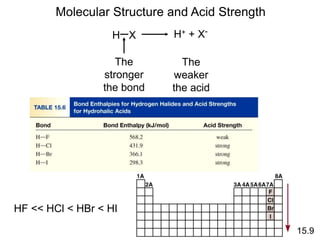
Molecular Structure and Acid Strength
H X H+ + X-
The
stronger
the bond
The
weaker
the acid
HF << HCl < HBr < HI
15.9
Molecular Structure and Acid Strength
Z O H Z O-
+ H+
d- d+
The O-H bond will be more polar and easier to break if:
• Z is very electronegative or
• Z is in a high oxidation state
15.9
Molecular Structure and Acid Strength
1. Oxoacids having different central atoms (Z) that are from
the same group and that have the same oxidation number.
Acid strength increases with increasing electronegativity of Z
H O Cl O
O
••
••
••
••
••
••
••
••
••
H O Br O
O
••
••
••
••
••
••
••
•
•
••
Cl is more electronegative than Br
HClO3 > HBrO3
15.9
Molecular Structure and Acid Strength
2. Oxoacids having the same central atom (Z) but different
numbers of attached groups.
Acid strength increases as the oxidation number of Z increases.
HClO4 > HClO3 > HClO2 > HClO
15.9
Acid-Base Properties of Salts
Neutral Solutions:
Salts containing an alkali metal or alkaline earth metal
ion (except Be2+) and the conjugate base of a strong
acid (e.g. Cl-, Br-, and NO3
-).
NaCl (s) Na+ (aq) + Cl- (aq)
H2O
Basic Solutions:
Salts derived from a strong base and a weak acid.
NaCH3COOH (s) Na+ (aq) + CH3COO- (aq)
H2O
CH3COO- (aq) + H2O (l) CH3COOH (aq) + OH- (aq)
15.10
Acid-Base Properties of Salts
Acid Solutions:
Salts derived from a strong acid and a weak base.
NH4Cl (s) NH4
+ (aq) + Cl- (aq)
H2O
NH4
+ (aq) NH3 (aq) + H+ (aq)
Salts with small, highly charged metal cations (e.g. Al3+,
Cr3+, and Be2+) and the conjugate base of a strong acid.
Al(H2O)6 (aq) Al(OH)(H2O)5 (aq) + H+ (aq)
3+ 2+
15.10
Acid Hydrolysis of Al3+
15.10
Acid-Base Properties of Salts
Solutions in which both the cation and the anion hydrolyze:
• Kb for the anion > Ka for the cation, solution will be basic
• Kb for the anion < Ka for the cation, solution will be acidic
• Kb for the anion  Ka for the cation, solution will be neutral
15.10
Oxides of the Representative Elements
In Their Highest Oxidation States
15.11
CO2 (g) + H2O (l) H2CO3 (aq)
N2O5 (g) + H2O (l) 2HNO3 (aq)
Arrhenius acid is a substance that produces H+ (H3O+) in water
A Brønsted acid is a proton donor
A Lewis acid is a substance that can accept a pair of electrons
A Lewis base is a substance that can donate a pair of electrons
Definition of An Acid
H+
H O H
••
••
+ OH-
••
••
••
acid base
N H
••
H
H
H+ +
acid base
15.12
N H
H
H
H
+
Lewis Acids and Bases
N H
••
H
H
acid base
F B
F
F
+ F B
F
F
N H
H
H
No protons donated or accepted!
15.12
Chemistry In Action: Antacids and the Stomach pH Balance
NaHCO3 (aq) + HCl (aq)
NaCl (aq) + H2O (l) + CO2 (g)
Mg(OH)2 (s) + 2HCl (aq)
MgCl2 (aq) + 2H2O (l)

Chapter_15_Acids_and_Bases.ppt

  • 1.
    Acids and Bases Chapter15 Copyright © The McGraw-Hill Companies, Inc. Permission required for reproduction or display.
  • 2.
    Acids Have a sourtaste. Vinegar owes its taste to acetic acid. Citrus fruits contain citric acid. React with certain metals to produce hydrogen gas. React with carbonates and bicarbonates to produce carbon dioxide gas Have a bitter taste. Feel slippery. Many soaps contain bases. Bases 4.3
  • 3.
    Arrhenius acid isa substance that produces H+ (H3O+) in water Arrhenius base is a substance that produces OH- in water 4.3
  • 4.
    A Brønsted acidis a proton donor A Brønsted base is a proton acceptor acid base acid base 15.1 acid conjugate base base conjugate acid
  • 5.
    O H H + O H HO H H H O H - + [ ] + Acid-Base Properties of Water H2O (l) H+ (aq) + OH- (aq) H2O + H2O H3O+ + OH- acid conjugate base base conjugate acid 15.2 autoionization of water
  • 6.
    H2O (l) H+(aq) + OH- (aq) The Ion Product of Water Kc = [H+][OH-] [H2O] [H2O] = constant Kc[H2O] = Kw = [H+][OH-] The ion-product constant (Kw) is the product of the molar concentrations of H+ and OH- ions at a particular temperature. At 250C Kw = [H+][OH-] = 1.0 x 10⁻¹⁴ [H+] = [OH-] [H+] > [OH-] [H+] < [OH-] Solution Is neutral acidic basic 15.2
  • 7.
    What is theconcentration of OH- ions in a HCl solution whose hydrogen ion concentration is 1.3 M? Kw = [H+][OH-] = 1.0 x 10⁻¹⁴ [H+] = 1.3 M [OH-] = Kw [H+] 1 x 10-14 1.3 = = 7.7 x 10⁻¹⁵ M 15.2
  • 8.
    pH – AMeasure of Acidity pH = -log [H+] [H+] = [OH-] [H+] > [OH-] [H+] < [OH-] Solution Is neutral acidic basic [H+] = 1 x 10⁻⁷ [H+] > 1 x 10⁻⁷ [H+] < 1 x 10⁻⁷ pH = 7 pH < 7 pH > 7 At 250C pH [H+] 15.3
  • 9.
    15.3 pOH = -log[OH-] [H+][OH-] = Kw = 1.0 x 10⁻¹⁴ -log [H+] – log [OH-] = 14.00 pH + pOH = 14.00
  • 10.
    The pH ofrainwater collected in a certain region of the northeastern United States on a particular day was 4.82. What is the H+ ion concentration of the rainwater? pH = -log [H+] [H+] = 10-pH = 10-4.82 = 1.5 x 10⁻⁵ M The OH- ion concentration of a blood sample is 2.5 x 10⁻⁷ M. What is the pH of the blood? pH + pOH = 14.00 pOH = -log [OH-] = -log (2.5 x 10⁻⁷) = 6.60 pH = 14.00 – pOH = 14.00 – 6.60 = 7.40 15.3
  • 11.
    Strong Electrolyte –100% dissociation NaCl (s) Na+ (aq) + Cl- (aq) H2O Weak Electrolyte – not completely dissociated CH3COOH CH3COO- (aq) + H+ (aq) Strong Acids are strong electrolytes HCl (aq) + H2O (l) H3O+ (aq) + Cl- (aq) HNO3 (aq) + H2O (l) H3O+ (aq) + NO3 - (aq) HClO4 (aq) + H2O (l) H3O+ (aq) + ClO4 - (aq) H2SO4 (aq) + H2O (l) H3O+ (aq) + HSO4 - (aq) 15.4
  • 12.
    HF (aq) +H2O (l) H3O+ (aq) + F- (aq) Weak Acids are weak electrolytes HNO2 (aq) + H2O (l) H3O+ (aq) + NO2 - (aq) HSO4 - (aq) + H2O (l) H3O+ (aq) + SO4 2- (aq) H2O (l) + H2O (l) H3O+ (aq) + OH- (aq) Strong Bases are strong electrolytes NaOH (s) Na+ (aq) + OH- (aq) H2O KOH (s) K+ (aq) + OH- (aq) H2O Ba(OH)2 (s) Ba2+ (aq) + 2OH- (aq) H2O 15.4
  • 13.
    F- (aq) +H2O (l) OH- (aq) + HF (aq) Weak Bases are weak electrolytes NO2 - (aq) + H2O (l) OH- (aq) + HNO2 (aq) Conjugate acid-base pairs: • The conjugate base of a strong acid has no measurable strength. • H3O+ is the strongest acid that can exist in aqueous solution. • The OH- ion is the strongest base that can exist in aqeous solution. 15.4
  • 14.
  • 15.
  • 16.
    What is thepH of a 2 x 10⁻³ M HNO3 solution? HNO3 is a strong acid – 100% dissociation. HNO3 (aq) + H2O (l) H3O+ (aq) + NO3 - (aq) pH = -log [H+] = -log [H3O+] = -log(0.002) = 2.7 Start End 0.002 M 0.002 M 0.002 M 0.0 M 0.0 M 0.0 M What is the pH of a 1.8 x 10⁻² M Ba(OH)2 solution? Ba(OH)2 is a strong base – 100% dissociation. Ba(OH)2 (s) Ba2+ (aq) + 2OH- (aq) Start End 0.018 M 0.018 M 0.036 M 0.0 M 0.0 M 0.0 M pH = 14.00 – pOH = 14.00 + log(0.036) = 12.6 15.4
  • 17.
    HA (aq) +H2O (l) H3O+ (aq) + A- (aq) Weak Acids (HA) and Acid Ionization Constants HA (aq) H+ (aq) + A- (aq) Ka = [H+][A-] [HA] Ka is the acid ionization constant Ka weak acid strength 15.5
  • 18.
  • 19.
    What is thepH of a 0.5 M HF solution (at 250C)? HF (aq) H+ (aq) + F- (aq) Ka = [H+][F-] [HF] = 7.1 x 10⁻⁴ HF (aq) H+ (aq) + F- (aq) Initial (M) Change (M) Equilibrium (M) 0.50 0.00 -x +x 0.50 - x 0.00 +x x x Ka = x2 0.50 - x = 7.1 x 10⁻⁴ Ka  x2 0.50 = 7.1 x 10⁻⁴ 0.50 – x  0.50 Ka << 1 x2 = 3.55 x 10⁻⁴ x = 0.019 M [H+] = [F-] = 0.019 M pH = -log [H+] = 1.72 [HF] = 0.50 – x = 0.48 M 15.5
  • 20.
    When can Iuse the approximation? 0.50 – x  0.50 Ka << 1 When x is less than 5% of the value from which it is subtracted. x = 0.019 0.019 M 0.50 M x 100% = 3.8% Less than 5% Approximation ok. What is the pH of a 0.05 M HF solution (at 250C)? Ka  x2 0.05 = 7.1 x 10⁻⁴ x = 0.006 M 0.006 M 0.05 M x 100% = 12% More than 5% Approximation not ok. Must solve for x exactly using quadratic equation or method of successive approximation. 15.5
  • 21.
    Solving weak acidionization problems: 1. Identify the major species that can affect the pH. • In most cases, you can ignore the autoionization of water. • Ignore [OH-] because it is determined by [H+]. 2. Use ICE to express the equilibrium concentrations in terms of single unknown x. 3. Write Ka in terms of equilibrium concentrations. Solve for x by the approximation method. If approximation is not valid, solve for x exactly. 4. Calculate concentrations of all species and/or pH of the solution. 15.5
  • 22.
    What is thepH of a 0.122 M monoprotic acid whose Ka is 5.7 x 10⁻⁴? HA (aq) H+ (aq) + A- (aq) Initial (M) Change (M) Equilibrium (M) 0.122 0.00 -x +x 0.122 - x 0.00 +x x x Ka = x2 0.122 - x = 5.7 x 10⁻⁴ Ka  x2 0.122 = 5.7 x 10⁻⁴ 0.122 – x  0.122 Ka << 1 x2 = 6.95 x 10⁻⁵ x = 0.0083 M 0.0083 M 0.122 M x 100% = 6.8% More than 5% Approximation not ok. 15.5
  • 23.
    Ka = x2 0.122 -x = 5.7 x 10-4 x2 + 0.00057x – 6.95 x 10-5 = 0 ax2 + bx + c =0 -b ± b2 – 4ac  2a x = x = 0.0081 x = - 0.0081 HA (aq) H+ (aq) + A- (aq) Initial (M) Change (M) Equilibrium (M) 0.122 0.00 -x +x 0.122 - x 0.00 +x x x [H+] = x = 0.0081 M pH = -log[H+] = 2.09 15.5
  • 24.
    percent ionization = Ionizedacid concentration at equilibrium Initial concentration of acid x 100% For a monoprotic acid HA Percent ionization = [H+] [HA]0 x 100% [HA]0 = initial concentration 15.5
  • 25.
    NH3 (aq) +H2O (l) NH4 + (aq) + OH- (aq) Weak Bases and Base Ionization Constants Kb = [NH4 +][OH-] [NH3] Kb is the base ionization constant Kb weak base strength 15.6 Solve weak base problems like weak acids except solve for [OH-] instead of [H+].
  • 26.
  • 27.
    15.7 Ionization Constants ofConjugate Acid-Base Pairs HA (aq) H+ (aq) + A- (aq) A- (aq) + H2O (l) OH- (aq) + HA (aq) Ka Kb H2O (l) H+ (aq) + OH- (aq) Kw KaKb = Kw Weak Acid and Its Conjugate Base Ka = Kw Kb Kb = Kw Ka
  • 28.
  • 29.
    Molecular Structure andAcid Strength H X H+ + X- The stronger the bond The weaker the acid HF << HCl < HBr < HI 15.9
  • 30.
    Molecular Structure andAcid Strength Z O H Z O- + H+ d- d+ The O-H bond will be more polar and easier to break if: • Z is very electronegative or • Z is in a high oxidation state 15.9
  • 31.
    Molecular Structure andAcid Strength 1. Oxoacids having different central atoms (Z) that are from the same group and that have the same oxidation number. Acid strength increases with increasing electronegativity of Z H O Cl O O •• •• •• •• •• •• •• •• •• H O Br O O •• •• •• •• •• •• •• • • •• Cl is more electronegative than Br HClO3 > HBrO3 15.9
  • 32.
    Molecular Structure andAcid Strength 2. Oxoacids having the same central atom (Z) but different numbers of attached groups. Acid strength increases as the oxidation number of Z increases. HClO4 > HClO3 > HClO2 > HClO 15.9
  • 33.
    Acid-Base Properties ofSalts Neutral Solutions: Salts containing an alkali metal or alkaline earth metal ion (except Be2+) and the conjugate base of a strong acid (e.g. Cl-, Br-, and NO3 -). NaCl (s) Na+ (aq) + Cl- (aq) H2O Basic Solutions: Salts derived from a strong base and a weak acid. NaCH3COOH (s) Na+ (aq) + CH3COO- (aq) H2O CH3COO- (aq) + H2O (l) CH3COOH (aq) + OH- (aq) 15.10
  • 34.
    Acid-Base Properties ofSalts Acid Solutions: Salts derived from a strong acid and a weak base. NH4Cl (s) NH4 + (aq) + Cl- (aq) H2O NH4 + (aq) NH3 (aq) + H+ (aq) Salts with small, highly charged metal cations (e.g. Al3+, Cr3+, and Be2+) and the conjugate base of a strong acid. Al(H2O)6 (aq) Al(OH)(H2O)5 (aq) + H+ (aq) 3+ 2+ 15.10
  • 35.
  • 36.
    Acid-Base Properties ofSalts Solutions in which both the cation and the anion hydrolyze: • Kb for the anion > Ka for the cation, solution will be basic • Kb for the anion < Ka for the cation, solution will be acidic • Kb for the anion  Ka for the cation, solution will be neutral 15.10
  • 37.
    Oxides of theRepresentative Elements In Their Highest Oxidation States 15.11 CO2 (g) + H2O (l) H2CO3 (aq) N2O5 (g) + H2O (l) 2HNO3 (aq)
  • 38.
    Arrhenius acid isa substance that produces H+ (H3O+) in water A Brønsted acid is a proton donor A Lewis acid is a substance that can accept a pair of electrons A Lewis base is a substance that can donate a pair of electrons Definition of An Acid H+ H O H •• •• + OH- •• •• •• acid base N H •• H H H+ + acid base 15.12 N H H H H +
  • 39.
    Lewis Acids andBases N H •• H H acid base F B F F + F B F F N H H H No protons donated or accepted! 15.12
  • 40.
    Chemistry In Action:Antacids and the Stomach pH Balance NaHCO3 (aq) + HCl (aq) NaCl (aq) + H2O (l) + CO2 (g) Mg(OH)2 (s) + 2HCl (aq) MgCl2 (aq) + 2H2O (l)