1
Petroleum department
3rd stage
Group (A)
Drilling Lab
9th
Experiment:
Hydrogen Ion Concentration (PH)
Date of experiment: March 31st
2016
Supervised by:
Mr. Pshtiwan Jaf &
Eng. Muhammad Jamal
Prepared by:
Muhammad Faisal
2
Aim of experiment:
The aim of this experiment is to indicate the (PH) number of a
specific drilling mud.
3
Theory:
The pH, or hydrogen ion concentration, is a measure of the
relative acidity or alkalinity. The pH value ranges from 0 to 14, with
0-6 being acid, 7 being neutral, and 8-14 being alkaline. Except for
salt muds, the pH of mud is seldom below 7. Generally, the pH of
mud falls between 8 and 11, depending on the mud type. The pH
may be determined by a pH meter, which measures the potential
difference and gives a direct dial reading of the pH. It is accurate, but
because of the delicate nature of the instrument, it has limited field
use. pH papers are more commonly used. These strips change color
in accordance with the acidity or alkalinity of the filtrate. There are a
variety of pH papers available to cover the entire pH range. When the
chloride content exceeds 10,000 ppm, the results become less
accurate. The pH of mud plays a major role in controlling the
solubility of calcium. At high pH values, calcium solubility is very
limited; this makes high-pH mud suitable for use in the drilling of
carbonate formations, which normally are susceptible to erosion and
dissolution by freshwater mud. The pH value is also an important
indicator for the control of corrosion. A minimum value of 9.5 should
always be maintained to prevent oxygen corrosion of casing, drill
pipe, and so forth. A high pH tends to disperse (disintegrate) the
active clays in the mud. (Azar & Samuel, 2007)
4
Introduction:
The term "pH" denotes the negative logarithm of the hydrogen
ion, H+, activity in aqueous solutions: pH = -log (H+) Field
measurement of drilling fluid or filtrate pH and adjustments to the
pH are fundamental to drilling fluid control. Clay interactions,
solubility of various components and contaminants, and
effectiveness of additives are all dependent on pH.
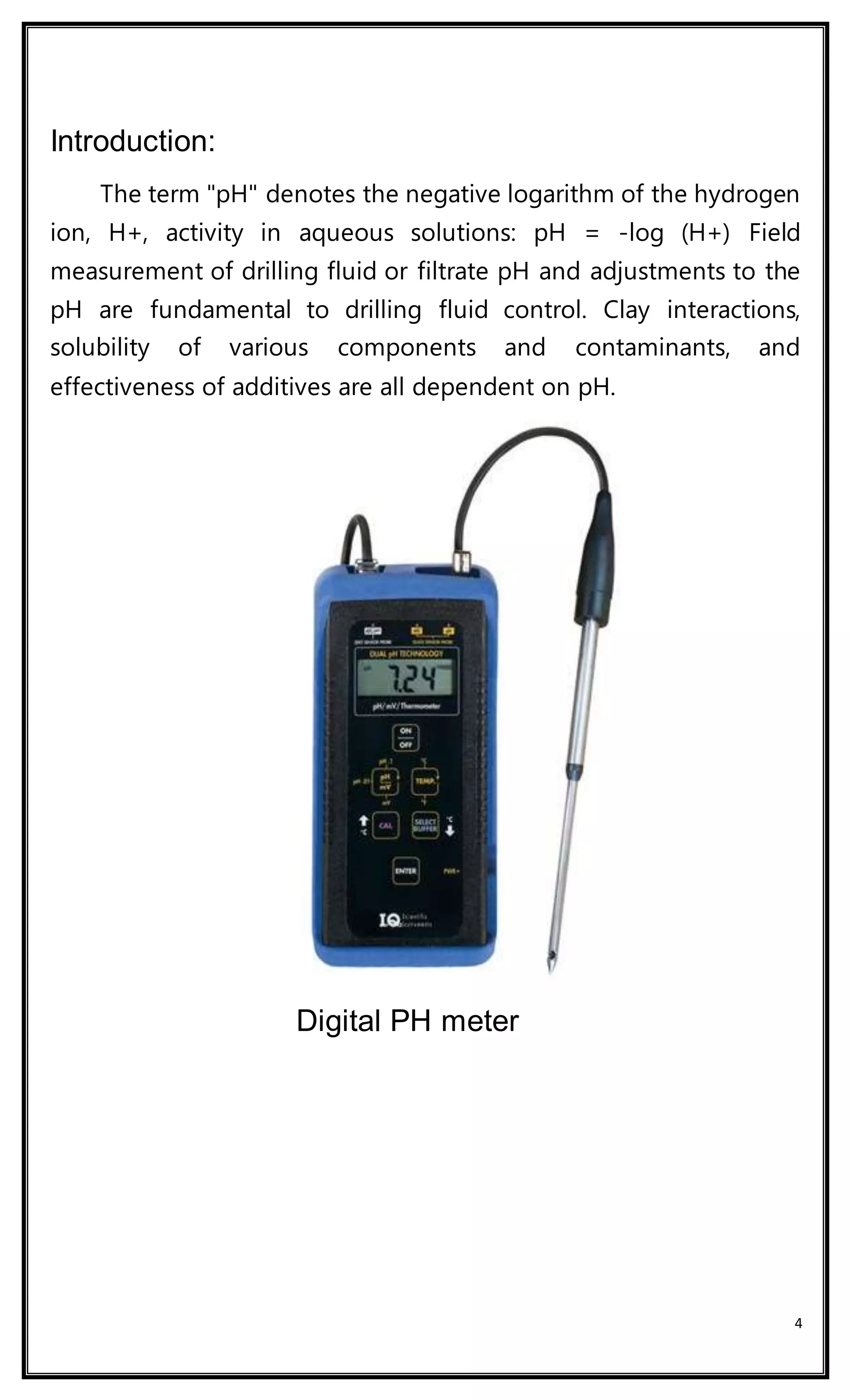
Digital PH meter
5
Apparatus:
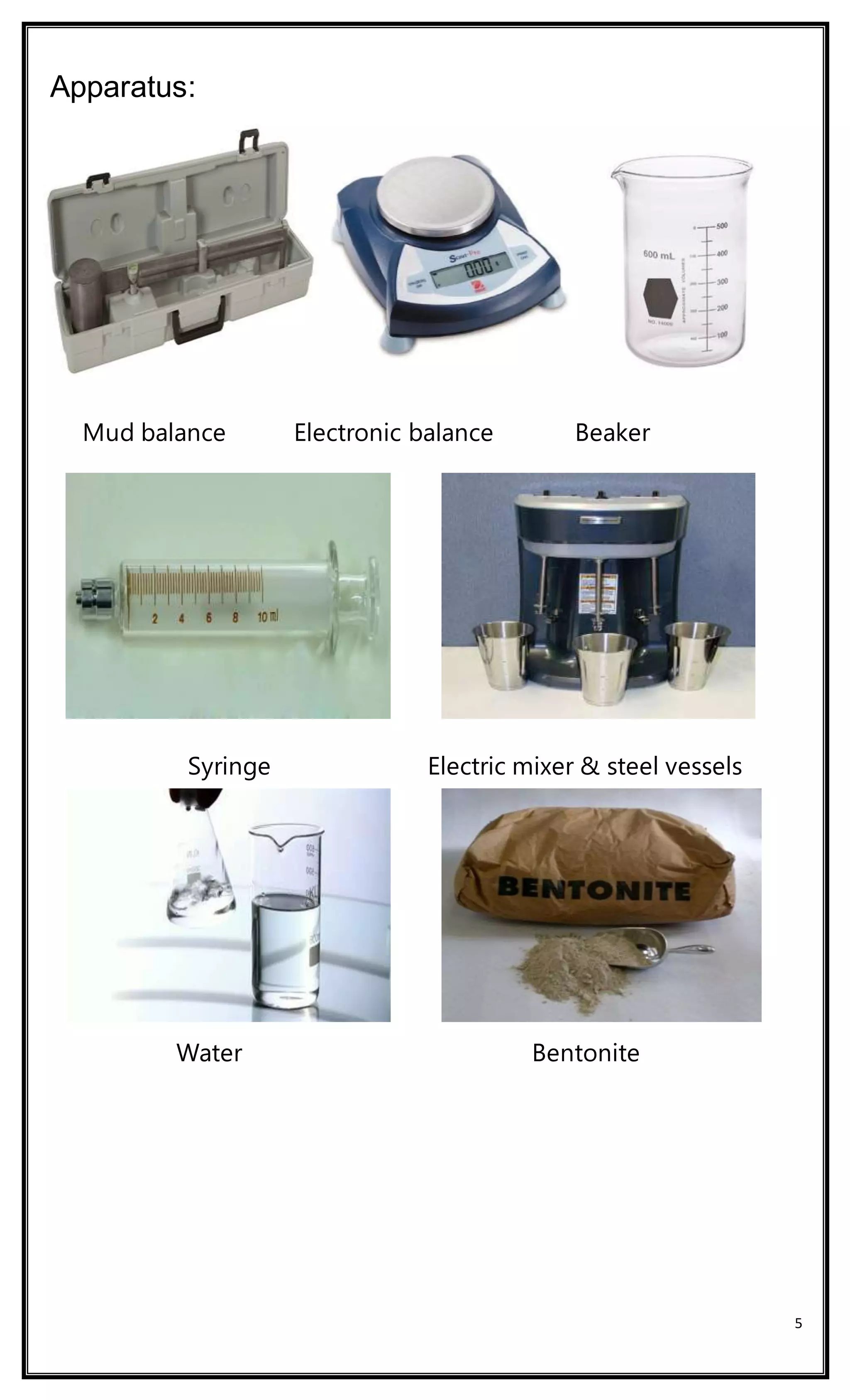
Mud balance Electronic balance Beaker
Syringe Electric mixer & steel vessels
Water Bentonite
6
Calibration:
1) Put some distilled water in a beaker.
2) Put the probe of the meter into the water.
3) The meter should read 7.3.
4) If the reading was smaller than 7.3 then we have to find the
difference between the shown PH and 7.3 then add the
difference to the PH of the mud sample and vice versa if the
PH of the distilled water is greater than 7.3.
Procedure:
1) Put the sample mud in a beaker.
2) Put the probe inside the mud and read the shown PH.
7
Calculation:
Reading PH=9.0
9.05-7.3=1.75
Reading PH mud=7.92
Real pH mud=7.92-1.75=6.42
8
Discussion:
In corrosion fatigue the corrosive environment plays a major role in
governing the corrosion-fatigue behavior of metals. Specifically, in
drill fluid environment, the presence of various dissolved gases in
combination presence of various dissolved gases in combination with
the pH level becomes an extremely significant factor in governing the
corrosion fatigue life expectancy of the drill pipe material in an actual
drill fluid environment. Most investigators have used brine solution
as the corrosive environment. No conclusive data have been found
to substantiate the recent modification of RP7G by the API Task
Group on Drill Stem Design and Operating Limits, which states in Sec.
6.2, "The fatigue life of drill pipe will be considerably decreased when
it is used in water base drilling fluids with low pH. Although it is
difficult to determine the exact lower limit of the pH for precluding
this possibility, where pH is the primary method of corrosion fatigue
control, many users consider that a mud pH of less than 9.5 will
shorten the fatigue life of the drill stem." Jackson et al. showed that
a 7 % sodium chloride brine adding just enough NAOH to raise the
pH to 9 to 10 range decreased the fatigue life of the steel specimen.
Uhlig has stated, "Within the range of about pH 4 to 10 the corrosion
rate is independent of pH, and depends only on how rapidly oxygen
diffuses to the metal surface." Crawford has shown that in some
water raising the pH to 9.5 has increased the corrosion rate. He went
on stating that continuing to raise the pH reduced the corrosion rate,
but still at a pH reduced the corrosion rate, but still at a pH of 10.5
the rate was higher than at a pH of pH of 10.5 the rate was higher
than at a pH of 4.
Q1) why is the PH number of the drilling mud so important?
A1) the pH is important because the pH affects the solubility of the
organic thinners and the dispersion of clays presents in the mud.
9
References:
Azar, J. J. & Samuel, R., 2007. Drilling Engineering. Tulsa, Oklaoma:
PennWell Corporation.
Committee, A. S. S., 2011. Drilling Fluids Processing Handbook.
s.l.:Elsevier.

ph concentration

  • 1.
    1 Petroleum department 3rd stage Group(A) Drilling Lab 9th Experiment: Hydrogen Ion Concentration (PH) Date of experiment: March 31st 2016 Supervised by: Mr. Pshtiwan Jaf & Eng. Muhammad Jamal Prepared by: Muhammad Faisal
  • 2.
    2 Aim of experiment: Theaim of this experiment is to indicate the (PH) number of a specific drilling mud.
  • 3.
    3 Theory: The pH, orhydrogen ion concentration, is a measure of the relative acidity or alkalinity. The pH value ranges from 0 to 14, with 0-6 being acid, 7 being neutral, and 8-14 being alkaline. Except for salt muds, the pH of mud is seldom below 7. Generally, the pH of mud falls between 8 and 11, depending on the mud type. The pH may be determined by a pH meter, which measures the potential difference and gives a direct dial reading of the pH. It is accurate, but because of the delicate nature of the instrument, it has limited field use. pH papers are more commonly used. These strips change color in accordance with the acidity or alkalinity of the filtrate. There are a variety of pH papers available to cover the entire pH range. When the chloride content exceeds 10,000 ppm, the results become less accurate. The pH of mud plays a major role in controlling the solubility of calcium. At high pH values, calcium solubility is very limited; this makes high-pH mud suitable for use in the drilling of carbonate formations, which normally are susceptible to erosion and dissolution by freshwater mud. The pH value is also an important indicator for the control of corrosion. A minimum value of 9.5 should always be maintained to prevent oxygen corrosion of casing, drill pipe, and so forth. A high pH tends to disperse (disintegrate) the active clays in the mud. (Azar & Samuel, 2007)
  • 4.
    4 Introduction: The term "pH"denotes the negative logarithm of the hydrogen ion, H+, activity in aqueous solutions: pH = -log (H+) Field measurement of drilling fluid or filtrate pH and adjustments to the pH are fundamental to drilling fluid control. Clay interactions, solubility of various components and contaminants, and effectiveness of additives are all dependent on pH. Digital PH meter
  • 5.
    5 Apparatus: Mud balance Electronicbalance Beaker Syringe Electric mixer & steel vessels Water Bentonite
  • 6.
    6 Calibration: 1) Put somedistilled water in a beaker. 2) Put the probe of the meter into the water. 3) The meter should read 7.3. 4) If the reading was smaller than 7.3 then we have to find the difference between the shown PH and 7.3 then add the difference to the PH of the mud sample and vice versa if the PH of the distilled water is greater than 7.3. Procedure: 1) Put the sample mud in a beaker. 2) Put the probe inside the mud and read the shown PH.
  • 7.
    7 Calculation: Reading PH=9.0 9.05-7.3=1.75 Reading PHmud=7.92 Real pH mud=7.92-1.75=6.42
  • 8.
    8 Discussion: In corrosion fatiguethe corrosive environment plays a major role in governing the corrosion-fatigue behavior of metals. Specifically, in drill fluid environment, the presence of various dissolved gases in combination presence of various dissolved gases in combination with the pH level becomes an extremely significant factor in governing the corrosion fatigue life expectancy of the drill pipe material in an actual drill fluid environment. Most investigators have used brine solution as the corrosive environment. No conclusive data have been found to substantiate the recent modification of RP7G by the API Task Group on Drill Stem Design and Operating Limits, which states in Sec. 6.2, "The fatigue life of drill pipe will be considerably decreased when it is used in water base drilling fluids with low pH. Although it is difficult to determine the exact lower limit of the pH for precluding this possibility, where pH is the primary method of corrosion fatigue control, many users consider that a mud pH of less than 9.5 will shorten the fatigue life of the drill stem." Jackson et al. showed that a 7 % sodium chloride brine adding just enough NAOH to raise the pH to 9 to 10 range decreased the fatigue life of the steel specimen. Uhlig has stated, "Within the range of about pH 4 to 10 the corrosion rate is independent of pH, and depends only on how rapidly oxygen diffuses to the metal surface." Crawford has shown that in some water raising the pH to 9.5 has increased the corrosion rate. He went on stating that continuing to raise the pH reduced the corrosion rate, but still at a pH reduced the corrosion rate, but still at a pH of 10.5 the rate was higher than at a pH of pH of 10.5 the rate was higher than at a pH of 4. Q1) why is the PH number of the drilling mud so important? A1) the pH is important because the pH affects the solubility of the organic thinners and the dispersion of clays presents in the mud.
  • 9.
    9 References: Azar, J. J.& Samuel, R., 2007. Drilling Engineering. Tulsa, Oklaoma: PennWell Corporation. Committee, A. S. S., 2011. Drilling Fluids Processing Handbook. s.l.:Elsevier.