Properties of Drilling Fluids
Density
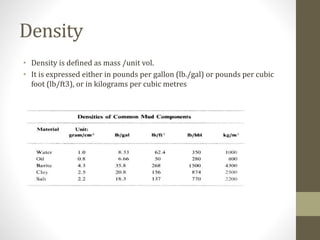
• Density is defined as mass /unit vol.
• It is expressed either in pounds per gallon (lb./gal) or pounds per cubic
foot (lb/ft3), or in kilograms per cubic metres
Cation Exchange Capacity
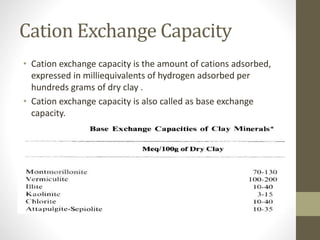
• Cation exchange capacity is the amount of cations adsorbed,
expressed in milliequivalents of hydrogen adsorbed per
hundreds grams of dry clay .
• Cation exchange capacity is also called as base exchange
capacity.
Significance:
• Cation exchange capacity and species of cations in the exchange positions
are good indications of colloidal activity of clay.
• Water holding capacity.
• pH.
Measurement of CEC
• It is determined by leaching the clay with excess of suitable salt
(Ammonium acetate) which displaces both the adsorbed cations and
water. Another sample is leached with excess of water which only
displaces the water, difference between both the filtrate gives the cation
exchange capacity
• It can also be calculated by methylene blue test.
Filtration Properties
• The ability of mud to seal permeable formations exposed by the
bit with a thin, low permeability filter cake.
• Bridging particles, are trapped in the surface pores resulting in the
formation of filter cake.
• The suspension of fine particles that enters the formation while the
cake is being established is known as the mud spurt. The liquid that
enters subsequently is known as filtrate.
• Both filtration rate and the mud spurt must be minimized when
penetrating potentially productive formations
• The rate of filtration depend on the occurrence of fluid or
mechanical erosion during the filtration process.
Major problems caused by poor Filtration of drilling fluid:
• Differential sticking.
• Formation Damage.
Filtration Properties and Formations
• Stable formations with low permeabilities, such as dense
carbonates, sandstones, and lithified shales, can usually be drilled
with little or no control of filtration properties.
• In permeable formations, filtration properties must be controlled in
order to prevent thick filter cakes from excessively reducing the
gauge of the borehole.
The filtration properties of drilling fluid is generally measured by
Standard API filtration test.
pH
 The pH is a measure of the hydrogen ion concentration, H+
 pH= -log [H+]
 The pH is usually measured with color-coded paper or with a
pH meter
 Caustic soda (NaOH) and potassium hydroxide (KOH) are the
two chemicals commonly used in a water-based mud to
control pH value.
 The optimum control of the mud systems is based on pH ,as is
the detection and treatment of the contaminations.
 A mud made by Bentonite and Fresh water will have pH
between 8 and 9.
 Contamination by cement will raise the pH to 10 and 11.
 Proper pH ranges are necessary for clays to disperse and
chemicals to react as well as for corrosion protection and to
provide a reserve of hydroxyl ions.
 The reserve of hydroxyl ions provides a measure of safety
against contaminants that may reduce the acid-neutralizing
ability of the filtrate.
Reasons to control pH
 Maintenance of lime treated mud
 Mitigation of corrosion
 Effective use of thinners
Need of pH regulation
Mud Rheology
science dealing with the deformation and flow of matter
Importance
• Controls pressure losses in the annulus
• Provides adequate lifting capacity for the removal of formation
solids
• Controls surge and swab pressures
• Indirect influences drilling rate and hole/ formation erosion
(turbulent flow).
Important terms:
•Shear stress
•Shear rate
•Viscosity
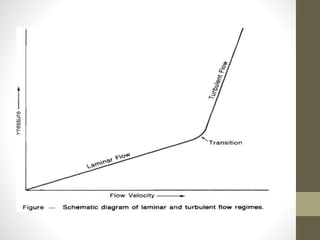
Flow Regime:
• Governs the flow behaviour of fluids
• Relationship between pressure and velocity
Laminar Flow:
• Prevails at low flow velocities
• Function of viscous properties of fluid
• In a round pipe, it can be visualised as infinitely thin cylinders
sliding over each other.
• Velocity of cylinder increases from zero at pipe wall to a
maximum at the pipe axis.
• All flow behavioral models are available only for this type of
fluid flow
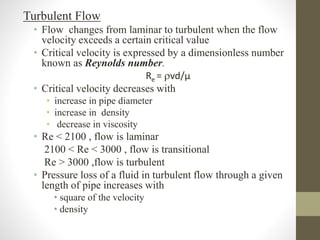
Turbulent Flow
• Flow changes from laminar to turbulent when the flow
velocity exceeds a certain critical value
• Critical velocity is expressed by a dimensionless number
known as Reynolds number.
Re = vd/μ
• Critical velocity decreases with
• increase in pipe diameter
• increase in density
• decrease in viscosity
• Re < 2100 , flow is laminar
2100 < Re < 3000 , flow is transitional
Re > 3000 ,flow is turbulent
• Pressure loss of a fluid in turbulent flow through a given
length of pipe increases with
• square of the velocity
• density
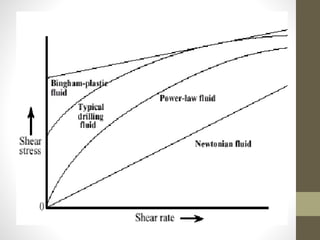
A mathematical fluid model describes the flow
behavior of a fluid by expressing a mathematical
relationship between shear rate and shear stress.
The three rheological models that are currently in
use are:
 Bingham Plastic model.
 Power Law model.
 Herschel-Bulkley (yield-power law [YPL]) model.
Flow models
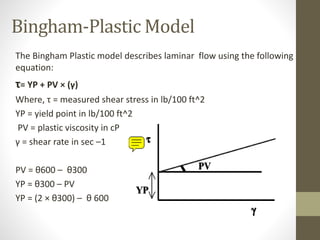
The Bingham Plastic model describes laminar flow using the following
equation:
τ= YP + PV × (γ)
Where, τ = measured shear stress in lb/100 ft^2
YP = yield point in lb/100 ft^2
PV = plastic viscosity in cP
γ = shear rate in sec –1
PV = θ600 – θ300
YP = θ300 – PV
YP = (2 × θ300) – θ 600
Bingham-Plastic Model
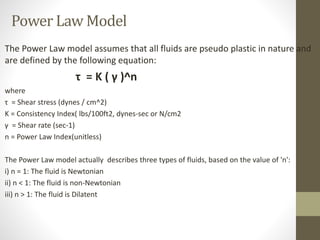
The Power Law model assumes that all fluids are pseudo plastic in nature and
are defined by the following equation:
τ = K ( γ )^n
where
τ = Shear stress (dynes / cm^2)
K = Consistency Index( lbs/100ft2, dynes-sec or N/cm2
γ = Shear rate (sec-1)
n = Power Law Index(unitless)
The Power Law model actually describes three types of fluids, based on the value of 'n':
i) n = 1: The fluid is Newtonian
ii) n < 1: The fluid is non-Newtonian
iii) n > 1: The fluid is Dilatent
Power Law Model
The Herschel-Bulkley (yield- power law [YPL]) model describes the rheological
behavior of drilling muds more accurately than any other model using the following
equation:
τ = τ o + K × ( γ )^n
where
τ = measured shear stress in lb/100 ft^2
τo= fluid's yield stress (shear stre ss at zero shear rate) in lb/100 ft^2
K = fluid's consistency index in cP or lb/100 ft sec^2
n = fluid's flow index
γ= shear rate in sec-1
The YPL model reduces to the Bingham Plastic model when n = 1 and it reduces to the
Power Law model when τ o = 0.
Herschel-Bulkley
 Alkalinity refers to the ability of a solution or mixture to react with an acid.
 Knowledge of the mud and filtrate alkalinity is important in many drilling
operations. Mud additives, particularly some organic deflocculates, require
an alkaline environment in order to function properly.
 The acidity or alkalinity (pH) of drilling fluid influences mud properties,
filtration control, hole-stability, and corrosion of equipment.
ALKALINITY:
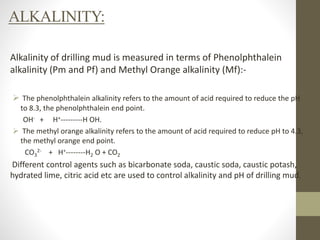
Alkalinity of drilling mud is measured in terms of Phenolphthalein
alkalinity (Pm and Pf) and Methyl Orange alkalinity (Mf):-
 The phenolphthalein alkalinity refers to the amount of acid required to reduce the pH
to 8.3, the phenolphthalein end point.
OH- + H+---------H OH.
 The methyl orange alkalinity refers to the amount of acid required to reduce pH to 4.3,
the methyl orange end point.
CO3
2- + H+--------H2 O + CO2
Different control agents such as bicarbonate soda, caustic soda, caustic potash,
hydrated lime, citric acid etc are used to control alkalinity and pH of drilling mud.
ALKALINITY:
Lubricity
 Frictional resistance to rotation of drill string(torque) and hoisting and
lowering the drill string(drag) are common in drilling. Hence lubricity an
important property in drilling directional wells.
 Lubricating additives used in drilling fluid fall into two categories: solid
lubricants and liquid lubricants.
 Solids can permanently damage an oil or gas bearing formation and hinder
production. Exemplary solids include graphite, bentonite clays, gilsonite,
cellulosic materials and even glass and plastic beads.
 Liquid lubricants can only provide temporary relief from torque and drag.
Exemplary liquids are diesel oil, vegetable oil, detergents, alcohols,
glycerines and amines.
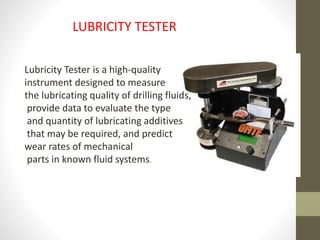
Lubricity Tester is a high-quality
instrument designed to measure
the lubricating quality of drilling fluids,
provide data to evaluate the type
and quantity of lubricating additives
that may be required, and predict
wear rates of mechanical
parts in known fluid systems.
LUBRICITY TESTER
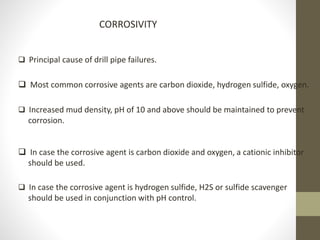
CORROSIVITY
 Principal cause of drill pipe failures.
 Most common corrosive agents are carbon dioxide, hydrogen sulfide, oxygen.
 Increased mud density, pH of 10 and above should be maintained to prevent
corrosion.
 In case the corrosive agent is carbon dioxide and oxygen, a cationic inhibitor
should be used.
 In case the corrosive agent is hydrogen sulfide, H2S or sulfide scavenger
should be used in conjunction with pH control.
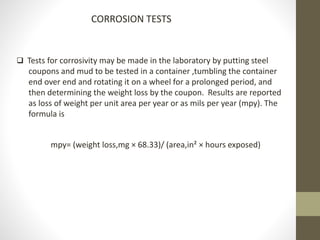
CORROSION TESTS
 Tests for corrosivity may be made in the laboratory by putting steel
coupons and mud to be tested in a container ,tumbling the container
end over end and rotating it on a wheel for a prolonged period, and
then determining the weight loss by the coupon. Results are reported
as loss of weight per unit area per year or as mils per year (mpy). The
formula is
mpy= (weight loss,mg × 68.33)/ (area,in² × hours exposed)
REFERENCES
•Composition and Properties of Drilling fluids by H C H
Darley
•www.spe.org
•www.wikipedia.org
•Well Engineering and Construction by Hussain Rabia
Thank You

Properties of drilling fluids

  • 1.
  • 2.
    Density • Density isdefined as mass /unit vol. • It is expressed either in pounds per gallon (lb./gal) or pounds per cubic foot (lb/ft3), or in kilograms per cubic metres
  • 3.
    Cation Exchange Capacity •Cation exchange capacity is the amount of cations adsorbed, expressed in milliequivalents of hydrogen adsorbed per hundreds grams of dry clay . • Cation exchange capacity is also called as base exchange capacity.
  • 4.
    Significance: • Cation exchangecapacity and species of cations in the exchange positions are good indications of colloidal activity of clay. • Water holding capacity. • pH. Measurement of CEC • It is determined by leaching the clay with excess of suitable salt (Ammonium acetate) which displaces both the adsorbed cations and water. Another sample is leached with excess of water which only displaces the water, difference between both the filtrate gives the cation exchange capacity • It can also be calculated by methylene blue test.
  • 5.
    Filtration Properties • Theability of mud to seal permeable formations exposed by the bit with a thin, low permeability filter cake. • Bridging particles, are trapped in the surface pores resulting in the formation of filter cake. • The suspension of fine particles that enters the formation while the cake is being established is known as the mud spurt. The liquid that enters subsequently is known as filtrate. • Both filtration rate and the mud spurt must be minimized when penetrating potentially productive formations • The rate of filtration depend on the occurrence of fluid or mechanical erosion during the filtration process.
  • 6.
    Major problems causedby poor Filtration of drilling fluid: • Differential sticking. • Formation Damage. Filtration Properties and Formations • Stable formations with low permeabilities, such as dense carbonates, sandstones, and lithified shales, can usually be drilled with little or no control of filtration properties. • In permeable formations, filtration properties must be controlled in order to prevent thick filter cakes from excessively reducing the gauge of the borehole. The filtration properties of drilling fluid is generally measured by Standard API filtration test.
  • 7.
    pH  The pHis a measure of the hydrogen ion concentration, H+  pH= -log [H+]  The pH is usually measured with color-coded paper or with a pH meter  Caustic soda (NaOH) and potassium hydroxide (KOH) are the two chemicals commonly used in a water-based mud to control pH value.  The optimum control of the mud systems is based on pH ,as is the detection and treatment of the contaminations.  A mud made by Bentonite and Fresh water will have pH between 8 and 9.  Contamination by cement will raise the pH to 10 and 11.
  • 8.
     Proper pHranges are necessary for clays to disperse and chemicals to react as well as for corrosion protection and to provide a reserve of hydroxyl ions.  The reserve of hydroxyl ions provides a measure of safety against contaminants that may reduce the acid-neutralizing ability of the filtrate. Reasons to control pH  Maintenance of lime treated mud  Mitigation of corrosion  Effective use of thinners Need of pH regulation
  • 9.
    Mud Rheology science dealingwith the deformation and flow of matter Importance • Controls pressure losses in the annulus • Provides adequate lifting capacity for the removal of formation solids • Controls surge and swab pressures • Indirect influences drilling rate and hole/ formation erosion (turbulent flow). Important terms: •Shear stress •Shear rate •Viscosity
  • 10.
    Flow Regime: • Governsthe flow behaviour of fluids • Relationship between pressure and velocity Laminar Flow: • Prevails at low flow velocities • Function of viscous properties of fluid • In a round pipe, it can be visualised as infinitely thin cylinders sliding over each other. • Velocity of cylinder increases from zero at pipe wall to a maximum at the pipe axis. • All flow behavioral models are available only for this type of fluid flow
  • 11.
    Turbulent Flow • Flowchanges from laminar to turbulent when the flow velocity exceeds a certain critical value • Critical velocity is expressed by a dimensionless number known as Reynolds number. Re = vd/μ • Critical velocity decreases with • increase in pipe diameter • increase in density • decrease in viscosity • Re < 2100 , flow is laminar 2100 < Re < 3000 , flow is transitional Re > 3000 ,flow is turbulent • Pressure loss of a fluid in turbulent flow through a given length of pipe increases with • square of the velocity • density
  • 13.
    A mathematical fluidmodel describes the flow behavior of a fluid by expressing a mathematical relationship between shear rate and shear stress. The three rheological models that are currently in use are:  Bingham Plastic model.  Power Law model.  Herschel-Bulkley (yield-power law [YPL]) model. Flow models
  • 15.
    The Bingham Plasticmodel describes laminar flow using the following equation: τ= YP + PV × (γ) Where, τ = measured shear stress in lb/100 ft^2 YP = yield point in lb/100 ft^2 PV = plastic viscosity in cP γ = shear rate in sec –1 PV = θ600 – θ300 YP = θ300 – PV YP = (2 × θ300) – θ 600 Bingham-Plastic Model
  • 16.
    The Power Lawmodel assumes that all fluids are pseudo plastic in nature and are defined by the following equation: τ = K ( γ )^n where τ = Shear stress (dynes / cm^2) K = Consistency Index( lbs/100ft2, dynes-sec or N/cm2 γ = Shear rate (sec-1) n = Power Law Index(unitless) The Power Law model actually describes three types of fluids, based on the value of 'n': i) n = 1: The fluid is Newtonian ii) n < 1: The fluid is non-Newtonian iii) n > 1: The fluid is Dilatent Power Law Model
  • 17.
    The Herschel-Bulkley (yield-power law [YPL]) model describes the rheological behavior of drilling muds more accurately than any other model using the following equation: τ = τ o + K × ( γ )^n where τ = measured shear stress in lb/100 ft^2 τo= fluid's yield stress (shear stre ss at zero shear rate) in lb/100 ft^2 K = fluid's consistency index in cP or lb/100 ft sec^2 n = fluid's flow index γ= shear rate in sec-1 The YPL model reduces to the Bingham Plastic model when n = 1 and it reduces to the Power Law model when τ o = 0. Herschel-Bulkley
  • 18.
     Alkalinity refersto the ability of a solution or mixture to react with an acid.  Knowledge of the mud and filtrate alkalinity is important in many drilling operations. Mud additives, particularly some organic deflocculates, require an alkaline environment in order to function properly.  The acidity or alkalinity (pH) of drilling fluid influences mud properties, filtration control, hole-stability, and corrosion of equipment. ALKALINITY:
  • 19.
    Alkalinity of drillingmud is measured in terms of Phenolphthalein alkalinity (Pm and Pf) and Methyl Orange alkalinity (Mf):-  The phenolphthalein alkalinity refers to the amount of acid required to reduce the pH to 8.3, the phenolphthalein end point. OH- + H+---------H OH.  The methyl orange alkalinity refers to the amount of acid required to reduce pH to 4.3, the methyl orange end point. CO3 2- + H+--------H2 O + CO2 Different control agents such as bicarbonate soda, caustic soda, caustic potash, hydrated lime, citric acid etc are used to control alkalinity and pH of drilling mud. ALKALINITY:
  • 20.
    Lubricity  Frictional resistanceto rotation of drill string(torque) and hoisting and lowering the drill string(drag) are common in drilling. Hence lubricity an important property in drilling directional wells.  Lubricating additives used in drilling fluid fall into two categories: solid lubricants and liquid lubricants.  Solids can permanently damage an oil or gas bearing formation and hinder production. Exemplary solids include graphite, bentonite clays, gilsonite, cellulosic materials and even glass and plastic beads.  Liquid lubricants can only provide temporary relief from torque and drag. Exemplary liquids are diesel oil, vegetable oil, detergents, alcohols, glycerines and amines.
  • 21.
    Lubricity Tester isa high-quality instrument designed to measure the lubricating quality of drilling fluids, provide data to evaluate the type and quantity of lubricating additives that may be required, and predict wear rates of mechanical parts in known fluid systems. LUBRICITY TESTER
  • 22.
    CORROSIVITY  Principal causeof drill pipe failures.  Most common corrosive agents are carbon dioxide, hydrogen sulfide, oxygen.  Increased mud density, pH of 10 and above should be maintained to prevent corrosion.  In case the corrosive agent is carbon dioxide and oxygen, a cationic inhibitor should be used.  In case the corrosive agent is hydrogen sulfide, H2S or sulfide scavenger should be used in conjunction with pH control.
  • 23.
    CORROSION TESTS  Testsfor corrosivity may be made in the laboratory by putting steel coupons and mud to be tested in a container ,tumbling the container end over end and rotating it on a wheel for a prolonged period, and then determining the weight loss by the coupon. Results are reported as loss of weight per unit area per year or as mils per year (mpy). The formula is mpy= (weight loss,mg × 68.33)/ (area,in² × hours exposed)
  • 24.
    REFERENCES •Composition and Propertiesof Drilling fluids by H C H Darley •www.spe.org •www.wikipedia.org •Well Engineering and Construction by Hussain Rabia
  • 25.