KOYA UNIVERSITY
FACULTY OF ENGINEERING
SCHOOL OF PETROLEUM AND
CHEMICAL
FLUID MECHANIC LAB
NAME OF EXPEREMENT:
Core Cleaning
NAME OF STUDENT:
Kamal Abdurahman
Group: B
SUPERVISED BY: Mr.Ali Kamal
Aim of Experiment:
This test is dedicated to review basic concept core cleaning and to
give basic definitions commonly used in core analysis.
Introduction
Rock samples are recovered from the bottom-hole of wells that are
being drilled, taken to surface and transported many miles away to
a core laboratory. These processes must be performed following
strict rules of proper core cleaning to preserve the original
properties of the reservoir rock. Ideally, the rock sample recovered
from the well will represent the reservoir rock.
However, once the rock is being drilled, exposed to drilling fluids,
and taken out of the hole, the original conditions at which the rock
is found in the reservoir will change. This is a drawback that must
be accepted because coring is the only method available to
physically perform analysis on a reservoir rock.
Theory
The most widely methods used are :
1- Distillation-Extraction (Dean-Stark and Soxhlet): This is the most
commonly used cleaning method. The sample is placed in a
soxhlet or Dean-Stark apparatus. Solvents are evaporated and
flowed through the core removing the fluids in place. Then they
condensate and evaporated again in a continuous closed process.
The main drawback of this method is that the solvent may not
contact all of the core especially smaller pores. This is the method
that will be illustrated in this laboratory and the procedure will be
explained in more detailed later in this chapter.
2- Flow-Through: The core is placed in a core holder and solvents
are continuously injected under pressure into the core. The
injection may be continuous or halted periodically allowing time for
the core to soak in the solvent. Cuiec (Cuiec-1975) stated that this
method is better that the extraction method in the sense that
solvents injected under pressure may contact even the smaller
pores of the rock; Gant and Anderson supported this statement
(Gant and Anderson-1986).
3- Centrifuge Flushing: A centrifuge is used to spray warm clean
solvent against the core. The centrifugal force causes the solvent
to flow through the sample.
The main advantage is that it is a fast method and can be used in
tight samples, which are not effectively cleaned by the extraction
method.
4- Gas-Driven Solvent Extraction: Used for whole cores where fluid
saturation are not needed. The core is cleaned by repeated cycles
of internal dissolved-gas drive. Toluene saturated with carbon
dioxide is injected under pressure into the rock and pressure is
rapidly released to expand the carbon dioxide and flush the solvent
through the pore space removing the oil and water.
5- Other methods
Solvents Used for Cleaning
The core cleaning process is said to be successful when all the
contaminants are removed from the surface of the rock leaving it
strongly water-wet (Gant and Anderson-1986). Core cleaning is
mostly a trial-and error process where the selection of the best
solvents to be used greatly depends on the experience with
particular rocks. It has been shown that mixtures of solvents work
better than single solvents (Gant and Anderson-1986, Cuiec).
Common solvent mixtures are chloroform/methanol,
toluene/methanol, toluene/ethanol, benzene, and carbon
disulphide among others. Some mixtures work better for different
types of rocks and fluids. Sandstones are known to have a surface
of acid type while limestones have a surface of basic type. Because
of the surface types of this rock surfaces, acidic solvents tend to
clean better the sandstones while basic solvents tend to clean
better the limestones (Cuiec-1975).
Distillation-Extraction (Dean-Stark and Soxhlet) Procedure:
Figure 2-1 shows a sketch of the distillation-extraction device. The
main components are a volumetric flask containing the solvents, a
heating mantle to heat the solvents in the volumetric flask, a reflux
core chamber where the core is exposed to the boiled solvent, and
a condenser to condense the solvent
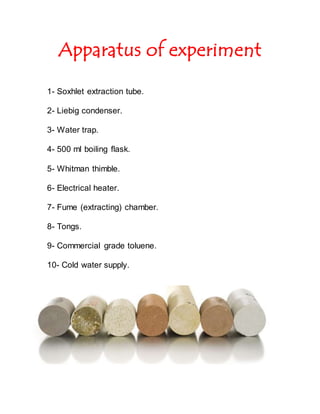
Apparatus of experiment
1- Soxhlet extraction tube.
2- Liebig condenser.
3- Water trap.
4- 500 ml boiling flask.
5- Whitman thimble.
6- Electrical heater.
7- Fume (extracting) chamber.
8- Tongs.
9- Commercial grade toluene.
10- Cold water supply.
Figure 2-1 Soxhlet - Extraction Device
Principle of Soxlhlet Method
A soxhlet extraction apparatus is the most common method for
cleaning core samples and it is routinely used by most laboratories.
Toluene is brought to a slow boil in a Pyrex flask, it is vapors move
upward and the core becomes engulfed in the toluene vapors at
approximately 12 degree centigrade eventual water within the core
sample in the thimble will be vaporized.
The toluene and water vapors enter the inner chamber of the
condenser, the cold water circulating about the inner
chamber…condenses both vapors to immiscible liquids.
Re-condensed toluene together with liquid water falls from the base
of the condenser on the core sample in the thimble, the toluene
soaks the core sample and dissolves any oil with which it comes
into the contact. When the liquid level within the soxhlet tube
reaches the top of the siphon tube arrangement, the lquied within
the soxhlet tube are automatically emptied by a siphon effect and
flow in to the boiling flask.
The toluene is then ready to start another cycle. A complete
extraction may take several days or several weeks in the case of
low API gravity crude or presence of heavy residual hydrocarbon
within the core.
Procedure
1- Remove the sample from the oil and carefully blot dry an excess
oil.
2- Place the sample inside the Wathman thimble and quickly weight
the sample and sample using the analytical balance.
3- Leave the sample in the thimble.
4- Re- assembles the apparatus as shown in the figure 1, tighten
the ground joint fitting but don’t apply sealing or lubricant.
5- Turn on the water supply to begin circulation in the condenser.
6- Turn on the heater and adjust the rate of the boiling so that the
reflex from the condenser is a few drops of solvents (toluene) per
second.
7- Allow the extraction to continue for several hours with a minimum
of 7 cycles or until the thimble content dissolved oil stain and is
close to original color.
8- Monitor the toluene level during the extraction to ensure that the
sample remains completely submerged in addition.
9- When the extraction is complete the solvent will be clean or
water white depending on the color of oil removed.
10- Read the volume of the water collected in the water trap, if any.
Note
In many cases the sample have been prepared using oil only to
saturate the core sample, therefore the absence of water does not
mean an invalid test.
11- Return the thimble containing the sample to the instructor, who
will place them in the drying oven at (105 - 120) degree centigrade.
12- The instructor will advise when to return to collect the dried
sample (sometimes will be the next day).
13- Place the dried sample in desiccators for a few hours prior to
weighting to ensure that they are completely dried.
14- Place the thimble containing the sample in the analytical
balance, measure the weight of the thimble and dried core sample
and record the result.
15- Remove the sample and then weight the empty thimble, record
the results or note if there are any grains of the sample remaining
in the thimble in the space provide.
Calculation Plan
1- The volume of the water caught in the trap is the direct measure
of the volume of the water in the sample.
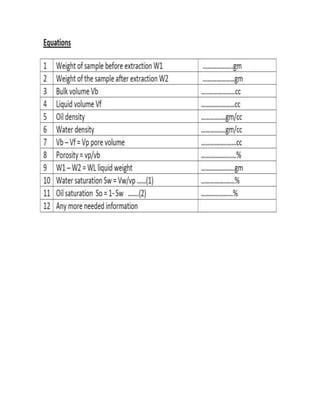
2- From the above step and with the use of equation no.1 we can
obtain water saturation Sw.
3- If the volume of water in the trap is zero, then Vw = Sw = 0.
4- The weight of the core sample before and after extraction can
be calculated by weight difference method.
5- The total of the fluid (water, oil and gas) extracted from the core
sample is the difference between the saturation weight and the dry
weight.
6- The weight of gas in the sample is usually neglected as it will be
insignificant compared with the weight of liquids.
Result of Experiment
The results from core cleaning is to purify the core from any
impurities that deposit in the core, this operation give the core show
a real properties without minimum error.
Reference
1. Park, A., 1985, Coring, Part 2—core barrel types and uses:
World Oil, v. 200, p. 83–90.
2. Bradburn, F. R., Cheatham, C. A., 1988, Improved core
recovery in laminated sand shale sequences: Journal of
Petroleum Technology, v. 40, p. 1544–1546., 10.,
2118/18570-PA
3.Toney, J. B., Speiglets, S. L., 1985, Coring, Part 6—sidewall
operations: World Oil, v. 201, p. 29–36.
4.American Petroleum Institute, 1960, RP-40 recommended
practices for core analysis procedures: Dallas, API, 55 p.

Core cleaning

  • 1.
    KOYA UNIVERSITY FACULTY OFENGINEERING SCHOOL OF PETROLEUM AND CHEMICAL FLUID MECHANIC LAB NAME OF EXPEREMENT: Core Cleaning NAME OF STUDENT: Kamal Abdurahman Group: B SUPERVISED BY: Mr.Ali Kamal
  • 2.
    Aim of Experiment: Thistest is dedicated to review basic concept core cleaning and to give basic definitions commonly used in core analysis.
  • 3.
    Introduction Rock samples arerecovered from the bottom-hole of wells that are being drilled, taken to surface and transported many miles away to a core laboratory. These processes must be performed following strict rules of proper core cleaning to preserve the original properties of the reservoir rock. Ideally, the rock sample recovered from the well will represent the reservoir rock. However, once the rock is being drilled, exposed to drilling fluids, and taken out of the hole, the original conditions at which the rock is found in the reservoir will change. This is a drawback that must be accepted because coring is the only method available to physically perform analysis on a reservoir rock.
  • 4.
    Theory The most widelymethods used are : 1- Distillation-Extraction (Dean-Stark and Soxhlet): This is the most commonly used cleaning method. The sample is placed in a soxhlet or Dean-Stark apparatus. Solvents are evaporated and flowed through the core removing the fluids in place. Then they condensate and evaporated again in a continuous closed process. The main drawback of this method is that the solvent may not contact all of the core especially smaller pores. This is the method that will be illustrated in this laboratory and the procedure will be explained in more detailed later in this chapter. 2- Flow-Through: The core is placed in a core holder and solvents are continuously injected under pressure into the core. The injection may be continuous or halted periodically allowing time for the core to soak in the solvent. Cuiec (Cuiec-1975) stated that this method is better that the extraction method in the sense that
  • 5.
    solvents injected underpressure may contact even the smaller pores of the rock; Gant and Anderson supported this statement (Gant and Anderson-1986). 3- Centrifuge Flushing: A centrifuge is used to spray warm clean solvent against the core. The centrifugal force causes the solvent to flow through the sample. The main advantage is that it is a fast method and can be used in tight samples, which are not effectively cleaned by the extraction method. 4- Gas-Driven Solvent Extraction: Used for whole cores where fluid saturation are not needed. The core is cleaned by repeated cycles of internal dissolved-gas drive. Toluene saturated with carbon dioxide is injected under pressure into the rock and pressure is rapidly released to expand the carbon dioxide and flush the solvent through the pore space removing the oil and water. 5- Other methods
  • 6.
    Solvents Used forCleaning The core cleaning process is said to be successful when all the contaminants are removed from the surface of the rock leaving it strongly water-wet (Gant and Anderson-1986). Core cleaning is mostly a trial-and error process where the selection of the best solvents to be used greatly depends on the experience with particular rocks. It has been shown that mixtures of solvents work better than single solvents (Gant and Anderson-1986, Cuiec). Common solvent mixtures are chloroform/methanol, toluene/methanol, toluene/ethanol, benzene, and carbon disulphide among others. Some mixtures work better for different types of rocks and fluids. Sandstones are known to have a surface of acid type while limestones have a surface of basic type. Because of the surface types of this rock surfaces, acidic solvents tend to clean better the sandstones while basic solvents tend to clean better the limestones (Cuiec-1975).
  • 7.
    Distillation-Extraction (Dean-Stark andSoxhlet) Procedure: Figure 2-1 shows a sketch of the distillation-extraction device. The main components are a volumetric flask containing the solvents, a heating mantle to heat the solvents in the volumetric flask, a reflux core chamber where the core is exposed to the boiled solvent, and a condenser to condense the solvent
  • 8.
    Apparatus of experiment 1-Soxhlet extraction tube. 2- Liebig condenser. 3- Water trap. 4- 500 ml boiling flask. 5- Whitman thimble. 6- Electrical heater. 7- Fume (extracting) chamber. 8- Tongs. 9- Commercial grade toluene. 10- Cold water supply.
  • 9.
    Figure 2-1 Soxhlet- Extraction Device
  • 10.
    Principle of SoxlhletMethod A soxhlet extraction apparatus is the most common method for cleaning core samples and it is routinely used by most laboratories. Toluene is brought to a slow boil in a Pyrex flask, it is vapors move upward and the core becomes engulfed in the toluene vapors at approximately 12 degree centigrade eventual water within the core sample in the thimble will be vaporized. The toluene and water vapors enter the inner chamber of the condenser, the cold water circulating about the inner chamber…condenses both vapors to immiscible liquids. Re-condensed toluene together with liquid water falls from the base of the condenser on the core sample in the thimble, the toluene soaks the core sample and dissolves any oil with which it comes into the contact. When the liquid level within the soxhlet tube reaches the top of the siphon tube arrangement, the lquied within
  • 11.
    the soxhlet tubeare automatically emptied by a siphon effect and flow in to the boiling flask. The toluene is then ready to start another cycle. A complete extraction may take several days or several weeks in the case of low API gravity crude or presence of heavy residual hydrocarbon within the core.
  • 12.
    Procedure 1- Remove thesample from the oil and carefully blot dry an excess oil. 2- Place the sample inside the Wathman thimble and quickly weight the sample and sample using the analytical balance. 3- Leave the sample in the thimble. 4- Re- assembles the apparatus as shown in the figure 1, tighten the ground joint fitting but don’t apply sealing or lubricant. 5- Turn on the water supply to begin circulation in the condenser. 6- Turn on the heater and adjust the rate of the boiling so that the reflex from the condenser is a few drops of solvents (toluene) per second. 7- Allow the extraction to continue for several hours with a minimum of 7 cycles or until the thimble content dissolved oil stain and is close to original color.
  • 13.
    8- Monitor thetoluene level during the extraction to ensure that the sample remains completely submerged in addition. 9- When the extraction is complete the solvent will be clean or water white depending on the color of oil removed. 10- Read the volume of the water collected in the water trap, if any. Note In many cases the sample have been prepared using oil only to saturate the core sample, therefore the absence of water does not mean an invalid test. 11- Return the thimble containing the sample to the instructor, who will place them in the drying oven at (105 - 120) degree centigrade. 12- The instructor will advise when to return to collect the dried sample (sometimes will be the next day). 13- Place the dried sample in desiccators for a few hours prior to weighting to ensure that they are completely dried.
  • 14.
    14- Place thethimble containing the sample in the analytical balance, measure the weight of the thimble and dried core sample and record the result. 15- Remove the sample and then weight the empty thimble, record the results or note if there are any grains of the sample remaining in the thimble in the space provide.
  • 15.
    Calculation Plan 1- Thevolume of the water caught in the trap is the direct measure of the volume of the water in the sample. 2- From the above step and with the use of equation no.1 we can obtain water saturation Sw. 3- If the volume of water in the trap is zero, then Vw = Sw = 0. 4- The weight of the core sample before and after extraction can be calculated by weight difference method. 5- The total of the fluid (water, oil and gas) extracted from the core sample is the difference between the saturation weight and the dry weight. 6- The weight of gas in the sample is usually neglected as it will be insignificant compared with the weight of liquids.
  • 17.
    Result of Experiment Theresults from core cleaning is to purify the core from any impurities that deposit in the core, this operation give the core show a real properties without minimum error.
  • 18.
    Reference 1. Park, A.,1985, Coring, Part 2—core barrel types and uses: World Oil, v. 200, p. 83–90. 2. Bradburn, F. R., Cheatham, C. A., 1988, Improved core recovery in laminated sand shale sequences: Journal of Petroleum Technology, v. 40, p. 1544–1546., 10., 2118/18570-PA 3.Toney, J. B., Speiglets, S. L., 1985, Coring, Part 6—sidewall operations: World Oil, v. 201, p. 29–36. 4.American Petroleum Institute, 1960, RP-40 recommended practices for core analysis procedures: Dallas, API, 55 p.