Petroleum engineering
Faculty of
Engineering
Koya University
Drilling Engineering
Laboratory
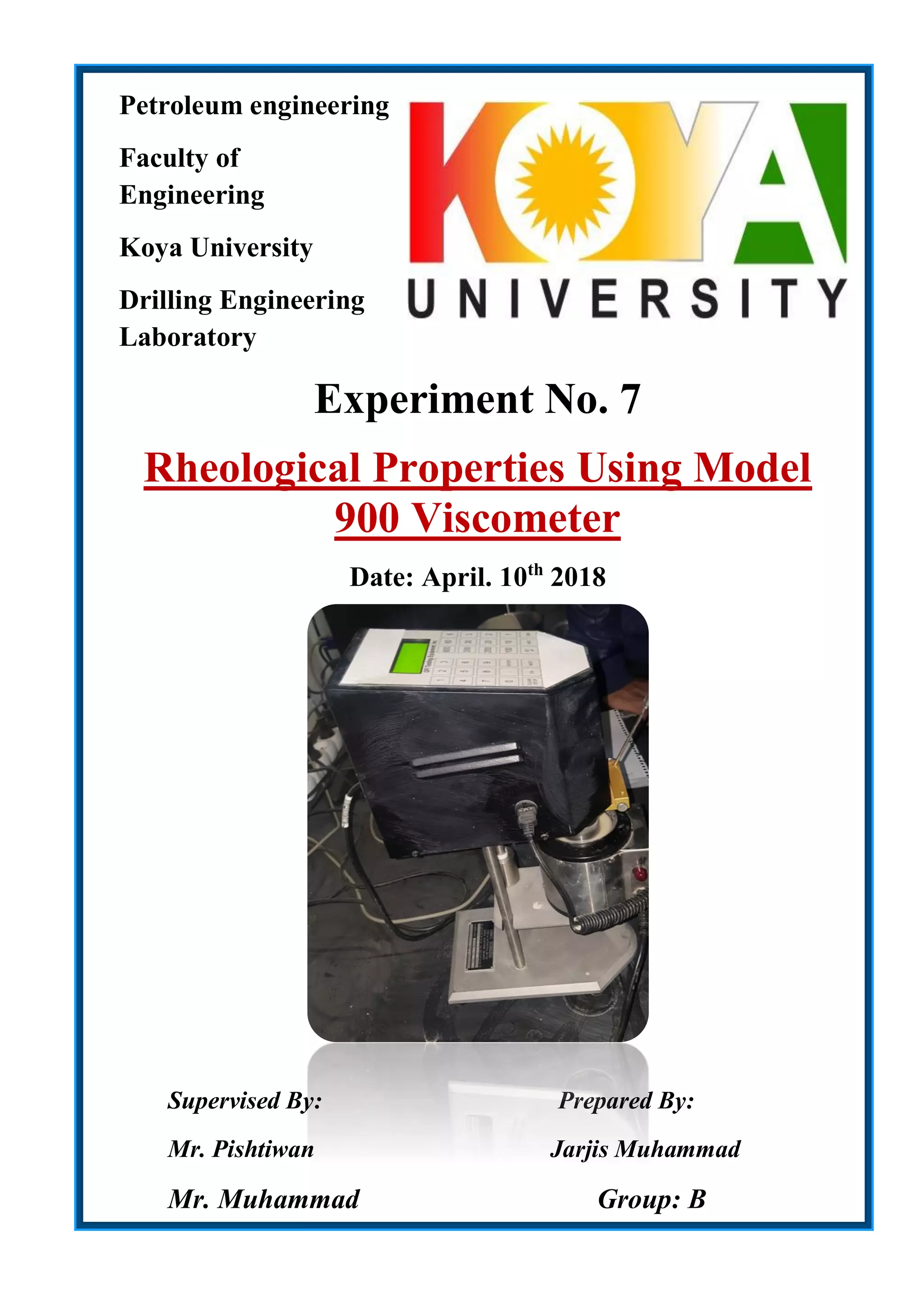
Experiment No. 7
Rheological Properties Using Model
900 Viscometer
Date: April. 10th
2018
Supervised By: Prepared By:
Mr. Pishtiwan Jarjis Muhammad
Mr. Muhammad Group: B
Rheological Properties Using Model 900 Viscometer point Jarjis Muhammad
Contents:
Subject Page
Aim 1
Theory 2
Introduction to Experiment 3
Procedure 5
Discussion 7
References 12
Rheological Properties Using Model 900 Viscometer point Jarjis Muhammad
Aim of the experiment:
The aim of this experiment is using model 900 viscometer to
determine plastic viscosity, yield point and gel strength.
Rheological Properties Using Model 900 Viscometer point Jarjis Muhammad
Theory:
The Model 900 Viscometer is a portable, yet fully
automated system for measuring fluid viscosity. It is
designed to be easy to use, easy to maintain and to provide
consistent results. Its simplicity makes it ideally suited for
field applications. Engineers will appreciate the push button
calibration, its reliability, and the ability to perform standard
American Petroleum Institute (API) recommended practices
with one command. With the addition of a computer, it is
able to perform a variety of more complex laboratory tests.
Routine repairs, like bearing and torsion spring replacement,
may be performed by field personnel with a minimum of
training, without having to return the viscometer for repair.
Rheological Properties Using Model 900 Viscometer point Jarjis Muhammad
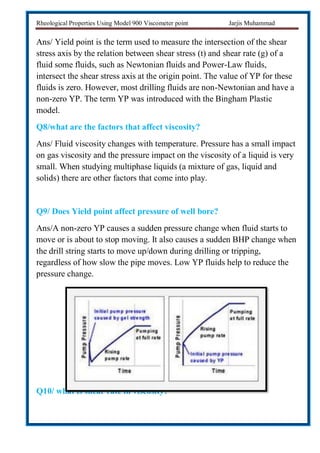
Introduction to Experiment:
Mud Container
Model 900 Viscometer
Rheological Properties Using Model 900 Viscometer point Jarjis Muhammad
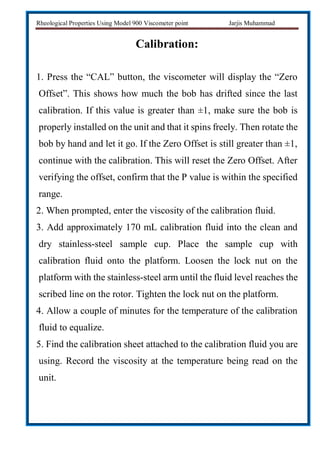
Calibration:
1. Press the ā€œCALā€ button, the viscometer will display the ā€œZero
Offsetā€. This shows how much the bob has drifted since the last
calibration. If this value is greater than ±1, make sure the bob is
properly installed on the unit and that it spins freely. Then rotate the
bob by hand and let it go. If the Zero Offset is still greater than ±1,
continue with the calibration. This will reset the Zero Offset. After
verifying the offset, confirm that the P value is within the specified
range.
2. When prompted, enter the viscosity of the calibration fluid.
3. Add approximately 170 mL calibration fluid into the clean and
dry stainless-steel sample cup. Place the sample cup with
calibration fluid onto the platform. Loosen the lock nut on the
platform with the stainless-steel arm until the fluid level reaches the
scribed line on the rotor. Tighten the lock nut on the platform.
4. Allow a couple of minutes for the temperature of the calibration
fluid to equalize.
5. Find the calibration sheet attached to the calibration fluid you are
using. Record the viscosity at the temperature being read on the
unit.
Rheological Properties Using Model 900 Viscometer point Jarjis Muhammad
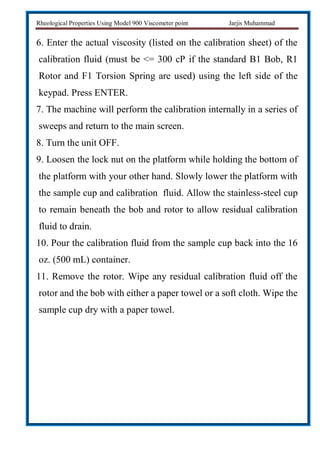
6. Enter the actual viscosity (listed on the calibration sheet) of the
calibration fluid (must be <= 300 cP if the standard B1 Bob, R1
Rotor and F1 Torsion Spring are used) using the left side of the
keypad. Press ENTER.
7. The machine will perform the calibration internally in a series of
sweeps and return to the main screen.
8. Turn the unit OFF.
9. Loosen the lock nut on the platform while holding the bottom of
the platform with your other hand. Slowly lower the platform with
the sample cup and calibration fluid. Allow the stainless-steel cup
to remain beneath the bob and rotor to allow residual calibration
fluid to drain.
10. Pour the calibration fluid from the sample cup back into the 16
oz. (500 mL) container.
11. Remove the rotor. Wipe any residual calibration fluid off the
rotor and the bob with either a paper towel or a soft cloth. Wipe the
sample cup dry with a paper towel.
Rheological Properties Using Model 900 Viscometer point Jarjis Muhammad
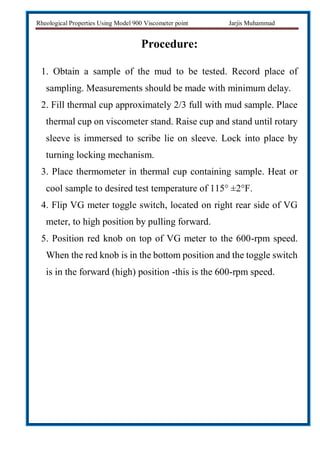
Procedure:
1. Obtain a sample of the mud to be tested. Record place of
sampling. Measurements should be made with minimum delay.
2. Fill thermal cup approximately 2/3 full with mud sample. Place
thermal cup on viscometer stand. Raise cup and stand until rotary
sleeve is immersed to scribe lie on sleeve. Lock into place by
turning locking mechanism.
3. Place thermometer in thermal cup containing sample. Heat or
cool sample to desired test temperature of 115° ±2°F.
4. Flip VG meter toggle switch, located on right rear side of VG
meter, to high position by pulling forward.
5. Position red knob on top of VG meter to the 600-rpm speed.
When the red knob is in the bottom position and the toggle switch
is in the forward (high) position -this is the 600-rpm speed.
Rheological Properties Using Model 900 Viscometer point Jarjis Muhammad
6. With the sleeve rotating at 600-rpm, wait for dial reading in the
top window of VG meter to stabilize (minimum 10 seconds).
Record 600-rpm dial reading.
7. With red knob in bottom position, flip the VG meter toggle
switch to low position by pushing the toggle switch away from
you. Wait for dial reading to stabilize (minimum 10 seconds).
Records 300-rpm dial reading. [See Step 8 to calculate the Plastic
Viscosity and Yield Point].
8. The Plastic Viscosity and Yield Point are calculated from the
600-rpm and 300-rpm dial readings. By calculate some simple
calculations.
Rheological Properties Using Model 900 Viscometer point Jarjis Muhammad
Discussion:
Q1/ Are there any errors in this lab experiment?
Ans/
1- Human errors like fill the cup with mud more than position limits.
2- Quality of calibration fluid.
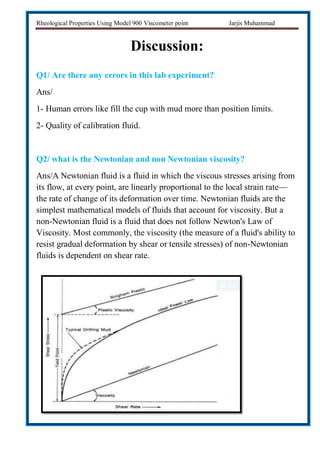
Q2/ what is the Newtonian and non Newtonian viscosity?
Ans/A Newtonian fluid is a fluid in which the viscous stresses arising from
its flow, at every point, are linearly proportional to the local strain rate—
the rate of change of its deformation over time. Newtonian fluids are the
simplest mathematical models of fluids that account for viscosity. But a
non-Newtonian fluid is a fluid that does not follow Newton's Law of
Viscosity. Most commonly, the viscosity (the measure of a fluid's ability to
resist gradual deformation by shear or tensile stresses) of non-Newtonian
fluids is dependent on shear rate.
Rheological Properties Using Model 900 Viscometer point Jarjis Muhammad
Q3/what is Plastic Viscosity? What does it characterize?
Ans/Plastic Viscosity is a measure of the high-shear-rate viscosity. Plastic
viscosity is largely due to mechanical friction between solid particles in the
drilling fluid. Plastic viscosity depends primarily on the size, shape, and
number of solids in the fluid. Progressive increases in plastic viscosity can
indicate a build up of drilled solids.
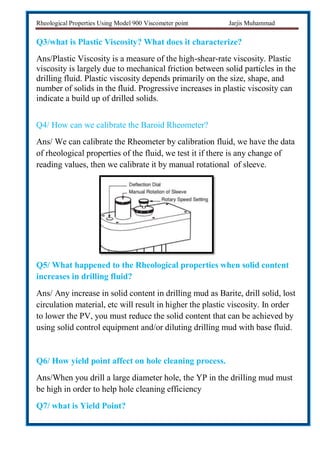
Q4/ How can we calibrate the Baroid Rheometer?
Ans/ We can calibrate the Rheometer by calibration fluid, we have the data
of rheological properties of the fluid, we test it if there is any change of
reading values, then we calibrate it by manual rotational of sleeve.
Q5/ What happened to the Rheological properties when solid content
increases in drilling fluid?
Ans/ Any increase in solid content in drilling mud as Barite, drill solid, lost
circulation material, etc will result in higher the plastic viscosity. In order
to lower the PV, you must reduce the solid content that can be achieved by
using solid control equipment and/or diluting drilling mud with base fluid.
Q6/ How yield point affect on hole cleaning process.
Ans/When you drill a large diameter hole, the YP in the drilling mud must
be high in order to help hole cleaning efficiency
Q7/ what is Yield Point?
Rheological Properties Using Model 900 Viscometer point Jarjis Muhammad
Ans/ Yield point is the term used to measure the intersection of the shear
stress axis by the relation between shear stress (t) and shear rate (g) of a
fluid some fluids, such as Newtonian fluids and Power-Law fluids,
intersect the shear stress axis at the origin point. The value of YP for these
fluids is zero. However, most drilling fluids are non-Newtonian and have a
non-zero YP. The term YP was introduced with the Bingham Plastic
model.
Q8/what are the factors that affect viscosity?
Ans/ Fluid viscosity changes with temperature. Pressure has a small impact
on gas viscosity and the pressure impact on the viscosity of a liquid is very
small. When studying multiphase liquids (a mixture of gas, liquid and
solids) there are other factors that come into play.
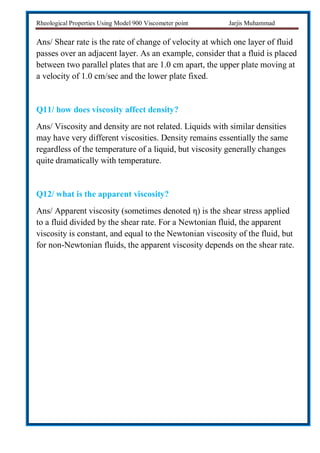
Q9/ Does Yield point affect pressure of well bore?
Ans/A non-zero YP causes a sudden pressure change when fluid starts to
move or is about to stop moving. It also causes a sudden BHP change when
the drill string starts to move up/down during drilling or tripping,
regardless of how slow the pipe moves. Low YP fluids help to reduce the
pressure change.
Q10/ what is shear rate in viscosity?
Rheological Properties Using Model 900 Viscometer point Jarjis Muhammad
Ans/ Shear rate is the rate of change of velocity at which one layer of fluid
passes over an adjacent layer. As an example, consider that a fluid is placed
between two parallel plates that are 1.0 cm apart, the upper plate moving at
a velocity of 1.0 cm/sec and the lower plate fixed.
Q11/ how does viscosity affect density?
Ans/ Viscosity and density are not related. Liquids with similar densities
may have very different viscosities. Density remains essentially the same
regardless of the temperature of a liquid, but viscosity generally changes
quite dramatically with temperature.
Q12/ what is the apparent viscosity?
Ans/ Apparent viscosity (sometimes denoted Ī·) is the shear stress applied
to a fluid divided by the shear rate. For a Newtonian fluid, the apparent
viscosity is constant, and equal to the Newtonian viscosity of the fluid, but
for non-Newtonian fluids, the apparent viscosity depends on the shear rate.
Rheological Properties Using Model 900 Viscometer point Jarjis Muhammad
References:
1. ASME Shale Shaker Committee.: ā€œDrilling Fluid
Process, 2005.
2. Priston L. Moore: ā€œDrilling Practices,ā€ PennWell
Publishing Company Tulsa, 1988

Rheology model 900 viscometer Mud Engineering Exp.

  • 1.
    Petroleum engineering Faculty of Engineering KoyaUniversity Drilling Engineering Laboratory Experiment No. 7 Rheological Properties Using Model 900 Viscometer Date: April. 10th 2018 Supervised By: Prepared By: Mr. Pishtiwan Jarjis Muhammad Mr. Muhammad Group: B
  • 2.
    Rheological Properties UsingModel 900 Viscometer point Jarjis Muhammad Contents: Subject Page Aim 1 Theory 2 Introduction to Experiment 3 Procedure 5 Discussion 7 References 12
  • 3.
    Rheological Properties UsingModel 900 Viscometer point Jarjis Muhammad Aim of the experiment: The aim of this experiment is using model 900 viscometer to determine plastic viscosity, yield point and gel strength.
  • 4.
    Rheological Properties UsingModel 900 Viscometer point Jarjis Muhammad Theory: The Model 900 Viscometer is a portable, yet fully automated system for measuring fluid viscosity. It is designed to be easy to use, easy to maintain and to provide consistent results. Its simplicity makes it ideally suited for field applications. Engineers will appreciate the push button calibration, its reliability, and the ability to perform standard American Petroleum Institute (API) recommended practices with one command. With the addition of a computer, it is able to perform a variety of more complex laboratory tests. Routine repairs, like bearing and torsion spring replacement, may be performed by field personnel with a minimum of training, without having to return the viscometer for repair.
  • 5.
    Rheological Properties UsingModel 900 Viscometer point Jarjis Muhammad Introduction to Experiment: Mud Container Model 900 Viscometer
  • 6.
    Rheological Properties UsingModel 900 Viscometer point Jarjis Muhammad Calibration: 1. Press the ā€œCALā€ button, the viscometer will display the ā€œZero Offsetā€. This shows how much the bob has drifted since the last calibration. If this value is greater than ±1, make sure the bob is properly installed on the unit and that it spins freely. Then rotate the bob by hand and let it go. If the Zero Offset is still greater than ±1, continue with the calibration. This will reset the Zero Offset. After verifying the offset, confirm that the P value is within the specified range. 2. When prompted, enter the viscosity of the calibration fluid. 3. Add approximately 170 mL calibration fluid into the clean and dry stainless-steel sample cup. Place the sample cup with calibration fluid onto the platform. Loosen the lock nut on the platform with the stainless-steel arm until the fluid level reaches the scribed line on the rotor. Tighten the lock nut on the platform. 4. Allow a couple of minutes for the temperature of the calibration fluid to equalize. 5. Find the calibration sheet attached to the calibration fluid you are using. Record the viscosity at the temperature being read on the unit.
  • 7.
    Rheological Properties UsingModel 900 Viscometer point Jarjis Muhammad 6. Enter the actual viscosity (listed on the calibration sheet) of the calibration fluid (must be <= 300 cP if the standard B1 Bob, R1 Rotor and F1 Torsion Spring are used) using the left side of the keypad. Press ENTER. 7. The machine will perform the calibration internally in a series of sweeps and return to the main screen. 8. Turn the unit OFF. 9. Loosen the lock nut on the platform while holding the bottom of the platform with your other hand. Slowly lower the platform with the sample cup and calibration fluid. Allow the stainless-steel cup to remain beneath the bob and rotor to allow residual calibration fluid to drain. 10. Pour the calibration fluid from the sample cup back into the 16 oz. (500 mL) container. 11. Remove the rotor. Wipe any residual calibration fluid off the rotor and the bob with either a paper towel or a soft cloth. Wipe the sample cup dry with a paper towel.
  • 8.
    Rheological Properties UsingModel 900 Viscometer point Jarjis Muhammad Procedure: 1. Obtain a sample of the mud to be tested. Record place of sampling. Measurements should be made with minimum delay. 2. Fill thermal cup approximately 2/3 full with mud sample. Place thermal cup on viscometer stand. Raise cup and stand until rotary sleeve is immersed to scribe lie on sleeve. Lock into place by turning locking mechanism. 3. Place thermometer in thermal cup containing sample. Heat or cool sample to desired test temperature of 115° ±2°F. 4. Flip VG meter toggle switch, located on right rear side of VG meter, to high position by pulling forward. 5. Position red knob on top of VG meter to the 600-rpm speed. When the red knob is in the bottom position and the toggle switch is in the forward (high) position -this is the 600-rpm speed.
  • 9.
    Rheological Properties UsingModel 900 Viscometer point Jarjis Muhammad 6. With the sleeve rotating at 600-rpm, wait for dial reading in the top window of VG meter to stabilize (minimum 10 seconds). Record 600-rpm dial reading. 7. With red knob in bottom position, flip the VG meter toggle switch to low position by pushing the toggle switch away from you. Wait for dial reading to stabilize (minimum 10 seconds). Records 300-rpm dial reading. [See Step 8 to calculate the Plastic Viscosity and Yield Point]. 8. The Plastic Viscosity and Yield Point are calculated from the 600-rpm and 300-rpm dial readings. By calculate some simple calculations.
  • 10.
    Rheological Properties UsingModel 900 Viscometer point Jarjis Muhammad Discussion: Q1/ Are there any errors in this lab experiment? Ans/ 1- Human errors like fill the cup with mud more than position limits. 2- Quality of calibration fluid. Q2/ what is the Newtonian and non Newtonian viscosity? Ans/A Newtonian fluid is a fluid in which the viscous stresses arising from its flow, at every point, are linearly proportional to the local strain rate— the rate of change of its deformation over time. Newtonian fluids are the simplest mathematical models of fluids that account for viscosity. But a non-Newtonian fluid is a fluid that does not follow Newton's Law of Viscosity. Most commonly, the viscosity (the measure of a fluid's ability to resist gradual deformation by shear or tensile stresses) of non-Newtonian fluids is dependent on shear rate.
  • 11.
    Rheological Properties UsingModel 900 Viscometer point Jarjis Muhammad Q3/what is Plastic Viscosity? What does it characterize? Ans/Plastic Viscosity is a measure of the high-shear-rate viscosity. Plastic viscosity is largely due to mechanical friction between solid particles in the drilling fluid. Plastic viscosity depends primarily on the size, shape, and number of solids in the fluid. Progressive increases in plastic viscosity can indicate a build up of drilled solids. Q4/ How can we calibrate the Baroid Rheometer? Ans/ We can calibrate the Rheometer by calibration fluid, we have the data of rheological properties of the fluid, we test it if there is any change of reading values, then we calibrate it by manual rotational of sleeve. Q5/ What happened to the Rheological properties when solid content increases in drilling fluid? Ans/ Any increase in solid content in drilling mud as Barite, drill solid, lost circulation material, etc will result in higher the plastic viscosity. In order to lower the PV, you must reduce the solid content that can be achieved by using solid control equipment and/or diluting drilling mud with base fluid. Q6/ How yield point affect on hole cleaning process. Ans/When you drill a large diameter hole, the YP in the drilling mud must be high in order to help hole cleaning efficiency Q7/ what is Yield Point?
  • 12.
    Rheological Properties UsingModel 900 Viscometer point Jarjis Muhammad Ans/ Yield point is the term used to measure the intersection of the shear stress axis by the relation between shear stress (t) and shear rate (g) of a fluid some fluids, such as Newtonian fluids and Power-Law fluids, intersect the shear stress axis at the origin point. The value of YP for these fluids is zero. However, most drilling fluids are non-Newtonian and have a non-zero YP. The term YP was introduced with the Bingham Plastic model. Q8/what are the factors that affect viscosity? Ans/ Fluid viscosity changes with temperature. Pressure has a small impact on gas viscosity and the pressure impact on the viscosity of a liquid is very small. When studying multiphase liquids (a mixture of gas, liquid and solids) there are other factors that come into play. Q9/ Does Yield point affect pressure of well bore? Ans/A non-zero YP causes a sudden pressure change when fluid starts to move or is about to stop moving. It also causes a sudden BHP change when the drill string starts to move up/down during drilling or tripping, regardless of how slow the pipe moves. Low YP fluids help to reduce the pressure change. Q10/ what is shear rate in viscosity?
  • 13.
    Rheological Properties UsingModel 900 Viscometer point Jarjis Muhammad Ans/ Shear rate is the rate of change of velocity at which one layer of fluid passes over an adjacent layer. As an example, consider that a fluid is placed between two parallel plates that are 1.0 cm apart, the upper plate moving at a velocity of 1.0 cm/sec and the lower plate fixed. Q11/ how does viscosity affect density? Ans/ Viscosity and density are not related. Liquids with similar densities may have very different viscosities. Density remains essentially the same regardless of the temperature of a liquid, but viscosity generally changes quite dramatically with temperature. Q12/ what is the apparent viscosity? Ans/ Apparent viscosity (sometimes denoted Ī·) is the shear stress applied to a fluid divided by the shear rate. For a Newtonian fluid, the apparent viscosity is constant, and equal to the Newtonian viscosity of the fluid, but for non-Newtonian fluids, the apparent viscosity depends on the shear rate.
  • 14.
    Rheological Properties UsingModel 900 Viscometer point Jarjis Muhammad References: 1. ASME Shale Shaker Committee.: ā€œDrilling Fluid Process, 2005. 2. Priston L. Moore: ā€œDrilling Practices,ā€ PennWell Publishing Company Tulsa, 1988