2015
Kamal Abdurahman
Group:B
2/25/2015
Liquid Permeability
Supervised By : Mr.AliKamal
Ms.Sana
Mr.Hewa
Contents
1- Aim.
2- Theory.
3- Apparatus.
4- Procedure.
5-Calculation.
6- discussion.
7- references.
Aim of experiment:
In this test we are determined the permeability of a core sample
by used the water (brine).
INTRODUCTION
The Liquid Perm is an instrument dedicated for routine core
analysis.
Two pressure control valves of respective range of 0-30 and 0-
100 psig are used to sense gas (air or nitrogen) pressure in a
vessel initially filled water (brine). The gas pressure transfers
water into the sample at constant pressure. The flow out is
determined by measuring time to fill a graduated flask (flasks
provided: 10 cc, 50cc and 100cc). After reporting the sample
diameter and length, the flow measured and the upstream
pressure in a template XLS file, the permeability is calculated
from Darcy’s law. Confining pressures up to 400 psig can be
applied to the cores, and displayed on the Gas perm console.
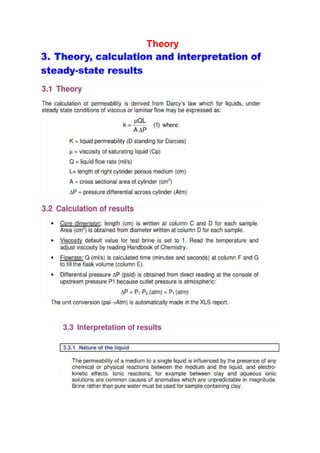
Theory
Note
If on increasing pressure with LOW pressure regulator, the
maximum pressure is obtained without generating any significant
flow through the core, switch the HIGH regulator on.
As an example we have plotted the permeability for a core of dia.
1” and length 3 inch as a function of required time to fill the flask
10cc and 100 cc respectively. The upstream pressure is varied
from 1 to 100 psi and the flow duration is from 1 minute to 60
minutes.
6. Report file operation
Copy the template XLS report file into [Your Name]. xls (for
instance Monday.xls).
Open Monday.xls.
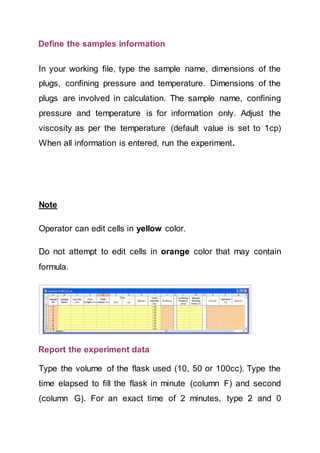
Define the samples information
In your working file, type the sample name, dimensions of the
plugs, confining pressure and temperature. Dimensions of the
plugs are involved in calculation. The sample name, confining
pressure and temperature is for information only. Adjust the
viscosity as per the temperature (default value is set to 1cp)
When all information is entered, run the experiment.
Note
Operator can edit cells in yellow color.
Do not attempt to edit cells in orange color that may contain
formula.
Report the experiment data
Type the volume of the flask used (10, 50 or 100cc). Type the
time elapsed to fill the flask in minute (column F) and second
(column G). For an exact time of 2 minutes, type 2 and 0
respectively at column F and G (it is important to type the value
of second whenever it is null. Type the pressure across the core
read from the display of upstream pressure.
Read the permeability
When all necessary data is typed, the permeability is calculated
in mD at column J.
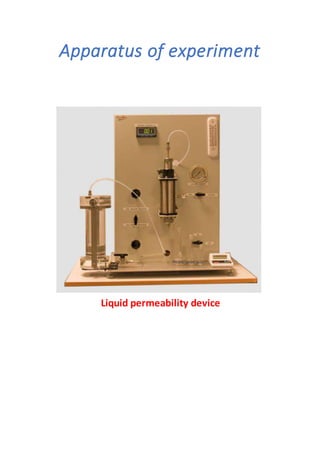
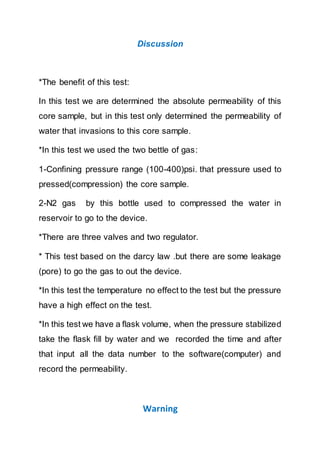
Apparatus of experiment
Liquid permeability device
PROCEDURE
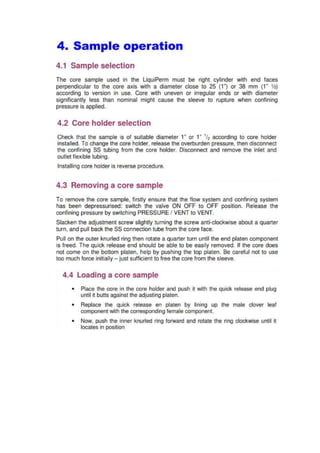
1- Connect to main supply and power up the instrument at main
switch on the rear panel. The pressure transducers require a
“warm up” period of about one hour before use.
2- Switch the source valve ON / OFF to OFF position.
3- Ensure that regulators are fully turned anticlockwise initially .
4- Connect two regulated nitrogen supply to the appropriate
ports on the rear of the instrument, i.e. confining pressure supply
at valve PRESSURE / VENT (1/8”OD) and core nitrogen supply
at valve ON / OFF (1/8 “ OD).
5- Load the core holder. Different core holders are available for
sample dia. of 1”, 1 ½”, 30 mm etc.
6- Regulate confining pressure supply to desired value without
exceeding 400 psi.
7- Regulate core nitrogen supply without exceeding 100 psi.
8- Turn confining valve PRESSURE / VENT to PRESSURE. Gas
at desired pressure is now applied to the core holder sleeve. This
pressure is now displayed on confining pressure gauge.
9- Prime the system by filling the dead volume with brine by
proceeding without core in place at first step (confining pressure
should NOT be applied)
10- Ensure that regulators are fully turned anticlockwise initially.
11- Install a beaker the outlet of the core holder.
12- For a core of unknown permeability, select initially the LOW
pressure regulator range.
13- Switch source valve ON / OFF to ON. Slowly increase
regulator to obtain desired liquid flow or test pressure.
14- Let the flow stabilize, then place the graduated flask at the
outlet of the core and start the stopwatch. Stop the watch as soon
as the water level reaches the graduation
Discussion
*The benefit of this test:
In this test we are determined the absolute permeability of this
core sample, but in this test only determined the permeability of
water that invasions to this core sample.
*In this test we used the two bettle of gas:
1-Confining pressure range (100-400)psi. that pressure used to
pressed(compression) the core sample.
2-N2 gas by this bottle used to compressed the water in
reservoir to go to the device.
*There are three valves and two regulator.
* This test based on the darcy law .but there are some leakage
(pore) to go the gas to out the device.
*In this test the temperature no effect to the test but the pressure
have a high effect on the test.
*In this test we have a flask volume, when the pressure stabilized
take the flask fill by water and we recorded the time and after
that input all the data number to the software(computer) and
record the permeability.
Warning
Operation and maintenance may only be carried out after all
necessary steps have been taken to ensure the safety of people
and equipment.
Any doubt must be resolved before performing a test or
maintenance.
It is very important to provide the required installation
environment, in agreement with the local legislation.
Due to the specification of the equipment, it is recommended to
ensure that only authorized and sufficiently trained and
experienced staff may operate the installation.
These concerns to all:
• Operators
• Technical staff (electrician, chemist...)
• Employees
• Non employees (visitors and contract personnel)
• Room maintenance staff, etc
Reference
/default.aspxtype/premeability-http://www.malvern.com/en/products/measurement
Colloidal andInterfacial Science,1994.162:p.,”Journal ofsteadystateJiao,D. and M.M. Sharma, “
462.-454
.slb.com/en/Terms/m/mudcake.aspxpremeabilityhttp://www.glossary.
Fisk, J.V., and Jamison,D.E., "Physical Properties of Rock at High Temperatures and Pressures,"SPE Drilling
Engineering,December 1989,pp.341-46.
Liquid permeability

Liquid permeability

  • 1.
  • 2.
    Contents 1- Aim. 2- Theory. 3-Apparatus. 4- Procedure. 5-Calculation. 6- discussion. 7- references.
  • 3.
    Aim of experiment: Inthis test we are determined the permeability of a core sample by used the water (brine).
  • 4.
    INTRODUCTION The Liquid Permis an instrument dedicated for routine core analysis. Two pressure control valves of respective range of 0-30 and 0- 100 psig are used to sense gas (air or nitrogen) pressure in a vessel initially filled water (brine). The gas pressure transfers water into the sample at constant pressure. The flow out is determined by measuring time to fill a graduated flask (flasks provided: 10 cc, 50cc and 100cc). After reporting the sample diameter and length, the flow measured and the upstream pressure in a template XLS file, the permeability is calculated from Darcy’s law. Confining pressures up to 400 psig can be applied to the cores, and displayed on the Gas perm console.
  • 5.
  • 7.
    Note If on increasingpressure with LOW pressure regulator, the maximum pressure is obtained without generating any significant flow through the core, switch the HIGH regulator on. As an example we have plotted the permeability for a core of dia. 1” and length 3 inch as a function of required time to fill the flask 10cc and 100 cc respectively. The upstream pressure is varied from 1 to 100 psi and the flow duration is from 1 minute to 60 minutes. 6. Report file operation Copy the template XLS report file into [Your Name]. xls (for instance Monday.xls). Open Monday.xls.
  • 8.
    Define the samplesinformation In your working file, type the sample name, dimensions of the plugs, confining pressure and temperature. Dimensions of the plugs are involved in calculation. The sample name, confining pressure and temperature is for information only. Adjust the viscosity as per the temperature (default value is set to 1cp) When all information is entered, run the experiment. Note Operator can edit cells in yellow color. Do not attempt to edit cells in orange color that may contain formula. Report the experiment data Type the volume of the flask used (10, 50 or 100cc). Type the time elapsed to fill the flask in minute (column F) and second (column G). For an exact time of 2 minutes, type 2 and 0
  • 9.
    respectively at columnF and G (it is important to type the value of second whenever it is null. Type the pressure across the core read from the display of upstream pressure. Read the permeability When all necessary data is typed, the permeability is calculated in mD at column J.
  • 10.
    Apparatus of experiment Liquidpermeability device
  • 11.
    PROCEDURE 1- Connect tomain supply and power up the instrument at main switch on the rear panel. The pressure transducers require a “warm up” period of about one hour before use. 2- Switch the source valve ON / OFF to OFF position. 3- Ensure that regulators are fully turned anticlockwise initially . 4- Connect two regulated nitrogen supply to the appropriate ports on the rear of the instrument, i.e. confining pressure supply at valve PRESSURE / VENT (1/8”OD) and core nitrogen supply at valve ON / OFF (1/8 “ OD). 5- Load the core holder. Different core holders are available for sample dia. of 1”, 1 ½”, 30 mm etc. 6- Regulate confining pressure supply to desired value without exceeding 400 psi. 7- Regulate core nitrogen supply without exceeding 100 psi. 8- Turn confining valve PRESSURE / VENT to PRESSURE. Gas at desired pressure is now applied to the core holder sleeve. This pressure is now displayed on confining pressure gauge.
  • 12.
    9- Prime thesystem by filling the dead volume with brine by proceeding without core in place at first step (confining pressure should NOT be applied) 10- Ensure that regulators are fully turned anticlockwise initially. 11- Install a beaker the outlet of the core holder. 12- For a core of unknown permeability, select initially the LOW pressure regulator range. 13- Switch source valve ON / OFF to ON. Slowly increase regulator to obtain desired liquid flow or test pressure. 14- Let the flow stabilize, then place the graduated flask at the outlet of the core and start the stopwatch. Stop the watch as soon as the water level reaches the graduation
  • 14.
    Discussion *The benefit ofthis test: In this test we are determined the absolute permeability of this core sample, but in this test only determined the permeability of water that invasions to this core sample. *In this test we used the two bettle of gas: 1-Confining pressure range (100-400)psi. that pressure used to pressed(compression) the core sample. 2-N2 gas by this bottle used to compressed the water in reservoir to go to the device. *There are three valves and two regulator. * This test based on the darcy law .but there are some leakage (pore) to go the gas to out the device. *In this test the temperature no effect to the test but the pressure have a high effect on the test. *In this test we have a flask volume, when the pressure stabilized take the flask fill by water and we recorded the time and after that input all the data number to the software(computer) and record the permeability. Warning
  • 15.
    Operation and maintenancemay only be carried out after all necessary steps have been taken to ensure the safety of people and equipment. Any doubt must be resolved before performing a test or maintenance. It is very important to provide the required installation environment, in agreement with the local legislation. Due to the specification of the equipment, it is recommended to ensure that only authorized and sufficiently trained and experienced staff may operate the installation. These concerns to all: • Operators • Technical staff (electrician, chemist...) • Employees • Non employees (visitors and contract personnel) • Room maintenance staff, etc
  • 16.
    Reference /default.aspxtype/premeability-http://www.malvern.com/en/products/measurement Colloidal andInterfacial Science,1994.162:p.,”JournalofsteadystateJiao,D. and M.M. Sharma, “ 462.-454 .slb.com/en/Terms/m/mudcake.aspxpremeabilityhttp://www.glossary. Fisk, J.V., and Jamison,D.E., "Physical Properties of Rock at High Temperatures and Pressures,"SPE Drilling Engineering,December 1989,pp.341-46.