1
Petroleum department
3rd stage
Group (A4)
Reservoir Lab
1st
Experiment:
Core Plug Test
Date of experiment: November 19th
2015
Supervised by:
Mr. Haval Hawez
Prepared by:
Muhammad Faisal
2
Aim of experiment:
The aim of this experiment is to prepare a typical core plug by
removing the plug of the sample rock by the core plug machine
then adjusting the plug by a special laboratory saw to match our
requirements from shape and size.
3
Theory:
A core plug sample refers to a much smaller portion or subsample
of the whole core sample. A core plug sample is obtained by
cutting cylindrical plugs of typically 1 or 1.5 in. in diameter and of
lengths up to 3 in... From a whole core. All necessary rock
properties are typically measured on a number of such core plug
samples. Generally, core plugs are cut from whole core samples in
two different orientations: perpendicular or parallel to the axis of
the whole core. These core plugs, when drilled from a whole core
from a vertical well bore, are called horizontal and vertical plugs
respectively. The determination of rock properties using core plugs
has some distinct advantages such as relatively short amount of
test duration and ease of maintaining experimental conditions. A
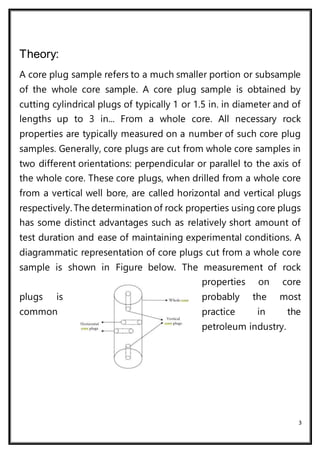
diagrammatic representation of core plugs cut from a whole core
sample is shown in Figure below. The measurement of rock
properties on core
plugs is probably the most
common practice in the
petroleum industry.
4
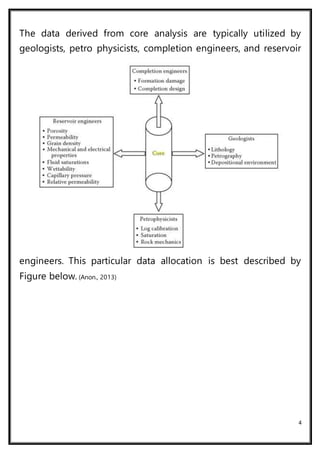
The data derived from core analysis are typically utilized by
geologists, petro physicists, completion engineers, and reservoir
engineers. This particular data allocation is best described by
Figure below. (Anon., 2013)
5
Introduction:
A plug, or sample, taken from a conventional core for analysis. Core
plugs are typically 1 in. to 1 1/2 in. [2.5 to 3.8 cm] in diameter and
1 in. to 2 in. [5 cm] long. Core plugs are ordinarily cut perpendicular
to the axis of the core or parallel to the axis, called horizontal and
vertical plugs, respectively, when cut from a vertical wellbore. The
terms horizontal and vertical are often applied for cores cut from a
deviated or horizontal wellbore, even though they are not strictly
correct unless core orientation is measured and plugs are cut to
the true in-situ orientation.
6
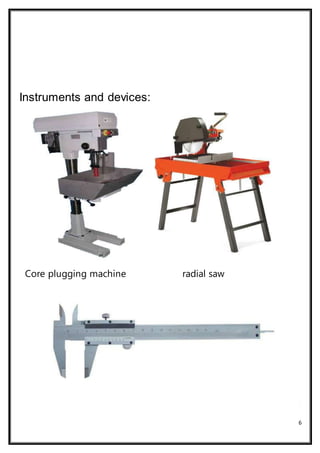
Instruments and devices:
Core plugging machine radial saw
7
Diameter ruler
Test procedures:
Caution: the device used in this experiment are extremely
dangerous. Before the lab begins full information should be
obtained. Lab coat, safety glasses and gloves are necessary for
this test.
1) Core slabbing:
 If the rock is big then it should first be cut by another method
 Put the sample on the table · Check the tension on the pulleys
 Adjust the direction of water line on both saw and sample
 Check water tanks and fill them if they are empty
 Start the water pump and check the direction of water and
check the flow
 Start the saw by pressing the start bottom
 Cut the sample by screwing up and down of the saw and
pushing the sample table of machine
 Press the stop button
 Unclamp the core sample
2) Plugging using plug drill Press machine:
 Check the tension on the pulleys
 Check the direction of the spindle
 Fill the recycling tank
 Screw down the core drill and lock it in place
8
 Mount a core sample and lock it firmly in the clamping unit
 Adjust the lower stop on the core drill. 1-2 mm before the end
of slab is sufficient for prevention of plugging the sample in
plug driller. Touching of the driller with table causes severe
damage to the driller.
 Close the core drill protective housing
 Press the Start button
 Open the irrigation taps
 Check the flows
 Cut the core sample
 Press the « Stop » button
 Unclamp the core sample
3) Measuring the plugs dimensions with the ruler.
9
Discussion:
Q1) what is the main problem associated with core plug data?
A1) the main problem is alternation of core between the reservoir
and the laboratory permeameter, and the method of averaging
core plug values to give a macroscopic layer permeability. (Stewart,
2011)
Q2) what are the data we get from core plugs?
A2) porosity, permeability, rock type, lithology, fluid type, fluid
saturation….
Q3) why does the Radial saw and the core plug machine have
cooling systems?
A3) to protect the saw and the core bit from damage and the heat
generated by the high friction and for safety as well to prevent any
launched sparks and splinters.
10
References:
Anon., 2013. Petroleum ReservoirRock and Fluid Properties,
Second Edition. 2 ed. Boca Raton: CRC Press.
Lamber, S. J., 1980. Recommended Analysis Plan for the
Borehole Plugging Program Potash Core Test. 1 ed. Department
of Energy,USA: Sandia National Laboratories.
Stewart, G., 2011. Well Test Design & Analysis. 1 ed.
Tulsa,Oklahoma:PennWell Corporation.
11

Core plug test

  • 1.
    1 Petroleum department 3rd stage Group(A4) Reservoir Lab 1st Experiment: Core Plug Test Date of experiment: November 19th 2015 Supervised by: Mr. Haval Hawez Prepared by: Muhammad Faisal
  • 2.
    2 Aim of experiment: Theaim of this experiment is to prepare a typical core plug by removing the plug of the sample rock by the core plug machine then adjusting the plug by a special laboratory saw to match our requirements from shape and size.
  • 3.
    3 Theory: A core plugsample refers to a much smaller portion or subsample of the whole core sample. A core plug sample is obtained by cutting cylindrical plugs of typically 1 or 1.5 in. in diameter and of lengths up to 3 in... From a whole core. All necessary rock properties are typically measured on a number of such core plug samples. Generally, core plugs are cut from whole core samples in two different orientations: perpendicular or parallel to the axis of the whole core. These core plugs, when drilled from a whole core from a vertical well bore, are called horizontal and vertical plugs respectively. The determination of rock properties using core plugs has some distinct advantages such as relatively short amount of test duration and ease of maintaining experimental conditions. A diagrammatic representation of core plugs cut from a whole core sample is shown in Figure below. The measurement of rock properties on core plugs is probably the most common practice in the petroleum industry.
  • 4.
    4 The data derivedfrom core analysis are typically utilized by geologists, petro physicists, completion engineers, and reservoir engineers. This particular data allocation is best described by Figure below. (Anon., 2013)
  • 5.
    5 Introduction: A plug, orsample, taken from a conventional core for analysis. Core plugs are typically 1 in. to 1 1/2 in. [2.5 to 3.8 cm] in diameter and 1 in. to 2 in. [5 cm] long. Core plugs are ordinarily cut perpendicular to the axis of the core or parallel to the axis, called horizontal and vertical plugs, respectively, when cut from a vertical wellbore. The terms horizontal and vertical are often applied for cores cut from a deviated or horizontal wellbore, even though they are not strictly correct unless core orientation is measured and plugs are cut to the true in-situ orientation.
  • 6.
    6 Instruments and devices: Coreplugging machine radial saw
  • 7.
    7 Diameter ruler Test procedures: Caution:the device used in this experiment are extremely dangerous. Before the lab begins full information should be obtained. Lab coat, safety glasses and gloves are necessary for this test. 1) Core slabbing:  If the rock is big then it should first be cut by another method  Put the sample on the table · Check the tension on the pulleys  Adjust the direction of water line on both saw and sample  Check water tanks and fill them if they are empty  Start the water pump and check the direction of water and check the flow  Start the saw by pressing the start bottom  Cut the sample by screwing up and down of the saw and pushing the sample table of machine  Press the stop button  Unclamp the core sample 2) Plugging using plug drill Press machine:  Check the tension on the pulleys  Check the direction of the spindle  Fill the recycling tank  Screw down the core drill and lock it in place
  • 8.
    8  Mount acore sample and lock it firmly in the clamping unit  Adjust the lower stop on the core drill. 1-2 mm before the end of slab is sufficient for prevention of plugging the sample in plug driller. Touching of the driller with table causes severe damage to the driller.  Close the core drill protective housing  Press the Start button  Open the irrigation taps  Check the flows  Cut the core sample  Press the « Stop » button  Unclamp the core sample 3) Measuring the plugs dimensions with the ruler.
  • 9.
    9 Discussion: Q1) what isthe main problem associated with core plug data? A1) the main problem is alternation of core between the reservoir and the laboratory permeameter, and the method of averaging core plug values to give a macroscopic layer permeability. (Stewart, 2011) Q2) what are the data we get from core plugs? A2) porosity, permeability, rock type, lithology, fluid type, fluid saturation…. Q3) why does the Radial saw and the core plug machine have cooling systems? A3) to protect the saw and the core bit from damage and the heat generated by the high friction and for safety as well to prevent any launched sparks and splinters.
  • 10.
    10 References: Anon., 2013. PetroleumReservoirRock and Fluid Properties, Second Edition. 2 ed. Boca Raton: CRC Press. Lamber, S. J., 1980. Recommended Analysis Plan for the Borehole Plugging Program Potash Core Test. 1 ed. Department of Energy,USA: Sandia National Laboratories. Stewart, G., 2011. Well Test Design & Analysis. 1 ed. Tulsa,Oklahoma:PennWell Corporation.
  • 11.