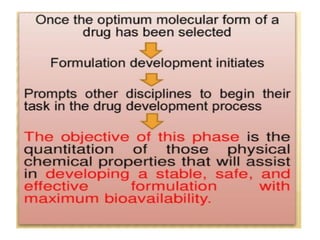
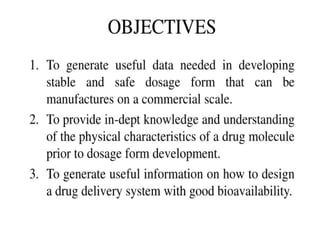
• It isdefined as the phase of R & D in which
preformulation studies characterize physical
and chemical properties of a drug molecule in
order to develop safe, effective and stable
dosage form.
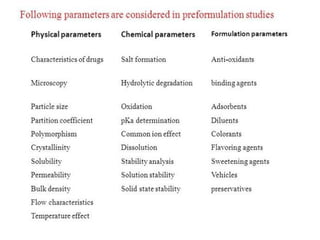
Preformulation
4.
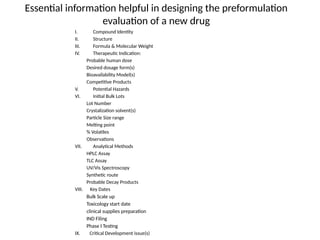
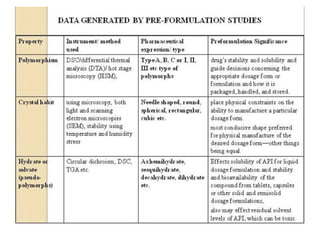
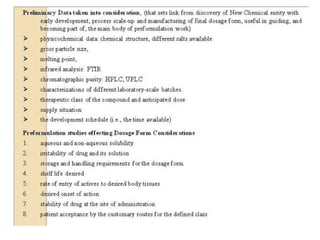
Essential information helpfulin designing the preformulation
evaluation of a new drug
I. Compound Identity
II. Structure
III. Formula & Molecular Weight
IV. Therapeutic Indication:
Probable human dose
Desired dosage form(s)
Bioavailability Model(s)
Competitive Products
V. Potential Hazards
VI. Initial Bulk Lots
Lot Number
Crystalization solvent(s)
Particle Size range
Melting point
% Volatiles
Observations
VII. Analytical Methods
HPLC Assay
TLC Assay
UV/Vis Spectroscopy
Synthetic route
Probable Decay Products
VIII. Key Dates
Bulk Scale up
Toxicology start date
clinical supplies preparation
IND Filing
Phase I Testing
IX. Critical Development issue(s)
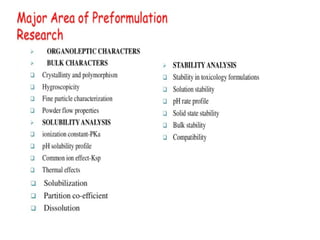
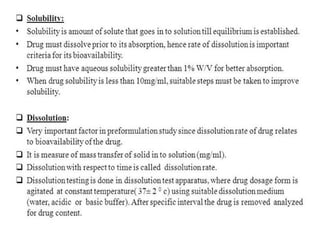
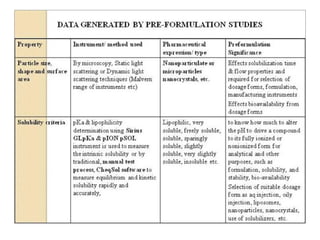
Solubility analysis
itis important for orally administered drugs or
drugs needed to be converted into solutions.
It includes:
pKa determinations
pH solubility profile and common ion effects
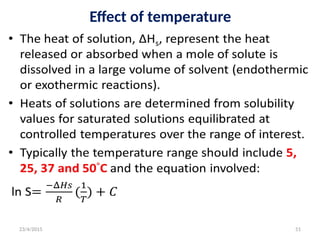
Effect of temperature
Solubilization
Partition coefficient
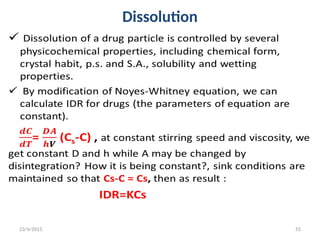
Dissolution
45
46.
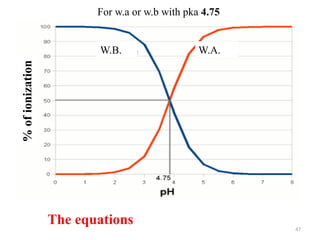
pKa determinations
Itis important for drugs capable of ionization within a
pH range (1-10), since solubility and then absorption
can be changed by pH changes.
As example, for a weakly acidic drug with pka value
greater than 3, the unionized form is present within the
acidic contents of the stomach, but the drug is ionized
predominantly in the neutral media of the intestine.
for basic drugs such as erythromycin, (pka ˜ 8-9), the
ionized form is predominant in both the stomach and
intestine.
46
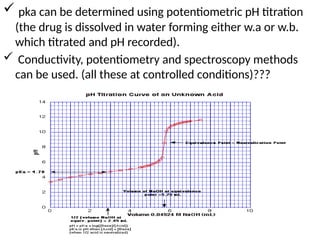
pka canbe determined using potentiometric pH titration
(the drug is dissolved in water forming either w.a or w.b.
which titrated and pH recorded).
Conductivity, potentiometry and spectroscopy methods
can be used. (all these at controlled conditions)???
23/4/2015 48
49.
pH solubility profileand Common ion effects
The solubility of an acidic or basic drug depends on the pka of the
ionizing functional group and the intrinsic solubilities for both the
ionized and un-ionized forms.
When the ionized or salt form of a drug is the solubility-limiting
species in solution, the concentration of the paired counter ion
(common ion) is usually the solubility determining factor. Ex. Salt
of basic amine BH+
Cl-
[BH
+
Cl
-
]solid [BH
+
] + [Cl
-
] , Ksp=[BH
+
][Cl
-
]
[Cl-
] increase total solubility decrease
Then, the solubility affected by pH, counter ion conc., drug conc.,
ionic strength, temp., and aqueous media composition.
23/4/2015 49
50.
For drug(Doxycycline, pka 3.4), there is common ion
effect for an amine hydrochloride salt on solubility.
The solubility in aqueous medium (pH 2 or less)
logarithmically decreased as a function of pH (which was
adjusted with hydrochloric acid) because of corresponding
increases in the chloride ion concentration.
In gastric juice (pH, 1-2 and [Cl-
]= 0.1-0.15M), doxycycline
hydrochloride dihydrate has a solubility of about 4mg/ml,
which is a factor of 7 less than its solubility in D.w.
In addition to that, protonated form (of solubility product)
of doxycycline can form dimeric species (due to self
association) at certain pH.
23/4/2015 50
23/4/2015 52
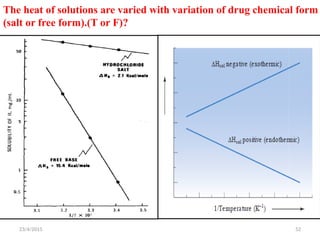
The heatof solutions are varied with variation of drug chemical form
(salt or free form).(T or F)?
53.
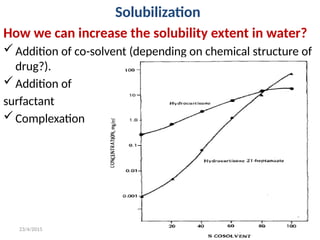
Solubilization
How we canincrease the solubility extent in water?
Addition of co-solvent (depending on chemical structure of
drug?).
Addition of
surfactant
Complexation
23/4/2015 53
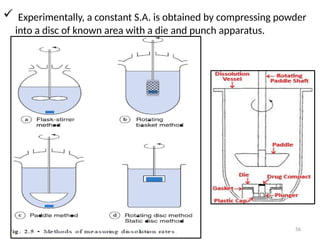
Experimentally, aconstant S.A. is obtained by compressing powder
into a disc of known area with a die and punch apparatus.
23/4/2015 56
57.
Stability analysis
Isusually the first quantitative assessment of
chemical stability of a new drug.
It includes both solution and solid state
experiments under conditions typical for the
handling, formulation, storage and administration of
a drug candidate.
Generally, it includes:
1. Stability in toxicology formulations
2. Solution stability
3. Solid state stability
57
58.
Stability in toxicologyformulations
A drug is administered to the animal in their feed, or
by oral gavage of a solution or suspension of the drug
in an aqueous vehicle.
Water, vitamins, minerals (metal ions), enzymes and a
multitude of functional groups are present in feed,
which can severely reduce the shelf- life of a drug.
Solution and suspension formulations are checked for
ease of manufacture and then stored in flame-sealed
ampoules at various temperatures.
58
59.
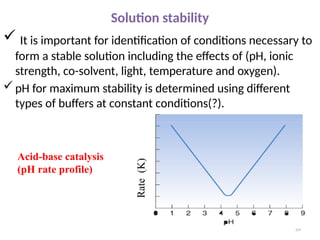
Solution stability
Itis important for identification of conditions necessary to
form a stable solution including the effects of (pH, ionic
strength, co-solvent, light, temperature and oxygen).
pH for maximum stability is determined using different
types of buffers at constant conditions(?).
59
Rate
(K)
Acid-base catalysis
(pH rate profile)
60.
Ionic strengthdepends on the molar concentrations
of ion (with valency), it must be constant specially for
injectable solutions (about 0.15).
Co-solvent can affect solubility and stability
(hydrolysis prevention), solvents effects originated
from dielectric constants values?, toxicity and
compatibility. So the selected cosolvent must be
selected at controlled conditions like (temperature
not causes evaporation, sealing/packaging).
The studies include photodegradation and oxidation
depending on the drug, so if found (must be
prevented ? how).
60
61.
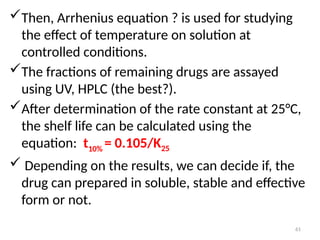
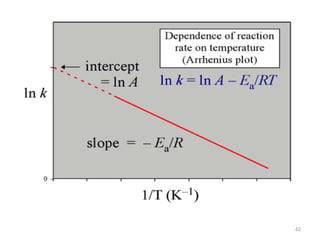
Then, Arrhenius equation? is used for studying
the effect of temperature on solution at
controlled conditions.
The fractions of remaining drugs are assayed
using UV, HPLC (the best?).
After determination of the rate constant at 25°C,
the shelf life can be calculated using the
equation: t10% = 0.105/K25
Depending on the results, we can decide if, the
drug can prepared in soluble, stable and effective
form or not.
61
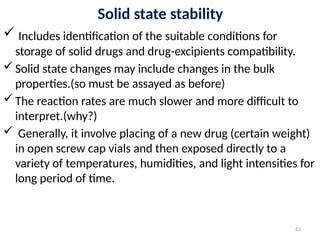
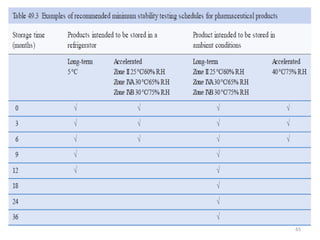
Solid state stability
Includes identification of the suitable conditions for
storage of solid drugs and drug-excipients compatibility.
Solid state changes may include changes in the bulk
properties.(so must be assayed as before)
The reaction rates are much slower and more difficult to
interpret.(why?)
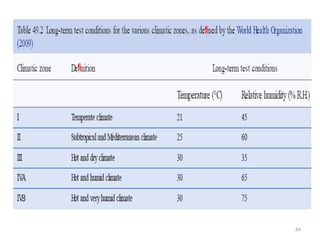
Generally, it involve placing of a new drug (certain weight)
in open screw cap vials and then exposed directly to a
variety of temperatures, humidities, and light intensities for
long period of time.
63
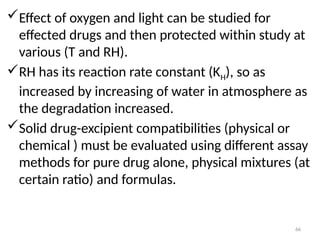
Effect of oxygenand light can be studied for
effected drugs and then protected within study at
various (T and RH).
RH has its reaction rate constant (KH), so as
increased by increasing of water in atmosphere as
the degradation increased.
Solid drug-excipient compatibilities (physical or
chemical ) must be evaluated using different assay
methods for pure drug alone, physical mixtures (at
certain ratio) and formulas.
66
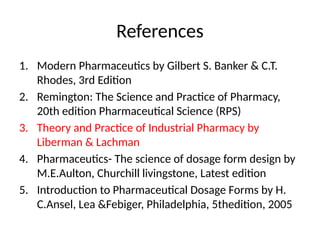
References
1. Modern Pharmaceuticsby Gilbert S. Banker & C.T.
Rhodes, 3rd Edition
2. Remington: The Science and Practice of Pharmacy,
20th edition Pharmaceutical Science (RPS)
3. Theory and Practice of Industrial Pharmacy by
Liberman & Lachman
4. Pharmaceutics- The science of dosage form design by
M.E.Aulton, Churchill livingstone, Latest edition
5. Introduction to Pharmaceutical Dosage Forms by H.
C.Ansel, Lea &Febiger, Philadelphia, 5thedition, 2005



![pH solubility profile and Common ion effects
The solubility of an acidic or basic drug depends on the pka of the
ionizing functional group and the intrinsic solubilities for both the
ionized and un-ionized forms.
When the ionized or salt form of a drug is the solubility-limiting
species in solution, the concentration of the paired counter ion
(common ion) is usually the solubility determining factor. Ex. Salt
of basic amine BH+
Cl-
[BH
+
Cl
-
]solid [BH
+
] + [Cl
-
] , Ksp=[BH
+
][Cl
-
]
[Cl-
] increase total solubility decrease
Then, the solubility affected by pH, counter ion conc., drug conc.,
ionic strength, temp., and aqueous media composition.
23/4/2015 49](https://image.slidesharecdn.com/preformulationstudies-250510172117-5473966c/85/PREFORMULATION-STUDIES-Industrial-Pharmacy-pptx-49-320.jpg)
![ For drug (Doxycycline, pka 3.4), there is common ion
effect for an amine hydrochloride salt on solubility.
The solubility in aqueous medium (pH 2 or less)
logarithmically decreased as a function of pH (which was
adjusted with hydrochloric acid) because of corresponding
increases in the chloride ion concentration.
In gastric juice (pH, 1-2 and [Cl-
]= 0.1-0.15M), doxycycline
hydrochloride dihydrate has a solubility of about 4mg/ml,
which is a factor of 7 less than its solubility in D.w.
In addition to that, protonated form (of solubility product)
of doxycycline can form dimeric species (due to self
association) at certain pH.
23/4/2015 50](https://image.slidesharecdn.com/preformulationstudies-250510172117-5473966c/85/PREFORMULATION-STUDIES-Industrial-Pharmacy-pptx-50-320.jpg)




![CTEV [ clubfoot] DR ARUN LAL ,DR MOHAMED ASHRAF travancore medical college k...](https://cdn.slidesharecdn.com/ss_thumbnails/ctevclubfootdrarunlaldrmohamedashraftravancoremedicalcollegekollamkeralaindia-260208063247-18fc466c-thumbnail.jpg?width=640&height=640&fit=bounds)
![ONFH[AVN HIP] -TRIPLE REGIME -A NOVAL SURGICAL CONCEPT .pptx](https://cdn.slidesharecdn.com/ss_thumbnails/onfhavnhip2026koaconcalicutdrgokuldevdrmashraf-260210064517-213ec005-thumbnail.jpg?width=640&height=640&fit=bounds)


