PostgreSQL,
Python,
and Squid.


Christophe Pettus            thebuild.com
PostgreSQL Experts, Inc.   pgexperts.com
Let’s Talk Squid.


   • What is a squid, anyway?
   • For our purposes, a squid has three
     attributes:
    • length — in centimeters.
    • number of tentacles.
    • weight — in kilograms.
And of course!


   • We’re using PostgreSQL.
   • We’re using Python.
   • We’re using psycopg2.
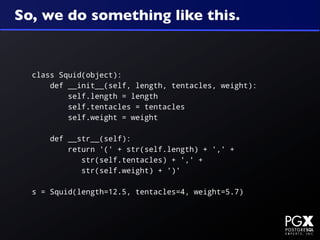
So, we do something like this.


  class Squid(object):
      def __init__(self, length, tentacles, weight):
          self.length = length
          self.tentacles = tentacles
          self.weight = weight

      def __str__(self):
          return '(' + str(self.length) + ',' +
             str(self.tentacles) + ',' +
             str(self.weight) + ')'

  s = Squid(length=12.5, tentacles=4, weight=5.7)
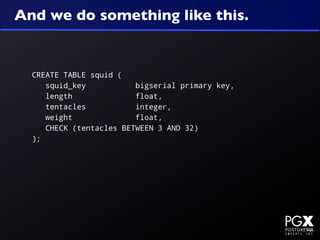
And we do something like this.


  CREATE TABLE squid (
     squid_key           bigserial primary key,
     length              float,
     tentacles           integer,
     weight              float,
     CHECK (tentacles BETWEEN 3 AND 32)
  );
And we write something like this.


  cur.execute(“””
     INSERT INTO squid VALUES(%s, %s, %s)
  “””, [s.length, s.tentacles, s.weight] )
  cur.commit()
And something like this.


  cur.execute(“””
      SELECT length, tentacles, weight FROM squid
         WHERE squid_key=%s
  “””, [skey])

  squid_row = cur.fetchone()

  squid = Squid(length=squid_row[0],
     tentacles=squid_row[1],
     weight=squid_row[2])
And we’re done.


   • Well, that was a short presentation.
   • But now, we want two different tables with
     Squid in them.
   • That’s OK, we just replicate the schema…
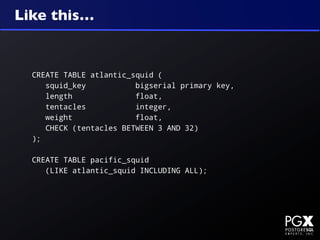
Like this…


  CREATE TABLE atlantic_squid (
     squid_key           bigserial primary key,
     length              float,
     tentacles           integer,
     weight              float,
     CHECK (tentacles BETWEEN 3 AND 32)
  );

  CREATE TABLE pacific_squid
     (LIKE atlantic_squid INCLUDING ALL);
And then we write something like…


  cur.execute(
     “INSERT INTO “ + ocean + “_squid VALUES(%s, %s, %s)”,
     [s.length, s.tentacles, s.weight] )
  cur.commit()
And at this point, we think…


   • Wait, PostgreSQL has types!
   • Maybe we can use PostgreSQL’s custom
     type facility.
But then you think…


   • Oh, only big packages like PostGIS do stuff
     like that.
   • We have to write C and PL/pgSQL and
     probably Scheme and Erlang for all we
     know.
   • And how about operators? And indexing?
   • Not for the likes of us Python people.
You would be wrong!


   • It’s easy to create custom types in
     PostgreSQL.
   • You can use custom PostgreSQL types in
     your application without much nasty code.
   • You can write functions in the PostgreSQL
     database in Python.
PostgreSQL Custom Types.


  • PostgreSQL has an extensive type system.
  • You can create your own types.
  • High-level aggregate types (structures of
    existing types).
  • Low-level C-language types.
   • Not today.
Declaring an aggregate type.


   • Any time you declare a table, you also get a
     type with the same name and same
     structure.
   • You can also just create a type without
     creating a new table.
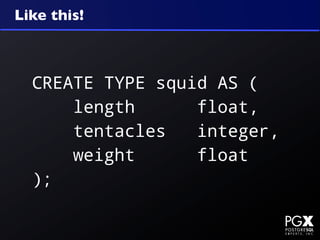
Like this!


  CREATE TYPE squid AS (
      length      float,
      tentacles   integer,
      weight      float
  );
That’s great, but…


   • How do we get that custom type into and
     out of Python?
   • psycopg2 has facilities for going both
     directions.
   • Once set up, it Just Works.
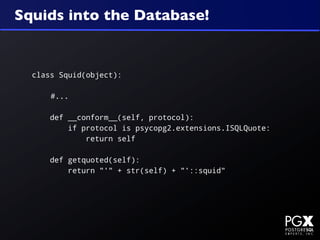
Squids into the Database!


  class Squid(object):

      #...

      def __conform__(self, protocol):
          if protocol is psycopg2.extensions.ISQLQuote:
              return self

      def getquoted(self):
          return "'" + str(self) + "'::squid"
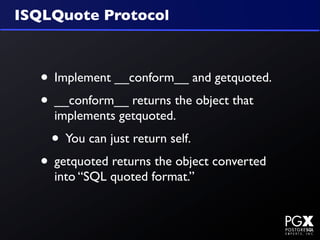
ISQLQuote Protocol


   • Implement __conform__ and getquoted.
   • __conform__ returns the object that
     implements getquoted.
    • You can just return self.
   • getquoted returns the object converted
     into “SQL quoted format.”
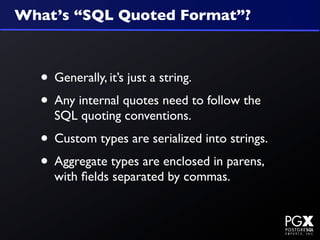
What’s “SQL Quoted Format”?


  • Generally, it’s just a string.
  • Any internal quotes need to follow the
    SQL quoting conventions.
  • Custom types are serialized into strings.
  • Aggregate types are enclosed in parens,
    with fields separated by commas.
For squids, it’s easy.


   • We just use the string representation, since
     there are no fields that might contain
     quotes.
     • If there were, you could just call the
       appropriate getquoted method on them.
   • We wrap the whole thing in SQL string
     quotes, and add a ‘::squid’ cast to it.
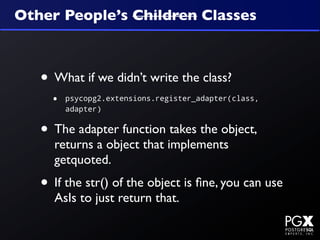
Other People’s Children Classes


   • What if we didn’t write the class?
     •   psycopg2.extensions.register_adapter(class,
         adapter)


   • The adapter function takes the object,
     returns a object that implements
     getquoted.
   • If the str() of the object is fine, you can use
     AsIs to just return that.
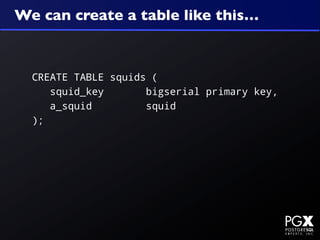
We can create a table like this…


  CREATE TABLE squids (
     squid_key       bigserial primary key,
     a_squid         squid
  );
… and insert into it like this!


  s = Squid(length=12.5, tentacles=4, weight=5.7
  cur.execute("INSERT INTO squids(a_squid) VALUES(%s)",
     [s,])
But how do we get the squids out?


   • Need to write a cast function.
   • Takes the string representation from the
     database, and returns the object.
   • We then register that function with
     psycopg2.
Now you have two problems.


  def cast_squid(value, cur):
      if value is None:
          return None

      match_object = re.match(r'((?P<length>[0-9.]+),(?P<tentacles>[0-9]+),
  (?P<weight>[0-9.]+))', value)

      if match_object is None:
          return None

      length = float(match_object.group('length'))
      tentacles = int(match_object.group('tentacles'))
      weight = float(match_object.group('weight'))

      return Squid(length=length, tentacles=tentacles, weight=weight)
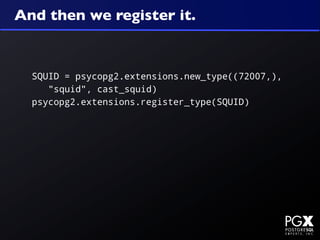
And then we register it.


  SQUID = psycopg2.extensions.new_type((72007,),
     "squid", cast_squid)
  psycopg2.extensions.register_type(SQUID)
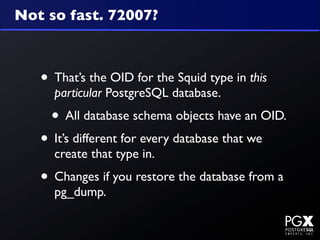
Not so fast. 72007?


   • That’s the OID for the Squid type in this
     particular PostgreSQL database.
     • All database schema objects have an OID.
   • It’s different for every database that we
     create that type in.
   • Changes if you restore the database from a
     pg_dump.
How do we get it?


  cur.execute("SELECT NULL::Squid")
  squid_oid = cur.description[0][1]
    # Can be executed once and cached.
And now SELECT works.


 >>> cur.execute("SELECT a_squid FROM squids")
 >>> s = cur.fetchone()[0]
 >>> print s.__class__
 <class '__main__.Squid'>
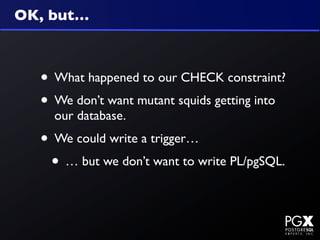
OK, but…


  • What happened to our CHECK constraint?
  • We don’t want mutant squids getting into
    our database.
  • We could write a trigger…
   • … but we don’t want to write PL/pgSQL.
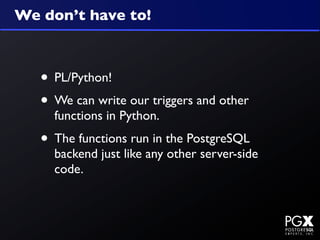
We don’t have to!


   • PL/Python!
   • We can write our triggers and other
     functions in Python.
   • The functions run in the PostgreSQL
     backend just like any other server-side
     code.
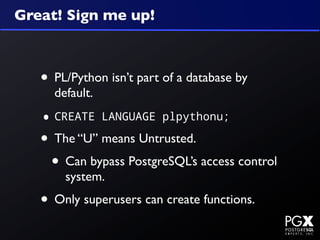
Great! Sign me up!


   • PL/Python isn’t part of a database by
     default.

   • CREATE     LANGUAGE plpythonu;

   • The “U” means Untrusted.
    • Can bypass PostgreSQL’s access control
       system.
   • Only superusers can create functions.
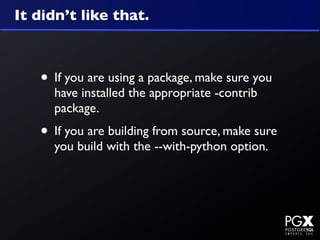
It didn’t like that.


   • If you are using a package, make sure you
     have installed the appropriate -contrib
     package.
   • If you are building from source, make sure
     you build with the --with-python option.
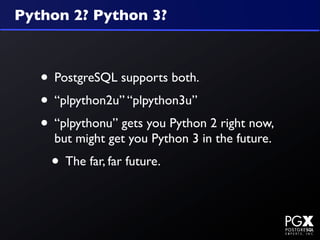
Python 2? Python 3?


   • PostgreSQL supports both.
   • “plpython2u” “plpython3u”
   • “plpythonu” gets you Python 2 right now,
     but might get you Python 3 in the future.
    • The far, far future.
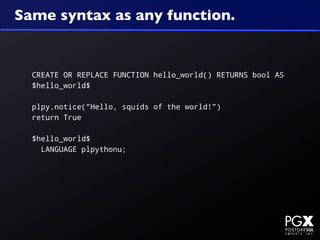
Same syntax as any function.


  CREATE OR REPLACE FUNCTION hello_world() RETURNS bool AS
  $hello_world$

  plpy.notice(“Hello, squids of the world!”)
  return True

  $hello_world$
    LANGUAGE plpythonu;
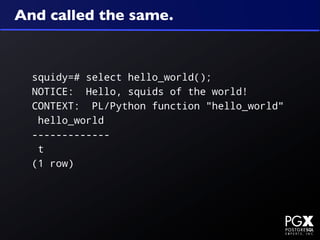
And called the same.


  squidy=# select hello_world();
  NOTICE: Hello, squids of the world!
  CONTEXT: PL/Python function "hello_world"
   hello_world
  -------------
   t
  (1 row)
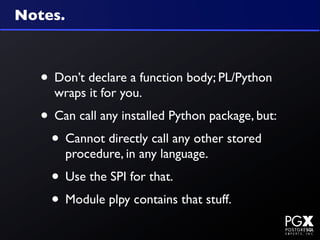
Notes.


   • Don’t declare a function body; PL/Python
     wraps it for you.
   • Can call any installed Python package, but:
    • Cannot directly call any other stored
         procedure, in any language.
     • Use the SPI for that.
     • Module plpy contains that stuff.
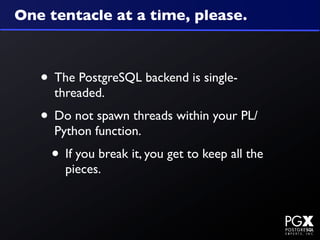
One tentacle at a time, please.


   • The PostgreSQL backend is single-
     threaded.
   • Do not spawn threads within your PL/
     Python function.
    • If you break it, you get to keep all the
       pieces.
So, let’s create our trigger!


  CREATE OR REPLACE FUNCTION squid_trigger() RETURNS trigger AS
  $squid_trigger$

      from plpy import spiexceptions

      calamari = TD["new"]["a_squid"][1:-1].split(',')

      tentacles = int(calamari[1])

      if tentacles > 32 or tentacles < 3:
          raise spiexceptions.CheckViolation

      return "OK"
  $squid_trigger$
      language plpythonu;
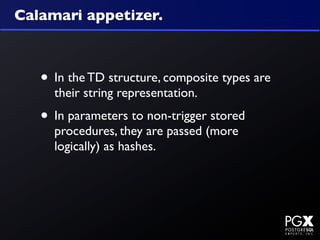
Calamari appetizer.


   • In the TD structure, composite types are
     their string representation.
   • In parameters to non-trigger stored
     procedures, they are passed (more
     logically) as hashes.
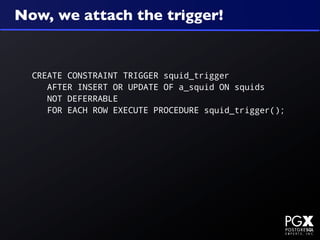
Now, we attach the trigger!


  CREATE CONSTRAINT TRIGGER squid_trigger
     AFTER INSERT OR UPDATE OF a_squid ON squids
     NOT DEFERRABLE
     FOR EACH ROW EXECUTE PROCEDURE squid_trigger();
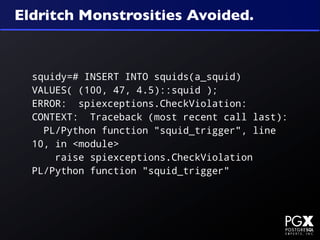
Eldritch Monstrosities Avoided.


  squidy=# INSERT INTO squids(a_squid)
  VALUES( (100, 47, 4.5)::squid );
  ERROR: spiexceptions.CheckViolation:
  CONTEXT: Traceback (most recent call last):
    PL/Python function "squid_trigger", line
  10, in <module>
      raise spiexceptions.CheckViolation
  PL/Python function "squid_trigger"
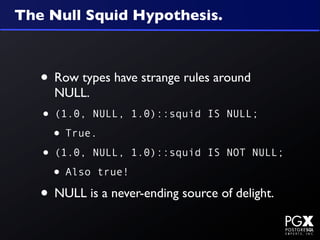
The Null Squid Hypothesis.


   • Row types have strange rules around
     NULL.
   • (1.0, NULL, 1.0)::squid     IS NULL;

    • True.
   • (1.0, NULL, 1.0)::squid     IS NOT NULL;

    • Also true!
   • NULL is a never-ending source of delight.
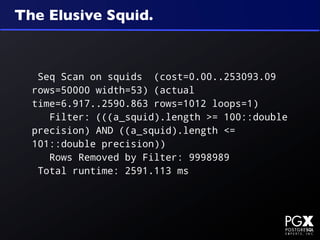
The Elusive Squid.


   Seq Scan on squids (cost=0.00..253093.09
  rows=50000 width=53) (actual
  time=6.917..2590.863 rows=1012 loops=1)
     Filter: (((a_squid).length >= 100::double
  precision) AND ((a_squid).length <=
  101::double precision))
     Rows Removed by Filter: 9998989
   Total runtime: 2591.113 ms
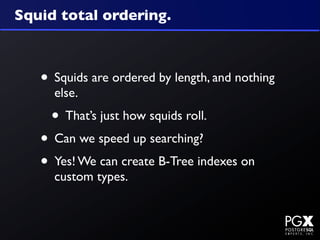
Squid total ordering.


   • Squids are ordered by length, and nothing
     else.
     • That’s just how squids roll.
   • Can we speed up searching?
   • Yes! We can create B-Tree indexes on
     custom types.
Defining ordering.


  CREATE OR REPLACE FUNCTION squid_comp (left squid, right
  squid)
     RETURNS int as
  $squid_comp$

      if left["length"] < right["length"]:
          return -1
      elif left["length"] > right["length"]:
          return 1
      else:
          return 0

  $squid_comp$
     LANGUAGE plpythonu
     IMMUTABLE STRICT;
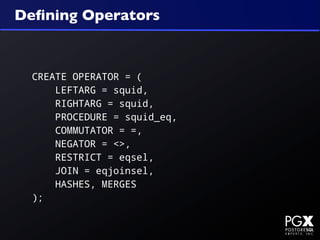
Defining Operators


  CREATE OR REPLACE FUNCTION squid_eq (left squid, right squid)
    RETURNS bool AS
  $squid_eq$

      return left["length"] == right["length"]

  $squid_eq$
     LANGUAGE plpythonu
     IMMUTABLE STRICT;
Defining Operators


  CREATE OPERATOR = (
      LEFTARG = squid,
      RIGHTARG = squid,
      PROCEDURE = squid_eq,
      COMMUTATOR = =,
      NEGATOR = <>,
      RESTRICT = eqsel,
      JOIN = eqjoinsel,
      HASHES, MERGES
  );
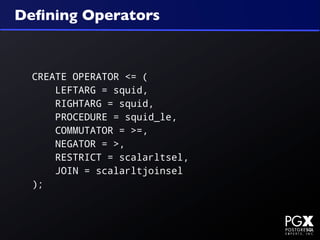
Defining Operators


  CREATE OPERATOR <= (
      LEFTARG = squid,
      RIGHTARG = squid,
      PROCEDURE = squid_le,
      COMMUTATOR = >=,
      NEGATOR = >,
      RESTRICT = scalarltsel,
      JOIN = scalarltjoinsel
  );
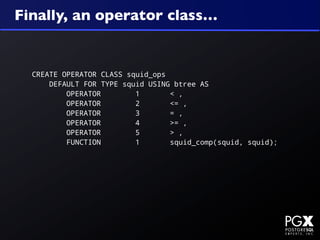
Finally, an operator class…


  CREATE OPERATOR CLASS squid_ops
      DEFAULT FOR TYPE squid USING btree AS
          OPERATOR        1       < ,
          OPERATOR        2       <= ,
          OPERATOR        3       = ,
          OPERATOR        4       >= ,
          OPERATOR        5       > ,
          FUNCTION        1       squid_comp(squid, squid);
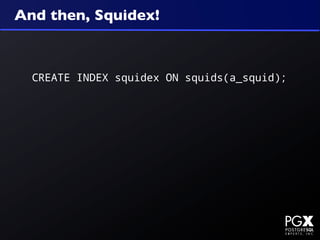
And then, Squidex!


  CREATE INDEX squidex ON squids(a_squid);
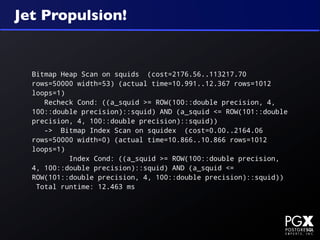
Jet Propulsion!


  Bitmap Heap Scan on squids (cost=2176.56..113217.70
  rows=50000 width=53) (actual time=10.991..12.367 rows=1012
  loops=1)
     Recheck Cond: ((a_squid >= ROW(100::double precision, 4,
  100::double precision)::squid) AND (a_squid <= ROW(101::double
  precision, 4, 100::double precision)::squid))
     -> Bitmap Index Scan on squidex (cost=0.00..2164.06
  rows=50000 width=0) (actual time=10.866..10.866 rows=1012
  loops=1)
           Index Cond: ((a_squid >= ROW(100::double precision,
  4, 100::double precision)::squid) AND (a_squid <=
  ROW(101::double precision, 4, 100::double precision)::squid))
   Total runtime: 12.463 ms
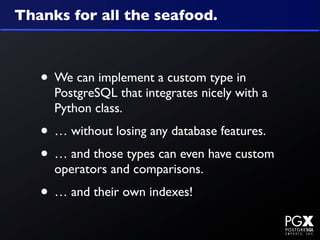
Thanks for all the seafood.


   • We can implement a custom type in
     PostgreSQL that integrates nicely with a
     Python class.
   • … without losing any database features.
   • … and those types can even have custom
     operators and comparisons.
   • … and their own indexes!
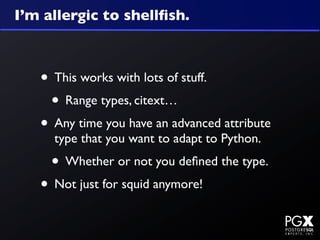
I’m allergic to shellfish.


   • This works with lots of stuff.
    • Range types, citext…
   • Any time you have an advanced attribute
     type that you want to adapt to Python.
     • Whether or not you defined the type.
   • Not just for squid anymore!
Questions?
Thank you!


        @xof
cpettus@pgexperts.com

Pg py-and-squid-pypgday

  • 1.
    PostgreSQL, Python, and Squid. Christophe Pettus thebuild.com PostgreSQL Experts, Inc. pgexperts.com
  • 2.
    Let’s Talk Squid. • What is a squid, anyway? • For our purposes, a squid has three attributes: • length — in centimeters. • number of tentacles. • weight — in kilograms.
  • 3.
    And of course! • We’re using PostgreSQL. • We’re using Python. • We’re using psycopg2.
  • 4.
    So, we dosomething like this. class Squid(object): def __init__(self, length, tentacles, weight): self.length = length self.tentacles = tentacles self.weight = weight def __str__(self): return '(' + str(self.length) + ',' + str(self.tentacles) + ',' + str(self.weight) + ')' s = Squid(length=12.5, tentacles=4, weight=5.7)
  • 5.
    And we dosomething like this. CREATE TABLE squid ( squid_key bigserial primary key, length float, tentacles integer, weight float, CHECK (tentacles BETWEEN 3 AND 32) );
  • 6.
    And we writesomething like this. cur.execute(“”” INSERT INTO squid VALUES(%s, %s, %s) “””, [s.length, s.tentacles, s.weight] ) cur.commit()
  • 7.
    And something likethis. cur.execute(“”” SELECT length, tentacles, weight FROM squid WHERE squid_key=%s “””, [skey]) squid_row = cur.fetchone() squid = Squid(length=squid_row[0], tentacles=squid_row[1], weight=squid_row[2])
  • 8.
    And we’re done. • Well, that was a short presentation. • But now, we want two different tables with Squid in them. • That’s OK, we just replicate the schema…
  • 9.
    Like this… CREATE TABLE atlantic_squid ( squid_key bigserial primary key, length float, tentacles integer, weight float, CHECK (tentacles BETWEEN 3 AND 32) ); CREATE TABLE pacific_squid (LIKE atlantic_squid INCLUDING ALL);
  • 10.
    And then wewrite something like… cur.execute( “INSERT INTO “ + ocean + “_squid VALUES(%s, %s, %s)”, [s.length, s.tentacles, s.weight] ) cur.commit()
  • 11.
    And at thispoint, we think… • Wait, PostgreSQL has types! • Maybe we can use PostgreSQL’s custom type facility.
  • 12.
    But then youthink… • Oh, only big packages like PostGIS do stuff like that. • We have to write C and PL/pgSQL and probably Scheme and Erlang for all we know. • And how about operators? And indexing? • Not for the likes of us Python people.
  • 13.
    You would bewrong! • It’s easy to create custom types in PostgreSQL. • You can use custom PostgreSQL types in your application without much nasty code. • You can write functions in the PostgreSQL database in Python.
  • 14.
    PostgreSQL Custom Types. • PostgreSQL has an extensive type system. • You can create your own types. • High-level aggregate types (structures of existing types). • Low-level C-language types. • Not today.
  • 15.
    Declaring an aggregatetype. • Any time you declare a table, you also get a type with the same name and same structure. • You can also just create a type without creating a new table.
  • 16.
    Like this! CREATE TYPE squid AS ( length float, tentacles integer, weight float );
  • 17.
    That’s great, but… • How do we get that custom type into and out of Python? • psycopg2 has facilities for going both directions. • Once set up, it Just Works.
  • 18.
    Squids into theDatabase! class Squid(object): #... def __conform__(self, protocol): if protocol is psycopg2.extensions.ISQLQuote: return self def getquoted(self): return "'" + str(self) + "'::squid"
  • 19.
    ISQLQuote Protocol • Implement __conform__ and getquoted. • __conform__ returns the object that implements getquoted. • You can just return self. • getquoted returns the object converted into “SQL quoted format.”
  • 20.
    What’s “SQL QuotedFormat”? • Generally, it’s just a string. • Any internal quotes need to follow the SQL quoting conventions. • Custom types are serialized into strings. • Aggregate types are enclosed in parens, with fields separated by commas.
  • 21.
    For squids, it’seasy. • We just use the string representation, since there are no fields that might contain quotes. • If there were, you could just call the appropriate getquoted method on them. • We wrap the whole thing in SQL string quotes, and add a ‘::squid’ cast to it.
  • 22.
    Other People’s ChildrenClasses • What if we didn’t write the class? • psycopg2.extensions.register_adapter(class, adapter) • The adapter function takes the object, returns a object that implements getquoted. • If the str() of the object is fine, you can use AsIs to just return that.
  • 23.
    We can createa table like this… CREATE TABLE squids ( squid_key bigserial primary key, a_squid squid );
  • 24.
    … and insertinto it like this! s = Squid(length=12.5, tentacles=4, weight=5.7 cur.execute("INSERT INTO squids(a_squid) VALUES(%s)", [s,])
  • 25.
    But how dowe get the squids out? • Need to write a cast function. • Takes the string representation from the database, and returns the object. • We then register that function with psycopg2.
  • 26.
    Now you havetwo problems. def cast_squid(value, cur): if value is None: return None match_object = re.match(r'((?P<length>[0-9.]+),(?P<tentacles>[0-9]+), (?P<weight>[0-9.]+))', value) if match_object is None: return None length = float(match_object.group('length')) tentacles = int(match_object.group('tentacles')) weight = float(match_object.group('weight')) return Squid(length=length, tentacles=tentacles, weight=weight)
  • 27.
    And then weregister it. SQUID = psycopg2.extensions.new_type((72007,), "squid", cast_squid) psycopg2.extensions.register_type(SQUID)
  • 28.
    Not so fast.72007? • That’s the OID for the Squid type in this particular PostgreSQL database. • All database schema objects have an OID. • It’s different for every database that we create that type in. • Changes if you restore the database from a pg_dump.
  • 29.
    How do weget it? cur.execute("SELECT NULL::Squid") squid_oid = cur.description[0][1] # Can be executed once and cached.
  • 30.
    And now SELECTworks. >>> cur.execute("SELECT a_squid FROM squids") >>> s = cur.fetchone()[0] >>> print s.__class__ <class '__main__.Squid'>
  • 31.
    OK, but… • What happened to our CHECK constraint? • We don’t want mutant squids getting into our database. • We could write a trigger… • … but we don’t want to write PL/pgSQL.
  • 32.
    We don’t haveto! • PL/Python! • We can write our triggers and other functions in Python. • The functions run in the PostgreSQL backend just like any other server-side code.
  • 33.
    Great! Sign meup! • PL/Python isn’t part of a database by default. • CREATE LANGUAGE plpythonu; • The “U” means Untrusted. • Can bypass PostgreSQL’s access control system. • Only superusers can create functions.
  • 34.
    It didn’t likethat. • If you are using a package, make sure you have installed the appropriate -contrib package. • If you are building from source, make sure you build with the --with-python option.
  • 35.
    Python 2? Python3? • PostgreSQL supports both. • “plpython2u” “plpython3u” • “plpythonu” gets you Python 2 right now, but might get you Python 3 in the future. • The far, far future.
  • 36.
    Same syntax asany function. CREATE OR REPLACE FUNCTION hello_world() RETURNS bool AS $hello_world$ plpy.notice(“Hello, squids of the world!”) return True $hello_world$ LANGUAGE plpythonu;
  • 37.
    And called thesame. squidy=# select hello_world(); NOTICE: Hello, squids of the world! CONTEXT: PL/Python function "hello_world" hello_world ------------- t (1 row)
  • 38.
    Notes. • Don’t declare a function body; PL/Python wraps it for you. • Can call any installed Python package, but: • Cannot directly call any other stored procedure, in any language. • Use the SPI for that. • Module plpy contains that stuff.
  • 39.
    One tentacle ata time, please. • The PostgreSQL backend is single- threaded. • Do not spawn threads within your PL/ Python function. • If you break it, you get to keep all the pieces.
  • 40.
    So, let’s createour trigger! CREATE OR REPLACE FUNCTION squid_trigger() RETURNS trigger AS $squid_trigger$ from plpy import spiexceptions calamari = TD["new"]["a_squid"][1:-1].split(',') tentacles = int(calamari[1]) if tentacles > 32 or tentacles < 3: raise spiexceptions.CheckViolation return "OK" $squid_trigger$ language plpythonu;
  • 41.
    Calamari appetizer. • In the TD structure, composite types are their string representation. • In parameters to non-trigger stored procedures, they are passed (more logically) as hashes.
  • 42.
    Now, we attachthe trigger! CREATE CONSTRAINT TRIGGER squid_trigger AFTER INSERT OR UPDATE OF a_squid ON squids NOT DEFERRABLE FOR EACH ROW EXECUTE PROCEDURE squid_trigger();
  • 43.
    Eldritch Monstrosities Avoided. squidy=# INSERT INTO squids(a_squid) VALUES( (100, 47, 4.5)::squid ); ERROR: spiexceptions.CheckViolation: CONTEXT: Traceback (most recent call last): PL/Python function "squid_trigger", line 10, in <module> raise spiexceptions.CheckViolation PL/Python function "squid_trigger"
  • 44.
    The Null SquidHypothesis. • Row types have strange rules around NULL. • (1.0, NULL, 1.0)::squid IS NULL; • True. • (1.0, NULL, 1.0)::squid IS NOT NULL; • Also true! • NULL is a never-ending source of delight.
  • 45.
    The Elusive Squid. Seq Scan on squids (cost=0.00..253093.09 rows=50000 width=53) (actual time=6.917..2590.863 rows=1012 loops=1) Filter: (((a_squid).length >= 100::double precision) AND ((a_squid).length <= 101::double precision)) Rows Removed by Filter: 9998989 Total runtime: 2591.113 ms
  • 46.
    Squid total ordering. • Squids are ordered by length, and nothing else. • That’s just how squids roll. • Can we speed up searching? • Yes! We can create B-Tree indexes on custom types.
  • 47.
    Defining ordering. CREATE OR REPLACE FUNCTION squid_comp (left squid, right squid) RETURNS int as $squid_comp$ if left["length"] < right["length"]: return -1 elif left["length"] > right["length"]: return 1 else: return 0 $squid_comp$ LANGUAGE plpythonu IMMUTABLE STRICT;
  • 48.
    Defining Operators CREATE OR REPLACE FUNCTION squid_eq (left squid, right squid) RETURNS bool AS $squid_eq$ return left["length"] == right["length"] $squid_eq$ LANGUAGE plpythonu IMMUTABLE STRICT;
  • 49.
    Defining Operators CREATE OPERATOR = ( LEFTARG = squid, RIGHTARG = squid, PROCEDURE = squid_eq, COMMUTATOR = =, NEGATOR = <>, RESTRICT = eqsel, JOIN = eqjoinsel, HASHES, MERGES );
  • 50.
    Defining Operators CREATE OPERATOR <= ( LEFTARG = squid, RIGHTARG = squid, PROCEDURE = squid_le, COMMUTATOR = >=, NEGATOR = >, RESTRICT = scalarltsel, JOIN = scalarltjoinsel );
  • 51.
    Finally, an operatorclass… CREATE OPERATOR CLASS squid_ops DEFAULT FOR TYPE squid USING btree AS OPERATOR 1 < , OPERATOR 2 <= , OPERATOR 3 = , OPERATOR 4 >= , OPERATOR 5 > , FUNCTION 1 squid_comp(squid, squid);
  • 52.
    And then, Squidex! CREATE INDEX squidex ON squids(a_squid);
  • 53.
    Jet Propulsion! Bitmap Heap Scan on squids (cost=2176.56..113217.70 rows=50000 width=53) (actual time=10.991..12.367 rows=1012 loops=1) Recheck Cond: ((a_squid >= ROW(100::double precision, 4, 100::double precision)::squid) AND (a_squid <= ROW(101::double precision, 4, 100::double precision)::squid)) -> Bitmap Index Scan on squidex (cost=0.00..2164.06 rows=50000 width=0) (actual time=10.866..10.866 rows=1012 loops=1) Index Cond: ((a_squid >= ROW(100::double precision, 4, 100::double precision)::squid) AND (a_squid <= ROW(101::double precision, 4, 100::double precision)::squid)) Total runtime: 12.463 ms
  • 54.
    Thanks for allthe seafood. • We can implement a custom type in PostgreSQL that integrates nicely with a Python class. • … without losing any database features. • … and those types can even have custom operators and comparisons. • … and their own indexes!
  • 55.
    I’m allergic toshellfish. • This works with lots of stuff. • Range types, citext… • Any time you have an advanced attribute type that you want to adapt to Python. • Whether or not you defined the type. • Not just for squid anymore!
  • 56.
  • 57.
    Thank you! @xof cpettus@pgexperts.com