Two great open source
databases: a comparison

                 Josh Berkus
                 PostgreSQL Core Team
                 HP Tux Talks, June 26, 2008
Who is Josh?
●   PostgreSQL Core Team
    –   10 years involvement with the project
    –   Large database performance, tuning, project press
        & corporate relations, user groups
●   Database geek
    –   15 years database application development
    –   MS SQL, MySQL, Oracle, others
●   Open Source guru
    –   OpenOffice.org, LedgerSMB, Bricolage, OpenBRR,
        OSCON, more
Topics
●   Sound Bite
●   History
●   Most Common Uses
●   Features
●   Performance
●   Summary
Topics
●   Sound Bite
●   History


                               QL t
    Most Common Uses


                             eS ou
●


                           gr ab
●   Features


                         st ly
                       Po t
    Performance


                          os
●


                       m
●   Summary
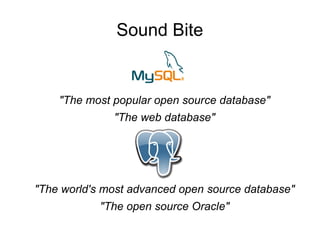
Sound Bite


    "The most popular open source database"
              "The web database"


"The world's most advanced open source database"
            "The open source Oracle"
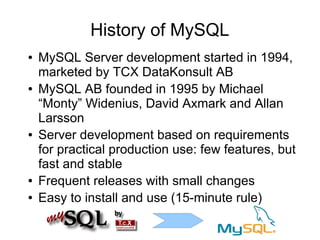
History of MySQL
●   MySQL Server development started in 1994,
    marketed by TCX DataKonsult AB
●   MySQL AB founded in 1995 by Michael
    “Monty” Widenius, David Axmark and Allan
    Larsson
●   Server development based on requirements
    for practical production use: few features, but
    fast and stable
●   Frequent releases with small changes
●   Easy to install and use (15-minute rule)
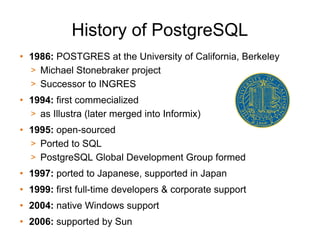
History of PostgreSQL
• 1986: POSTGRES at the University of California, Berkeley
  > Michael Stonebraker project
  > Successor to INGRES
• 1994: first commecialized
  > as Illustra (later merged into Informix)
• 1995: open-sourced
  > Ported to SQL
  > PostgreSQL Global Development Group formed
• 1997: ported to Japanese, supported in Japan
• 1999: first full-time developers & corporate support
• 2004: native Windows support
• 2006: supported by Sun
Development History


Designed by/for Application Developers


Designed by/for Database Administrators
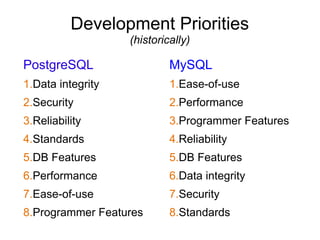
Development Priorities
                   (historically)

PostgreSQL                  MySQL
1.Data integrity            1.Ease-of-use
2.Security                  2.Performance
3.Reliability               3.Programmer Features
4.Standards                 4.Reliability
5.DB Features               5.DB Features
6.Performance               6.Data integrity
7.Ease-of-use               7.Security
8.Programmer Features       8.Standards
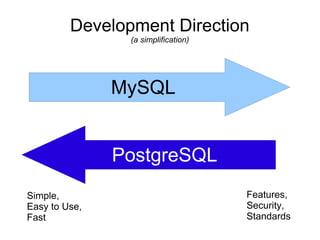
Development Direction
                (a simplification)


               MySQL


               PostgreSQL
Simple,                              Features,
Easy to Use,                         Security,
Fast                                 Standards
Community


 Owned by one company with user community


Community-owned with many companies involved
●   Core MySQL is 100% owned by Sun/MySQL
●   90% of MySQL developers work for Sun
    –   except for the many storage engines
●   MySQL has a large user community
    –   many thousands active worldwide
    –   many partners in other open source groups
●   Sun/MySQL contributes to other OSS projects
    –   PHP especially
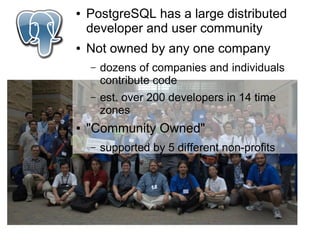
●   PostgreSQL has a large distributed
    developer and user community
●   Not owned by any one company
    –   dozens of companies and individuals
        contribute code
    –   est. over 200 developers in 14 time
        zones
●   "Community Owned"
    –   supported by 5 different non-profits
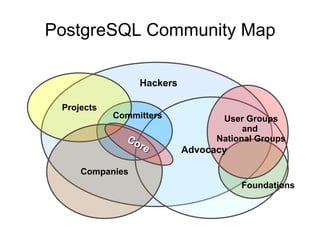
PostgreSQL Community Map

                 Hackers

 Projects
            Committers            User Groups
                                       and
              Co                 National Groups
                 re        Advocacy

     Companies
                                      Foundations
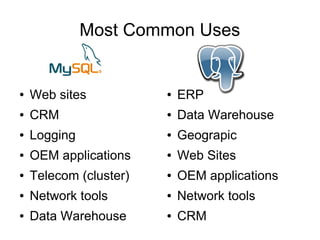
Most Common Uses


●   Web sites           ●   ERP
●   CRM                 ●   Data Warehouse
●   Logging             ●   Geograpic
●   OEM applications    ●   Web Sites
●   Telecom (cluster)   ●   OEM applications
●   Network tools       ●   Network tools
●   Data Warehouse      ●   CRM
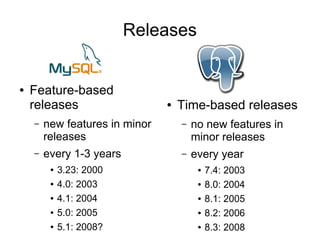
Releases


●   Feature-based
    releases                    ●   Time-based releases
    –   new features in minor       –   no new features in
        releases                        minor releases
    –   every 1-3 years             –   every year
         ●   3.23: 2000                  ●   7.4: 2003
         ●   4.0: 2003                   ●   8.0: 2004
         ●   4.1: 2004                   ●   8.1: 2005
         ●   5.0: 2005                   ●   8.2: 2006
         ●   5.1: 2008?                  ●   8.3: 2008
Features
Storage Engines
●   Pluggable "Storage Engines" allow MySQL to
    behave like a variety of different databases
    –   Telecom DB: MySQL Cluster
    –   Non-transactional: MyISAM
    –   Transactional: InnoDB
    –   Compressed: Archive
    –   In-Memory: Memory
    –   Write-only: Blackhole
Programmer Features
●   Excellent drivers for all languages
    –   including JDBC4
●   PHP
    –   high-performance drivers & special syntax
    –   Native driver
●   MySQL Proxy
3rd Party Support
●   Most open source web projects default to
    MySQL
    –   many use only MySQL
    –   primary relational database for most top 25 web
        sites
●   Hundreds of vendors support MySQL
    –   more than 50% of multi-database products
    –   many "MySQL Partners"
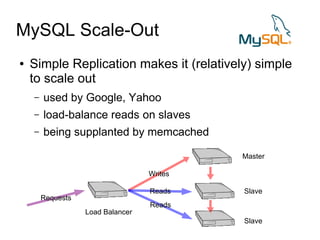
MySQL Scale-Out
●   Simple Replication makes it (relatively) simple
    to scale out
    –   used by Google, Yahoo
    –   load-balance reads on slaves
    –   being supplanted by memcached

                                            Master

                                   Writes

                                   Reads    Slave
        Requests
                                   Reads
                   Load Balancer
                                            Slave
Simplicity
●   Easy to set up
    –   "15 minute rule"
    –   everything included
●   Easy to administrate
    –   programmer-administered
    –   most installations don't need tuning
●   Easy Replication
    –   very simple master-slave & multimaster replication
Features
Migrateability
●   Closest to proprietary enterprise DBs
●   Automatic migration from Informix
    –   Informix is 50% PostgreSQL
●   Relatively easy migration from Oracle
    –   easiest of any OSS database
    –   puts migration cost within affordable range
    –   tools for data integration
●   SQL Server, DB2 harder
    –   but easier that MySQL
Security


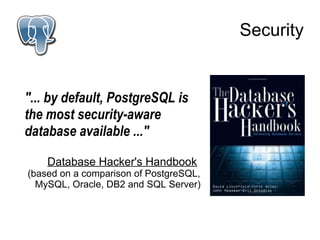
"... by default, PostgreSQL is
the most security-aware
database available ..."

    Database Hacker's Handbook
(based on a comparison of PostgreSQL,
  MySQL, Oracle, DB2 and SQL Server)
Security
●   Authentication
    –   multiple methods: login, SSL, Kerberos, more
    –   host-based authentication
●   Logging
    –   log output is highly configurable and supports user
        auditing
●   Permissions model
    –   SQL ROLES supported, including nested roles
    –   multiple settable permissions on all database
        objects
Security
●   Clean code
    –   only one security patch per two months
    –   community patches usually out in less 72 hours
    –   only one exploit in the field in the last four years
●   DB Auditing
    –   PostgreSQL supports highly configurable triggers
        and other DB automation
    –   No “auditing toolkit” out yet
Transaction Support
●   "Bulletproof" ACID thanks to MVCC
    –   possibly best of any RDBMS
●   Transactional DDL
    –   apply schema changes in a transaction
    –   great for change management
         ●   including agile development
●   Savepoints
    –   spec-compliant "subtransactions"
BI/DW Features
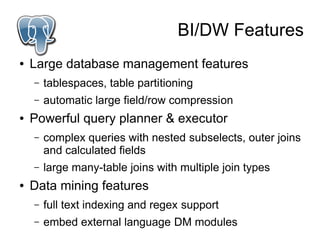
●   Large database management features
    –   tablespaces, table partitioning
    –   automatic large field/row compression
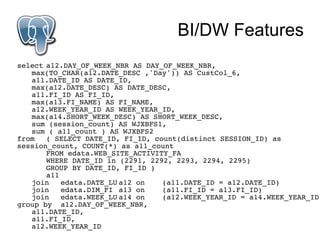
●   Powerful query planner & executor
    –   complex queries with nested subselects, outer joins
        and calculated fields
    –   large many-table joins with multiple join types
●   Data mining features
    –   full text indexing and regex support
    –   embed external language DM modules
BI/DW Features
select a12.DAY_OF_WEEK_NBR AS DAY_OF_WEEK_NBR,
   max(TO_CHAR(a12.DATE_DESC ,'Day')) AS CustCol_6,
   a11.DATE_ID AS DATE_ID,
   max(a12.DATE_DESC) AS DATE_DESC,
   a11.FI_ID AS FI_ID,
   max(a13.FI_NAME) AS FI_NAME,
   a12.WEEK_YEAR_ID AS WEEK_YEAR_ID,
   max(a14.SHORT_WEEK_DESC) AS SHORT_WEEK_DESC,
   sum (session_count) AS WJXBFS1,
   sum ( a11_count ) AS WJXBFS2
from   ( SELECT DATE_ID, FI_ID, count(distinct SESSION_ID) as
session_count, COUNT(*) as a11_count
       FROM edata.WEB_SITE_ACTIVITY_FA
       WHERE DATE_ID in (2291, 2292, 2293, 2294, 2295)
       GROUP BY DATE_ID, FI_ID )
       a11
   join    edata.DATE_LU a12 on   (a11.DATE_ID = a12.DATE_ID)
   join    edata.DIM_FI a13 on    (a11.FI_ID = a13.FI_ID)
   join    edata.WEEK_LU a14 on   (a12.WEEK_YEAR_ID = a14.WEEK_YEAR_ID)
group by a12.DAY_OF_WEEK_NBR,
   a11.DATE_ID,
   a11.FI_ID,
   a12.WEEK_YEAR_ID
Extensibility
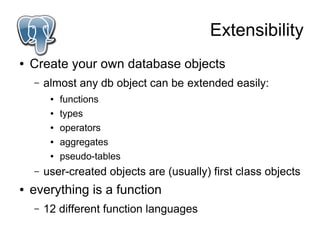
●   Create your own database objects
    –   almost any db object can be extended easily:
         ●   functions
         ●   types
         ●   operators
         ●   aggregates
         ●   pseudo-tables
    –   user-created objects are (usually) first class objects
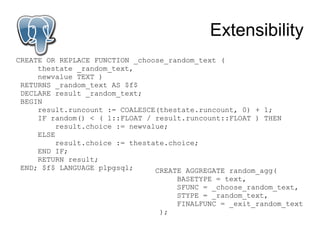
●   everything is a function
    –   12 different function languages
Extensibility
CREATE OR REPLACE FUNCTION _choose_random_text (
     thestate _random_text,
     newvalue TEXT )
 RETURNS _random_text AS $f$
 DECLARE result _random_text;
 BEGIN
     result.runcount := COALESCE(thestate.runcount, 0) + 1;
     IF random() < ( 1::FLOAT / result.runcount::FLOAT ) THEN
          result.choice := newvalue;
     ELSE
          result.choice := thestate.choice;
     END IF;
     RETURN result;
 END; $f$ LANGUAGE plpgsql;      CREATE AGGREGATE random_agg(
                                     BASETYPE = text,
                                     SFUNC = _choose_random_text,
                                     STYPE = _random_text,
                                     FINALFUNC = _exit_random_text
                                );
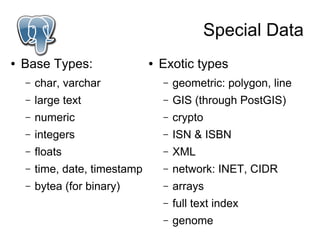
Special Data
●   Base Types:                 ●   Exotic types
    –   char, varchar               –   geometric: polygon, line
    –   large text                  –   GIS (through PostGIS)
    –   numeric                     –   crypto
    –   integers                    –   ISN & ISBN
    –   floats                      –   XML
    –   time, date, timestamp       –   network: INET, CIDR
    –   bytea (for binary)          –   arrays
                                    –   full text index
                                    –   genome
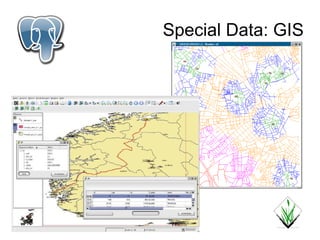
Special Data: GIS
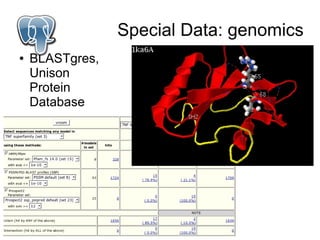
Special Data: genomics
●   BLASTgres,
    Unison
    Protein
    Database
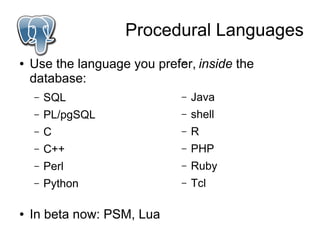
Procedural Languages
●   Use the language you prefer, inside the
                             –

    database:
    –   SQL                   –   Java
    –   PL/pgSQL              –   shell
    –   C                     –   R
    –   C++                   –   PHP
    –   Perl                  –   Ruby
    –   Python                –   Tcl

●   In beta now: PSM, Lua
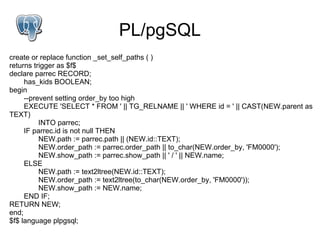
PL/pgSQL
create or replace function _set_self_paths ( )
returns trigger as $f$
declare parrec RECORD;
     has_kids BOOLEAN;
begin
     --prevent setting order_by too high
     EXECUTE 'SELECT * FROM ' || TG_RELNAME || ' WHERE id = ' || CAST(NEW.parent as
TEXT)
          INTO parrec;
     IF parrec.id is not null THEN
          NEW.path := parrec.path || (NEW.id::TEXT);
          NEW.order_path := parrec.order_path || to_char(NEW.order_by, 'FM0000');
          NEW.show_path := parrec.show_path || ' / ' || NEW.name;
     ELSE
          NEW.path := text2ltree(NEW.id::TEXT);
          NEW.order_path := text2ltree(to_char(NEW.order_by, 'FM0000'));
          NEW.show_path := NEW.name;
     END IF;
RETURN NEW;
end;
$f$ language plpgsql;
PL/Perl
CREATE FUNCTION "if_strip_numeric"
(text,smallint) RETURNS text AS $f$
my($the_text, $cutoff) = @_;
$the_text =~ s/[^0-9]/""/eg;
if ( $cutoff > 0 ) {
  $the_text =
    ( substr $the_text, 0, $cutoff );
}
return $the_text;
$f$ LANGUAGE plperl IMMUTABLE, STRICT;
PL/R

create or replace function statsum(text)
returns summarytup as '
 sql<-paste("select id_val from sample_numeric_data ",
           "where ia_id=''", arg1, "''", sep="")
 rs <- pg.spi.exec(sql)
 rng <- range(rs[,1])
 return(data.frame(mean = mean(rs[,1]),
  stddev = sd(rs[,1]), min = rng[1], max = rng[2],
  range = rng[2] - rng[1], count = length(rs[,1])))
' language 'plr';
PL/Java
/**
 * Update a modification time when the row is updated.
 */
static void moddatetime(TriggerData td)
throws SQLException
{
  if(td.isFiredForStatement())
    throw new TriggerException(td, "can't process STATEMENT events");

    if(td.isFiredAfter())
      throw new TriggerException(td, "must be fired before event");

    if(!td.isFiredByUpdate())
      throw new TriggerException(td, "can only process UPDATE events");

    ResultSet _new = td.getNew();
    String[] args = td.getArguments();
    if(args.length != 1)
      throw new TriggerException(td, "one argument was expected");

    _new.updateTimestamp(args[0], new Timestamp(System.currentTimeMillis()));
}
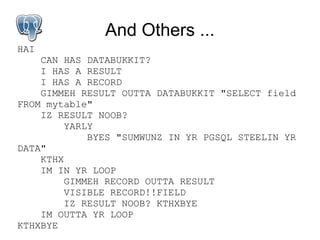
And Others ...
HAI
    CAN HAS DATABUKKIT?
    I HAS A RESULT
    I HAS A RECORD
    GIMMEH RESULT OUTTA DATABUKKIT "SELECT field
FROM mytable"
    IZ RESULT NOOB?
         YARLY
             BYES "SUMWUNZ IN YR PGSQL STEELIN YR
DATA"
    KTHX
    IM IN YR LOOP
         GIMMEH RECORD OUTTA RESULT
         VISIBLE RECORD!!FIELD
         IZ RESULT NOOB? KTHXBYE
    IM OUTTA YR LOOP
KTHXBYE
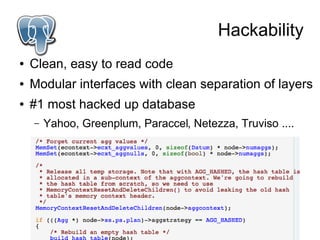
Hackability
●   Clean, easy to read code
●   Modular interfaces with clean separation of layers
●   #1 most hacked up database
    –   Yahoo, Greenplum, Paraccel, Netezza, Truviso ....
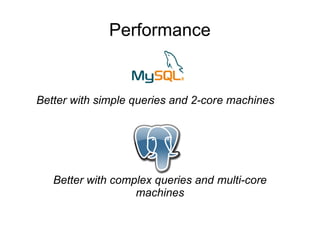
Performance


Better with simple queries and 2-core machines


   Better with complex queries and multi-core
                   machines
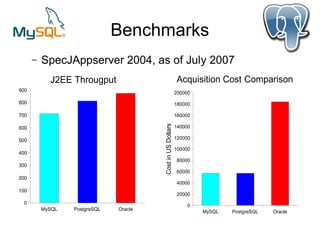
Benchmarks
      –   SpecJAppserver 2004, as of July 2007
            J2EE Througput                                   Acquisition Cost Comparison
900
                                                             200000
800                                                          180000

700                                                          160000


                                        Cost in US Dollars
600                                                          140000

500                                                          120000

                                                             100000
400
                                                             80000
300
                                                             60000
200
                                                             40000
100
                                                             20000
 0
                                                                  0
          MySQL   PostgreSQL   Oracle                                 MySQL   PostgreSQL   Oracle
Essential Performance
1)Every application performs best with the
  database for which is was designed.
2)Performance benchmarks for databases are
  constantly increasing.
3)Top databases are close enough that you can
  pick the one which suits you best.
Questions?
●   e-mail: josh@postgresql.org
●   IRC: irc.freenode.net, #postgresql
●   blog: blogs.ittoolbox.com/database/soup


                                               Special thanks to:
                                               Giuseppe Maxia and Harrison Fisk of MySQL for information
                                               about MySQL

              This talk is copyright 2008 Josh Berkus, and is licensed under the creative commons attribution license

PostgreSQL and MySQL

  • 1.
    Two great opensource databases: a comparison Josh Berkus PostgreSQL Core Team HP Tux Talks, June 26, 2008
  • 2.
    Who is Josh? ● PostgreSQL Core Team – 10 years involvement with the project – Large database performance, tuning, project press & corporate relations, user groups ● Database geek – 15 years database application development – MS SQL, MySQL, Oracle, others ● Open Source guru – OpenOffice.org, LedgerSMB, Bricolage, OpenBRR, OSCON, more
  • 3.
    Topics ● Sound Bite ● History ● Most Common Uses ● Features ● Performance ● Summary
  • 4.
    Topics ● Sound Bite ● History QL t Most Common Uses eS ou ● gr ab ● Features st ly Po t Performance os ● m ● Summary
  • 5.
    Sound Bite "The most popular open source database" "The web database" "The world's most advanced open source database" "The open source Oracle"
  • 6.
    History of MySQL ● MySQL Server development started in 1994, marketed by TCX DataKonsult AB ● MySQL AB founded in 1995 by Michael “Monty” Widenius, David Axmark and Allan Larsson ● Server development based on requirements for practical production use: few features, but fast and stable ● Frequent releases with small changes ● Easy to install and use (15-minute rule)
  • 7.
    History of PostgreSQL •1986: POSTGRES at the University of California, Berkeley > Michael Stonebraker project > Successor to INGRES • 1994: first commecialized > as Illustra (later merged into Informix) • 1995: open-sourced > Ported to SQL > PostgreSQL Global Development Group formed • 1997: ported to Japanese, supported in Japan • 1999: first full-time developers & corporate support • 2004: native Windows support • 2006: supported by Sun
  • 8.
    Development History Designed by/forApplication Developers Designed by/for Database Administrators
  • 9.
    Development Priorities (historically) PostgreSQL MySQL 1.Data integrity 1.Ease-of-use 2.Security 2.Performance 3.Reliability 3.Programmer Features 4.Standards 4.Reliability 5.DB Features 5.DB Features 6.Performance 6.Data integrity 7.Ease-of-use 7.Security 8.Programmer Features 8.Standards
  • 10.
    Development Direction (a simplification) MySQL PostgreSQL Simple, Features, Easy to Use, Security, Fast Standards
  • 11.
    Community Owned byone company with user community Community-owned with many companies involved
  • 12.
    Core MySQL is 100% owned by Sun/MySQL ● 90% of MySQL developers work for Sun – except for the many storage engines ● MySQL has a large user community – many thousands active worldwide – many partners in other open source groups ● Sun/MySQL contributes to other OSS projects – PHP especially
  • 13.
    PostgreSQL has a large distributed developer and user community ● Not owned by any one company – dozens of companies and individuals contribute code – est. over 200 developers in 14 time zones ● "Community Owned" – supported by 5 different non-profits
  • 14.
    PostgreSQL Community Map Hackers Projects Committers User Groups and Co National Groups re Advocacy Companies Foundations
  • 15.
    Most Common Uses ● Web sites ● ERP ● CRM ● Data Warehouse ● Logging ● Geograpic ● OEM applications ● Web Sites ● Telecom (cluster) ● OEM applications ● Network tools ● Network tools ● Data Warehouse ● CRM
  • 16.
    Releases ● Feature-based releases ● Time-based releases – new features in minor – no new features in releases minor releases – every 1-3 years – every year ● 3.23: 2000 ● 7.4: 2003 ● 4.0: 2003 ● 8.0: 2004 ● 4.1: 2004 ● 8.1: 2005 ● 5.0: 2005 ● 8.2: 2006 ● 5.1: 2008? ● 8.3: 2008
  • 17.
  • 18.
    Storage Engines ● Pluggable "Storage Engines" allow MySQL to behave like a variety of different databases – Telecom DB: MySQL Cluster – Non-transactional: MyISAM – Transactional: InnoDB – Compressed: Archive – In-Memory: Memory – Write-only: Blackhole
  • 19.
    Programmer Features ● Excellent drivers for all languages – including JDBC4 ● PHP – high-performance drivers & special syntax – Native driver ● MySQL Proxy
  • 20.
    3rd Party Support ● Most open source web projects default to MySQL – many use only MySQL – primary relational database for most top 25 web sites ● Hundreds of vendors support MySQL – more than 50% of multi-database products – many "MySQL Partners"
  • 21.
    MySQL Scale-Out ● Simple Replication makes it (relatively) simple to scale out – used by Google, Yahoo – load-balance reads on slaves – being supplanted by memcached Master Writes Reads Slave Requests Reads Load Balancer Slave
  • 22.
    Simplicity ● Easy to set up – "15 minute rule" – everything included ● Easy to administrate – programmer-administered – most installations don't need tuning ● Easy Replication – very simple master-slave & multimaster replication
  • 23.
  • 24.
    Migrateability ● Closest to proprietary enterprise DBs ● Automatic migration from Informix – Informix is 50% PostgreSQL ● Relatively easy migration from Oracle – easiest of any OSS database – puts migration cost within affordable range – tools for data integration ● SQL Server, DB2 harder – but easier that MySQL
  • 25.
    Security "... by default,PostgreSQL is the most security-aware database available ..." Database Hacker's Handbook (based on a comparison of PostgreSQL, MySQL, Oracle, DB2 and SQL Server)
  • 26.
    Security ● Authentication – multiple methods: login, SSL, Kerberos, more – host-based authentication ● Logging – log output is highly configurable and supports user auditing ● Permissions model – SQL ROLES supported, including nested roles – multiple settable permissions on all database objects
  • 27.
    Security ● Clean code – only one security patch per two months – community patches usually out in less 72 hours – only one exploit in the field in the last four years ● DB Auditing – PostgreSQL supports highly configurable triggers and other DB automation – No “auditing toolkit” out yet
  • 28.
    Transaction Support ● "Bulletproof" ACID thanks to MVCC – possibly best of any RDBMS ● Transactional DDL – apply schema changes in a transaction – great for change management ● including agile development ● Savepoints – spec-compliant "subtransactions"
  • 29.
    BI/DW Features ● Large database management features – tablespaces, table partitioning – automatic large field/row compression ● Powerful query planner & executor – complex queries with nested subselects, outer joins and calculated fields – large many-table joins with multiple join types ● Data mining features – full text indexing and regex support – embed external language DM modules
  • 30.
    BI/DW Features select a12.DAY_OF_WEEK_NBRAS DAY_OF_WEEK_NBR, max(TO_CHAR(a12.DATE_DESC ,'Day')) AS CustCol_6, a11.DATE_ID AS DATE_ID, max(a12.DATE_DESC) AS DATE_DESC, a11.FI_ID AS FI_ID, max(a13.FI_NAME) AS FI_NAME, a12.WEEK_YEAR_ID AS WEEK_YEAR_ID, max(a14.SHORT_WEEK_DESC) AS SHORT_WEEK_DESC, sum (session_count) AS WJXBFS1, sum ( a11_count ) AS WJXBFS2 from ( SELECT DATE_ID, FI_ID, count(distinct SESSION_ID) as session_count, COUNT(*) as a11_count FROM edata.WEB_SITE_ACTIVITY_FA WHERE DATE_ID in (2291, 2292, 2293, 2294, 2295) GROUP BY DATE_ID, FI_ID ) a11 join edata.DATE_LU a12 on (a11.DATE_ID = a12.DATE_ID) join edata.DIM_FI a13 on (a11.FI_ID = a13.FI_ID) join edata.WEEK_LU a14 on (a12.WEEK_YEAR_ID = a14.WEEK_YEAR_ID) group by a12.DAY_OF_WEEK_NBR, a11.DATE_ID, a11.FI_ID, a12.WEEK_YEAR_ID
  • 31.
    Extensibility ● Create your own database objects – almost any db object can be extended easily: ● functions ● types ● operators ● aggregates ● pseudo-tables – user-created objects are (usually) first class objects ● everything is a function – 12 different function languages
  • 32.
    Extensibility CREATE OR REPLACEFUNCTION _choose_random_text ( thestate _random_text, newvalue TEXT ) RETURNS _random_text AS $f$ DECLARE result _random_text; BEGIN result.runcount := COALESCE(thestate.runcount, 0) + 1; IF random() < ( 1::FLOAT / result.runcount::FLOAT ) THEN result.choice := newvalue; ELSE result.choice := thestate.choice; END IF; RETURN result; END; $f$ LANGUAGE plpgsql; CREATE AGGREGATE random_agg( BASETYPE = text, SFUNC = _choose_random_text, STYPE = _random_text, FINALFUNC = _exit_random_text );
  • 33.
    Special Data ● Base Types: ● Exotic types – char, varchar – geometric: polygon, line – large text – GIS (through PostGIS) – numeric – crypto – integers – ISN & ISBN – floats – XML – time, date, timestamp – network: INET, CIDR – bytea (for binary) – arrays – full text index – genome
  • 34.
  • 35.
    Special Data: genomics ● BLASTgres, Unison Protein Database
  • 36.
    Procedural Languages ● Use the language you prefer, inside the – database: – SQL – Java – PL/pgSQL – shell – C – R – C++ – PHP – Perl – Ruby – Python – Tcl ● In beta now: PSM, Lua
  • 37.
    PL/pgSQL create or replacefunction _set_self_paths ( ) returns trigger as $f$ declare parrec RECORD; has_kids BOOLEAN; begin --prevent setting order_by too high EXECUTE 'SELECT * FROM ' || TG_RELNAME || ' WHERE id = ' || CAST(NEW.parent as TEXT) INTO parrec; IF parrec.id is not null THEN NEW.path := parrec.path || (NEW.id::TEXT); NEW.order_path := parrec.order_path || to_char(NEW.order_by, 'FM0000'); NEW.show_path := parrec.show_path || ' / ' || NEW.name; ELSE NEW.path := text2ltree(NEW.id::TEXT); NEW.order_path := text2ltree(to_char(NEW.order_by, 'FM0000')); NEW.show_path := NEW.name; END IF; RETURN NEW; end; $f$ language plpgsql;
  • 38.
    PL/Perl CREATE FUNCTION "if_strip_numeric" (text,smallint)RETURNS text AS $f$ my($the_text, $cutoff) = @_; $the_text =~ s/[^0-9]/""/eg; if ( $cutoff > 0 ) { $the_text = ( substr $the_text, 0, $cutoff ); } return $the_text; $f$ LANGUAGE plperl IMMUTABLE, STRICT;
  • 39.
    PL/R create or replacefunction statsum(text) returns summarytup as ' sql<-paste("select id_val from sample_numeric_data ", "where ia_id=''", arg1, "''", sep="") rs <- pg.spi.exec(sql) rng <- range(rs[,1]) return(data.frame(mean = mean(rs[,1]), stddev = sd(rs[,1]), min = rng[1], max = rng[2], range = rng[2] - rng[1], count = length(rs[,1]))) ' language 'plr';
  • 40.
    PL/Java /** * Updatea modification time when the row is updated. */ static void moddatetime(TriggerData td) throws SQLException { if(td.isFiredForStatement()) throw new TriggerException(td, "can't process STATEMENT events"); if(td.isFiredAfter()) throw new TriggerException(td, "must be fired before event"); if(!td.isFiredByUpdate()) throw new TriggerException(td, "can only process UPDATE events"); ResultSet _new = td.getNew(); String[] args = td.getArguments(); if(args.length != 1) throw new TriggerException(td, "one argument was expected"); _new.updateTimestamp(args[0], new Timestamp(System.currentTimeMillis())); }
  • 41.
    And Others ... HAI CAN HAS DATABUKKIT? I HAS A RESULT I HAS A RECORD GIMMEH RESULT OUTTA DATABUKKIT "SELECT field FROM mytable" IZ RESULT NOOB? YARLY BYES "SUMWUNZ IN YR PGSQL STEELIN YR DATA" KTHX IM IN YR LOOP GIMMEH RECORD OUTTA RESULT VISIBLE RECORD!!FIELD IZ RESULT NOOB? KTHXBYE IM OUTTA YR LOOP KTHXBYE
  • 42.
    Hackability ● Clean, easy to read code ● Modular interfaces with clean separation of layers ● #1 most hacked up database – Yahoo, Greenplum, Paraccel, Netezza, Truviso ....
  • 43.
    Performance Better with simplequeries and 2-core machines Better with complex queries and multi-core machines
  • 44.
    Benchmarks – SpecJAppserver 2004, as of July 2007 J2EE Througput Acquisition Cost Comparison 900 200000 800 180000 700 160000 Cost in US Dollars 600 140000 500 120000 100000 400 80000 300 60000 200 40000 100 20000 0 0 MySQL PostgreSQL Oracle MySQL PostgreSQL Oracle
  • 45.
    Essential Performance 1)Every applicationperforms best with the database for which is was designed. 2)Performance benchmarks for databases are constantly increasing. 3)Top databases are close enough that you can pick the one which suits you best.
  • 46.
    Questions? ● e-mail: josh@postgresql.org ● IRC: irc.freenode.net, #postgresql ● blog: blogs.ittoolbox.com/database/soup Special thanks to: Giuseppe Maxia and Harrison Fisk of MySQL for information about MySQL This talk is copyright 2008 Josh Berkus, and is licensed under the creative commons attribution license