GPars(Groovy Parallel Systems)
Gagan Agrawal
Xebia
Agenda
What is Gpars?
Data Parallelism
Actors
Agents
Dataflow
Trend
Multi Core Processor
Problems with Java Concurrency Model
Synchronization
Dead-Locks
Live-Locks
Race Conditions
Starvation
GPars GOAL


    To fully utilize all available processors
What is GPars ?
An open-source concurrency and parallelism
library for Groovy and Java
Gives a number of high-level abstractions for
writing concurrent and parallel code
  Abstractions like..
Map-Reduce
Fork-Join
Asynchronous Closures
Actors
Agents
DataFlow
Data Parallelism
Data Parallelism
For low level data parallelism techniques

GParsPool – Relies on JSR-166y Fork/Join
Framework and offers greater functionality and
better performance.

GParsExecutorsPool – Uses old Java executors and
so is easy to setup in a managed or restricted
environment.
Data Parallelism – Parallel Collections
Dealing with data frequently involves
manipulating collections
Lists, arrays, sets, maps, iterators, strings etc.
can be viewed as collections of items
Common pattern to process such collections is to
take elements sequentially, one-by-one, and
make an action for each of the items in row.
E.g min() function – Iterates over the collection
sequentially to find the minimum value
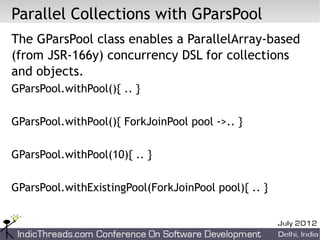
Parallel Collections with GParsPool
The GParsPool class enables a ParallelArray-based
(from JSR-166y) concurrency DSL for collections
and objects.
GParsPool.withPool(){ .. }

GParsPool.withPool(){ ForkJoinPool pool ->.. }

GParsPool.withPool(10){ .. }

GParsPool.withExistingPool(ForkJoinPool pool){ .. }
Parallel Collections with GParsPool
 Some of the methods supported are -
eachParallel()
collectParallel()
findAllParallel()
findAnyParallel()
groupByParallel()
minParallel()
maxParallel()
sumParallel()
countParallel()
Parallel Collections with Meta-class enhancer

ParallelEnhancer


  def list = [1,2,3,4,5,6,7,8]
  ParallelEnhancer.enhanceInstance(list)
  println list.collectParallel{it * 2}
Parallel Collections with Meta-class enhancer

ParallelEnhancer


  def animals = ['dog','ant','cat','whale']
  ParallelEnhancer.enhanceInstance(animals)
  println(animals.anyParallel{it=='ant'} ? 'Found
  an ant' : 'No ants found')

  println(animals.everyParallel{it.contains("a")}
  ? 'All animals contain a' : 'Some animals can
  live without a')
Parallel Collections – Warning
Don't do this

  def thumbnails = []
  images.eachParallel{
     thumbnails << it.thumbnail
  }
Parallel Collections - Memoize

Enables caching of function's return values.

Repeated calls to the memoized function will
retrieve the result value from an internal
transparent cache.

Example
Data Parallelism – Map Reduce

Can be used for the same purpose as the
xxxParallel() family methods and has very similar
semantics.

Can perform considerably faster if you need to
chain multiple methods to process a single
collection in multiple steps.

Example
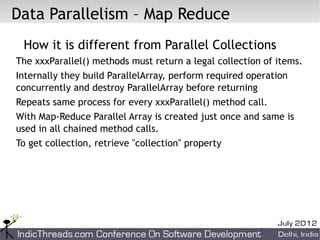
Data Parallelism – Map Reduce
 How it is different from Parallel Collections
The xxxParallel() methods must return a legal collection of items.
Internally they build ParallelArray, perform required operation
concurrently and destroy ParallelArray before returning
Repeats same process for every xxxParallel() method call.
With Map-Reduce Parallel Array is created just once and same is
used in all chained method calls.
To get collection, retrieve "collection" property
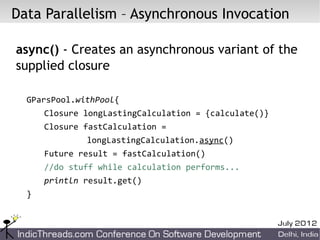
Data Parallelism – Asynchronous Invocation

async() - Creates an asynchronous variant of the
supplied closure

  GParsPool.withPool{
      Closure longLastingCalculation = {calculate()}
      Closure fastCalculation =
              longLastingCalculation.async()
      Future result = fastCalculation()
      //do stuff while calculation performs...
      println result.get()
  }
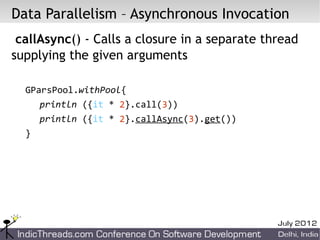
Data Parallelism – Asynchronous Invocation
 callAsync() - Calls a closure in a separate thread
supplying the given arguments

  GParsPool.withPool{
     println ({it * 2}.call(3))
     println ({it * 2}.callAsync(3).get())
  }
Actors
Actors

Was originally inspired by the Actors library in
Scala
Allow for a message passing-based concurrency
model
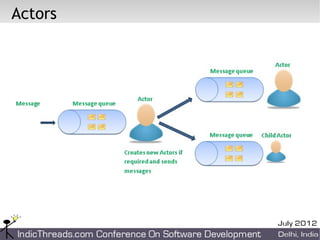
Programs are collections of independent active
objects that exchange messages and have no
mutable shared state
Always guarantee that at most one thread
processes the actor's body
Actors

Helps to avoid deadlock, live-lock and starvation
A great number of actors can share a relatively
small thread pool
An actor with no work doesn't consume threads.
No shared mutable state.
Runs in daemon threads.
Actors
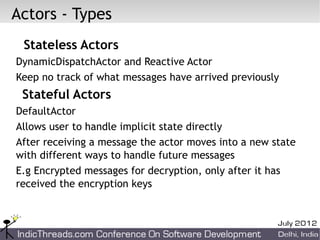
Actors - Types
 Stateless Actors
DynamicDispatchActor and Reactive Actor
Keep no track of what messages have arrived previously
 Stateful Actors
DefaultActor
Allows user to handle implicit state directly
After receiving a message the actor moves into a new state
with different ways to handle future messages
E.g Encrypted messages for decryption, only after it has
received the encryption keys
Stateful Actors
Can be created in one of two ways

By extending DefaultActor class

Static methods of Actors class
Actors - Usage
 Performs 3 specific operations

Send Messages

Receive Messages

Create new actors
Actors – Sending Messages
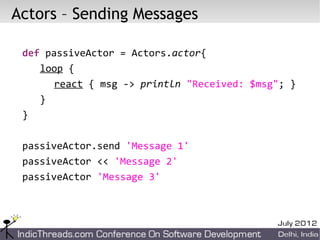
Messages can be sent to actors using

send() method

<< operator

Implicit call() method
Actors – Sending Messages

 def passiveActor = Actors.actor{
    loop {
       react { msg -> println "Received: $msg"; }
    }
 }

 passiveActor.send 'Message 1'
 passiveActor << 'Message 2'
 passiveActor 'Message 3'
Actors – Sending Messages


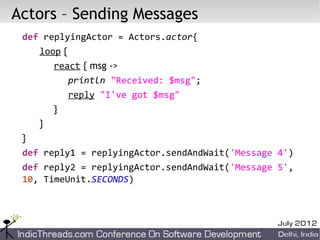
 sendAndWait()
Blocks the caller until a reply from the actor is
available.
Actors – Sending Messages
 def replyingActor = Actors.actor{
    loop {
       react { msg ->
           println "Received: $msg";
           reply "I've got $msg"
       }
    }
 }
 def reply1 = replyingActor.sendAndWait('Message 4')
 def reply2 = replyingActor.sendAndWait('Message 5',
 10, TimeUnit.SECONDS)
Actors – Sending Messages


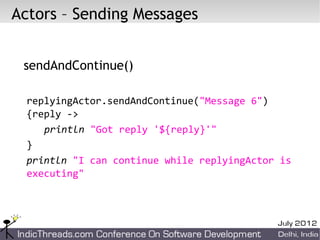
 sendAndContinue()

  replyingActor.sendAndContinue("Message 6")
  {reply ->
     println "Got reply '${reply}'"
  }
  println "I can continue while replyingActor is
  executing"
Actors – Sending Messages


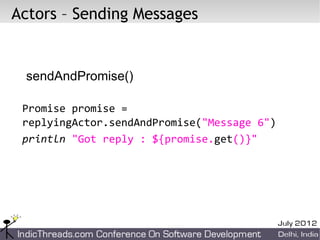
 sendAndPromise()

 Promise promise =
 replyingActor.sendAndPromise("Message 6")
 println "Got reply : ${promise.get()}"
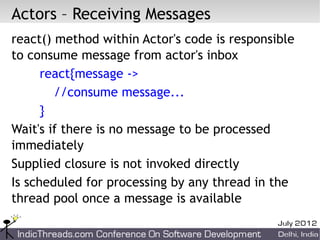
Actors – Receiving Messages
react() method within Actor's code is responsible
to consume message from actor's inbox
      react{message ->
        //consume message...
      }
Wait's if there is no message to be processed
immediately
Supplied closure is not invoked directly
Is scheduled for processing by any thread in the
thread pool once a message is available
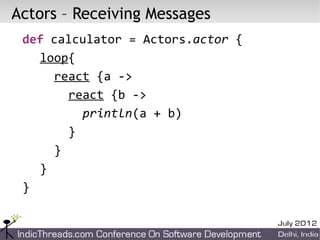
Actors – Receiving Messages
 def calculator = Actors.actor {
   loop{
     react {a ->
       react {b ->
         println(a + b)
       }
     }
   }
 }
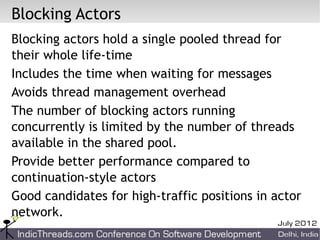
Blocking Actors
Blocking actors hold a single pooled thread for
their whole life-time
Includes the time when waiting for messages
Avoids thread management overhead
The number of blocking actors running
concurrently is limited by the number of threads
available in the shared pool.
Provide better performance compared to
continuation-style actors
Good candidates for high-traffic positions in actor
network.
Blocking Actors
  def decryptor = blockingActor {
  while (true) {
      receive {message ->
          if (message instanceof String)
            reply message.reverse()
          else stop()
      }
  }
  }
  def console = blockingActor {
      decryptor.send 'lellarap si yvoorG'
      println 'Decrypted message: ' + receive()
      decryptor.send false
  }
  [decryptor, console]*.join()
Stateless Actors
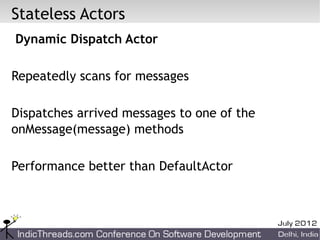
Dynamic Dispatch Actor

Repeatedly scans for messages

Dispatches arrived messages to one of the
onMessage(message) methods

Performance better than DefaultActor
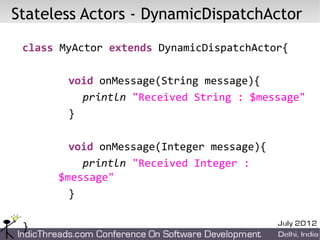
Stateless Actors - DynamicDispatchActor
 class MyActor extends DynamicDispatchActor{

        void onMessage(String message){
          println "Received String : $message"
        }

        void onMessage(Integer message){
          println "Received Integer :
      $message"
        }

 }
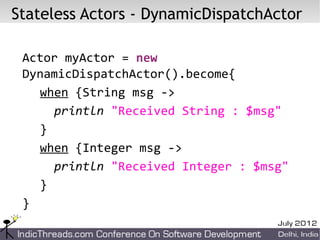
Stateless Actors - DynamicDispatchActor

 Actor myActor = new
 DynamicDispatchActor().become{
   when {String msg ->
     println "Received String : $msg"
   }
   when {Integer msg ->
     println "Received Integer : $msg"
   }
 }
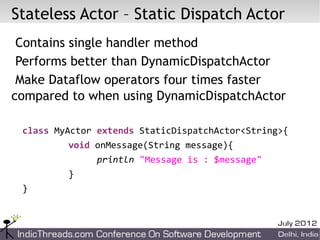
Stateless Actor – Static Dispatch Actor
 Contains single handler method
 Performs better than DynamicDispatchActor
 Make Dataflow operators four times faster
compared to when using DynamicDispatchActor

 class MyActor extends StaticDispatchActor<String>{
          void onMessage(String message){
               println "Message is : $message"
          }
 }
Agents
Agents

Inspired by Agents in Clojure
Used when shared mutable state is required e.g
Shopping Cart
Is a thread-safe non-blocking shared mutable
state wrapper
Hides data and protects from direct access
Accepts messages and process them
asynchronously
Agents

Messages are commands(functions) and executed
inside Agent
Agent guarantees execution of a single function at
a time
After reception, received function is run against
the internal state of Agent and return value is new
internal state of Agent
The mutable values are not directly accessible
from outside
Agents

Requests have to be sent to Agent
Agent guarantees to process the requests
seqentially on behaf of callers
Wraps a reference to mutable state held inside a
single field
Messages can be sent via
'<<' operator
send() method
Implicit call() method
Agents - Basic Rules


Submitted commands obtain the agent's state as
a parameter.
Can call any methods on the agent's state.
Replacing the state object with a new one is also
possible using the updateValue() method.
The val property waits until all preceding
commands are consumed
Agents – Basic Rules
The valAsync() does not block caller.
The instantVal returns immediate snapshot of
agent state.
All Agent instances share a default daemon thread
pool.
Setting the threadPool property of an Agent
instance will allow it to use a different thread
pool.
Agents


         Example
Agent – Listeners & Validators

Listeners
Get notified each time internal state changes


Validators
Get a chance to reject a coming change by throwing an
exception
Dataflow
Dataflow

Operations in Dataflow programs consists of
“Black Boxes”
Inputs and Outputs are always explicitly defined
They run as soon as all of their inputs become
valid
Dataflow program is more like series of workers
in assembly line
They are inherently parallel
Dataflow Channels

Variables

Queues

Brodcasts

Streams
Dataflow Variables

Channel to safely and reliably transfer data from
producers to their consumers
Value is set using '<<' operator
A task blocks until value has been set by another
task
DF Variable can only be set only one in its
lifetime
Don't have to bother with ordering and
synchronizing the tasks or threads
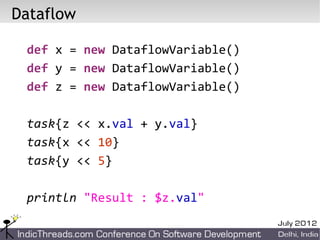
Dataflow

 def x = new DataflowVariable()
 def y = new DataflowVariable()
 def z = new DataflowVariable()

 task{z << x.val + y.val}
 task{x << 10}
 task{y << 5}

 println "Result : $z.val"
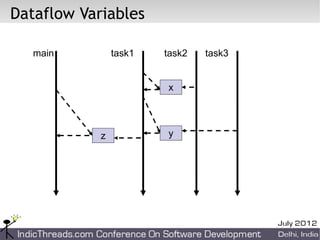
Dataflow Variables

   main         task1   task2   task3


                        x


            z           y
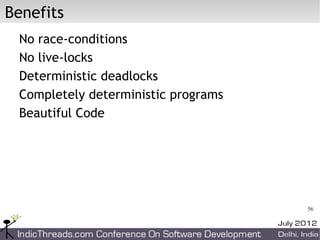
Benefits
 No race-conditions
 No live-locks
 Deterministic deadlocks
 Completely deterministic programs
 Beautiful Code


                                     56
Thank You

GPars (Groovy Parallel Systems)

  • 1.
  • 2.
    Agenda What is Gpars? DataParallelism Actors Agents Dataflow
  • 3.
  • 4.
  • 5.
    Problems with JavaConcurrency Model Synchronization Dead-Locks Live-Locks Race Conditions Starvation
  • 6.
    GPars GOAL To fully utilize all available processors
  • 7.
    What is GPars? An open-source concurrency and parallelism library for Groovy and Java Gives a number of high-level abstractions for writing concurrent and parallel code Abstractions like.. Map-Reduce Fork-Join Asynchronous Closures Actors Agents DataFlow
  • 8.
  • 9.
    Data Parallelism For lowlevel data parallelism techniques GParsPool – Relies on JSR-166y Fork/Join Framework and offers greater functionality and better performance. GParsExecutorsPool – Uses old Java executors and so is easy to setup in a managed or restricted environment.
  • 10.
    Data Parallelism –Parallel Collections Dealing with data frequently involves manipulating collections Lists, arrays, sets, maps, iterators, strings etc. can be viewed as collections of items Common pattern to process such collections is to take elements sequentially, one-by-one, and make an action for each of the items in row. E.g min() function – Iterates over the collection sequentially to find the minimum value
  • 11.
    Parallel Collections withGParsPool The GParsPool class enables a ParallelArray-based (from JSR-166y) concurrency DSL for collections and objects. GParsPool.withPool(){ .. } GParsPool.withPool(){ ForkJoinPool pool ->.. } GParsPool.withPool(10){ .. } GParsPool.withExistingPool(ForkJoinPool pool){ .. }
  • 12.
    Parallel Collections withGParsPool Some of the methods supported are - eachParallel() collectParallel() findAllParallel() findAnyParallel() groupByParallel() minParallel() maxParallel() sumParallel() countParallel()
  • 13.
    Parallel Collections withMeta-class enhancer ParallelEnhancer def list = [1,2,3,4,5,6,7,8] ParallelEnhancer.enhanceInstance(list) println list.collectParallel{it * 2}
  • 14.
    Parallel Collections withMeta-class enhancer ParallelEnhancer def animals = ['dog','ant','cat','whale'] ParallelEnhancer.enhanceInstance(animals) println(animals.anyParallel{it=='ant'} ? 'Found an ant' : 'No ants found') println(animals.everyParallel{it.contains("a")} ? 'All animals contain a' : 'Some animals can live without a')
  • 15.
    Parallel Collections –Warning Don't do this def thumbnails = [] images.eachParallel{ thumbnails << it.thumbnail }
  • 16.
    Parallel Collections -Memoize Enables caching of function's return values. Repeated calls to the memoized function will retrieve the result value from an internal transparent cache. Example
  • 17.
    Data Parallelism –Map Reduce Can be used for the same purpose as the xxxParallel() family methods and has very similar semantics. Can perform considerably faster if you need to chain multiple methods to process a single collection in multiple steps. Example
  • 18.
    Data Parallelism –Map Reduce How it is different from Parallel Collections The xxxParallel() methods must return a legal collection of items. Internally they build ParallelArray, perform required operation concurrently and destroy ParallelArray before returning Repeats same process for every xxxParallel() method call. With Map-Reduce Parallel Array is created just once and same is used in all chained method calls. To get collection, retrieve "collection" property
  • 19.
    Data Parallelism –Asynchronous Invocation async() - Creates an asynchronous variant of the supplied closure GParsPool.withPool{ Closure longLastingCalculation = {calculate()} Closure fastCalculation = longLastingCalculation.async() Future result = fastCalculation() //do stuff while calculation performs... println result.get() }
  • 20.
    Data Parallelism –Asynchronous Invocation callAsync() - Calls a closure in a separate thread supplying the given arguments GParsPool.withPool{ println ({it * 2}.call(3)) println ({it * 2}.callAsync(3).get()) }
  • 21.
  • 22.
    Actors Was originally inspiredby the Actors library in Scala Allow for a message passing-based concurrency model Programs are collections of independent active objects that exchange messages and have no mutable shared state Always guarantee that at most one thread processes the actor's body
  • 23.
    Actors Helps to avoiddeadlock, live-lock and starvation A great number of actors can share a relatively small thread pool An actor with no work doesn't consume threads. No shared mutable state. Runs in daemon threads.
  • 24.
  • 25.
    Actors - Types Stateless Actors DynamicDispatchActor and Reactive Actor Keep no track of what messages have arrived previously Stateful Actors DefaultActor Allows user to handle implicit state directly After receiving a message the actor moves into a new state with different ways to handle future messages E.g Encrypted messages for decryption, only after it has received the encryption keys
  • 26.
    Stateful Actors Can becreated in one of two ways By extending DefaultActor class Static methods of Actors class
  • 27.
    Actors - Usage Performs 3 specific operations Send Messages Receive Messages Create new actors
  • 28.
    Actors – SendingMessages Messages can be sent to actors using send() method << operator Implicit call() method
  • 29.
    Actors – SendingMessages def passiveActor = Actors.actor{ loop { react { msg -> println "Received: $msg"; } } } passiveActor.send 'Message 1' passiveActor << 'Message 2' passiveActor 'Message 3'
  • 30.
    Actors – SendingMessages sendAndWait() Blocks the caller until a reply from the actor is available.
  • 31.
    Actors – SendingMessages def replyingActor = Actors.actor{ loop { react { msg -> println "Received: $msg"; reply "I've got $msg" } } } def reply1 = replyingActor.sendAndWait('Message 4') def reply2 = replyingActor.sendAndWait('Message 5', 10, TimeUnit.SECONDS)
  • 32.
    Actors – SendingMessages sendAndContinue() replyingActor.sendAndContinue("Message 6") {reply -> println "Got reply '${reply}'" } println "I can continue while replyingActor is executing"
  • 33.
    Actors – SendingMessages sendAndPromise() Promise promise = replyingActor.sendAndPromise("Message 6") println "Got reply : ${promise.get()}"
  • 34.
    Actors – ReceivingMessages react() method within Actor's code is responsible to consume message from actor's inbox react{message -> //consume message... } Wait's if there is no message to be processed immediately Supplied closure is not invoked directly Is scheduled for processing by any thread in the thread pool once a message is available
  • 35.
    Actors – ReceivingMessages def calculator = Actors.actor { loop{ react {a -> react {b -> println(a + b) } } } }
  • 36.
    Blocking Actors Blocking actorshold a single pooled thread for their whole life-time Includes the time when waiting for messages Avoids thread management overhead The number of blocking actors running concurrently is limited by the number of threads available in the shared pool. Provide better performance compared to continuation-style actors Good candidates for high-traffic positions in actor network.
  • 37.
    Blocking Actors def decryptor = blockingActor { while (true) { receive {message -> if (message instanceof String) reply message.reverse() else stop() } } } def console = blockingActor { decryptor.send 'lellarap si yvoorG' println 'Decrypted message: ' + receive() decryptor.send false } [decryptor, console]*.join()
  • 38.
    Stateless Actors Dynamic DispatchActor Repeatedly scans for messages Dispatches arrived messages to one of the onMessage(message) methods Performance better than DefaultActor
  • 39.
    Stateless Actors -DynamicDispatchActor class MyActor extends DynamicDispatchActor{ void onMessage(String message){ println "Received String : $message" } void onMessage(Integer message){ println "Received Integer : $message" } }
  • 40.
    Stateless Actors -DynamicDispatchActor Actor myActor = new DynamicDispatchActor().become{ when {String msg -> println "Received String : $msg" } when {Integer msg -> println "Received Integer : $msg" } }
  • 41.
    Stateless Actor –Static Dispatch Actor Contains single handler method Performs better than DynamicDispatchActor Make Dataflow operators four times faster compared to when using DynamicDispatchActor class MyActor extends StaticDispatchActor<String>{ void onMessage(String message){ println "Message is : $message" } }
  • 42.
  • 43.
    Agents Inspired by Agentsin Clojure Used when shared mutable state is required e.g Shopping Cart Is a thread-safe non-blocking shared mutable state wrapper Hides data and protects from direct access Accepts messages and process them asynchronously
  • 44.
    Agents Messages are commands(functions)and executed inside Agent Agent guarantees execution of a single function at a time After reception, received function is run against the internal state of Agent and return value is new internal state of Agent The mutable values are not directly accessible from outside
  • 45.
    Agents Requests have tobe sent to Agent Agent guarantees to process the requests seqentially on behaf of callers Wraps a reference to mutable state held inside a single field Messages can be sent via '<<' operator send() method Implicit call() method
  • 46.
    Agents - BasicRules Submitted commands obtain the agent's state as a parameter. Can call any methods on the agent's state. Replacing the state object with a new one is also possible using the updateValue() method. The val property waits until all preceding commands are consumed
  • 47.
    Agents – BasicRules The valAsync() does not block caller. The instantVal returns immediate snapshot of agent state. All Agent instances share a default daemon thread pool. Setting the threadPool property of an Agent instance will allow it to use a different thread pool.
  • 48.
    Agents Example
  • 49.
    Agent – Listeners& Validators Listeners Get notified each time internal state changes Validators Get a chance to reject a coming change by throwing an exception
  • 50.
  • 51.
    Dataflow Operations in Dataflowprograms consists of “Black Boxes” Inputs and Outputs are always explicitly defined They run as soon as all of their inputs become valid Dataflow program is more like series of workers in assembly line They are inherently parallel
  • 52.
  • 53.
    Dataflow Variables Channel tosafely and reliably transfer data from producers to their consumers Value is set using '<<' operator A task blocks until value has been set by another task DF Variable can only be set only one in its lifetime Don't have to bother with ordering and synchronizing the tasks or threads
  • 54.
    Dataflow def x= new DataflowVariable() def y = new DataflowVariable() def z = new DataflowVariable() task{z << x.val + y.val} task{x << 10} task{y << 5} println "Result : $z.val"
  • 55.
    Dataflow Variables main task1 task2 task3 x z y
  • 56.
    Benefits No race-conditions No live-locks Deterministic deadlocks Completely deterministic programs Beautiful Code 56
  • 57.