Audio Feedback
Overview of Audio FeedbackEnrol on PGCERT Community SiteRecord your Good Learning ExperienceMacgregor, G., Spiers, A. & Taylor, C. (2011), Exploratory evaluation of audio email technology informative assessment feedback, ALT-J, Research in Learning Technology
Why?http://www.flickr.com/photos/debord/4932655275/
Feedback on student learningImproving and accelerating student learningImportance in learning indisputable [1]Few formative assessment opportunities for studentsSemester based systems [2, 3]Formative feedback: timely, relevant and delivered to students prior to summative assessment [1]Audio provides scope for greater feedback detail, quicker delivery, etc. thus holding potential for learningPrincipal motivation of work – Sounds Good Project
Barriers of AudioUnlike text, an audio file cannot be searched.
Length of recordings vs engagement.
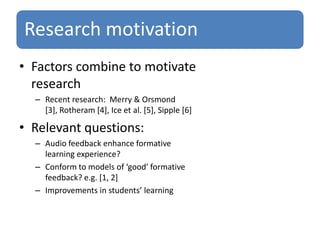
Could have accessibility issues for some learnersFactors combine to motivate researchRecent research:  Merry & Orsmond [3], Rotheram [4], Ice et al. [5], Sipple [6]Relevant questions:Audio feedback enhance formative learning experience?Conform to models of ‘good’ formative feedback? e.g. [1, 2]Improvements in students’ learning
Staff time commitmenthttp://www.flickr.com/photos/helloturkeytoe/4581002553/
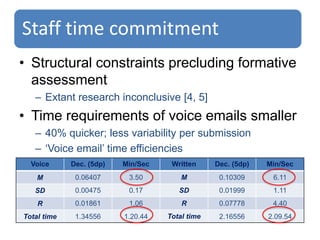
Structural constraints precluding formative assessmentExtant research inconclusive [4, 5]Time requirements of voice emails smaller40% quicker; less variability per submission‘Voice email’ time efficiencies
Data themeshttp://www.flickr.com/photos/ableman/4673424141/
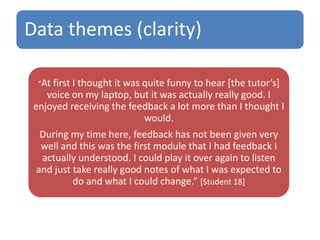
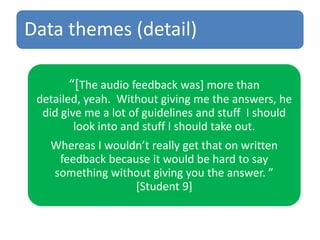
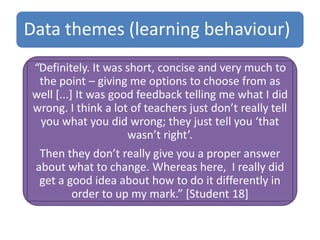
“Definitely. It was short, concise and very much to the point – giving me options to choose from as well [...] It was good feedback telling me what I did wrong. I think a lot of teachers just don’t really tell you what you did wrong; they just tell you ‘that wasn’t right’. Then they don’t really give you a proper answer about what to change. Whereas here,  I really did get a good idea about how to do it differently in order to up my mark.” [Student 18]
Other themeshttp://www.flickr.com/photos/sroown/2247858939/
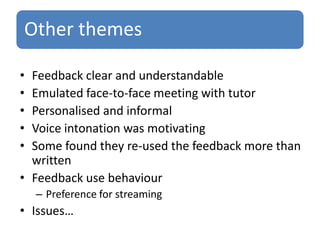
Feedback clear and understandableEmulated face-to-face meeting with tutorPersonalised and informalVoice intonation was motivatingSome found they re-used the feedback more than writtenFeedback use behaviourPreference for streamingIssues…
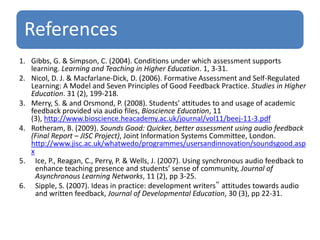
Gibbs, G. & Simpson, C. (2004). Conditions under which assessment supports learning. Learning and Teaching in Higher Education. 1, 3-31.Nicol, D. J. & Macfarlane-Dick, D. (2006). Formative Assessment and Self-Regulated Learning: A Model and Seven Principles of Good Feedback Practice. Studies in Higher Education. 31 (2), 199-218.Merry, S. & and Orsmond, P. (2008). Students’ attitudes to and usage of academic feedback provided via audio files, Bioscience Education, 11 (3), http://www.bioscience.heacademy.ac.uk/journal/vol11/beej-11-3.pdfRotheram, B. (2009). Sounds Good: Quicker, better assessment using audio feedback (Final Report – JISC Project), Joint Information Systems Committee, London. http://www.jisc.ac.uk/whatwedo/programmes/usersandinnovation/soundsgood.aspxIce, P., Reagan, C., Perry, P. & Wells, J. (2007). Using synchronous audio feedback to enhance teaching presence and students’ sense of community, Journal of Asynchronous Learning Networks, 11 (2), pp 3-25.Sipple, S. (2007). Ideas in practice: development writers‟ attitudes towards audio and written feedback, Journal of Developmental Education, 30 (3), pp 22-31.

Pg cert lthe alex spiers

  • 1.
  • 2.
    Overview of AudioFeedbackEnrol on PGCERT Community SiteRecord your Good Learning ExperienceMacgregor, G., Spiers, A. & Taylor, C. (2011), Exploratory evaluation of audio email technology informative assessment feedback, ALT-J, Research in Learning Technology
  • 3.
  • 4.
    Feedback on studentlearningImproving and accelerating student learningImportance in learning indisputable [1]Few formative assessment opportunities for studentsSemester based systems [2, 3]Formative feedback: timely, relevant and delivered to students prior to summative assessment [1]Audio provides scope for greater feedback detail, quicker delivery, etc. thus holding potential for learningPrincipal motivation of work – Sounds Good Project
  • 6.
    Barriers of AudioUnliketext, an audio file cannot be searched.
  • 7.
    Length of recordingsvs engagement.
  • 8.
    Could have accessibilityissues for some learnersFactors combine to motivate researchRecent research: Merry & Orsmond [3], Rotheram [4], Ice et al. [5], Sipple [6]Relevant questions:Audio feedback enhance formative learning experience?Conform to models of ‘good’ formative feedback? e.g. [1, 2]Improvements in students’ learning
  • 9.
  • 10.
    Structural constraints precludingformative assessmentExtant research inconclusive [4, 5]Time requirements of voice emails smaller40% quicker; less variability per submission‘Voice email’ time efficiencies
  • 11.
  • 14.
    “Definitely. It wasshort, concise and very much to the point – giving me options to choose from as well [...] It was good feedback telling me what I did wrong. I think a lot of teachers just don’t really tell you what you did wrong; they just tell you ‘that wasn’t right’. Then they don’t really give you a proper answer about what to change. Whereas here, I really did get a good idea about how to do it differently in order to up my mark.” [Student 18]
  • 15.
  • 16.
    Feedback clear andunderstandableEmulated face-to-face meeting with tutorPersonalised and informalVoice intonation was motivatingSome found they re-used the feedback more than writtenFeedback use behaviourPreference for streamingIssues…
  • 17.
    Gibbs, G. &Simpson, C. (2004). Conditions under which assessment supports learning. Learning and Teaching in Higher Education. 1, 3-31.Nicol, D. J. & Macfarlane-Dick, D. (2006). Formative Assessment and Self-Regulated Learning: A Model and Seven Principles of Good Feedback Practice. Studies in Higher Education. 31 (2), 199-218.Merry, S. & and Orsmond, P. (2008). Students’ attitudes to and usage of academic feedback provided via audio files, Bioscience Education, 11 (3), http://www.bioscience.heacademy.ac.uk/journal/vol11/beej-11-3.pdfRotheram, B. (2009). Sounds Good: Quicker, better assessment using audio feedback (Final Report – JISC Project), Joint Information Systems Committee, London. http://www.jisc.ac.uk/whatwedo/programmes/usersandinnovation/soundsgood.aspxIce, P., Reagan, C., Perry, P. & Wells, J. (2007). Using synchronous audio feedback to enhance teaching presence and students’ sense of community, Journal of Asynchronous Learning Networks, 11 (2), pp 3-25.Sipple, S. (2007). Ideas in practice: development writers‟ attitudes towards audio and written feedback, Journal of Developmental Education, 30 (3), pp 22-31.

Editor's Notes

  • #5 “Good feedback comprises not just commentary about what has been done, but suggestions for what can be done next” (Brown 2007, p1)If we are prepared to delve into the literature, we can clearly see the pivotal role formative feedback has to play in effective student learning.  For formative learning to occur and the benefits of formative assessment to be achieved, feedback needs to be timely, relevant and delivered prior to summative assessment Gibbs and Simpson( (2004).  Biggs (2007) forcibly states that feedback (or formative assessment) is crucial to facilitate learning and can be seen as a key indicator effective teaching. Ramsden (2003 p187) asserts that “it is impossible to overstate the role of effective comments on student progress in any discussion of effective teaching and assessment”. Race (1999 p27) suggests that the volume and quality of feedback opportunities “are probably the most important factors in enhancing student learning”.  
  • #12 Feedback can be difficult for students to interpret and decode (e.g. Language, jargon, etc.)Student conundrumVoice emails more effective in providing clear and understandable feedbackMinimising confusion, handwriting issues, voice characteristics, etc.