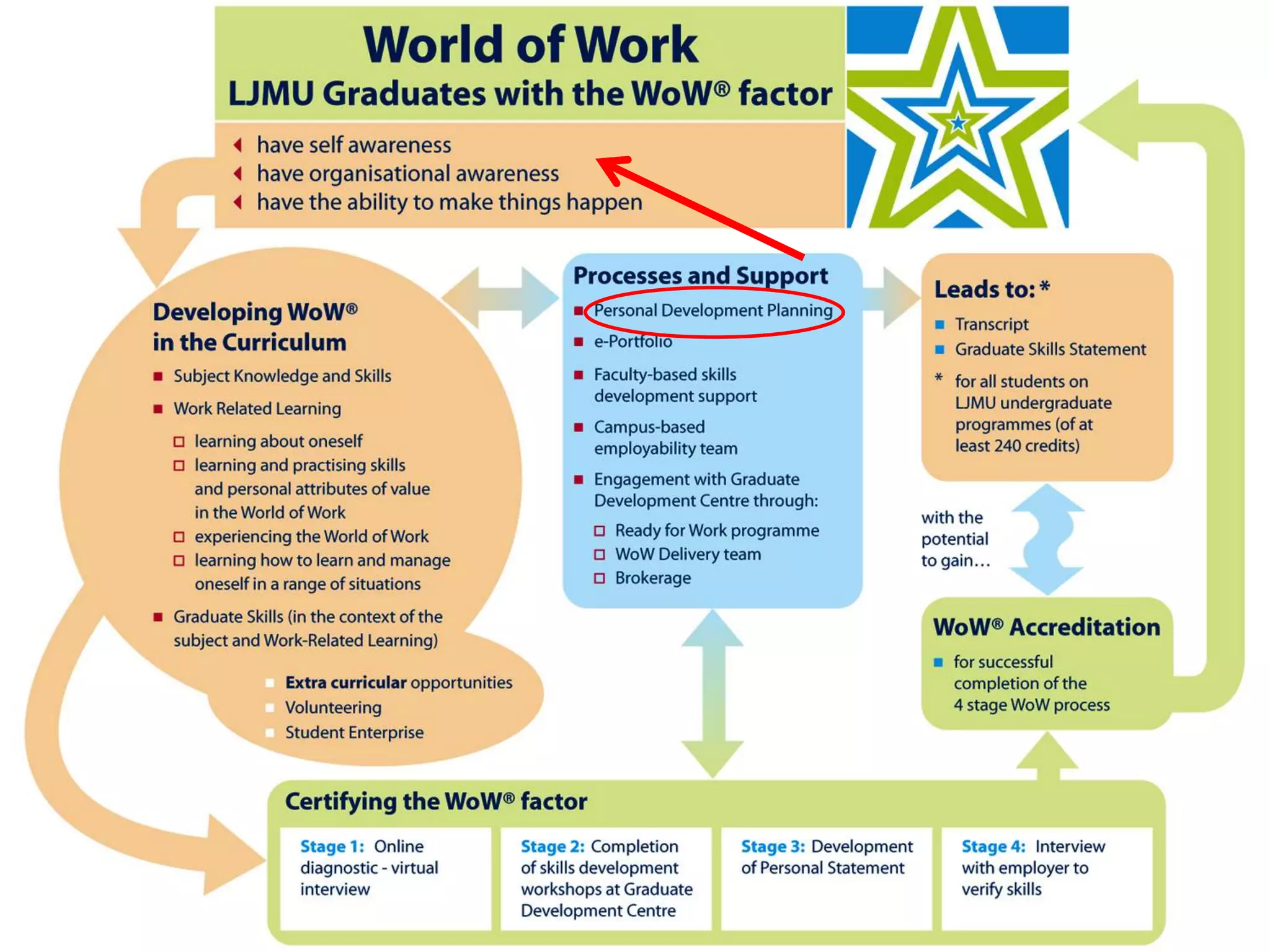
Personal Development Planning;
      Philosophies and Processes


    Personal development ‘is a term that means
different things to different people’ (Strivens 2006).
Run the workshop like a PDP
           session

           • What’s on top
• Set-up the session – your outcomes
           • My outcomes
           • Do some stuff
             • Feedback
Session set-up
For this session to be really useful for you it
 will be like what ?

For the session to be like that, you will need
to be like what?


For you to be like that and for the session
to go just the way you would like it to, what
support and resources do you need?
My outcomes.........
• LJMU and PDP
• What the literature tells us about
  PDP
• PDP in practice in the curriculum
• Sharing of PDP models and
  practices
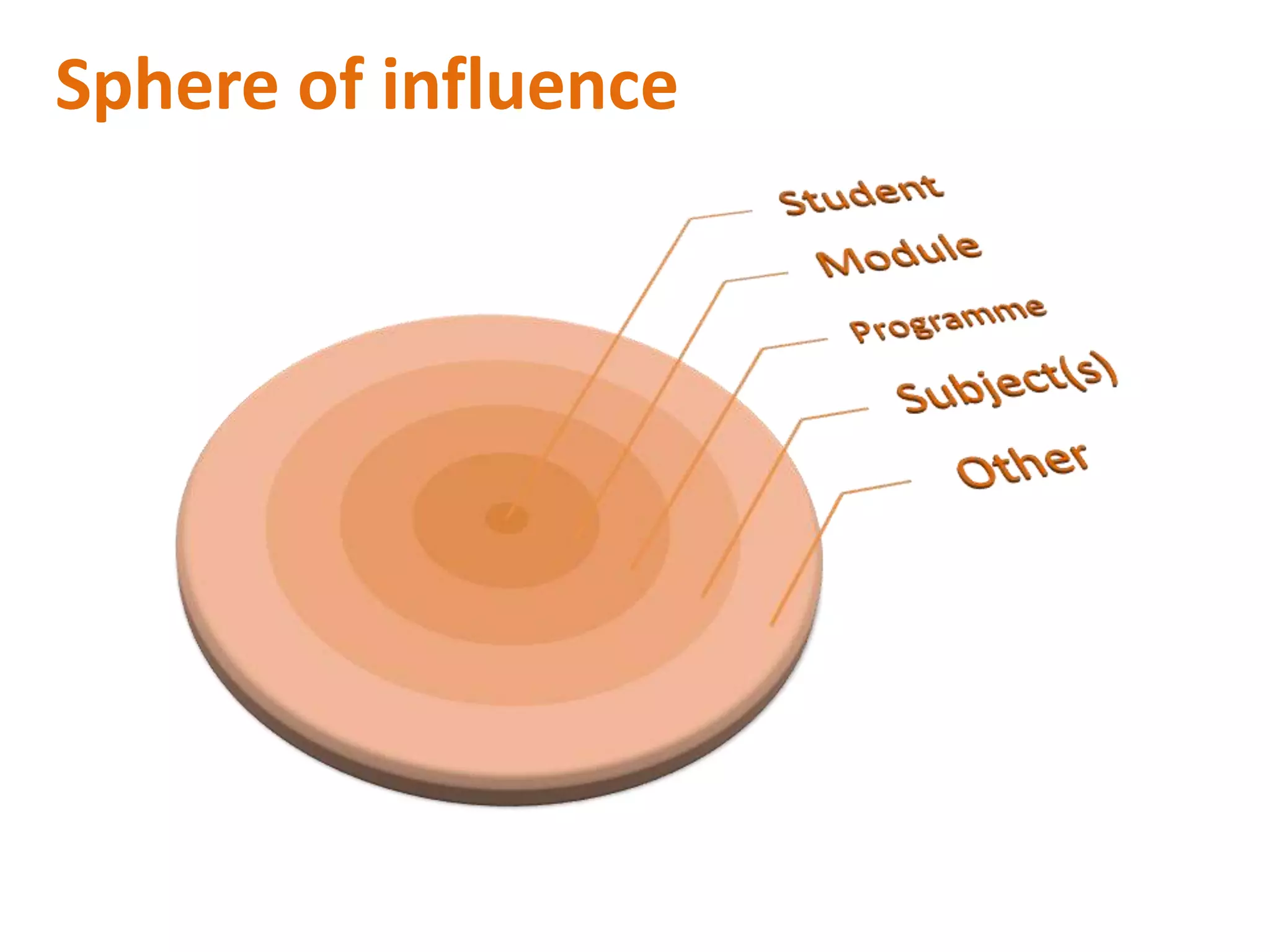
Sphere of influence
PDP is a “structured and
supported process undertaken by
a learner to reflect upon their own
  learning, performance and / or
 achievement and to plan for their
 personal, educational and career
  development. It is an inclusive
process, open to all learners, in all
  HE provision and at all levels.”

                       (QAA 2009)
According to the HEA
PDP embraces a range of approaches
to learning that connect planning (an
individual's goals and intentions for
learning or achievement), doing
(aligning actions to
intentions), recording
(thoughts, ideas, experiences, in order
to understand and evidence the
process and results of learning) and
reflection (reviewing and evaluating
experiences and the results of
learning)
According to Gosling (2003), PDP is
           effective when;

•Mainstream academic activity
•Linked to learning objectives and outcomes
•Undertaken regularly
•Supported and valued by staff
•Owned by institutional structures
•Owned by the learner
•Seen to be valued by society
Conceptually, PDP covers a range of
pedagogies, intentions and practices
    (Clegg 2004), and is a chaotic
  conception which might be better
thought of as an umbrella term for a
variety of strategies designed to help
   students think about their own
learning and plan for the future (Clegg
            and Burfton 2008).
Time to think and talk
• Thinking about your practice
  – what does PDP mean to you
  – how is it delivered
  – how do you think it could be delivered


• Looking at the literature provided
  – what resonates with you
  – what would you want to challenge
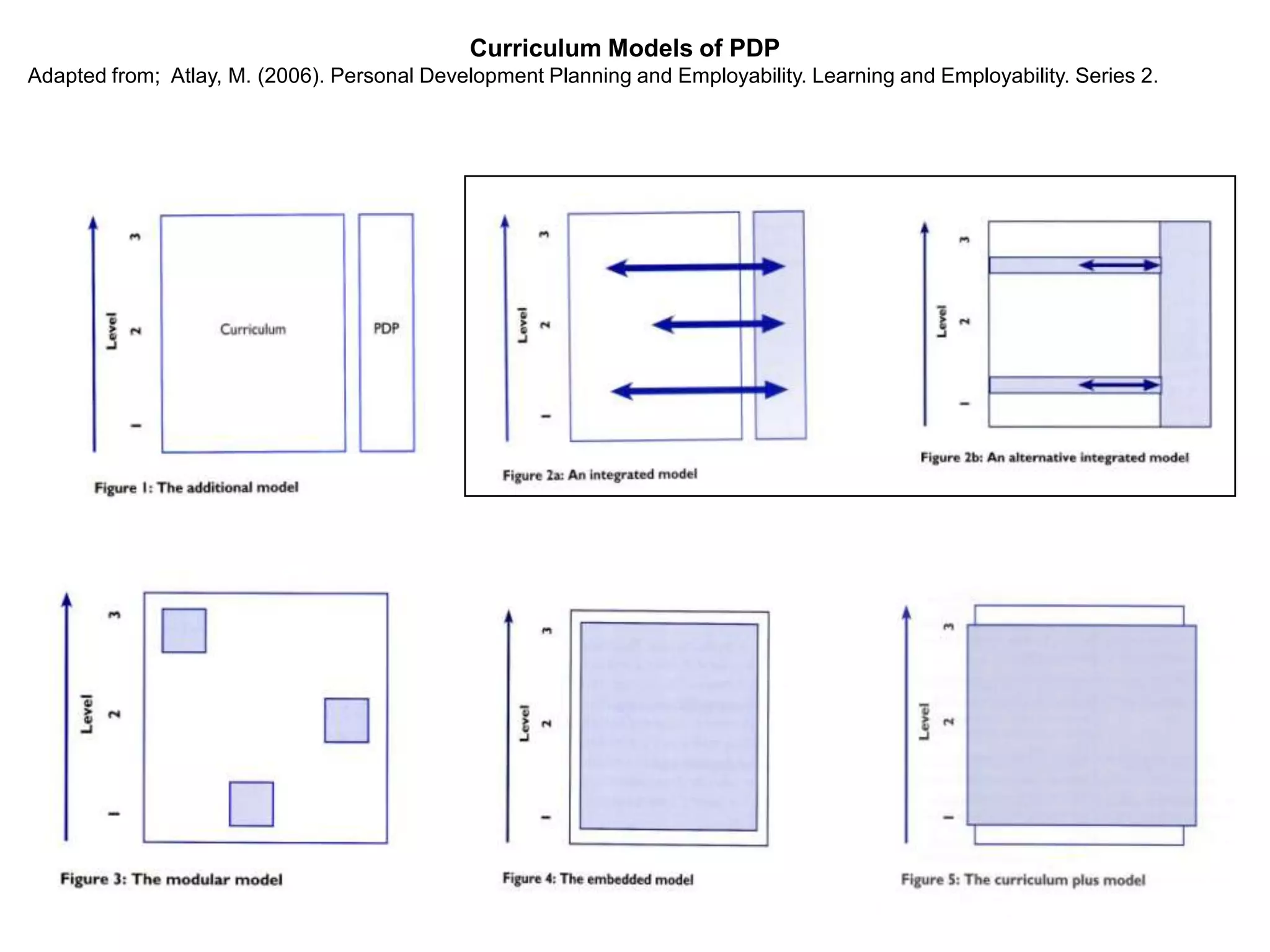
Curriculum Models of PDP
Adapted from; Atlay, M. (2006). Personal Development Planning and Employability. Learning and Employability. Series 2.
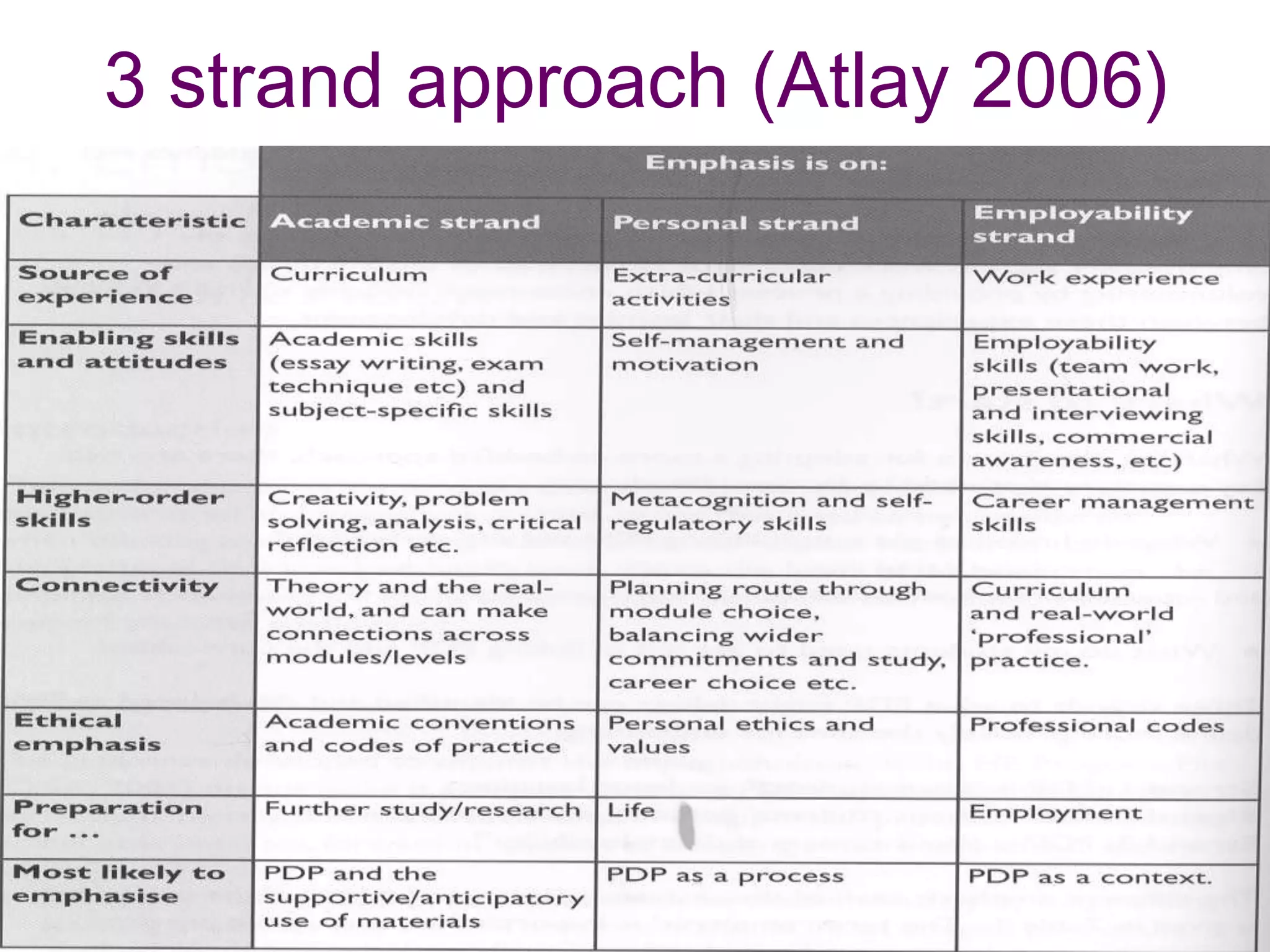
3 strand approach (Atlay 2006)
Curriculum Design and PDP
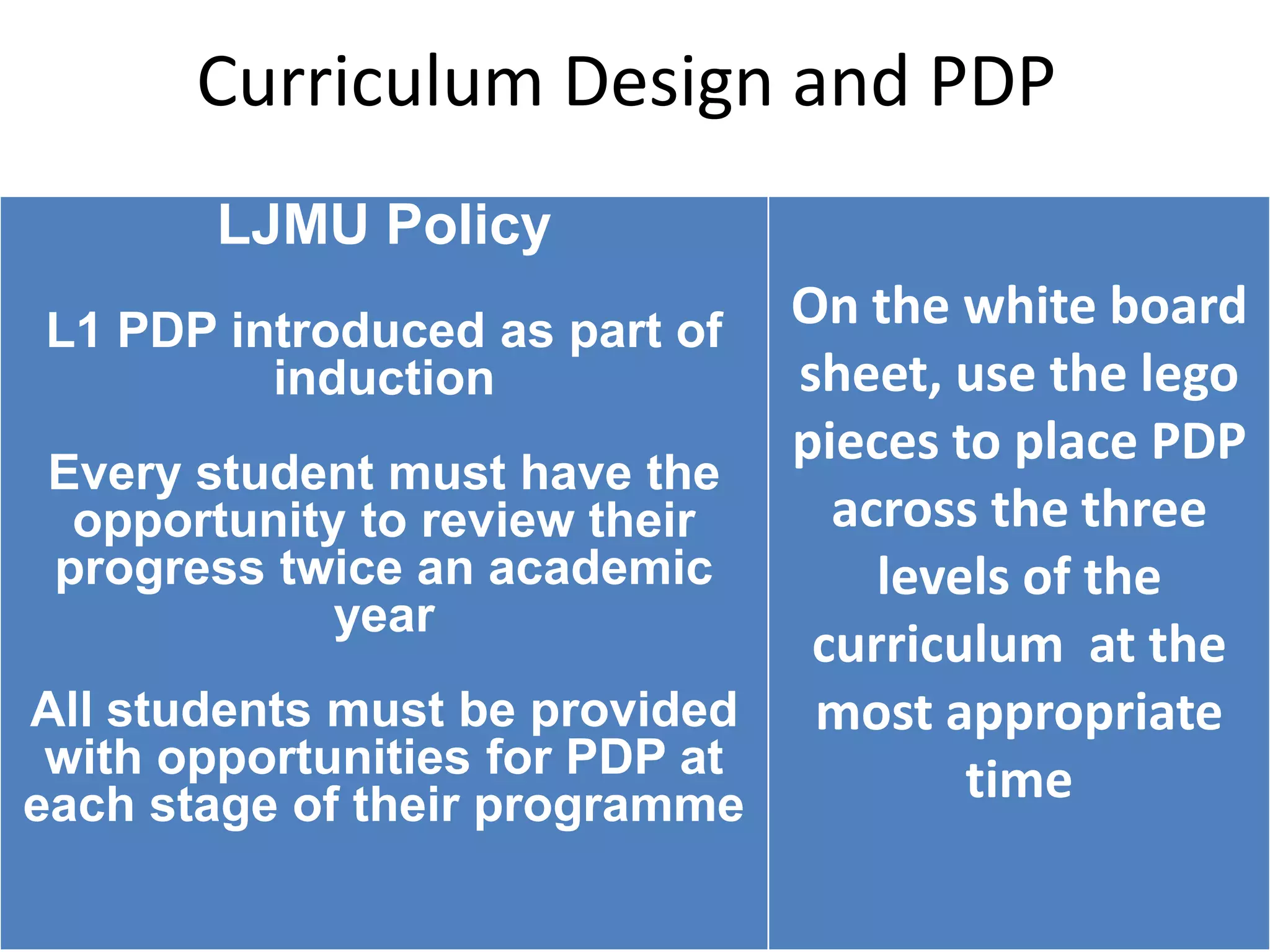
       LJMU Policy
 L1 PDP introduced as part of  On the white board
          induction            sheet, use the lego
                               pieces to place PDP
 Every student must have the
  opportunity to review their    across the three
 progress twice an academic        levels of the
             year
                                curriculum at the
All students must be provided   most appropriate
 with opportunities for PDP at         time
each stage of their programme
Curriculum Design and PDP
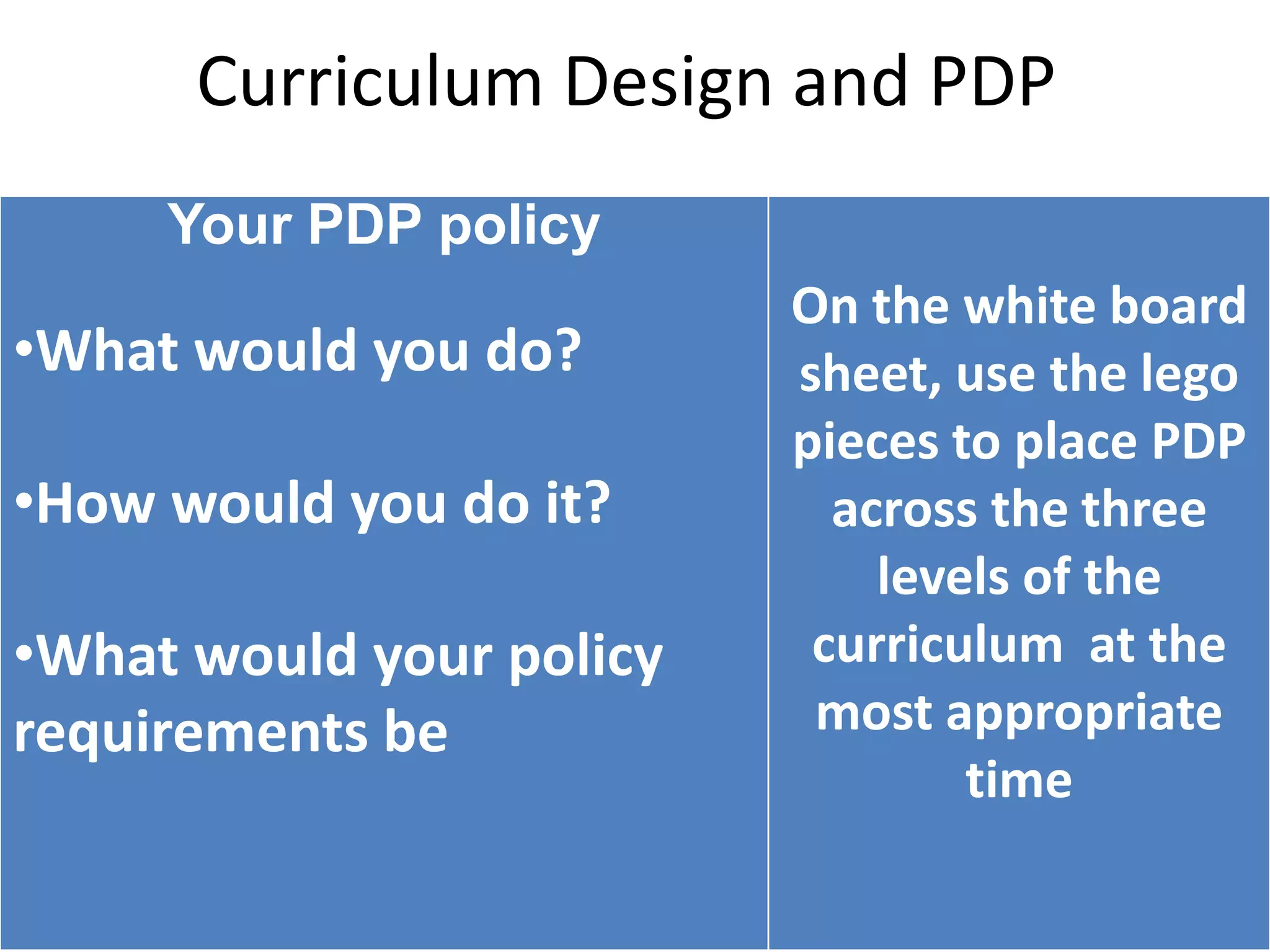
     Your PDP policy
                          On the white board
•What would you do?       sheet, use the lego
                          pieces to place PDP
•How would you do it?       across the three
                              levels of the
•What would your policy    curriculum at the
requirements be            most appropriate
                                  time
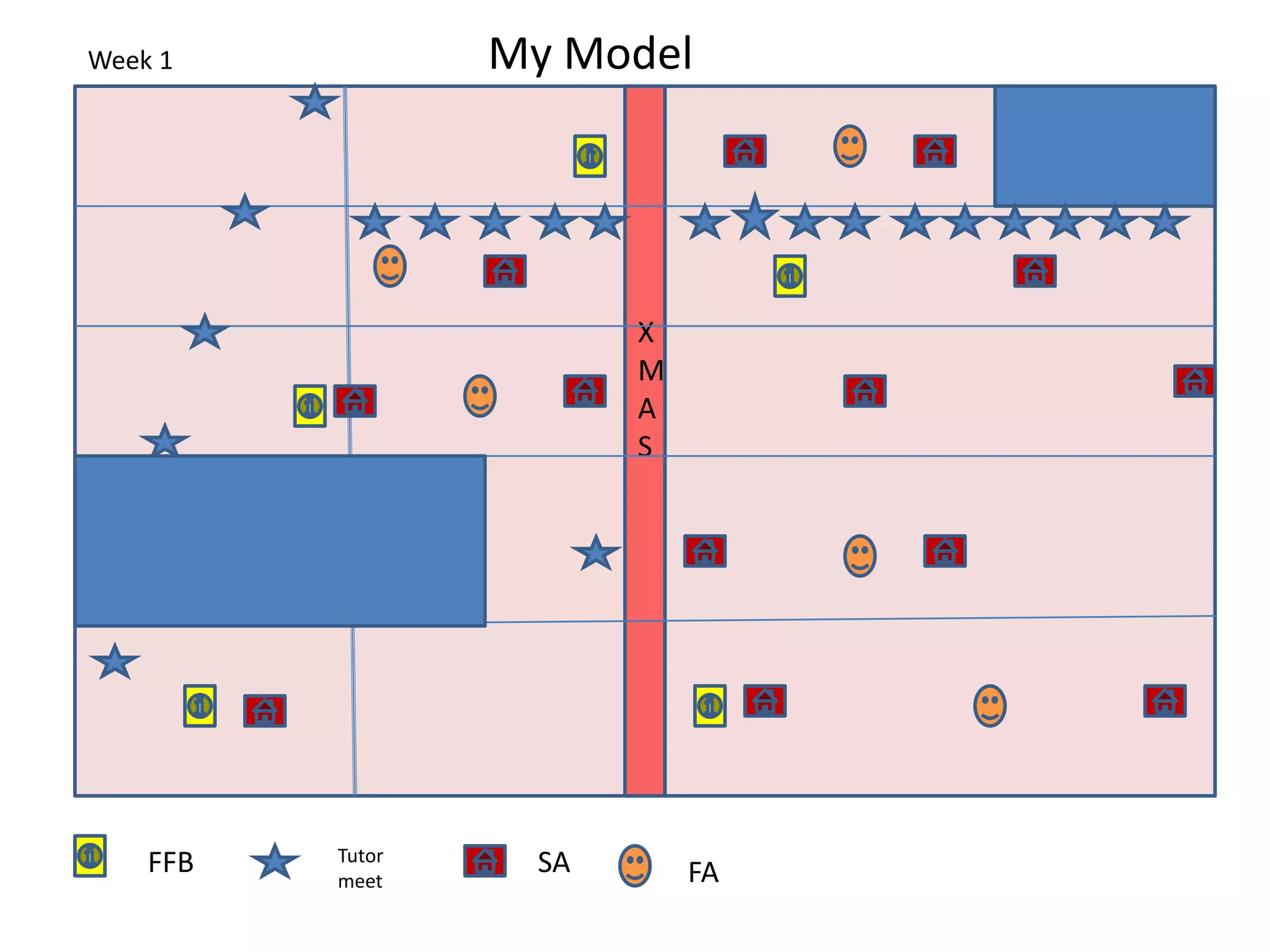
Week 1            My Model


                        X
                        M
                        A
                        S


    FFB   Tutor    SA
          meet              FA
PDP for us
The approach taken within Sport Development is based up on
some core areas;
 – Support effective learning (Ward 2006)
 – Provide a context within which students may recognise,
   record and evidence their development of skills, qualities
   and capabilities that employees may seek (Ward 2006) in
   addition to this enabling them to grow through the process
 – Engage students in representing their own learning and
   communicate this to different audiences (Universities UK
   2004)
 – Developing student potential, metacognitive abilities, self-
   efficacy (Yorke 2007)
Our PDP aims to create the
      context for;


          Self-awareness
            Self-reflection
      Self - development
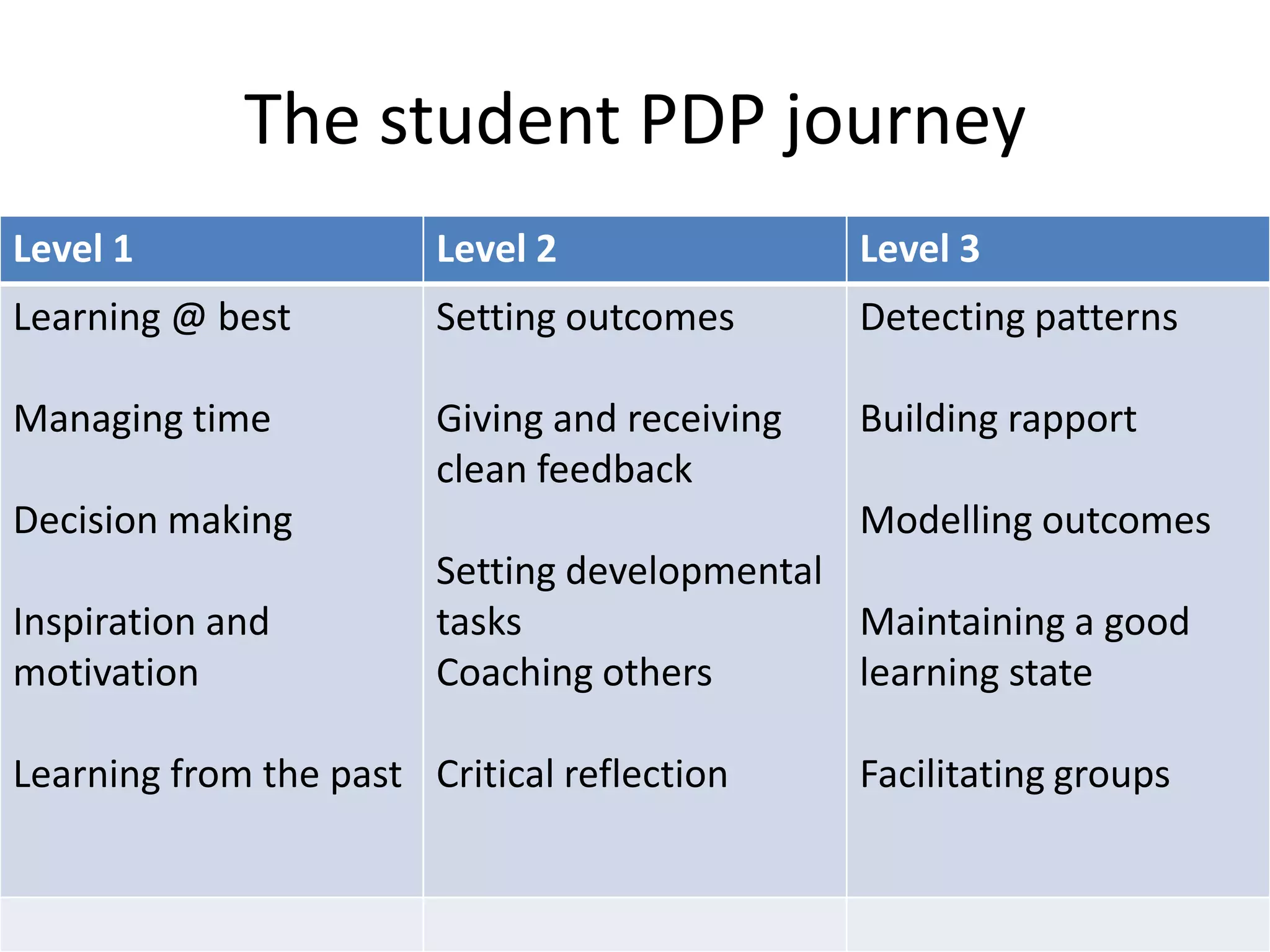
The student PDP journey
Level 1                 Level 2                Level 3
Learning @ best         Setting outcomes       Detecting patterns

Managing time           Giving and receiving   Building rapport
                        clean feedback
Decision making                                Modelling outcomes
                        Setting developmental
Inspiration and         tasks                 Maintaining a good
motivation              Coaching others       learning state

Learning from the past Critical reflection     Facilitating groups
When you are learning
at your best you are like
         what ?
What we have learnt
• Needs to be as embedded as possible into the
  curriculum and works best when it crosses
  module boundaries
• Staff buy-in and support is crucial and difficult
• Students don’t necessarily like or value it at L1
  and this tends to have changed by L3
• Can make a real difference to the students
  both as a learner and as a person
• Link to employability can be a real hook for
  the students
What is one thing you
will do or think about in
 relation to your ideas
 from today's session?
References
Atlay, M. (2006). Personal Development Planning and
   Employability. Learning and Employability. Series 2.

Gosling, D.(2003). Personal Development Planning. SEDA
  Paper 115

Strivens, J. (2006). Personal Development Planning and
   Employability. Learning and Employability. Series 2.
Universities UK 2004 cited in Personal Development Planning and
  Employability. Learning and Employability. Series 2.

Ward, R. (2006). Personal Development Planning and
  Employability. Learning and Employability. Series 2.

Pg cert pdp march 2012

  • 1.
    Personal Development Planning; Philosophies and Processes Personal development ‘is a term that means different things to different people’ (Strivens 2006).
  • 2.
    Run the workshoplike a PDP session • What’s on top • Set-up the session – your outcomes • My outcomes • Do some stuff • Feedback
  • 4.
    Session set-up For thissession to be really useful for you it will be like what ? For the session to be like that, you will need to be like what? For you to be like that and for the session to go just the way you would like it to, what support and resources do you need?
  • 5.
    My outcomes......... • LJMUand PDP • What the literature tells us about PDP • PDP in practice in the curriculum • Sharing of PDP models and practices
  • 6.
  • 7.
    PDP is a“structured and supported process undertaken by a learner to reflect upon their own learning, performance and / or achievement and to plan for their personal, educational and career development. It is an inclusive process, open to all learners, in all HE provision and at all levels.” (QAA 2009)
  • 8.
    According to theHEA PDP embraces a range of approaches to learning that connect planning (an individual's goals and intentions for learning or achievement), doing (aligning actions to intentions), recording (thoughts, ideas, experiences, in order to understand and evidence the process and results of learning) and reflection (reviewing and evaluating experiences and the results of learning)
  • 9.
    According to Gosling(2003), PDP is effective when; •Mainstream academic activity •Linked to learning objectives and outcomes •Undertaken regularly •Supported and valued by staff •Owned by institutional structures •Owned by the learner •Seen to be valued by society
  • 10.
    Conceptually, PDP coversa range of pedagogies, intentions and practices (Clegg 2004), and is a chaotic conception which might be better thought of as an umbrella term for a variety of strategies designed to help students think about their own learning and plan for the future (Clegg and Burfton 2008).
  • 11.
    Time to thinkand talk • Thinking about your practice – what does PDP mean to you – how is it delivered – how do you think it could be delivered • Looking at the literature provided – what resonates with you – what would you want to challenge
  • 12.
    Curriculum Models ofPDP Adapted from; Atlay, M. (2006). Personal Development Planning and Employability. Learning and Employability. Series 2.
  • 13.
    3 strand approach(Atlay 2006)
  • 15.
    Curriculum Design andPDP LJMU Policy L1 PDP introduced as part of On the white board induction sheet, use the lego pieces to place PDP Every student must have the opportunity to review their across the three progress twice an academic levels of the year curriculum at the All students must be provided most appropriate with opportunities for PDP at time each stage of their programme
  • 16.
    Curriculum Design andPDP Your PDP policy On the white board •What would you do? sheet, use the lego pieces to place PDP •How would you do it? across the three levels of the •What would your policy curriculum at the requirements be most appropriate time
  • 17.
    Week 1 My Model X M A S FFB Tutor SA meet FA
  • 18.
    PDP for us Theapproach taken within Sport Development is based up on some core areas; – Support effective learning (Ward 2006) – Provide a context within which students may recognise, record and evidence their development of skills, qualities and capabilities that employees may seek (Ward 2006) in addition to this enabling them to grow through the process – Engage students in representing their own learning and communicate this to different audiences (Universities UK 2004) – Developing student potential, metacognitive abilities, self- efficacy (Yorke 2007)
  • 19.
    Our PDP aimsto create the context for; Self-awareness Self-reflection Self - development
  • 21.
    The student PDPjourney Level 1 Level 2 Level 3 Learning @ best Setting outcomes Detecting patterns Managing time Giving and receiving Building rapport clean feedback Decision making Modelling outcomes Setting developmental Inspiration and tasks Maintaining a good motivation Coaching others learning state Learning from the past Critical reflection Facilitating groups
  • 22.
    When you arelearning at your best you are like what ?
  • 23.
    What we havelearnt • Needs to be as embedded as possible into the curriculum and works best when it crosses module boundaries • Staff buy-in and support is crucial and difficult • Students don’t necessarily like or value it at L1 and this tends to have changed by L3 • Can make a real difference to the students both as a learner and as a person • Link to employability can be a real hook for the students
  • 24.
    What is onething you will do or think about in relation to your ideas from today's session?
  • 25.
    References Atlay, M. (2006).Personal Development Planning and Employability. Learning and Employability. Series 2. Gosling, D.(2003). Personal Development Planning. SEDA Paper 115 Strivens, J. (2006). Personal Development Planning and Employability. Learning and Employability. Series 2. Universities UK 2004 cited in Personal Development Planning and Employability. Learning and Employability. Series 2. Ward, R. (2006). Personal Development Planning and Employability. Learning and Employability. Series 2.