Using	muddiest	point	forma1ve	feedback	
to	encourage	reflec1ve	teaching	and	
improve	student	learning		
	
Claire	Yan	
School	of	Engineering,	UBC	Okanagan	
Stephen	Krause	
Ira	A.	Fulton	School	of	Engineering,	Arizona	
State	University	
Fes?val	of	Learning,	Burnaby	BC,	June	6-9,	2016
Agenda	
•  Forma?ve	and	summa?ve	feedback	
•  Features	of	effec?ve	feedback	
•  Muddiest	point	survey	
– Background	
– Implementa?on	via	Blackboard	survey	tool	
– Impact	on	instructor’s	teaching	
– Impact	on	student	learning	
•  Summary	
	 2
3	
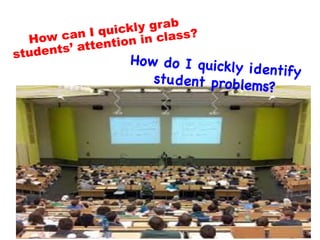
How can I quickly grab
students’ attention in class?
How do I quickly identifystudent problems?
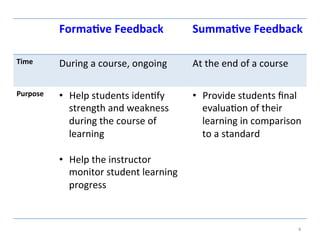
Forma1ve	Feedback	 Summa1ve	Feedback	
Time	 During	a	course,	ongoing	 At	the	end	of	a	course	
Purpose	 •  Help	students	iden?fy	
strength	and	weakness	
during	the	course	of	
learning	
	
•  Help	the	instructor	
monitor	student	learning	
progress	
•  Provide	students	final	
evalua?on	of	their	
learning	in	comparison	
to	a	standard	
4
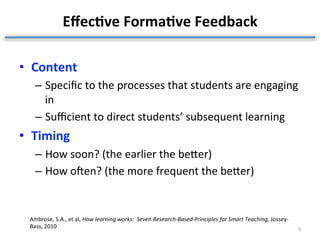
Effec1ve	Forma1ve	Feedback	
•  Content	
– Specific	to	the	processes	that	students	are	engaging	
in	
– Sufficient	to	direct	students’	subsequent	learning	
•  Timing	
– How	soon?	(the	earlier	the	beZer)	
– How	oen?	(the	more	frequent	the	beZer)		
5	
Ambrose,	S.A.,	et	al,	How	learning	works:		Seven	Research-Based	Principles	for	Smart	Teaching,	Jossey-
Bass,	2010
Muddiest	Point	(MP)	Survey	
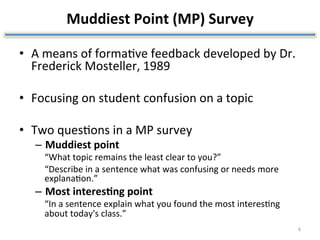
•  A	means	of	forma?ve	feedback	developed	by	Dr.	
Frederick	Mosteller,	1989	
•  Focusing	on	student	confusion	on	a	topic	
•  Two	ques?ons	in	a	MP	survey	
–  Muddiest	point		
“What	topic	remains	the	least	clear	to	you?”	
“Describe	in	a	sentence	what	was	confusing	or	needs	more	
explana?on.”		
–  Most	interes1ng	point		
“In	a	sentence	explain	what	you	found	the	most	interes?ng	
about	today's	class.”		
6
Blackboard	survey	tool	for	MP	data	collec1on		
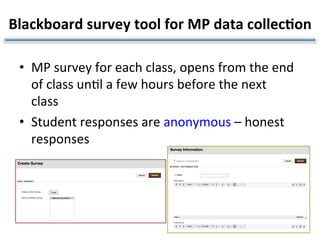
•  MP	survey	for	each	class,	opens	from	the	end	
of	class	un?l	a	few	hours	before	the	next	
class	
•  Student	responses	are	anonymous	–	honest	
responses		
	
		
7
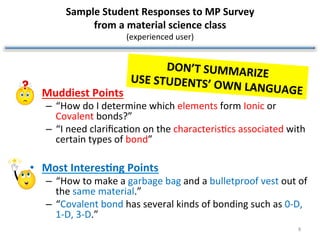
Sample	Student	Responses	to	MP	Survey		
from	a	material	science	class		
(experienced	user)	
•  Muddiest	Points	
–  “How	do	I	determine	which	elements	form	Ionic	or	
Covalent	bonds?”	
–  “I	need	clarifica?on	on	the	characteris?cs	associated	with	
certain	types	of	bond”	
•  Most	Interes1ng	Points	
–  “How	to	make	a	garbage	bag	and	a	bulletproof	vest	out	of	
the	same	material.”	
–  “Covalent	bond	has	several	kinds	of	bonding	such	as	0-D,	
1-D,	3-D.”	
8	
DON’T	SUMMARIZE		USE	STUDENTS’	OWN	LANGUAGE
MP	Survey	for	Reflec1ve	Teaching	
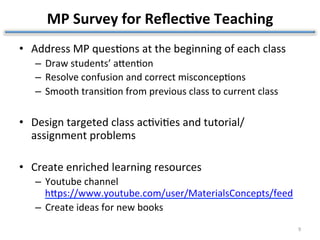
•  Address	MP	ques?ons	at	the	beginning	of	each	class	
–  Draw	students’	aZen?on	
–  Resolve	confusion	and	correct	misconcep?ons	
–  Smooth	transi?on	from	previous	class	to	current	class	
•  Design	targeted	class	ac?vi?es	and	tutorial/
assignment	problems	
•  Create	enriched	learning	resources	
–  Youtube	channel
hZps://www.youtube.com/user/MaterialsConcepts/feed												
–  Create	ideas	for	new	books	
	
9
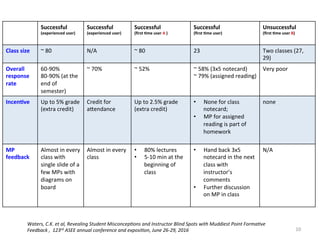
Successful	
(experienced	user)	
Successful	
(experienced	user)	
	
Successful	
(first	1me	user	A	)	
Successful	
(first	1me	user)		
	
Unsuccessful		
(first	1me	user	B)	
Class	size	 ~	80	 N/A	 ~	80	 23	 Two	classes	(27,	
29)	
Overall	
response	
rate	
60-90%		
80-90%	(at	the	
end	of	
semester)	
~	70%	 ~	52%	 ~	58%	(3x5	notecard)	
~	79%	(assigned	reading)	
Very	poor	
Incen1ve		 Up	to	5%	grade	
(extra	credit)	
	
Credit	for	
aZendance	
Up	to	2.5%	grade	
(extra	credit)	
•  None	for	class	
notecard;	
•  MP	for	assigned	
reading	is	part	of	
homework	
	
none	
MP	
feedback	
Almost	in	every	
class	with	
single	slide	of	a	
few	MPs	with	
diagrams	on	
board	
Almost	in	every	
class	
	
•  80%	lectures	
•  5-10	min	at	the	
beginning	of	
class	
•  Hand	back	3x5	
notecard	in	the	next		
class	with	
instructor’s	
comments	
•  Further	discussion	
on	MP	in	class	
	
N/A	
10	
Waters,	C.K.	et	al,	Revealing	Student	MisconcepDons	and	Instructor	Blind	Spots	with	Muddiest	Point	FormaDve	
Feedback	,		123rd	ASEE	annual	conference	and	exposiDon,	June	26-29,	2016
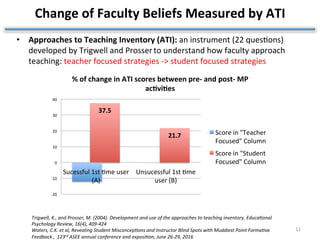
Change	of	Faculty	Beliefs	Measured	by	ATI	
•  Approaches	to	Teaching	Inventory	(ATI):	an	instrument	(22	ques?ons)	
developed	by	Trigwell	and	Prosser	to	understand	how	faculty	approach	
teaching:	teacher	focused	strategies	->	student	focused	strategies	
11	
Trigwell,	K.,	and	Prosser,	M.	(2004).	Development	and	use	of	the	approaches	to	teaching	inventory.	EducaDonal	
Psychology	Review,	16(4),	409-424		
Waters,	C.K.	et	al,	Revealing	Student	MisconcepDons	and	Instructor	Blind	Spots	with	Muddiest	Point	FormaDve	
Feedback	,		123rd	ASEE	annual	conference	and	exposiDon,	June	26-29,	2016	
37.5	
21.7	
-20	
-10	
0	
10	
20	
30	
40	
Sucessful	1st	?me	user	
(A)	
Unsucessful	1st	?me	
user	(B)	
%	of	change	in	ATI	scores	between	pre-	and	post-	MP	
ac1vi1es		
Score	in	"Teacher	
Focused"	Column	
Score	in	"Student	
Focused"	Column
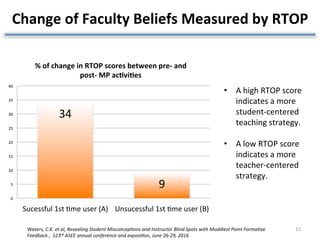
Change	of	Faculty	Beliefs	Measured	by	RTOP	
12	
34	
9	
0	
5	
10	
15	
20	
25	
30	
35	
40	
Sucessful	1st	?me	user	(A)	 Unsucessful	1st	?me	user	(B)	
%	of	change	in	RTOP	scores	between	pre-	and	
post-	MP	ac1vi1es		
Waters,	C.K.	et	al,	Revealing	Student	MisconcepDons	and	Instructor	Blind	Spots	with	Muddiest	Point	FormaDve	
Feedback	,		123rd	ASEE	annual	conference	and	exposiDon,	June	26-29,	2016	
•  A	high	RTOP	score	
indicates	a	more	
student-centered	
teaching	strategy.	
		
•  A	low	RTOP	score	
indicates	a	more	
teacher-centered	
strategy.
Impact	on	Student	Learning	
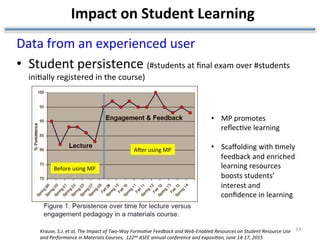
Data	from	an	experienced	user	
•  Student	persistence	(#students	at	final	exam	over	#students	
ini?ally	registered	in	the	course)	
13	
•  MP	promotes	
reflec?ve	learning	
•  Scaffolding	with	?mely	
feedback	and	enriched	
learning	resources	
boosts	students’	
interest	and	
confidence	in	learning	
Krause,	S.J.	et	al,	The	Impact	of	Two-Way	FormaDve	Feedback	and	Web-Enabled	Resources	on	Student	Resource	Use	
and	Performance	in	Materials	Courses,		122nd	ASEE	annual	conference	and	exposiDon,	June	14-17,	2015	
Before	using	MP	
Aer	using	MP
Impact	on	Student	Learning		
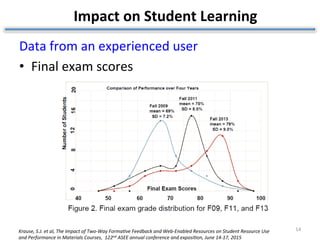
Data	from	an	experienced	user	
•  Final	exam	scores	
14	Krause,	S.J.	et	al,	The	Impact	of	Two-Way	FormaDve	Feedback	and	Web-Enabled	Resources	on	Student	Resource	Use	
and	Performance	in	Materials	Courses,		122nd	ASEE	annual	conference	and	exposiDon,	June	14-17,	2015
Summary	
•  MP	makes	learning	“visible”	to	both	instructors	and	
students	
•  MP,	if	used	effec?vely,	may	
–  For	faculty	
•  Promote	reflec?ve	teaching		
•  Help	plan/create	enriched	learning	resources	and	engagement	
ac?vi?es	
•  Help	foster	student-centered	teaching	philosophy	and	prac?ce	
–  For	students	
•  Encourage	reflec?ve	learning	
•  Promote	responsibility	for	and	confidence	in	learning		
•  To	encourage	student	par?cipa?on	
–  Use	incen?ves	
–  Faculty	provides	consistent	and	?mely	feedback	to	help	
students	see	the	value	of	MP	
15
Acknowledgement	
•  Bethany	Smith,	MASc,	Arizona	State	University	
•  Yong-Seok	Park,	PhD,	Arizona	State	University	
•  Danielle	Stevens,	MASc,	Arizona	State	University	
	
	
Contact:	Claire	Yan	(	yu.yan@ubc.ca	)	


16

Using Muddiest Point Formative Feedback to Encourage Reflective Teaching and Improve Student Learning