Peter A. Slovinsky, Marine Geologist Maine Geological Survey Bureau of Resource Information and Land Use Planning Department of Agriculture, Conservation and Forestry 
Sea level rise and storm surge tools and datasets supporting Municipal Resiliency GrowSmart Maine Summit October 21, 2014
I’ll cover…. 
Setting the stage: very quickly summarize the latest sea level rise predictions and historical storm surge data in Maine 
Federal and NGO Mapping Tools 
Statewide datasets supporting municipal resiliency 
Potential Hurricane Inundation Mapping 
Highest Annual Tide Mapping 
A few transferable local efforts on municipal resiliency
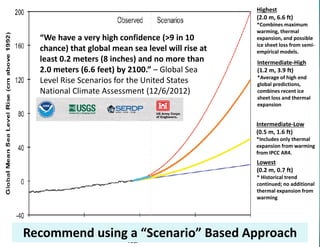
Highest 
(2.0 m, 6.6 ft) 
*Combines maximum 
warming, thermal 
expansion, and possible 
ice sheet loss from semi-empirical 
models. 
Intermediate-High 
(1.2 m, 3.9 ft) 
*Average of high end 
global predictions, 
combines recent ice 
sheet loss and thermal 
expansion 
Intermediate-Low 
(0.5 m, 1.6 ft) 
*Includes only thermal 
expansion from warming 
from IPCC AR4. 
Lowest 
(0.2 m, 0.7 ft) 
* Historical trend 
continued; no additional 
thermal expansion from 
warming 
“We have a very high confidence (>9 in 10 
chance) that global mean sea level will rise at 
least 0.2 meters (8 inches) and no more than 
2.0 meters (6.6 feet) by 2100.” – Global Sea 
Level Rise Scenarios for the United States 
National Climate Assessment (12/6/2012) 
GSLRRS UeSNcCA,o 12/m6/201m2 end using a “Scenario” Based Approach
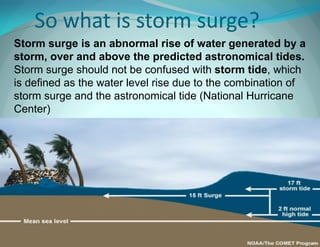
So what is storm surge? 
Storm surge is an abnormal rise of water generated by a storm, over and above the predicted astronomical tides. Storm surge should not be confused with storm tide, which is defined as the water level rise due to the combination of storm surge and the astronomical tide (National Hurricane Center)
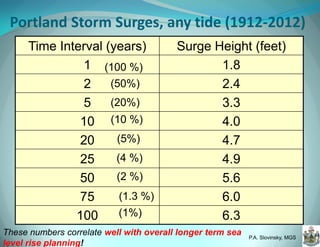
Portland Storm Surges, any tide (1912-2012) 
Time Interval (years) 
Surge Height (feet) 
1 
1.8 
2 
2.4 
5 
3.3 
10 
4.0 
20 
4.7 
25 
4.9 
50 
5.6 
75 
6.0 
100 
6.3 
P.A. Slovinsky, MGS 
(1%) 
(10 %) 
(100 %) 
(2 %) 
(4 %) 
(50%) 
(5%) 
(20%) 
(1.3 %) 
These numbers correlate well with overall longer term sea level rise planning!
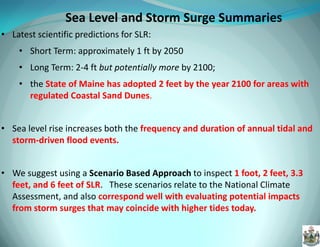
Sea Level and Storm Surge Summaries 
•Latest scientific predictions for SLR: 
•Short Term: approximately 1 ft by 2050 
•Long Term: 2-4 ft but potentially more by 2100; 
•the State of Maine has adopted 2 feet by the year 2100 for areas with regulated Coastal Sand Dunes. 
•Sea level rise increases both the frequency and duration of annual tidal and storm-driven flood events. 
•We suggest using a Scenario Based Approach to inspect 1 foot, 2 feet, 3.3 feet, and 6 feet of SLR. These scenarios relate to the National Climate Assessment, and also correspond well with evaluating potential impacts from storm surges that may coincide with higher tides today.
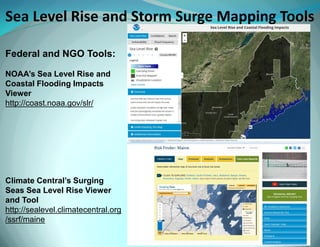
Sea Level Rise and Storm Surge Mapping Tools 
Federal and NGO Tools: NOAA’s Sea Level Rise and Coastal Flooding Impacts Viewer http://coast.noaa.gov/slr/ Climate Central’s Surging Seas Sea Level Rise Viewer and Tool http://sealevel.climatecentral.org/ssrf/maine
Datasets created by the State to 
support Municipal Resiliency Maine’s Potential Hurricane Inundation Mapping Maine’s Highest Annual Tide Mapping
Potential uses of the dataset 
Potential Hurricane Inundation Mapping 
•emergency preparedness, management, and evacuation planning purposes only.
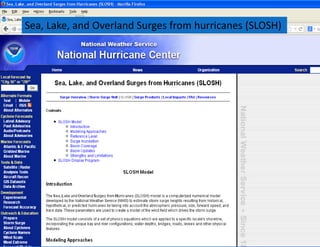
Sea, Lake, and Overland Surges from hurricanes (SLOSH)
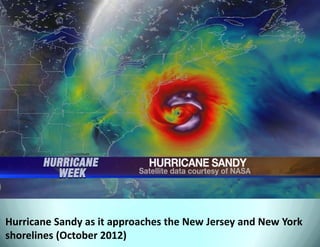
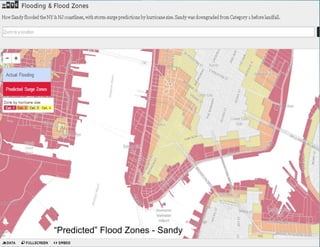
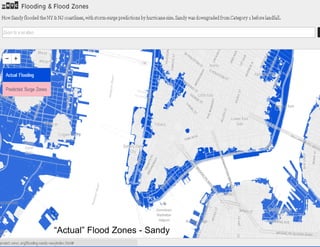
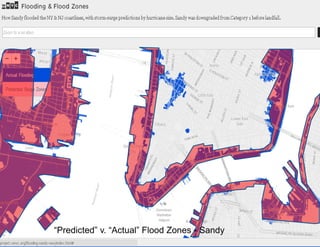
Hurricane Sandy as it approaches the New Jersey and New York shorelines (October 2012)
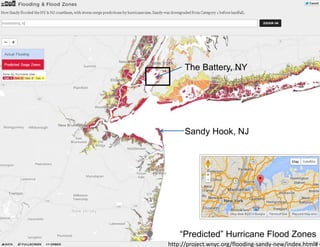
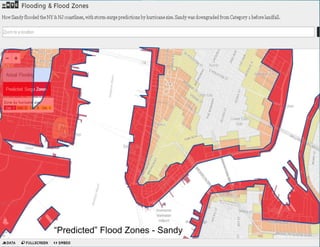
“Predicted” Hurricane Flood Zones 
http://project.wnyc.org/flooding-sandy-new/index.html# 
Sandy Hook, NJ 
The Battery, NY
“Predicted” Flood Zones - Sandy
“Actual” Flood Zones - Sandy
“Predicted” v. “Actual” Flood Zones - Sandy
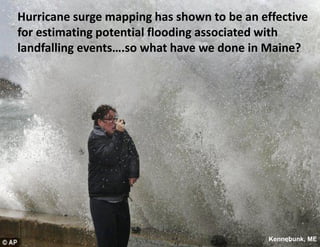
Hurricane surge mapping has shown to be an effective for estimating potential flooding associated with landfalling events….so what have we done in Maine? 
Kennebunk, ME
Potential Hurricane Inundation Mapping 
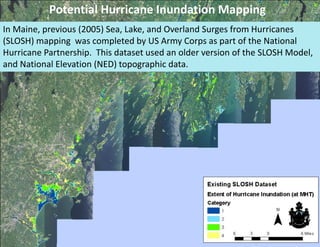
In Maine, previous (2005) Sea, Lake, and Overland Surges from Hurricanes (SLOSH) mapping was completed by US Army Corps as part of the National Hurricane Partnership. This dataset used an older version of the SLOSH Model, and National Elevation (NED) topographic data.
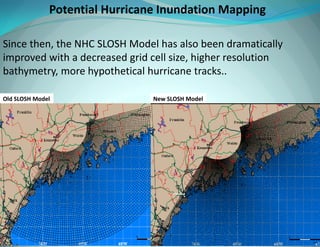
Since then, the NHC SLOSH Model has also been dramatically improved with a decreased grid cell size, higher resolution bathymetry, more hypothetical hurricane tracks.. 
Old SLOSH Model 
New SLOSH Model 
Potential Hurricane Inundation Mapping
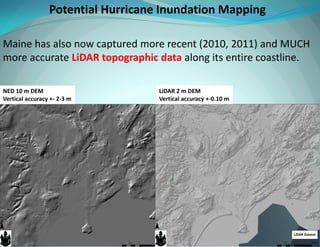
Maine has also now captured more recent (2010, 2011) and MUCH more accurate LiDAR topographic data along its entire coastline. 
NED 10 m DEM Vertical accuracy +- 2-3 m 
LiDAR 2 m DEM Vertical accuracy +-0.10 m 
Potential Hurricane Inundation Mapping
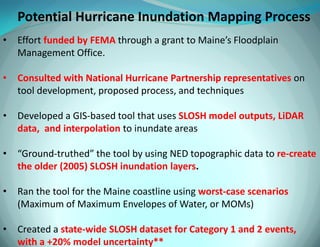
Potential Hurricane Inundation Mapping Process 
•Effort funded by FEMA through a grant to Maine’s Floodplain Management Office. 
•Consulted with National Hurricane Partnership representatives on tool development, proposed process, and techniques 
•Developed a GIS-based tool that uses SLOSH model outputs, LiDAR data, and interpolation to inundate areas 
•“Ground-truthed” the tool by using NED topographic data to re-create the older (2005) SLOSH inundation layers. 
•Ran the tool for the Maine coastline using worst-case scenarios (Maximum of Maximum Envelopes of Water, or MOMs) 
•Created a state-wide SLOSH dataset for Category 1 and 2 events, with a +20% model uncertainty**
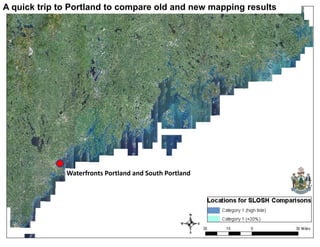
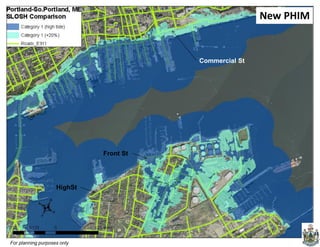
Waterfronts Portland and South Portland 
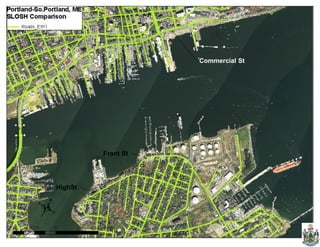
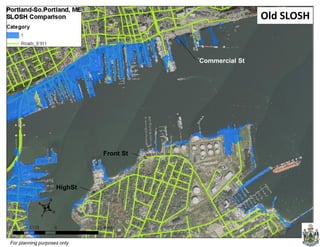
A quick trip to Portland to compare old and new mapping results
Commercial St 
Front St 
HighSt
Old SLOSH 
For planning purposes only 
Commercial St 
Front St 
HighSt
New PHIM 
For planning purposes only 
Commercial St 
Front St 
HighSt
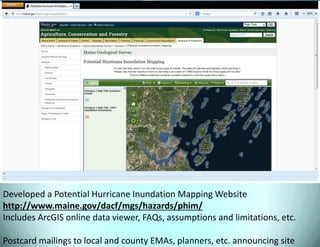
Developed a Potential Hurricane Inundation Mapping Website http://www.maine.gov/dacf/mgs/hazards/phim/ Includes ArcGIS online data viewer, FAQs, assumptions and limitations, etc. Postcard mailings to local and county EMAs, planners, etc. announcing site
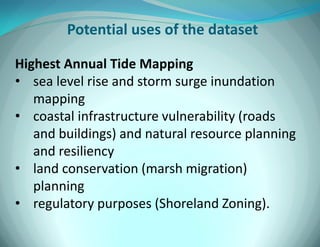
Potential uses of the dataset 
Highest Annual Tide Mapping 
•sea level rise and storm surge inundation mapping 
•coastal infrastructure vulnerability (roads and buildings) and natural resource planning and resiliency 
•land conservation (marsh migration) planning 
•regulatory purposes (Shoreland Zoning).
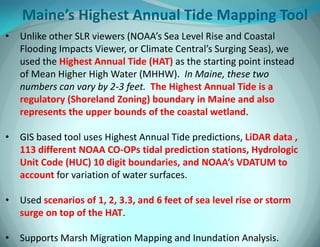
Maine’s Highest Annual Tide Mapping Tool 
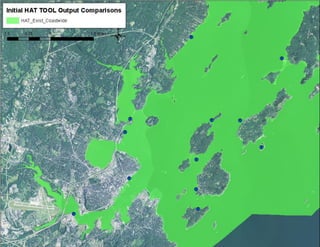
•Unlike other SLR viewers (NOAA’s Sea Level Rise and Coastal Flooding Impacts Viewer, or Climate Central’s Surging Seas), we used the Highest Annual Tide (HAT) as the starting point instead of Mean Higher High Water (MHHW). In Maine, these two numbers can vary by 2-3 feet. The Highest Annual Tide is a regulatory (Shoreland Zoning) boundary in Maine and also represents the upper bounds of the coastal wetland. 
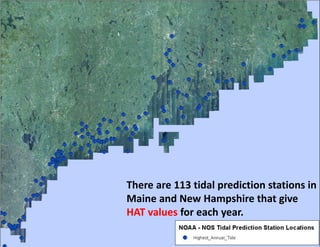
•GIS based tool uses Highest Annual Tide predictions, LiDAR data , 113 different NOAA CO-OPs tidal prediction stations, Hydrologic Unit Code (HUC) 10 digit boundaries, and NOAA’s VDATUM to account for variation of water surfaces. 
•Used scenarios of 1, 2, 3.3, and 6 feet of sea level rise or storm surge on top of the HAT. 
•Supports Marsh Migration Mapping and Inundation Analysis.
There are 113 tidal prediction stations in Maine and New Hampshire that give HAT values for each year.
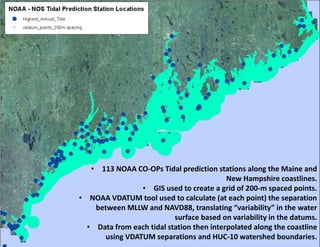
•113 NOAA CO-OPs Tidal prediction stations along the Maine and New Hampshire coastlines. 
•GIS used to create a grid of 200-m spaced points. 
•NOAA VDATUM tool used to calculate (at each point) the separation between MLLW and NAVD88, translating “variability” in the water surface based on variability in the datums. 
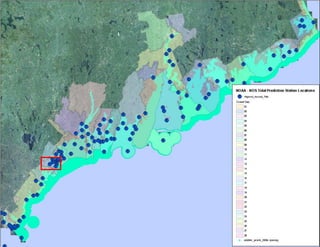
•Data from each tidal station then interpolated along the coastline using VDATUM separations and HUC-10 watershed boundaries.
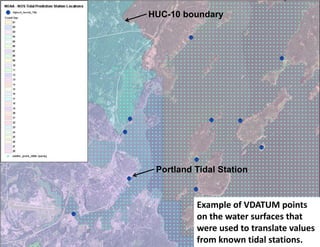
Example of VDATUM points on the water surfaces that were used to translate values from known tidal stations. 
HUC-10 boundary 
Portland Tidal Station
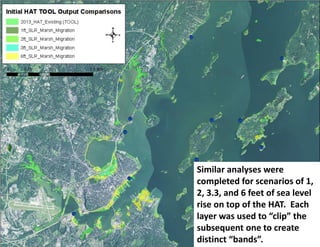
Similar analyses were completed for scenarios of 1, 2, 3.3, and 6 feet of sea level rise on top of the HAT. Each layer was used to “clip” the subsequent one to create distinct “bands”.
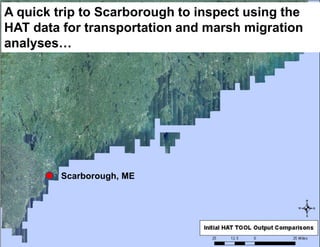
Scarborough, ME 
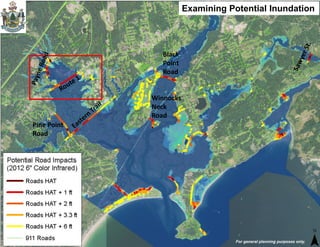
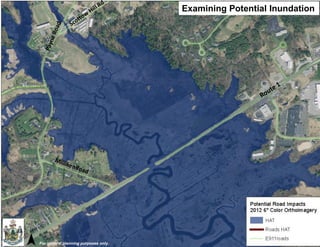
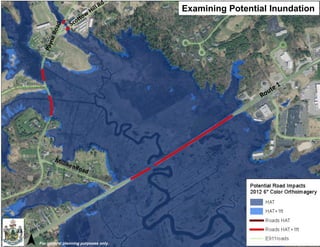
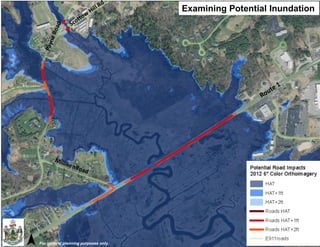
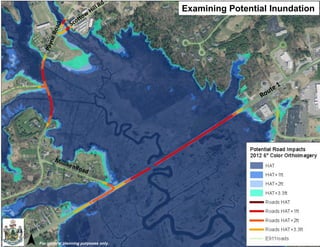
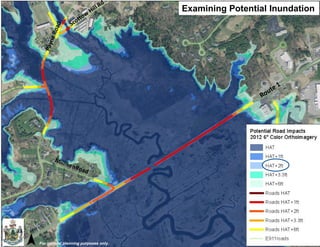
A quick trip to Scarborough to inspect using the HAT data for transportation and marsh migration analyses…
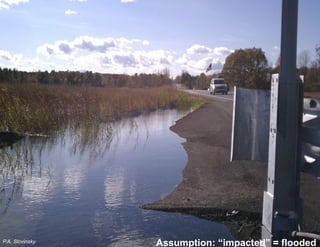
Assumption: “impacted” = flooded 
P.A. Slovinsky
Black 
Point 
Road 
Pine Point 
Road 
Winnocks 
Neck 
Road 
For general planning purposes only. 
Examining Potential Inundation
Examining Potential Inundation 
For general planning purposes only.
Examining Potential Inundation 
For general planning purposes only.
Examining Potential Inundation 
For general planning purposes only.
Examining Potential Inundation 
For general planning purposes only.
Examining Potential Inundation 
For general planning purposes only.
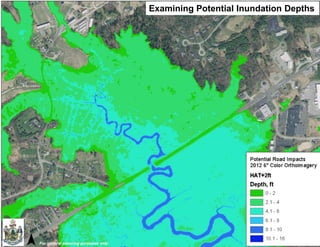
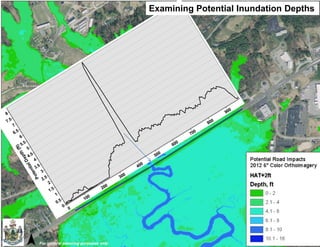
Examining Potential Inundation Depths 
For general planning purposes only.
Distance along Transect (m) 
900 800 700 600 500 400 300 200 100 0 
Potential Depth (ft) 
8 
7.5 
7 
6.5 
6 
5.5 
5 
4.5 
4 
3.5 
3 
2.5 
2 
1.5 
1 
0.5 
0 
Examining Potential Inundation Depths 
For general planning purposes only.
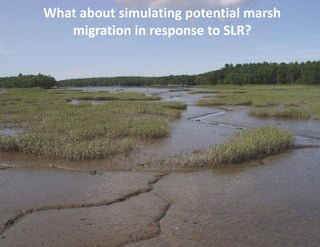
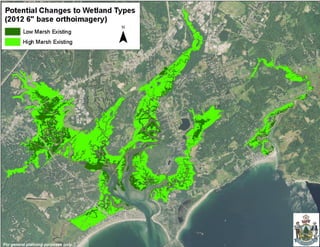
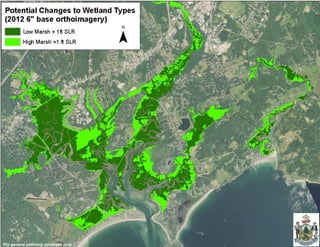
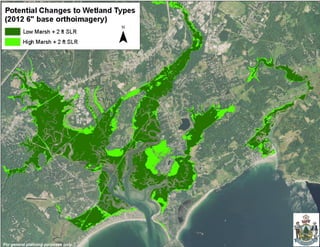
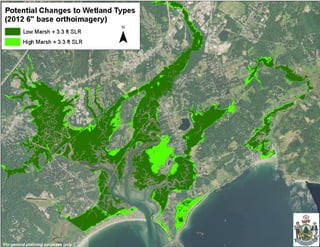
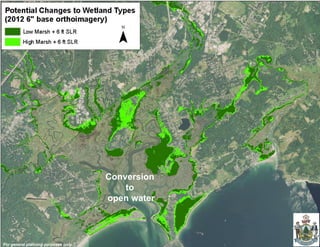
What about simulating potential marsh migration in response to SLR?
For general planning purposes only.
Conversion 
to 
open water 
For general planning purposes only.
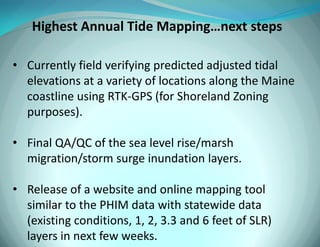
Highest Annual Tide Mapping…next steps 
•Currently field verifying predicted adjusted tidal elevations at a variety of locations along the Maine coastline using RTK-GPS (for Shoreland Zoning purposes). 
•Final QA/QC of the sea level rise/marsh migration/storm surge inundation layers. 
•Release of a website and online mapping tool similar to the PHIM data with statewide data (existing conditions, 1, 2, 3.3 and 6 feet of SLR) layers in next few weeks.
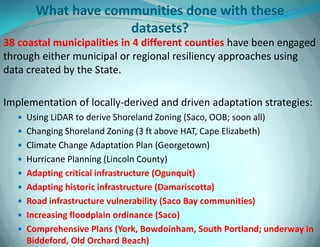
What have communities done with these datasets? 
38 coastal municipalities in 4 different counties have been engaged through either municipal or regional resiliency approaches using data created by the State. 
Implementation of locally-derived and driven adaptation strategies: 
Using LiDAR to derive Shoreland Zoning (Saco, OOB; soon all) 
Changing Shoreland Zoning (3 ft above HAT, Cape Elizabeth) 
Climate Change Adaptation Plan (Georgetown) 
Hurricane Planning (Lincoln County) 
Adapting critical infrastructure (Ogunquit) 
Adapting historic infrastructure (Damariscotta) 
Road infrastructure vulnerability (Saco Bay communities) 
Increasing floodplain ordinance (Saco) 
Comprehensive Plans (York, Bowdoinham, South Portland; underway in Biddeford, Old Orchard Beach)
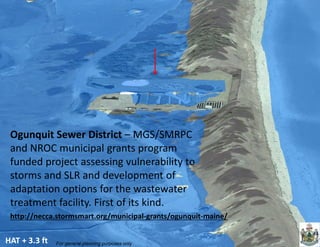
Ogunquit Sewer District – MGS/SMRPC and NROC municipal grants program funded project assessing vulnerability to storms and SLR and development of adaptation options for the wastewater treatment facility. First of its kind. 
http://necca.stormsmart.org/municipal-grants/ogunquit-maine/ 
HAT + 3.3 ft 
For general planning purposes only
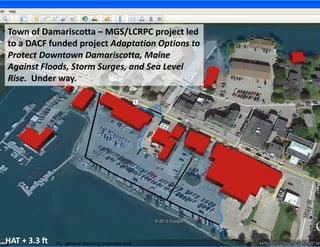
Town of Damariscotta – MGS/LCRPC project led to a DACF funded project Adaptation Options to Protect Downtown Damariscotta, Maine Against Floods, Storm Surges, and Sea Level Rise. Under way. 
For general planning purposes only 
HAT + 3.3 ft
For general planning purposes only 
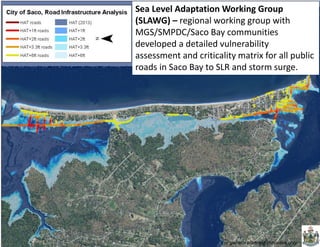
Sea Level Adaptation Working Group (SLAWG) – regional working group with MGS/SMPDC/Saco Bay communities developed a detailed vulnerability assessment and criticality matrix for all public roads in Saco Bay to SLR and storm surge.
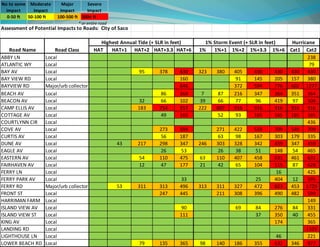
Assessment of Potential Impacts to Roads: City of Saco 
HAT HAT+1 HAT+2 HAT+3.3 HAT+6 1% 1%+1 1%+2 1%+3.3 1%+6 Cat1 Cat2 
ABBY LN Local 238 
ATLANTIC WY Local 79 
BAY AV Local 95 378 430 323 380 405 430 430 430 430 
BAY VIEW RD Local 160 91 145 205 157 380 
BAYVIEW RD Major/urb collector 646 372 594 776 602 1277 
BEACH AV Local 86 364 7 87 216 347 364 351 364 
BEACON AV Local 32 66 102 39 66 77 96 419 97 504 
CAMP ELLIS AV Local 183 754 917 222 807 916 916 916 916 916 
COTTAGE AV Local 49 165 52 93 165 165 165 165 
COURTLYNN CIR Local 436 
COVE AV Local 273 594 271 422 559 709 549 709 
CURTIS AV Local 56 187 63 98 167 303 179 335 
DUNE AV Local 43 217 298 347 246 303 328 342 459 347 459 
EAGLE AV Local 26 53 26 38 51 148 54 465 
EASTERN AV Local 54 110 475 63 110 407 458 631 461 631 
FAIRHAVEN AV Local 12 47 177 21 42 65 104 515 87 628 
FERRY LN Local 16 425 
FERRY PARK AV Local 33 25 404 12 595 
FERRY RD Major/urb collector 53 311 313 496 313 311 327 472 823 453 1729 
FRONT ST Local 247 445 211 308 396 490 482 599 
HARRIMAN FARM Local 149 
ISLAND VIEW AV Local 90 69 84 276 84 331 
ISLAND VIEW ST Local 111 37 350 40 455 
KING AV Local 174 365 
LANDING RD Local 1103 
LIGHTHOUSE LN Local 46 221 
LOWER BEACH RD Local 79 135 365 98 140 186 355 632 346 877 
Road Name Road Class 
Highest Annual Tide (+ SLR in feet) 1% Storm Event (+ SLR in feet) Hurricane 
0-50 ft 50-100 ft 100-500 ft 500+ ft 
* or entire road 
No to some 
impact 
Major 
Impact 
Moderate 
Impact 
Severe 
Impact
P.A. Slovinsky, MGS 
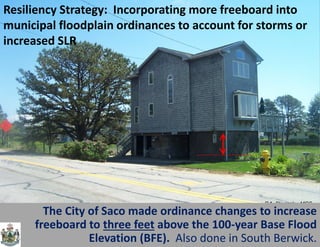
The City of Saco made ordinance changes to increase freeboard to three feet above the 100-year Base Flood Elevation (BFE). Also done in South Berwick. 
Resiliency Strategy: Incorporating more freeboard into municipal floodplain ordinances to account for storms or increased SLR
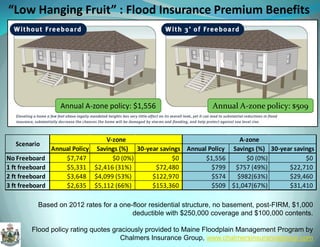
“Low Hanging Fruit” : Flood Insurance Premium Benefits 
Based on 2012 rates for a one-floor residential structure, no basement, post-FIRM, $1,000 
deductible with $250,000 coverage and $100,000 contents. 
Flood policy rating quotes graciously provided to Maine Floodplain Management Program by 
Chalmers Insurance Group, www.chalmersinsurancegroup.com 
Annual Policy Savings (%) 30-year savings Annual Policy Savings (%) 30-year savings 
No Freeboard $7,747 $0 (0%) $0 $1,556 $0 (0%) $0 
1 ft freeboard $5,331 $2,416 (31%) $72,480 $799 $757 (49%) $22,710 
2 ft freeboard $3,648 $4,099 (53%) $122,970 $574 $982(63%) $29,460 
3 ft freeboard $2,635 $5,112 (66%) $153,360 $509 $1,047(67%) $31,410 
Scenario 
V-zone A-zone 
Annual A-zone policy: $1,556 Annual A-zone policy: $509
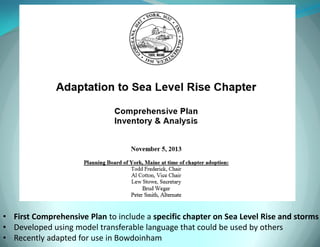
•First Comprehensive Plan to include a specific chapter on Sea Level Rise and storms 
•Developed using model transferable language that could be used by others 
•Recently adapted for use in Bowdoinham
Final thoughts on using this data for Municipal Adaptation 
Impacts from existing storms and SLR will be felt most at the local level, regardless of what happens at the State or Federal government levels. Preparation needs to start with the “ground zero” of potential impacts, the municipalities. 
Consider using a “Scenario Based Approach” to build on the concept of “no regrets actions” and cover a range of scientific predictions and manageable planning horizons 
Consider using existing regulatory mechanisms for incorporating sea level rise and storm surge planning . You don’t have to recreate the wheel.
Expect unforeseen delays and to work on your own municipal time frames - expect to take your time! 
Bring planning time horizons and goals down to realistic levels…you don’t have to tackle it all at once! 
Shoot for the “low hanging fruit” in terms of planning or ordinance changes – something that has a definitive benefit in terms of creating resiliency for the “storms of today and potential tides of tomorrow” 
Resiliency efforts have been mainly focused on the coast and potential impacts from sea level rise. The gaping hole is inland communities and potential changes in precipitation and resulting impacts on engineering infrastructure. 
Final thoughts on Municipal Adaptation
Sea level rise and storm surge tools and datasets supporting Municipal Resiliency Peter Slovinsky, Marine Geologist Maine Geological Survey Department of Agriculture, Conservation and Forestry Peter.a.slovinsky@maine.gov (207) 287-7173

Sea level rise and storm surge tools and datasets supporting Municipal Resiliency - GSMSummit 2014,Peter Slovinsky

  • 1.
    Peter A. Slovinsky,Marine Geologist Maine Geological Survey Bureau of Resource Information and Land Use Planning Department of Agriculture, Conservation and Forestry Sea level rise and storm surge tools and datasets supporting Municipal Resiliency GrowSmart Maine Summit October 21, 2014
  • 2.
    I’ll cover…. Settingthe stage: very quickly summarize the latest sea level rise predictions and historical storm surge data in Maine Federal and NGO Mapping Tools Statewide datasets supporting municipal resiliency Potential Hurricane Inundation Mapping Highest Annual Tide Mapping A few transferable local efforts on municipal resiliency
  • 3.
    Highest (2.0 m,6.6 ft) *Combines maximum warming, thermal expansion, and possible ice sheet loss from semi-empirical models. Intermediate-High (1.2 m, 3.9 ft) *Average of high end global predictions, combines recent ice sheet loss and thermal expansion Intermediate-Low (0.5 m, 1.6 ft) *Includes only thermal expansion from warming from IPCC AR4. Lowest (0.2 m, 0.7 ft) * Historical trend continued; no additional thermal expansion from warming “We have a very high confidence (>9 in 10 chance) that global mean sea level will rise at least 0.2 meters (8 inches) and no more than 2.0 meters (6.6 feet) by 2100.” – Global Sea Level Rise Scenarios for the United States National Climate Assessment (12/6/2012) GSLRRS UeSNcCA,o 12/m6/201m2 end using a “Scenario” Based Approach
  • 4.
    So what isstorm surge? Storm surge is an abnormal rise of water generated by a storm, over and above the predicted astronomical tides. Storm surge should not be confused with storm tide, which is defined as the water level rise due to the combination of storm surge and the astronomical tide (National Hurricane Center)
  • 5.
    Portland Storm Surges,any tide (1912-2012) Time Interval (years) Surge Height (feet) 1 1.8 2 2.4 5 3.3 10 4.0 20 4.7 25 4.9 50 5.6 75 6.0 100 6.3 P.A. Slovinsky, MGS (1%) (10 %) (100 %) (2 %) (4 %) (50%) (5%) (20%) (1.3 %) These numbers correlate well with overall longer term sea level rise planning!
  • 6.
    Sea Level andStorm Surge Summaries •Latest scientific predictions for SLR: •Short Term: approximately 1 ft by 2050 •Long Term: 2-4 ft but potentially more by 2100; •the State of Maine has adopted 2 feet by the year 2100 for areas with regulated Coastal Sand Dunes. •Sea level rise increases both the frequency and duration of annual tidal and storm-driven flood events. •We suggest using a Scenario Based Approach to inspect 1 foot, 2 feet, 3.3 feet, and 6 feet of SLR. These scenarios relate to the National Climate Assessment, and also correspond well with evaluating potential impacts from storm surges that may coincide with higher tides today.
  • 7.
    Sea Level Riseand Storm Surge Mapping Tools Federal and NGO Tools: NOAA’s Sea Level Rise and Coastal Flooding Impacts Viewer http://coast.noaa.gov/slr/ Climate Central’s Surging Seas Sea Level Rise Viewer and Tool http://sealevel.climatecentral.org/ssrf/maine
  • 8.
    Datasets created bythe State to support Municipal Resiliency Maine’s Potential Hurricane Inundation Mapping Maine’s Highest Annual Tide Mapping
  • 9.
    Potential uses ofthe dataset Potential Hurricane Inundation Mapping •emergency preparedness, management, and evacuation planning purposes only.
  • 10.
    Sea, Lake, andOverland Surges from hurricanes (SLOSH)
  • 11.
    Hurricane Sandy asit approaches the New Jersey and New York shorelines (October 2012)
  • 12.
    “Predicted” Hurricane FloodZones http://project.wnyc.org/flooding-sandy-new/index.html# Sandy Hook, NJ The Battery, NY
  • 13.
  • 14.
  • 15.
  • 16.
  • 17.
    Hurricane surge mappinghas shown to be an effective for estimating potential flooding associated with landfalling events….so what have we done in Maine? Kennebunk, ME
  • 18.
    Potential Hurricane InundationMapping In Maine, previous (2005) Sea, Lake, and Overland Surges from Hurricanes (SLOSH) mapping was completed by US Army Corps as part of the National Hurricane Partnership. This dataset used an older version of the SLOSH Model, and National Elevation (NED) topographic data.
  • 19.
    Since then, theNHC SLOSH Model has also been dramatically improved with a decreased grid cell size, higher resolution bathymetry, more hypothetical hurricane tracks.. Old SLOSH Model New SLOSH Model Potential Hurricane Inundation Mapping
  • 20.
    Maine has alsonow captured more recent (2010, 2011) and MUCH more accurate LiDAR topographic data along its entire coastline. NED 10 m DEM Vertical accuracy +- 2-3 m LiDAR 2 m DEM Vertical accuracy +-0.10 m Potential Hurricane Inundation Mapping
  • 21.
    Potential Hurricane InundationMapping Process •Effort funded by FEMA through a grant to Maine’s Floodplain Management Office. •Consulted with National Hurricane Partnership representatives on tool development, proposed process, and techniques •Developed a GIS-based tool that uses SLOSH model outputs, LiDAR data, and interpolation to inundate areas •“Ground-truthed” the tool by using NED topographic data to re-create the older (2005) SLOSH inundation layers. •Ran the tool for the Maine coastline using worst-case scenarios (Maximum of Maximum Envelopes of Water, or MOMs) •Created a state-wide SLOSH dataset for Category 1 and 2 events, with a +20% model uncertainty**
  • 22.
    Waterfronts Portland andSouth Portland A quick trip to Portland to compare old and new mapping results
  • 23.
  • 24.
    Old SLOSH Forplanning purposes only Commercial St Front St HighSt
  • 25.
    New PHIM Forplanning purposes only Commercial St Front St HighSt
  • 26.
    Developed a PotentialHurricane Inundation Mapping Website http://www.maine.gov/dacf/mgs/hazards/phim/ Includes ArcGIS online data viewer, FAQs, assumptions and limitations, etc. Postcard mailings to local and county EMAs, planners, etc. announcing site
  • 27.
    Potential uses ofthe dataset Highest Annual Tide Mapping •sea level rise and storm surge inundation mapping •coastal infrastructure vulnerability (roads and buildings) and natural resource planning and resiliency •land conservation (marsh migration) planning •regulatory purposes (Shoreland Zoning).
  • 28.
    Maine’s Highest AnnualTide Mapping Tool •Unlike other SLR viewers (NOAA’s Sea Level Rise and Coastal Flooding Impacts Viewer, or Climate Central’s Surging Seas), we used the Highest Annual Tide (HAT) as the starting point instead of Mean Higher High Water (MHHW). In Maine, these two numbers can vary by 2-3 feet. The Highest Annual Tide is a regulatory (Shoreland Zoning) boundary in Maine and also represents the upper bounds of the coastal wetland. •GIS based tool uses Highest Annual Tide predictions, LiDAR data , 113 different NOAA CO-OPs tidal prediction stations, Hydrologic Unit Code (HUC) 10 digit boundaries, and NOAA’s VDATUM to account for variation of water surfaces. •Used scenarios of 1, 2, 3.3, and 6 feet of sea level rise or storm surge on top of the HAT. •Supports Marsh Migration Mapping and Inundation Analysis.
  • 29.
    There are 113tidal prediction stations in Maine and New Hampshire that give HAT values for each year.
  • 30.
    •113 NOAA CO-OPsTidal prediction stations along the Maine and New Hampshire coastlines. •GIS used to create a grid of 200-m spaced points. •NOAA VDATUM tool used to calculate (at each point) the separation between MLLW and NAVD88, translating “variability” in the water surface based on variability in the datums. •Data from each tidal station then interpolated along the coastline using VDATUM separations and HUC-10 watershed boundaries.
  • 32.
    Example of VDATUMpoints on the water surfaces that were used to translate values from known tidal stations. HUC-10 boundary Portland Tidal Station
  • 34.
    Similar analyses werecompleted for scenarios of 1, 2, 3.3, and 6 feet of sea level rise on top of the HAT. Each layer was used to “clip” the subsequent one to create distinct “bands”.
  • 35.
    Scarborough, ME Aquick trip to Scarborough to inspect using the HAT data for transportation and marsh migration analyses…
  • 36.
    Assumption: “impacted” =flooded P.A. Slovinsky
  • 37.
    Black Point Road Pine Point Road Winnocks Neck Road For general planning purposes only. Examining Potential Inundation
  • 38.
    Examining Potential Inundation For general planning purposes only.
  • 39.
    Examining Potential Inundation For general planning purposes only.
  • 40.
    Examining Potential Inundation For general planning purposes only.
  • 41.
    Examining Potential Inundation For general planning purposes only.
  • 42.
    Examining Potential Inundation For general planning purposes only.
  • 43.
    Examining Potential InundationDepths For general planning purposes only.
  • 44.
    Distance along Transect(m) 900 800 700 600 500 400 300 200 100 0 Potential Depth (ft) 8 7.5 7 6.5 6 5.5 5 4.5 4 3.5 3 2.5 2 1.5 1 0.5 0 Examining Potential Inundation Depths For general planning purposes only.
  • 45.
    What about simulatingpotential marsh migration in response to SLR?
  • 46.
    For general planningpurposes only.
  • 47.
    For general planningpurposes only.
  • 48.
    For general planningpurposes only.
  • 49.
    For general planningpurposes only.
  • 50.
    Conversion to openwater For general planning purposes only.
  • 51.
    Highest Annual TideMapping…next steps •Currently field verifying predicted adjusted tidal elevations at a variety of locations along the Maine coastline using RTK-GPS (for Shoreland Zoning purposes). •Final QA/QC of the sea level rise/marsh migration/storm surge inundation layers. •Release of a website and online mapping tool similar to the PHIM data with statewide data (existing conditions, 1, 2, 3.3 and 6 feet of SLR) layers in next few weeks.
  • 52.
    What have communitiesdone with these datasets? 38 coastal municipalities in 4 different counties have been engaged through either municipal or regional resiliency approaches using data created by the State. Implementation of locally-derived and driven adaptation strategies: Using LiDAR to derive Shoreland Zoning (Saco, OOB; soon all) Changing Shoreland Zoning (3 ft above HAT, Cape Elizabeth) Climate Change Adaptation Plan (Georgetown) Hurricane Planning (Lincoln County) Adapting critical infrastructure (Ogunquit) Adapting historic infrastructure (Damariscotta) Road infrastructure vulnerability (Saco Bay communities) Increasing floodplain ordinance (Saco) Comprehensive Plans (York, Bowdoinham, South Portland; underway in Biddeford, Old Orchard Beach)
  • 53.
    Ogunquit Sewer District– MGS/SMRPC and NROC municipal grants program funded project assessing vulnerability to storms and SLR and development of adaptation options for the wastewater treatment facility. First of its kind. http://necca.stormsmart.org/municipal-grants/ogunquit-maine/ HAT + 3.3 ft For general planning purposes only
  • 54.
    Town of Damariscotta– MGS/LCRPC project led to a DACF funded project Adaptation Options to Protect Downtown Damariscotta, Maine Against Floods, Storm Surges, and Sea Level Rise. Under way. For general planning purposes only HAT + 3.3 ft
  • 55.
    For general planningpurposes only Sea Level Adaptation Working Group (SLAWG) – regional working group with MGS/SMPDC/Saco Bay communities developed a detailed vulnerability assessment and criticality matrix for all public roads in Saco Bay to SLR and storm surge.
  • 56.
    Assessment of PotentialImpacts to Roads: City of Saco HAT HAT+1 HAT+2 HAT+3.3 HAT+6 1% 1%+1 1%+2 1%+3.3 1%+6 Cat1 Cat2 ABBY LN Local 238 ATLANTIC WY Local 79 BAY AV Local 95 378 430 323 380 405 430 430 430 430 BAY VIEW RD Local 160 91 145 205 157 380 BAYVIEW RD Major/urb collector 646 372 594 776 602 1277 BEACH AV Local 86 364 7 87 216 347 364 351 364 BEACON AV Local 32 66 102 39 66 77 96 419 97 504 CAMP ELLIS AV Local 183 754 917 222 807 916 916 916 916 916 COTTAGE AV Local 49 165 52 93 165 165 165 165 COURTLYNN CIR Local 436 COVE AV Local 273 594 271 422 559 709 549 709 CURTIS AV Local 56 187 63 98 167 303 179 335 DUNE AV Local 43 217 298 347 246 303 328 342 459 347 459 EAGLE AV Local 26 53 26 38 51 148 54 465 EASTERN AV Local 54 110 475 63 110 407 458 631 461 631 FAIRHAVEN AV Local 12 47 177 21 42 65 104 515 87 628 FERRY LN Local 16 425 FERRY PARK AV Local 33 25 404 12 595 FERRY RD Major/urb collector 53 311 313 496 313 311 327 472 823 453 1729 FRONT ST Local 247 445 211 308 396 490 482 599 HARRIMAN FARM Local 149 ISLAND VIEW AV Local 90 69 84 276 84 331 ISLAND VIEW ST Local 111 37 350 40 455 KING AV Local 174 365 LANDING RD Local 1103 LIGHTHOUSE LN Local 46 221 LOWER BEACH RD Local 79 135 365 98 140 186 355 632 346 877 Road Name Road Class Highest Annual Tide (+ SLR in feet) 1% Storm Event (+ SLR in feet) Hurricane 0-50 ft 50-100 ft 100-500 ft 500+ ft * or entire road No to some impact Major Impact Moderate Impact Severe Impact
  • 57.
    P.A. Slovinsky, MGS The City of Saco made ordinance changes to increase freeboard to three feet above the 100-year Base Flood Elevation (BFE). Also done in South Berwick. Resiliency Strategy: Incorporating more freeboard into municipal floodplain ordinances to account for storms or increased SLR
  • 58.
    “Low Hanging Fruit”: Flood Insurance Premium Benefits Based on 2012 rates for a one-floor residential structure, no basement, post-FIRM, $1,000 deductible with $250,000 coverage and $100,000 contents. Flood policy rating quotes graciously provided to Maine Floodplain Management Program by Chalmers Insurance Group, www.chalmersinsurancegroup.com Annual Policy Savings (%) 30-year savings Annual Policy Savings (%) 30-year savings No Freeboard $7,747 $0 (0%) $0 $1,556 $0 (0%) $0 1 ft freeboard $5,331 $2,416 (31%) $72,480 $799 $757 (49%) $22,710 2 ft freeboard $3,648 $4,099 (53%) $122,970 $574 $982(63%) $29,460 3 ft freeboard $2,635 $5,112 (66%) $153,360 $509 $1,047(67%) $31,410 Scenario V-zone A-zone Annual A-zone policy: $1,556 Annual A-zone policy: $509
  • 59.
    •First Comprehensive Planto include a specific chapter on Sea Level Rise and storms •Developed using model transferable language that could be used by others •Recently adapted for use in Bowdoinham
  • 60.
    Final thoughts onusing this data for Municipal Adaptation Impacts from existing storms and SLR will be felt most at the local level, regardless of what happens at the State or Federal government levels. Preparation needs to start with the “ground zero” of potential impacts, the municipalities. Consider using a “Scenario Based Approach” to build on the concept of “no regrets actions” and cover a range of scientific predictions and manageable planning horizons Consider using existing regulatory mechanisms for incorporating sea level rise and storm surge planning . You don’t have to recreate the wheel.
  • 61.
    Expect unforeseen delaysand to work on your own municipal time frames - expect to take your time! Bring planning time horizons and goals down to realistic levels…you don’t have to tackle it all at once! Shoot for the “low hanging fruit” in terms of planning or ordinance changes – something that has a definitive benefit in terms of creating resiliency for the “storms of today and potential tides of tomorrow” Resiliency efforts have been mainly focused on the coast and potential impacts from sea level rise. The gaping hole is inland communities and potential changes in precipitation and resulting impacts on engineering infrastructure. Final thoughts on Municipal Adaptation
  • 62.
    Sea level riseand storm surge tools and datasets supporting Municipal Resiliency Peter Slovinsky, Marine Geologist Maine Geological Survey Department of Agriculture, Conservation and Forestry Peter.a.slovinsky@maine.gov (207) 287-7173