Dr. Rajendra Prasad Central Agricultural University, Pusa,
Samastipur, 848 125, Bihar, India
Presentation
On
Pest risk analysis
Mr. Rabiranjan Sethi
Course Name: Concepts of Integrated Pest Management
Course Name: ENT-508
PEST RISK ANALYSIS
o Pest Risk Analysis (PRA) is a systematic process to assess the risk of pest entry, establishment, and spread.
o It helps in identifying and managing harmful pests that may affect plants, agriculture, and biodiversity.
o PRA is essential for making informed decisions on quarantine, trade regulations, and pest control measures.
o It is guided by international standards, especially those of the International Plant Protection Convention
(IPPC) under FAO.
Introduction:
Historical Background:
o The concept of pest regulation emerged in the early 20th century with growing international trade and pest
movement.
o In 1951, the IPPC was adopted, providing a global framework for plant protection and PRA.
o PRA became more structured in the 1990s, especially after the WTO’s SPS Agreement (1995), which
emphasized science-based risk assessments in trade.
o Since then, PRA has become a key tool for biosecurity and international cooperation in pest management.
Why is PRA Important?
o To protect the country's agriculture from damage that can be caused by harmful (quarantine) pests which can be
brought in along with imported commodities.
o To evaluate and manage risk from specific pests and internationally traded commodities.
o Identify and assess risks to agricultural and horticultural crops forestry and the environment from plant pests.
o To create lists of regulated pests.
o To produce lists of prohibited plants and plant products, which assist in identifying appropriate management
options.
o Pest: Any species, strain, or biotype of plant, animal, or pathogenic agent injurious to plants or products.
o Quarantine Pest: Pest of economic importance not present or under control in an area.
o Regulated Non-Quarantine Pest: Pest present but managed to reduce its spread.
Key Terms in PRA:
Stages of Pest Risk Analysis (PRA)
1. Initiation:
o The process begins when a new pest is detected, a new trade route opens, or when
reviewing an existing policy.
o Identifies the specific pest or pathway (such as a commodity or import) of concern.
o The target area at risk is clearly defined at this stage.
Initiation Points
Not a Pest
Pest or Pathway
for a Pest
Identification of
PRAArea
End
o At the end of Stage 1, the pests and pathways of concern and the PRA area would have been
identified.
o Relevant information has been collected and pests have been identified as possible targets for
phytosanitary measures, either individually or in association with a pathway.
2. Pest Risk Assessment:
It could be divided into three steps:
A. Pest Categorization
B. Assessment of the probability of introduction and spread.
C. Assessment of potential economic consequences (including environmental impacts).
A. Pest Categorisation:
• Identify quarantine pests.
• Categorise pests (do they occur on the pathway?)
• Prepare data sheets
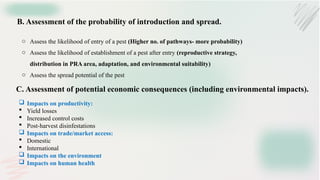
B. Assessment of the probability of introduction and spread.
o Assess the likelihood of entry of a pest (Higher no. of pathways- more probability)
o Assess the likelihood of establishment of a pest after entry (reproductive strategy,
distribution in PRA area, adaptation, and environmental suitability)
o Assess the spread potential of the pest
C. Assessment of potential economic consequences (including environmental impacts).
 Impacts on productivity:
 Yield losses
 Increased control costs
 Post-harvest disinfestations
 Impacts on trade/market access:
 Domestic
 International
 Impacts on the environment
 Impacts on human health
3. Pest Risk Management:
Generate, evaluate, and
compare management
option
Select option
Monitor, evaluate after
implementation
Conclusion of Pest Risk
Assessment
PRA status
Risk acceptable PRA ends
Risk unacceptable PRA Continues
 Consider all pathways
• Traded plants or plant products
• Natural spread of the pest
• Entry with human travellers.
• Vehicular transport
• Associate Materials
 Identify points at which mitigation measures might be applied.
 Identify possible mitigation measures at each point.
 Assess each for effectiveness, efficiency, and feasibility.
 Select appropriate measure(s)
 Evaluation
• Effectiveness
• Efficiency
• Cost effectiveness
• Feasibility
• Reproducibility
• Potential negative social, economic or environmental consequences
 Documentation
• Phytosanitary Certificates
• Import permits
 Phytosanitary Certificates
• Official assurance that specified import requirements are met
• Confirms that risk management measures have been taken
• Only for regulated articles
 Educate
• Educate & inform travellers, importers, industry, government or public
How PRA operated in India
 Pest Risk Analysis is mandatory for importing any plant or plant materials.
 The Import Permit issuing authorities shall issue permits for commodities specified in
 Schedule-V
 Schedule-VI
 Schedule VII of the PQ Order, 2003, for which PRA has already been done.
References..
ISPM 11 Pest risk analysis for quarantine pests, including analysis of environmental risks and living
modified organisms http://www.ippc.int/IPP/En/ispm.htm
ISPM 8 Determination of pest status in an area http://www.ippc.int/IPP/En/ispm.htm
WTO 1995, Agreement on the Application of Sanitary and Phytosanitary Measures
Biosecurity Australia, September 2001. Draft guidelines for Import Risk Analysis (Draft)
Devorshak, C. and Griffin, R. (2002). Role and relationship of official and scientific information concerning
pest status.
In G.J. Hallman and C.P. Scwalbe (eds.) Invasive arthropods in agriculture: problems and solutions.
Scientific Publishers, Enfield, NH.
THANK YOU

Pest Risk Analysis (IPM presentation).pptx

  • 1.
    Dr. Rajendra PrasadCentral Agricultural University, Pusa, Samastipur, 848 125, Bihar, India Presentation On Pest risk analysis Mr. Rabiranjan Sethi Course Name: Concepts of Integrated Pest Management Course Name: ENT-508
  • 2.
    PEST RISK ANALYSIS oPest Risk Analysis (PRA) is a systematic process to assess the risk of pest entry, establishment, and spread. o It helps in identifying and managing harmful pests that may affect plants, agriculture, and biodiversity. o PRA is essential for making informed decisions on quarantine, trade regulations, and pest control measures. o It is guided by international standards, especially those of the International Plant Protection Convention (IPPC) under FAO. Introduction: Historical Background: o The concept of pest regulation emerged in the early 20th century with growing international trade and pest movement. o In 1951, the IPPC was adopted, providing a global framework for plant protection and PRA. o PRA became more structured in the 1990s, especially after the WTO’s SPS Agreement (1995), which emphasized science-based risk assessments in trade. o Since then, PRA has become a key tool for biosecurity and international cooperation in pest management.
  • 3.
    Why is PRAImportant? o To protect the country's agriculture from damage that can be caused by harmful (quarantine) pests which can be brought in along with imported commodities. o To evaluate and manage risk from specific pests and internationally traded commodities. o Identify and assess risks to agricultural and horticultural crops forestry and the environment from plant pests. o To create lists of regulated pests. o To produce lists of prohibited plants and plant products, which assist in identifying appropriate management options. o Pest: Any species, strain, or biotype of plant, animal, or pathogenic agent injurious to plants or products. o Quarantine Pest: Pest of economic importance not present or under control in an area. o Regulated Non-Quarantine Pest: Pest present but managed to reduce its spread. Key Terms in PRA:
  • 4.
    Stages of PestRisk Analysis (PRA)
  • 5.
    1. Initiation: o Theprocess begins when a new pest is detected, a new trade route opens, or when reviewing an existing policy. o Identifies the specific pest or pathway (such as a commodity or import) of concern. o The target area at risk is clearly defined at this stage. Initiation Points Not a Pest Pest or Pathway for a Pest Identification of PRAArea End
  • 6.
    o At theend of Stage 1, the pests and pathways of concern and the PRA area would have been identified. o Relevant information has been collected and pests have been identified as possible targets for phytosanitary measures, either individually or in association with a pathway. 2. Pest Risk Assessment: It could be divided into three steps: A. Pest Categorization B. Assessment of the probability of introduction and spread. C. Assessment of potential economic consequences (including environmental impacts).
  • 7.
    A. Pest Categorisation: •Identify quarantine pests. • Categorise pests (do they occur on the pathway?) • Prepare data sheets
  • 8.
    B. Assessment ofthe probability of introduction and spread. o Assess the likelihood of entry of a pest (Higher no. of pathways- more probability) o Assess the likelihood of establishment of a pest after entry (reproductive strategy, distribution in PRA area, adaptation, and environmental suitability) o Assess the spread potential of the pest C. Assessment of potential economic consequences (including environmental impacts).  Impacts on productivity:  Yield losses  Increased control costs  Post-harvest disinfestations  Impacts on trade/market access:  Domestic  International  Impacts on the environment  Impacts on human health
  • 9.
    3. Pest RiskManagement: Generate, evaluate, and compare management option Select option Monitor, evaluate after implementation Conclusion of Pest Risk Assessment PRA status Risk acceptable PRA ends Risk unacceptable PRA Continues
  • 10.
     Consider allpathways • Traded plants or plant products • Natural spread of the pest • Entry with human travellers. • Vehicular transport • Associate Materials  Identify points at which mitigation measures might be applied.  Identify possible mitigation measures at each point.  Assess each for effectiveness, efficiency, and feasibility.  Select appropriate measure(s)  Evaluation • Effectiveness • Efficiency • Cost effectiveness • Feasibility • Reproducibility • Potential negative social, economic or environmental consequences
  • 11.
     Documentation • PhytosanitaryCertificates • Import permits  Phytosanitary Certificates • Official assurance that specified import requirements are met • Confirms that risk management measures have been taken • Only for regulated articles  Educate • Educate & inform travellers, importers, industry, government or public
  • 12.
    How PRA operatedin India  Pest Risk Analysis is mandatory for importing any plant or plant materials.  The Import Permit issuing authorities shall issue permits for commodities specified in  Schedule-V  Schedule-VI  Schedule VII of the PQ Order, 2003, for which PRA has already been done.
  • 13.
    References.. ISPM 11 Pestrisk analysis for quarantine pests, including analysis of environmental risks and living modified organisms http://www.ippc.int/IPP/En/ispm.htm ISPM 8 Determination of pest status in an area http://www.ippc.int/IPP/En/ispm.htm WTO 1995, Agreement on the Application of Sanitary and Phytosanitary Measures Biosecurity Australia, September 2001. Draft guidelines for Import Risk Analysis (Draft) Devorshak, C. and Griffin, R. (2002). Role and relationship of official and scientific information concerning pest status. In G.J. Hallman and C.P. Scwalbe (eds.) Invasive arthropods in agriculture: problems and solutions. Scientific Publishers, Enfield, NH.
  • 14.