COLLEGE OF AGRICULTURAL TECHNOLOGY
Affiliated to Tamil Nadu Agricultural University, Coimbatore
Kullapuram, Via Vaigai dam, Theni-625 562
PIGEON PEA STERILITY MOSAIC VIRUS
SUBMITTED BY COURSE TEACHER
PATHMAPRIYA. B Dr. S. PARTHASARATHY
ID. No. 2016021028 Asst. Prof., (Plant Pathology)
Significance of SMD
• Sterility mosaic is an important disease of pigeon pea.
• Sterility mosaic disease (SMD), first described in
1931 from Pusa (Bihar, India).
• The sterility of plant results in yield losses of up to
100 %.
• Annual loss is about 2 million tons of grain in India
in 1984.
• Plants infected when less than 45 days old shows 96-
100% loss in grain yield.
• Infection older plants results in losses varying from
27-97% loss depending on the number of branches
infected per plants and show partial sterility.
Distribution of SMD
World:
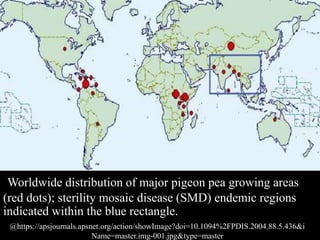
• Sterility mosaic is a major problem in India,
Bangladesh, Myanmar, Nepal and Sri Lanka.
India:
• The disease is present in all pigeon pea growing
places of India but it is more serious in some states
like Gujarat, Karnataka, Eastern Uttar Pradesh, Bihar
and Tamil Nadu.
Worldwide distribution of major pigeon pea growing areas
(red dots); sterility mosaic disease (SMD) endemic regions
indicated within the blue rectangle.
@https://apsjournals.apsnet.org/action/showImage?doi=10.1094%2FPDIS.2004.88.5.436&i
Name=master.img-001.jpg&type=master
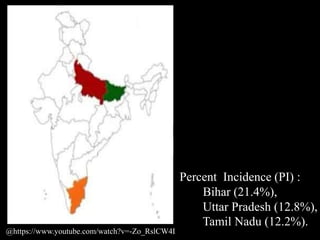
Percent Incidence (PI) :
Bihar (21.4%),
Uttar Pradesh (12.8%),
Tamil Nadu (12.2%).
@https://www.youtube.com/watch?v=-Zo_RslCW4I
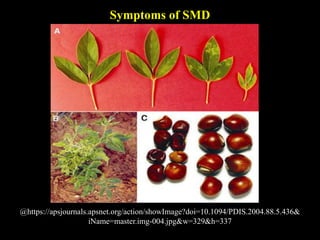
Symptoms of SMD
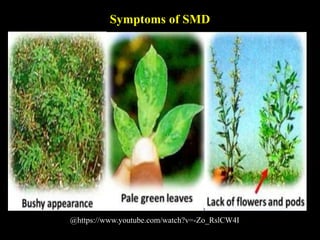
• The disease symptoms appear in the field as pale
green, stunted or bushy appearance of infected plants.
• Some plants exhibit clear mosaic and ring spot
symptoms.
• The leaf size, flowers and pods are reduced.
• The severely infected plants do not produced flowers
and pods, if formed they are sterile.
Symptoms of SMD
@https://www.youtube.com/watch?v=-Zo_RslCW4I
@https://apsjournals.apsnet.org/action/showImage?doi=10.1094/PDIS.2004.88.5.436&
iName=master.img-004.jpg&w=329&h=337
Symptoms of SMD
Four type of symptoms appears in infected plants
which are varies in the different genotypes,
1. Severe mosaic in leaflets with complete sterility.
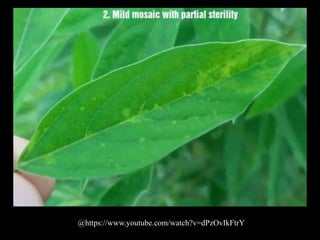
2. Mild mosaic with partial sterility.
3. Ring spot symptoms are characterized by green
island surrounding by a chlorotic halo on leaflets
and this symptoms disappear as the plants mature
(no sterility).
4. Masked infection without any visual symptoms.
@https://www.youtube.com/watch?v=dPzOvIkFtrY
Pathogen
• The disease is caused by Pigeon Pea Sterility Mosaic
Virus (PPSMV).
Systematic position :
Group : Group V { (- ) ss RNA}
Order : Bunyavirales
Family : Fimoviridae
Genus : Emaravirus
Species : Pigeon pea sterility mosaic virus
Pathogen Characters
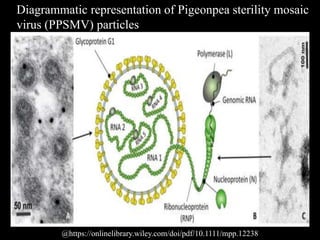
• The virions are slender highly flexuous filamentous
virus like particles (VLPS) of 3-10 nm diameter, a
major virus specific proteins of 32kDa and 5-7 major
RNA species of 0.8-6.8kb.
Diagrammatic representation of Pigeonpea sterility mosaic
virus (PPSMV) particles
@https://onlinelibrary.wiley.com/doi/pdf/10.1111/mpp.12238
Epidemiology
• PPSM virus and its vector Aceria cajani have been
survived during summer in ratoon, perennial, off
season and self sown volunteer pigeon pea plants.
• Wild pigeon pea (Cajanus scarabaeoides) plays
important role in the survival of virus and its vector in
absence of main crop in South India.
• But in North India, wild pigeon pea are not found.
Therefore it does not provide the primary inoculums
to the main pigeon pea crop.
• Therefore, ratoon perennial, off season and self sown
volunteer pigeon pea plants provide the the primary
inoculums in North Indian conditions.
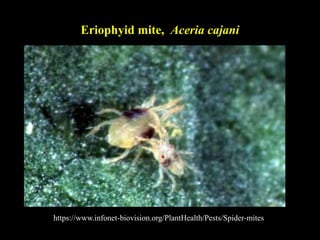
Eriophyid mite, Aceria cajani
https://www.infonet-biovision.org/PlantHealth/Pests/Spider-mites
Vector Transmission
• The mite can multiply to high densities within a few
weeks.
• These vectors are very small, measuring 200-250 μm
and have a very short life of about 2 weeks.
• They inhabit the lower surface of the leaves.
• Their feeding does not cause any direct damage to the
pigeon pea plants.
Vector Transmission
• The transmission efficiency of a single eriophyid mite
is 53% but is 100% when >5 mites per plant are used.
• The acquisition feeding period are 5-10 minutes and
inoculation test period are 20-30 minutes.
• Incubation period of virus ranges from 11-27 days.
• The vector can retain the virus for up to 13 hours.
There is no transovarial transmission.
Vector Transmission
• Pigeonpea sterility mosaic virus is transmitted by an
eriophyid mite, Aceria cajani in a semi persistent
manner.
• This virus is transmitted by both nymph and adult
mite but nymphs are more efficient vectors than
adults.
Favourable Condition
• Temperature:
Minimum temperature (10-15°C).
Maximum temperature (25-30°C).
• Relative humidity ( > 60%).
• Rainfall have been found congenial for buildup of
mite population.
• Wind direction and wind velocity plays important
role in dissemination of virus and its vector.
• The younger plants are more susceptible to the
sterility mosaic than older plants.
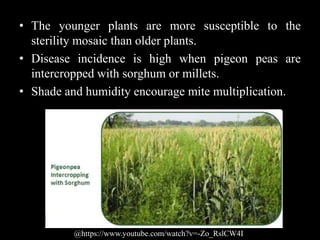
• Disease incidence is high when pigeon peas are
intercropped with sorghum or millets.
• Shade and humidity encourage mite multiplication.
@https://www.youtube.com/watch?v=-Zo_RslCW4I
Management of SMD
Cultural Management
• Rouging out infected plants up to 40 days after
sowing.
• Early sowing and early maturing varieties crosses the
most susceptible stage of the crop.
• Destroy the source of sterility mosaic inoculums.
Remove volunteer and perennial plants of pigeon pea
in the vicinity of fields.
Management of SMD
Resistant Varieties
• Grow resistant varieties like - Bahar, DA-13, Pant A-
3, Rampur Rahar, UPAS-120, DA-11, Bageshwari,
ICPL-146, ICPL-87119 (Asha), ICPL 151, MA-3,
BSMR-175, BSMR 736, Amar, Azad, Hy 3C, Pusa 9,
MA 3 and NDA-1.
• VBN 1, VBN 2 and VBN 3.
Chemical Management
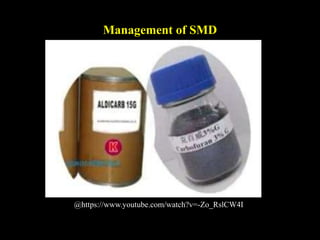
• Seed dressing with 25% Carbofuran (Furadan)3G or
10% Aldicarb (Temik) @3 g/kg seed protect the crop
upto 45 days after sowing.
• Soil application of Carbofuran (Furadan) 3G @ 1.2
kg/ha or Aldicarb (Temik) 10% @1.5 kg/ha protect
the crop upto 75 days after sowing.
Management of SMD
Management of SMD
Chemical Management
• Spraying of acaricide or insecticide like Kelthane
(Dicofol), Oxythioquinox (Morestan), Metasystox
(Oxydemeton-methyl) @ 0.1% to control the mite
vector in early stage of plant growth.
• Spraying with Fenazaquin (Trick) @ 1 ml/ litre soon
after appearance of the disease and if
necessary repeat after 15 days.
Management of SMD
@https://www.youtube.com/watch?v=-Zo_RslCW4I
References
• Sushil Kumar Singh., Dinesh Singh., and Adesh
Kumar. 2015. Plant Diseases and Their Management.
Kalyani Publishers, New Delhi.
• Singh,R.S., 2018. Plant Diseases. Vinod Kumar Jain,
Scientific International (Pvt.) Ltd, New Delhi.
• http://agropedia.iitk.ac.in/content/sterility-mosaic-
disease-pigeonpea
• http://eagri.org/eagri50/PATH272/lecture14/006.html

pigeon pea sterility mosaic virus

  • 1.
    COLLEGE OF AGRICULTURALTECHNOLOGY Affiliated to Tamil Nadu Agricultural University, Coimbatore Kullapuram, Via Vaigai dam, Theni-625 562 PIGEON PEA STERILITY MOSAIC VIRUS SUBMITTED BY COURSE TEACHER PATHMAPRIYA. B Dr. S. PARTHASARATHY ID. No. 2016021028 Asst. Prof., (Plant Pathology)
  • 2.
    Significance of SMD •Sterility mosaic is an important disease of pigeon pea. • Sterility mosaic disease (SMD), first described in 1931 from Pusa (Bihar, India). • The sterility of plant results in yield losses of up to 100 %. • Annual loss is about 2 million tons of grain in India in 1984.
  • 3.
    • Plants infectedwhen less than 45 days old shows 96- 100% loss in grain yield. • Infection older plants results in losses varying from 27-97% loss depending on the number of branches infected per plants and show partial sterility.
  • 4.
    Distribution of SMD World: •Sterility mosaic is a major problem in India, Bangladesh, Myanmar, Nepal and Sri Lanka. India: • The disease is present in all pigeon pea growing places of India but it is more serious in some states like Gujarat, Karnataka, Eastern Uttar Pradesh, Bihar and Tamil Nadu.
  • 5.
    Worldwide distribution ofmajor pigeon pea growing areas (red dots); sterility mosaic disease (SMD) endemic regions indicated within the blue rectangle. @https://apsjournals.apsnet.org/action/showImage?doi=10.1094%2FPDIS.2004.88.5.436&i Name=master.img-001.jpg&type=master
  • 6.
    Percent Incidence (PI): Bihar (21.4%), Uttar Pradesh (12.8%), Tamil Nadu (12.2%). @https://www.youtube.com/watch?v=-Zo_RslCW4I
  • 7.
    Symptoms of SMD •The disease symptoms appear in the field as pale green, stunted or bushy appearance of infected plants. • Some plants exhibit clear mosaic and ring spot symptoms. • The leaf size, flowers and pods are reduced. • The severely infected plants do not produced flowers and pods, if formed they are sterile.
  • 8.
  • 9.
  • 10.
    Four type ofsymptoms appears in infected plants which are varies in the different genotypes, 1. Severe mosaic in leaflets with complete sterility. 2. Mild mosaic with partial sterility. 3. Ring spot symptoms are characterized by green island surrounding by a chlorotic halo on leaflets and this symptoms disappear as the plants mature (no sterility). 4. Masked infection without any visual symptoms.
  • 11.
  • 12.
  • 13.
  • 14.
    Pathogen • The diseaseis caused by Pigeon Pea Sterility Mosaic Virus (PPSMV). Systematic position : Group : Group V { (- ) ss RNA} Order : Bunyavirales Family : Fimoviridae Genus : Emaravirus Species : Pigeon pea sterility mosaic virus
  • 15.
    Pathogen Characters • Thevirions are slender highly flexuous filamentous virus like particles (VLPS) of 3-10 nm diameter, a major virus specific proteins of 32kDa and 5-7 major RNA species of 0.8-6.8kb.
  • 16.
    Diagrammatic representation ofPigeonpea sterility mosaic virus (PPSMV) particles @https://onlinelibrary.wiley.com/doi/pdf/10.1111/mpp.12238
  • 17.
    Epidemiology • PPSM virusand its vector Aceria cajani have been survived during summer in ratoon, perennial, off season and self sown volunteer pigeon pea plants. • Wild pigeon pea (Cajanus scarabaeoides) plays important role in the survival of virus and its vector in absence of main crop in South India.
  • 18.
    • But inNorth India, wild pigeon pea are not found. Therefore it does not provide the primary inoculums to the main pigeon pea crop. • Therefore, ratoon perennial, off season and self sown volunteer pigeon pea plants provide the the primary inoculums in North Indian conditions.
  • 19.
    Eriophyid mite, Aceriacajani https://www.infonet-biovision.org/PlantHealth/Pests/Spider-mites
  • 20.
    Vector Transmission • Themite can multiply to high densities within a few weeks. • These vectors are very small, measuring 200-250 μm and have a very short life of about 2 weeks. • They inhabit the lower surface of the leaves. • Their feeding does not cause any direct damage to the pigeon pea plants.
  • 21.
    Vector Transmission • Thetransmission efficiency of a single eriophyid mite is 53% but is 100% when >5 mites per plant are used. • The acquisition feeding period are 5-10 minutes and inoculation test period are 20-30 minutes. • Incubation period of virus ranges from 11-27 days. • The vector can retain the virus for up to 13 hours. There is no transovarial transmission.
  • 22.
    Vector Transmission • Pigeonpeasterility mosaic virus is transmitted by an eriophyid mite, Aceria cajani in a semi persistent manner. • This virus is transmitted by both nymph and adult mite but nymphs are more efficient vectors than adults.
  • 23.
    Favourable Condition • Temperature: Minimumtemperature (10-15°C). Maximum temperature (25-30°C). • Relative humidity ( > 60%). • Rainfall have been found congenial for buildup of mite population. • Wind direction and wind velocity plays important role in dissemination of virus and its vector.
  • 24.
    • The youngerplants are more susceptible to the sterility mosaic than older plants. • Disease incidence is high when pigeon peas are intercropped with sorghum or millets. • Shade and humidity encourage mite multiplication. @https://www.youtube.com/watch?v=-Zo_RslCW4I
  • 25.
    Management of SMD CulturalManagement • Rouging out infected plants up to 40 days after sowing. • Early sowing and early maturing varieties crosses the most susceptible stage of the crop. • Destroy the source of sterility mosaic inoculums. Remove volunteer and perennial plants of pigeon pea in the vicinity of fields.
  • 26.
    Management of SMD ResistantVarieties • Grow resistant varieties like - Bahar, DA-13, Pant A- 3, Rampur Rahar, UPAS-120, DA-11, Bageshwari, ICPL-146, ICPL-87119 (Asha), ICPL 151, MA-3, BSMR-175, BSMR 736, Amar, Azad, Hy 3C, Pusa 9, MA 3 and NDA-1. • VBN 1, VBN 2 and VBN 3.
  • 27.
    Chemical Management • Seeddressing with 25% Carbofuran (Furadan)3G or 10% Aldicarb (Temik) @3 g/kg seed protect the crop upto 45 days after sowing. • Soil application of Carbofuran (Furadan) 3G @ 1.2 kg/ha or Aldicarb (Temik) 10% @1.5 kg/ha protect the crop upto 75 days after sowing. Management of SMD
  • 28.
    Management of SMD ChemicalManagement • Spraying of acaricide or insecticide like Kelthane (Dicofol), Oxythioquinox (Morestan), Metasystox (Oxydemeton-methyl) @ 0.1% to control the mite vector in early stage of plant growth. • Spraying with Fenazaquin (Trick) @ 1 ml/ litre soon after appearance of the disease and if necessary repeat after 15 days.
  • 29.
  • 30.
    References • Sushil KumarSingh., Dinesh Singh., and Adesh Kumar. 2015. Plant Diseases and Their Management. Kalyani Publishers, New Delhi. • Singh,R.S., 2018. Plant Diseases. Vinod Kumar Jain, Scientific International (Pvt.) Ltd, New Delhi. • http://agropedia.iitk.ac.in/content/sterility-mosaic- disease-pigeonpea • http://eagri.org/eagri50/PATH272/lecture14/006.html