CFIA-ACIA
Lecture 5
Pest Risk Analysis (PRA)
R K Panse
Subject: Principles of Integrated pest and Disease Management
What is PRA?
- The process of evaluating biological or other scientific and
economic evidence to determine whether a pest should be regulated
and the strength of any phytosanitary measures to be taken against it
Pest risk analysis is set of activities, in which-
-the probability and the severity of impact of a particular pest is assessed
- the means of reducing these are evaluated, and the results of this review
are shared with those involved
-It helps to ensure that decisions on the control of imports and exports
are based on sound science, are related to the risks involved and have
minimal impact on trade.
Why is PRA done?
To protect the country’s agriculture from damages that can be caused
by harmful (quarantine) pests which can be brought in along with
imported commodities;
To evaluate and manage risk from specific pests and internationally
traded commodities
Identify and assess risks to agricultural and horticultural crops
forestry and the environment from plant pests
To create lists of regulated pests
To produce lists of prohibited plants and plant products
To assist in identifying appropriate management options
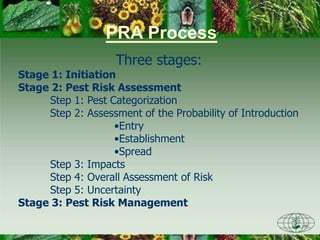
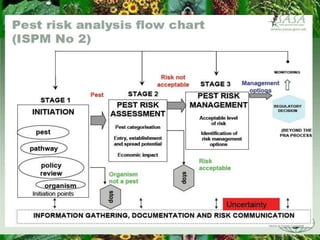
PRA Process
Three stages:
Stage 1: Initiation
Stage 2: Pest Risk Assessment
Step 1: Pest Categorization
Step 2: Assessment of the Probability of Introduction
•Entry
•Establishment
•Spread
Step 3: Impacts
Step 4: Overall Assessment of Risk
Step 5: Uncertainty
Stage 3: Pest Risk Management
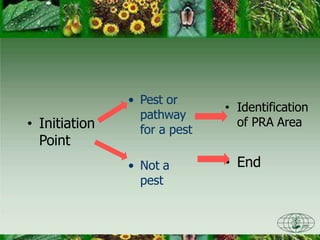
• Initiation
Point
• Pest or
pathway
for a pest
• Not a
pest
• Identification
of PRA Area
• End
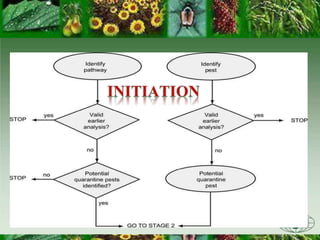
 Pest identified or detected likely to pose threat to the
agricultural economy and it requires Phytosanitary
Measures.
 identification of a pathway that presents a potential pest
hazard like augmentation of International Trade of a new
variety of a commodity.
 review or revision of phytosanitary policies and priorities by
the Government of a country.
Identification of PRAArea
- PRA area to be defined normally the whole importing country
information gathering is an essential element of all stages of PRA.
- To clarify the identity of the pest(s), its/their present distribution and
association with host plants, commodities, etc.
- Information for PRA may come from various sources.
-Official information regarding pest status is an obligation under the
IPPC (Art. VIII.1c) to be provided by the NPPO or Official contact
points.
• At the end of Stage 1, the pests and pathways of
concern and the PRA area would have been
identified.
• Relevant information has been collected and pests
have been identified as possible target for
phytosanitary measures, either individually or in
association with a pathway.
Conclusion
Could be divided into three steps:
A. Pest Categorization
B. Assessment of the probability of introduction and spread
C. Assessment of potential economic consequences (including
environmental impacts).
Estimating the Overall Risk Posed by a
Quarantine Pest
For each pest, combine the likelihood of:
- entry/establishment/ spread, and
- Consequence of entry/establishment spread:
“Extreme” “High” “Moderate” “Low”
• Step 1 – Pest categorisation
• Identify quarantine pests
• Categorise pests (do they occur on the pathway?)
• Prepare data sheets
• Assess the likelihood of entry of a pest- higher no. of
pathway- more probability
• Assess likelihood of establishment of a pest after
entry- reproductive strategy, distribution in PRA area,
adaptation, environment suitability
• Assess spread potential of the pest
• Include economic ,environmental, and societal impacts
• Include direct or indirect effect to plants
• May be qualitative or quantitive measures of impacts
• Impacts on productivity:
– Yield losses
– Increased control costs
– Post-harvest disinfestations
• Impacts on trade / market access:
– Domestic
– International
• Impacts on the environment
• Impacts on human health
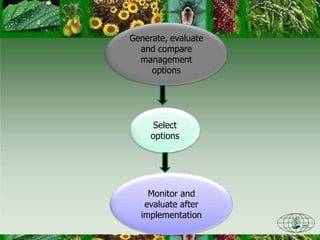
Generate, evaluate
and compare
management
options
Select
options
Monitor and
evaluate after
implementation
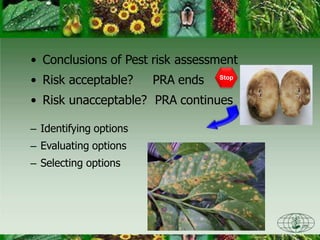
• Conclusions of Pest risk assessment
• Risk acceptable? PRA ends Stop
• Risk unacceptable? PRA continues
– Identifying options
– Evaluating options
– Selecting options
• Consider all pathways
– Traded plants or plant products
– Natural spread of the pest
– Entry with human travellers
– Vehicular transport
– Associated materials
• Identify points at which mitigation measures might be applied
• Identify possible mitigation measures at each point
• Assess each for effectiveness, efficiency, feasibility ….
• Select appropriate measure(s)
• Document
– Phytosanitary Certificates
– Import permits
• Phytosanitary Certificates
– Official assurance that specified import
requirements are met
– Confirms that risk management
measures have been taken
– Only for regulated articles
• Educate
– Educate & inform travellers,
importers, industry, government or
public
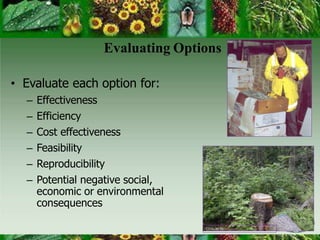
Evaluating Options
• Evaluate each option for:
– Effectiveness
– Efficiency
– Cost effectiveness
– Feasibility
– Reproducibility
– Potential negative social,
economic or environmental
consequences
CFIA-ACIA
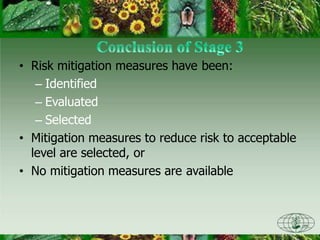
• Risk mitigation measures have been:
– Identified
– Evaluated
– Selected
• Mitigation measures to reduce risk to acceptable
level are selected, or
• No mitigation measures are available
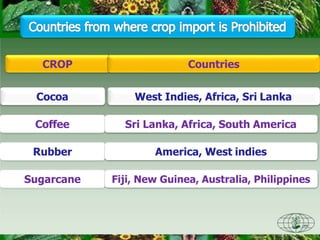
CROP Countries
Cocoa West Indies, Africa, Sri Lanka
Coffee Sri Lanka, Africa, South America
Rubber America, West indies
Sugarcane Fiji, New Guinea, Australia, Philippines
Lec. 5 pra rkp

Lec. 5 pra rkp

  • 1.
    CFIA-ACIA Lecture 5 Pest RiskAnalysis (PRA) R K Panse Subject: Principles of Integrated pest and Disease Management
  • 2.
    What is PRA? -The process of evaluating biological or other scientific and economic evidence to determine whether a pest should be regulated and the strength of any phytosanitary measures to be taken against it Pest risk analysis is set of activities, in which- -the probability and the severity of impact of a particular pest is assessed - the means of reducing these are evaluated, and the results of this review are shared with those involved -It helps to ensure that decisions on the control of imports and exports are based on sound science, are related to the risks involved and have minimal impact on trade.
  • 3.
    Why is PRAdone? To protect the country’s agriculture from damages that can be caused by harmful (quarantine) pests which can be brought in along with imported commodities; To evaluate and manage risk from specific pests and internationally traded commodities Identify and assess risks to agricultural and horticultural crops forestry and the environment from plant pests To create lists of regulated pests To produce lists of prohibited plants and plant products To assist in identifying appropriate management options
  • 4.
    PRA Process Three stages: Stage1: Initiation Stage 2: Pest Risk Assessment Step 1: Pest Categorization Step 2: Assessment of the Probability of Introduction •Entry •Establishment •Spread Step 3: Impacts Step 4: Overall Assessment of Risk Step 5: Uncertainty Stage 3: Pest Risk Management
  • 7.
    • Initiation Point • Pestor pathway for a pest • Not a pest • Identification of PRA Area • End
  • 9.
     Pest identifiedor detected likely to pose threat to the agricultural economy and it requires Phytosanitary Measures.  identification of a pathway that presents a potential pest hazard like augmentation of International Trade of a new variety of a commodity.  review or revision of phytosanitary policies and priorities by the Government of a country.
  • 10.
    Identification of PRAArea -PRA area to be defined normally the whole importing country information gathering is an essential element of all stages of PRA. - To clarify the identity of the pest(s), its/their present distribution and association with host plants, commodities, etc. - Information for PRA may come from various sources. -Official information regarding pest status is an obligation under the IPPC (Art. VIII.1c) to be provided by the NPPO or Official contact points.
  • 11.
    • At theend of Stage 1, the pests and pathways of concern and the PRA area would have been identified. • Relevant information has been collected and pests have been identified as possible target for phytosanitary measures, either individually or in association with a pathway. Conclusion
  • 13.
    Could be dividedinto three steps: A. Pest Categorization B. Assessment of the probability of introduction and spread C. Assessment of potential economic consequences (including environmental impacts).
  • 14.
    Estimating the OverallRisk Posed by a Quarantine Pest For each pest, combine the likelihood of: - entry/establishment/ spread, and - Consequence of entry/establishment spread: “Extreme” “High” “Moderate” “Low”
  • 15.
    • Step 1– Pest categorisation • Identify quarantine pests • Categorise pests (do they occur on the pathway?) • Prepare data sheets
  • 16.
    • Assess thelikelihood of entry of a pest- higher no. of pathway- more probability • Assess likelihood of establishment of a pest after entry- reproductive strategy, distribution in PRA area, adaptation, environment suitability • Assess spread potential of the pest
  • 17.
    • Include economic,environmental, and societal impacts • Include direct or indirect effect to plants • May be qualitative or quantitive measures of impacts
  • 18.
    • Impacts onproductivity: – Yield losses – Increased control costs – Post-harvest disinfestations • Impacts on trade / market access: – Domestic – International • Impacts on the environment • Impacts on human health
  • 20.
  • 21.
    • Conclusions ofPest risk assessment • Risk acceptable? PRA ends Stop • Risk unacceptable? PRA continues – Identifying options – Evaluating options – Selecting options
  • 22.
    • Consider allpathways – Traded plants or plant products – Natural spread of the pest – Entry with human travellers – Vehicular transport – Associated materials • Identify points at which mitigation measures might be applied • Identify possible mitigation measures at each point • Assess each for effectiveness, efficiency, feasibility …. • Select appropriate measure(s)
  • 23.
    • Document – PhytosanitaryCertificates – Import permits • Phytosanitary Certificates – Official assurance that specified import requirements are met – Confirms that risk management measures have been taken – Only for regulated articles • Educate – Educate & inform travellers, importers, industry, government or public
  • 24.
    Evaluating Options • Evaluateeach option for: – Effectiveness – Efficiency – Cost effectiveness – Feasibility – Reproducibility – Potential negative social, economic or environmental consequences CFIA-ACIA
  • 25.
    • Risk mitigationmeasures have been: – Identified – Evaluated – Selected • Mitigation measures to reduce risk to acceptable level are selected, or • No mitigation measures are available
  • 26.
    CROP Countries Cocoa WestIndies, Africa, Sri Lanka Coffee Sri Lanka, Africa, South America Rubber America, West indies Sugarcane Fiji, New Guinea, Australia, Philippines