Doctoral seminar II
Fusarium oxysporum f.sp. cubense race TR4
New threat to banana cultivation in Bihar
Speaker
DN Shukla
PhD Student
DEPARTMENT OF PLANT PATHOLOGY
Dr. RAJENDRA PRASAD CENTRAL AGRICULTURAL UNIVERSITY
PUSA, SAMASTIPURBIHAR– 848125
Major Advisor
Dr S.K.SINGH
Associate Professor(Plant
Pathology)
Speaker
Daya Nand Shukla
PhD Student
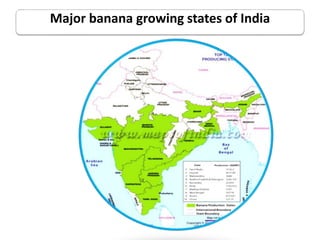
Major banana growing states of India
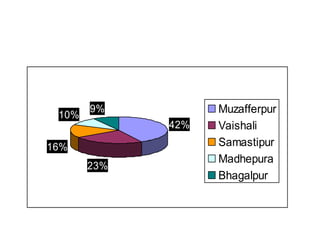
42%
23%
16%
10%
9% Muzafferpur
Vaishali
Samastipur
Madhepura
Bhagalpur
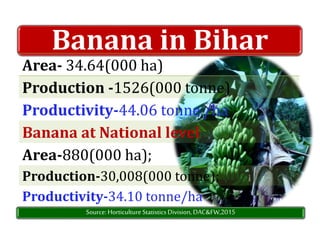
Banana in Bihar
Area- 34.64(000 ha)
Production -1526(000 tonne)
Productivity-44.06 tonne /ha
Banana at National level
Area-880(000 ha);
Production-30,008(000 tonne);
Productivity-34.10 tonne/ha
Source:HorticultureStatisticsDivision, DAC&FW,2015
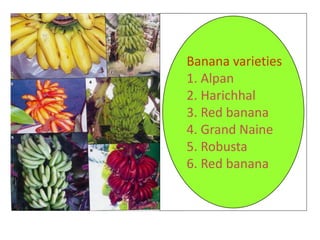
Banana varieties
1. Alpan
2. Harichhal
3. Red banana
4. Grand Naine
5. Robusta
6. Red banana
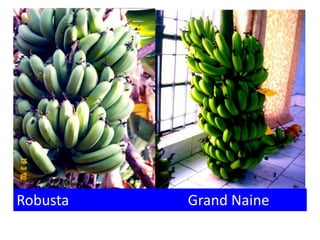
Robusta Grand Naine
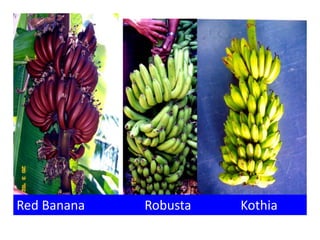
Red Banana Robusta Kothia
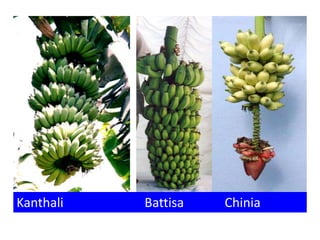
Kanthali Battisa Chinia
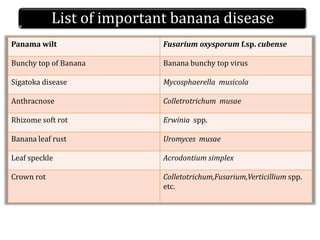
Panama wilt Fusarium oxysporum f.sp. cubense
Bunchy top of Banana Banana bunchy top virus
Sigatoka disease Mycosphaerella musicola
Anthracnose Colletrotrichum musae
Rhizome soft rot Erwinia spp.
Banana leaf rust Uromyces musae
Leaf speckle Acrodontium simplex
Crown rot Colletotrichum,Fusarium,Verticillium spp.
etc.
List of important banana disease
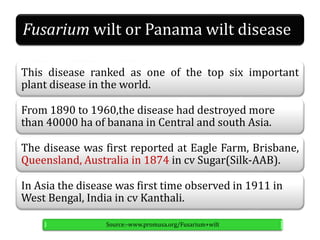
Fusarium wilt or Panama wilt disease
This disease ranked as one of the top six important
plant disease in the world.
From 1890 to 1960,the disease had destroyed more
than 40000 ha of banana in Central and south Asia.
The disease was first reported at Eagle Farm, Brisbane,
Queensland, Australia in 1874 in cv Sugar(Silk-AAB).
In Asia the disease was first time observed in 1911 in
West Bengal, India in cv Kanthali.
Source:-www.promusa.org/Fusarium+wilt
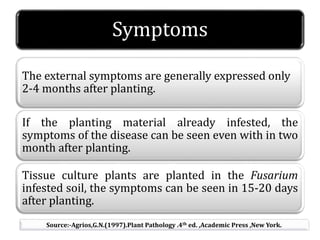
Symptoms
The external symptoms are generally expressed only
2-4 months after planting.
If the planting material already infested, the
symptoms of the disease can be seen even with in two
month after planting.
Tissue culture plants are planted in the Fusarium
infested soil, the symptoms can be seen in 15-20 days
after planting.
Source:-Agrios,G.N.(1997).Plant Pathology .4th ed. ,Academic Press ,New York.
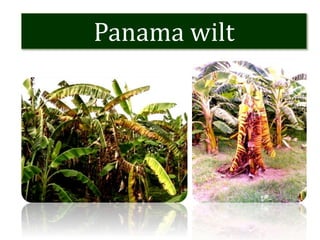
Panama wilt
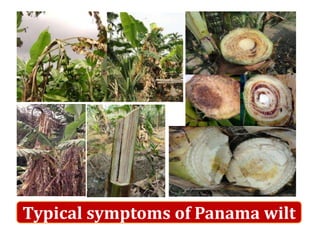
Typical symptoms of Panama wilt
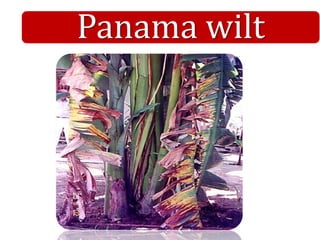
Panama wilt
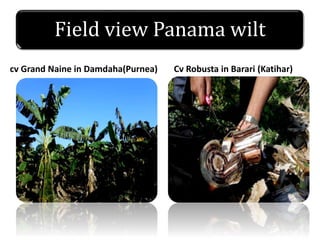
Field view Panama wilt
cv Grand Naine in Damdaha(Purnea) Cv Robusta in Barari (Katihar)
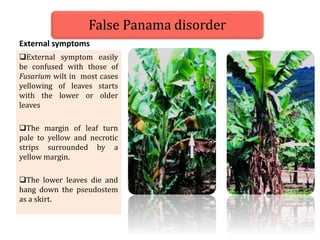
External symptoms
External symptom easily
be confused with those of
Fusarium wilt in most cases
yellowing of leaves starts
with the lower or older
leaves
The margin of leaf turn
pale to yellow and necrotic
strips surrounded by a
yellow margin.
The lower leaves die and
hang down the pseudostem
as a skirt.
False Panama disorder
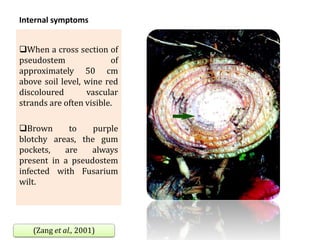
Internal symptoms
When a cross section of
pseudostem of
approximately 50 cm
above soil level, wine red
discoloured vascular
strands are often visible.
Brown to purple
blotchy areas, the gum
pockets, are always
present in a pseudostem
infected with Fusarium
wilt.
(Zang et al., 2001)
Races of Fusarium oxysporum f. sp cubense (Foc)
Race I attacks Silk, Pisang Awak, Pome
Race II affects Bluggoe
Race III attack only of Heliconia sp.
Race IV attacks silk, Pisang Awak, Pome- Bluggoe +
Cavendish groups of Banana
In India (including Bihar) only two races viz. race 1 and
race 2 are present. Cavendish and Poovan groups are not
affected in India but incidence of Panama wilt is reported in
Cavendish Group of Banana in Bihar of India.
(Singh,2002)
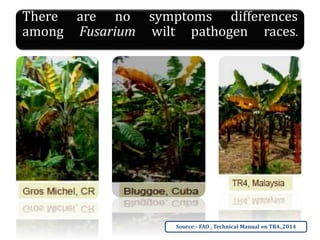
There are no symptoms differences
among Fusarium wilt pathogen races.
Source:- FAO , Technical Manual on TR4.,2014
.
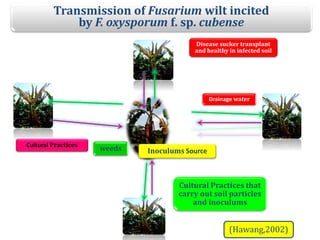
Disease sucker transplant
and healthy in infected soil
Cultural Practices
Cultural Practices that
carry out soil particles
and inoculums
Inoculums Sourceweeds
(Hawang,2002)
Drainage water
Transmission of Fusarium wilt incited
by F. oxysporum f. sp. cubense
Survival
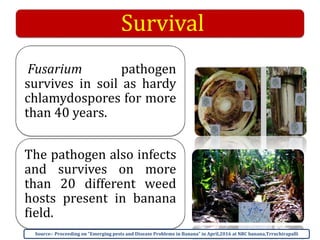
Fusarium pathogen
survives in soil as hardy
chlamydospores for more
than 40 years.
The pathogen also infects
and survives on more
than 20 different weed
hosts present in banana
field.
Source:- Proceeding on “Emerging pests and Disease Problems in Banana” in April,2016 at NRC banana,Trruchirapalli
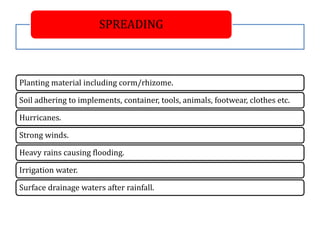
SPREADING
Planting material including corm/rhizome.
Soil adhering to implements, container, tools, animals, footwear, clothes etc.
Hurricanes.
Strong winds.
Heavy rains causing flooding.
Irrigation water.
Surface drainage waters after rainfall.
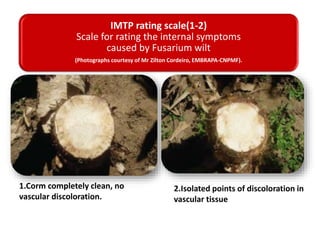
IMTP rating scale(1-2)
Scale for rating the internal symptoms
caused by Fusarium wilt
(Photographs courtesy of Mr Zilton Cordeiro, EMBRAPA-CNPMF).
1.Corm completely clean, no
vascular discoloration.
2.Isolated points of discoloration in
vascular tissue
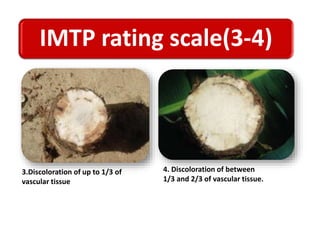
IMTP rating scale(3-4)
3.Discoloration of up to 1/3 of
vascular tissue
4. Discoloration of between
1/3 and 2/3 of vascular tissue.
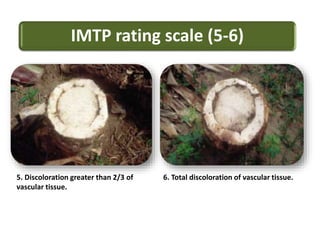
IMTP rating scale (5-6)
5. Discoloration greater than 2/3 of
vascular tissue.
6. Total discoloration of vascular tissue.
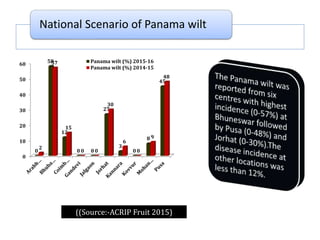
National Scenario of Panama wilt
0
10
20
30
40
50
60
0
58
12
0 0
27
3
0
8
45
2
57
15
0 0
30
6
0
9
48
Panama wilt (%) 2015-16
Panama wilt (%) 2014-15
((Source:-ACRIP Fruit 2015)
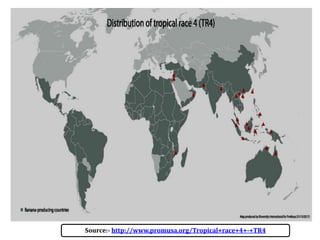
International scenario of virulent race TR4
In 20th century TR4 had been observed in Taiwan, Malaysia, Indonesia
(Java, Sumatra, Sulawesi, Halmahera, Kalimantan on the island of
Borneo, and Papua Province on the island of New Guinea), mainland
China (Guangdong, Hainan, Guangxi, Fujian and Yunnan), the
Philippines' island of Mindanao and Australia (Northern
Territory),Oman,Jordan,Mozambique,Lebnan,Pakistan,Laos,Vietnam and
India.
It has destroyed>20,000 ha of Grand Naine Cavendish banana in china
and poses serious threat to the multibillion-dollar export industry and
also to the lively hood small scale banana growers in Asia, Africa and
Australia.
Source:- http://www.promusa.org/Tropical+race+4+-+TR4
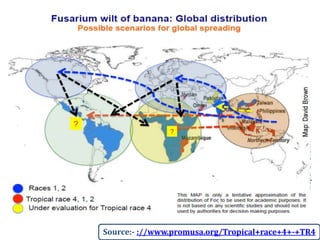
•.
Source:- ://www.promusa.org/Tropical+race+4+-+TR4
Source:- https://www.google.co.in/search?q=panama+wilt+of+banana+symptoms
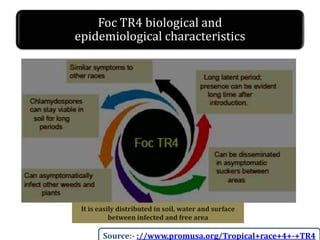
Foc TR4 biological and
epidemiological characteristics
It is easily distributed in soil, water and surface
between infected and free area
Source:- ://www.promusa.org/Tropical+race+4+-+TR4
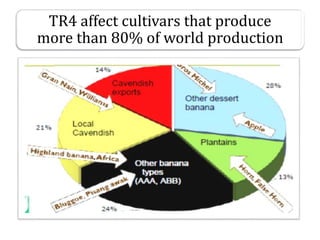
TR4 affect cultivars that produce
more than 80% of world production
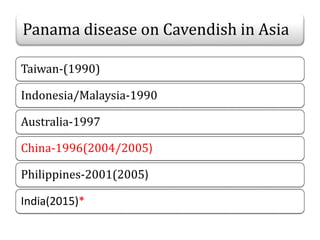
Panama disease on Cavendish in Asia
Taiwan-(1990)
Indonesia/Malaysia-1990
Australia-1997
China-1996(2004/2005)
Philippines-2001(2005)
India(2015)*
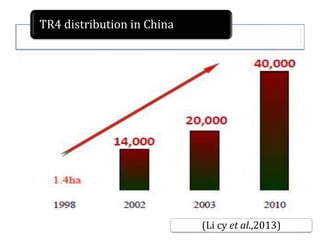
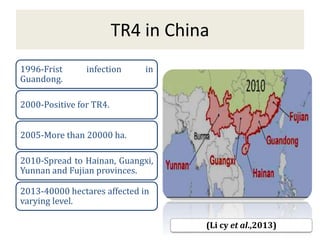
TR4 in China
1996-Frist infection in
Guandong.
2000-Positive for TR4.
2005-More than 20000 ha.
2010-Spread to Hainan, Guangxi,
Yunnan and Fujian provinces.
2013-40000 hectares affected in
varying level.
(Li cy et al.,2013)
TR4 distribution in China
.
(Li cy et al.,2013)
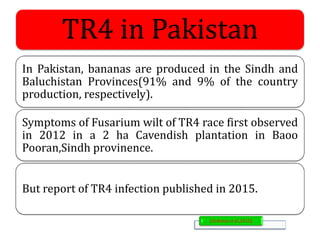
TR4 in Pakistan
In Pakistan, bananas are produced in the Sindh and
Baluchistan Provinces(91% and 9% of the country
production, respectively).
Symptoms of Fusarium wilt of TR4 race first observed
in 2012 in a 2 ha Cavendish plantation in Baoo
Pooran,Sindh provinence.
But report of TR4 infection published in 2015.
(Ordonez et al.,2015)
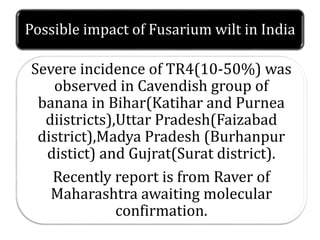
Possible impact of Fusarium wilt in India
.
Severe incidence of TR4(10-50%) was
observed in Cavendish group of
banana in Bihar(Katihar and Purnea
diistricts),Uttar Pradesh(Faizabad
district),Madya Pradesh (Burhanpur
distict) and Gujrat(Surat district).
Recently report is from Raver of
Maharashtra awaiting molecular
confirmation.
.
There is a chance for the further spread of this virulent
strain rapidly to other states like West
Bengal,Odissa,Karnatka,Andhra Pradesh,Tamil Nadu and
NES states .
Banana growers now switching over to other less
remunerative crops like maize, paddy, etc., which will profit
of only Rs.25,000/ as against Rs.>2 lakhs/acre in banana,
there is a possibility of incurring a heavy loss to Indian
banana industry which worth nearly Rs.50,000/ crores.
Besides ,this it create unemployment followed by farm
workers from Bihar migrating to other states like Punjab
and Haryana for employment opportunities
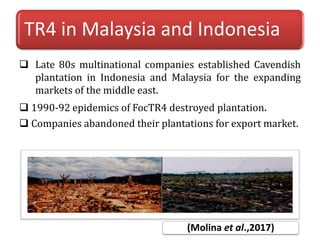
TR4 in Malaysia and Indonesia
 Late 80s multinational companies established Cavendish
plantation in Indonesia and Malaysia for the expanding
markets of the middle east.
 1990-92 epidemics of FocTR4 destroyed plantation.
 Companies abandoned their plantations for export market.
(Molina et al.,2017)
TR4 distribution in Philippines
2001-Frist appeared in Cavendish plantation grown for “sweet
bananas” in the highland of Mindanao.
2003-Sporadic cases observed in the traditional lowland
plantation.
2005-Increased FOC infection in the lowland further spread.
2013-Thousand of hectares affected.
Small independent growers farms are most affected.
Source:- https//www.networks.og./Bapnet/2014
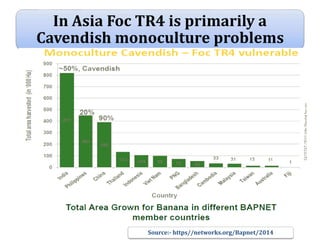
In Asia Foc TR4 is primarily a
Cavendish monoculture problems
Source:- https//networks.org/Bapnet/2014
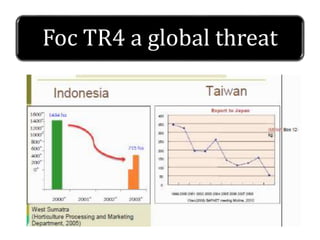
Foc TR4 a global threat
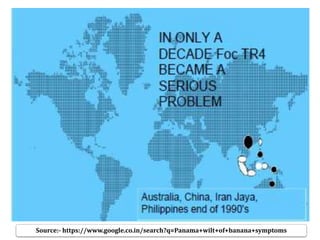
Source:- https://www.google.co.in/search?q=Panama+wilt+of+banana+symptoms
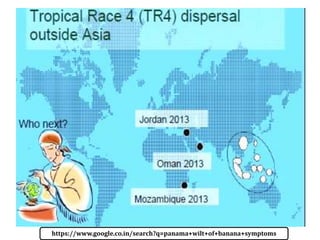
https://www.google.co.in/search?q=panama+wilt+of+banana+symptoms
Risk and noxiousness factors of an
outbreak of Foc TR4
Similar symptoms to other races and long latent
period; evidence or it presence can happen after
many years of introduction.
High dependency in cultivars (Cavendish, AAB
plantains, Bluggoe and Pisang awak types, ABB, etc.).
Poor knowledge and conscience among growers of
disease impact, infection cycle and management
tactics.
Source:--www.krishisewa.com/articles/disease-management/80-panama-wilt-banana.html
.
Persistence in soil by many years.
Limited options of management.
Easy dissemination by different ways to be
introduced.
Lack of certified free planting material to
grower.
Source:--www.krishisewa.com/articles/disease-management/80-panama-wilt-banana.html
If the field infected by Tr4 how to manage?
Keep the sign board at entry of each field affected with Fusarium
wilt tropical race 4.
Demarcated the wilt infected plants with rope/coulred ribbon
for restricted entry inside the field.
Inject the wilt infected plant with Glyphosate 2-5 ml/plant and
after death ,burn them immediately.
Sign of wilt infection is noticed, drenching of carbendazim(0.1 to
0.3%) @3-5 litters per plant for 3-5 times at 15 days interval.
.
Follow "come clean and go clean” keep the plant and field
very clean without weeds and banana plant wastes.
When the harvest over, entire plant uprooted and brunt.
Follow crop rotation including
paddy/sugarcane/tapioca/onion/pineapple once or twice.
Intercropping with onion/growing cover crops.
.Good agricultural practices so as to improve the
soil haealth by applying recommended dose of
fertilizer,apply 1 kg wood ash,more amount of
vermicompost ,neem cake etc.
Soil application of rice chaffy grain formulation of
endophytic penicillium pinophilum+rhizosporic
Trichoderma aserellum@100 g /plant.
Follow drip irrigation/fertigation.
How to prevent the occurrence of Tr4 in the
fields not infested
Restriction of banana plants imports others than certified
virus, bacteria and fungi free tissue culture indexed plants
from trusted sources.
Develop of an Emergency Contingency Plan for a case of an
incursion of Foc TR4 following the guidelines of the
technical document developed by OIRSA, Bioversity
International and INISAV.
Develop of a survey of Panama disease risky areas based on
cultivars and Foc Race1/Race2 current presence.
.
Development of disease clean seed programs accessible
to growers.
If farmer seen the infection in Cavendish group of banana
then contact to NRC banana ,Dr.RPCAU,Pusa and BAU,
Sabour .
Distribution of advertising brochures among visitors to
countries with presence of Foc TR4 help in reduction of
further distribution in those countries in which it is not
present .
.
Officials and growers help each other on symptoms
identification, sampling, storage, transport and mailing
samples.
Create brochures by Agricultural
Universities(CAU,SAU)and other Institutes' for extension
officers and growers with disease description and steps
to follow in a case of an incursion.
It is possible that due to infrastructure weakness in these
countries disease could disseminate therefore
infrastructure development essential.
Status of Panama wilt in Bihar vis a vis National scenario 5th August, 2017

Panama wilt of banana

  • 1.
    Doctoral seminar II Fusariumoxysporum f.sp. cubense race TR4 New threat to banana cultivation in Bihar Speaker DN Shukla PhD Student DEPARTMENT OF PLANT PATHOLOGY Dr. RAJENDRA PRASAD CENTRAL AGRICULTURAL UNIVERSITY PUSA, SAMASTIPURBIHAR– 848125 Major Advisor Dr S.K.SINGH Associate Professor(Plant Pathology) Speaker Daya Nand Shukla PhD Student
  • 3.
    Major banana growingstates of India
  • 5.
  • 6.
    Banana in Bihar Area-34.64(000 ha) Production -1526(000 tonne) Productivity-44.06 tonne /ha Banana at National level Area-880(000 ha); Production-30,008(000 tonne); Productivity-34.10 tonne/ha Source:HorticultureStatisticsDivision, DAC&FW,2015
  • 7.
    Banana varieties 1. Alpan 2.Harichhal 3. Red banana 4. Grand Naine 5. Robusta 6. Red banana
  • 8.
  • 9.
  • 10.
  • 11.
    Panama wilt Fusariumoxysporum f.sp. cubense Bunchy top of Banana Banana bunchy top virus Sigatoka disease Mycosphaerella musicola Anthracnose Colletrotrichum musae Rhizome soft rot Erwinia spp. Banana leaf rust Uromyces musae Leaf speckle Acrodontium simplex Crown rot Colletotrichum,Fusarium,Verticillium spp. etc. List of important banana disease
  • 12.
    Fusarium wilt orPanama wilt disease This disease ranked as one of the top six important plant disease in the world. From 1890 to 1960,the disease had destroyed more than 40000 ha of banana in Central and south Asia. The disease was first reported at Eagle Farm, Brisbane, Queensland, Australia in 1874 in cv Sugar(Silk-AAB). In Asia the disease was first time observed in 1911 in West Bengal, India in cv Kanthali. Source:-www.promusa.org/Fusarium+wilt
  • 13.
    Symptoms The external symptomsare generally expressed only 2-4 months after planting. If the planting material already infested, the symptoms of the disease can be seen even with in two month after planting. Tissue culture plants are planted in the Fusarium infested soil, the symptoms can be seen in 15-20 days after planting. Source:-Agrios,G.N.(1997).Plant Pathology .4th ed. ,Academic Press ,New York.
  • 14.
  • 15.
  • 16.
  • 17.
    Field view Panamawilt cv Grand Naine in Damdaha(Purnea) Cv Robusta in Barari (Katihar)
  • 18.
    External symptoms External symptomeasily be confused with those of Fusarium wilt in most cases yellowing of leaves starts with the lower or older leaves The margin of leaf turn pale to yellow and necrotic strips surrounded by a yellow margin. The lower leaves die and hang down the pseudostem as a skirt. False Panama disorder
  • 19.
    Internal symptoms When across section of pseudostem of approximately 50 cm above soil level, wine red discoloured vascular strands are often visible. Brown to purple blotchy areas, the gum pockets, are always present in a pseudostem infected with Fusarium wilt. (Zang et al., 2001)
  • 20.
    Races of Fusariumoxysporum f. sp cubense (Foc) Race I attacks Silk, Pisang Awak, Pome Race II affects Bluggoe Race III attack only of Heliconia sp. Race IV attacks silk, Pisang Awak, Pome- Bluggoe + Cavendish groups of Banana In India (including Bihar) only two races viz. race 1 and race 2 are present. Cavendish and Poovan groups are not affected in India but incidence of Panama wilt is reported in Cavendish Group of Banana in Bihar of India. (Singh,2002)
  • 21.
    There are nosymptoms differences among Fusarium wilt pathogen races. Source:- FAO , Technical Manual on TR4.,2014
  • 22.
    . Disease sucker transplant andhealthy in infected soil Cultural Practices Cultural Practices that carry out soil particles and inoculums Inoculums Sourceweeds (Hawang,2002) Drainage water Transmission of Fusarium wilt incited by F. oxysporum f. sp. cubense
  • 23.
    Survival Fusarium pathogen survives insoil as hardy chlamydospores for more than 40 years. The pathogen also infects and survives on more than 20 different weed hosts present in banana field. Source:- Proceeding on “Emerging pests and Disease Problems in Banana” in April,2016 at NRC banana,Trruchirapalli
  • 24.
    SPREADING Planting material includingcorm/rhizome. Soil adhering to implements, container, tools, animals, footwear, clothes etc. Hurricanes. Strong winds. Heavy rains causing flooding. Irrigation water. Surface drainage waters after rainfall.
  • 25.
    IMTP rating scale(1-2) Scalefor rating the internal symptoms caused by Fusarium wilt (Photographs courtesy of Mr Zilton Cordeiro, EMBRAPA-CNPMF). 1.Corm completely clean, no vascular discoloration. 2.Isolated points of discoloration in vascular tissue
  • 26.
    IMTP rating scale(3-4) 3.Discolorationof up to 1/3 of vascular tissue 4. Discoloration of between 1/3 and 2/3 of vascular tissue.
  • 27.
    IMTP rating scale(5-6) 5. Discoloration greater than 2/3 of vascular tissue. 6. Total discoloration of vascular tissue.
  • 28.
    National Scenario ofPanama wilt 0 10 20 30 40 50 60 0 58 12 0 0 27 3 0 8 45 2 57 15 0 0 30 6 0 9 48 Panama wilt (%) 2015-16 Panama wilt (%) 2014-15 ((Source:-ACRIP Fruit 2015)
  • 29.
    International scenario ofvirulent race TR4 In 20th century TR4 had been observed in Taiwan, Malaysia, Indonesia (Java, Sumatra, Sulawesi, Halmahera, Kalimantan on the island of Borneo, and Papua Province on the island of New Guinea), mainland China (Guangdong, Hainan, Guangxi, Fujian and Yunnan), the Philippines' island of Mindanao and Australia (Northern Territory),Oman,Jordan,Mozambique,Lebnan,Pakistan,Laos,Vietnam and India. It has destroyed>20,000 ha of Grand Naine Cavendish banana in china and poses serious threat to the multibillion-dollar export industry and also to the lively hood small scale banana growers in Asia, Africa and Australia. Source:- http://www.promusa.org/Tropical+race+4+-+TR4
  • 30.
  • 31.
  • 32.
  • 33.
    Foc TR4 biologicaland epidemiological characteristics It is easily distributed in soil, water and surface between infected and free area Source:- ://www.promusa.org/Tropical+race+4+-+TR4
  • 34.
    TR4 affect cultivarsthat produce more than 80% of world production
  • 35.
    Panama disease onCavendish in Asia Taiwan-(1990) Indonesia/Malaysia-1990 Australia-1997 China-1996(2004/2005) Philippines-2001(2005) India(2015)*
  • 36.
    TR4 in China 1996-Fristinfection in Guandong. 2000-Positive for TR4. 2005-More than 20000 ha. 2010-Spread to Hainan, Guangxi, Yunnan and Fujian provinces. 2013-40000 hectares affected in varying level. (Li cy et al.,2013)
  • 37.
    TR4 distribution inChina . (Li cy et al.,2013)
  • 38.
    TR4 in Pakistan InPakistan, bananas are produced in the Sindh and Baluchistan Provinces(91% and 9% of the country production, respectively). Symptoms of Fusarium wilt of TR4 race first observed in 2012 in a 2 ha Cavendish plantation in Baoo Pooran,Sindh provinence. But report of TR4 infection published in 2015. (Ordonez et al.,2015)
  • 39.
    Possible impact ofFusarium wilt in India . Severe incidence of TR4(10-50%) was observed in Cavendish group of banana in Bihar(Katihar and Purnea diistricts),Uttar Pradesh(Faizabad district),Madya Pradesh (Burhanpur distict) and Gujrat(Surat district). Recently report is from Raver of Maharashtra awaiting molecular confirmation.
  • 40.
    . There is achance for the further spread of this virulent strain rapidly to other states like West Bengal,Odissa,Karnatka,Andhra Pradesh,Tamil Nadu and NES states . Banana growers now switching over to other less remunerative crops like maize, paddy, etc., which will profit of only Rs.25,000/ as against Rs.>2 lakhs/acre in banana, there is a possibility of incurring a heavy loss to Indian banana industry which worth nearly Rs.50,000/ crores. Besides ,this it create unemployment followed by farm workers from Bihar migrating to other states like Punjab and Haryana for employment opportunities
  • 41.
    TR4 in Malaysiaand Indonesia  Late 80s multinational companies established Cavendish plantation in Indonesia and Malaysia for the expanding markets of the middle east.  1990-92 epidemics of FocTR4 destroyed plantation.  Companies abandoned their plantations for export market. (Molina et al.,2017)
  • 42.
    TR4 distribution inPhilippines 2001-Frist appeared in Cavendish plantation grown for “sweet bananas” in the highland of Mindanao. 2003-Sporadic cases observed in the traditional lowland plantation. 2005-Increased FOC infection in the lowland further spread. 2013-Thousand of hectares affected. Small independent growers farms are most affected. Source:- https//www.networks.og./Bapnet/2014
  • 43.
    In Asia FocTR4 is primarily a Cavendish monoculture problems Source:- https//networks.org/Bapnet/2014
  • 44.
    Foc TR4 aglobal threat
  • 45.
  • 46.
  • 47.
    Risk and noxiousnessfactors of an outbreak of Foc TR4 Similar symptoms to other races and long latent period; evidence or it presence can happen after many years of introduction. High dependency in cultivars (Cavendish, AAB plantains, Bluggoe and Pisang awak types, ABB, etc.). Poor knowledge and conscience among growers of disease impact, infection cycle and management tactics. Source:--www.krishisewa.com/articles/disease-management/80-panama-wilt-banana.html
  • 48.
    . Persistence in soilby many years. Limited options of management. Easy dissemination by different ways to be introduced. Lack of certified free planting material to grower. Source:--www.krishisewa.com/articles/disease-management/80-panama-wilt-banana.html
  • 49.
    If the fieldinfected by Tr4 how to manage? Keep the sign board at entry of each field affected with Fusarium wilt tropical race 4. Demarcated the wilt infected plants with rope/coulred ribbon for restricted entry inside the field. Inject the wilt infected plant with Glyphosate 2-5 ml/plant and after death ,burn them immediately. Sign of wilt infection is noticed, drenching of carbendazim(0.1 to 0.3%) @3-5 litters per plant for 3-5 times at 15 days interval.
  • 50.
    . Follow "come cleanand go clean” keep the plant and field very clean without weeds and banana plant wastes. When the harvest over, entire plant uprooted and brunt. Follow crop rotation including paddy/sugarcane/tapioca/onion/pineapple once or twice. Intercropping with onion/growing cover crops.
  • 51.
    .Good agricultural practicesso as to improve the soil haealth by applying recommended dose of fertilizer,apply 1 kg wood ash,more amount of vermicompost ,neem cake etc. Soil application of rice chaffy grain formulation of endophytic penicillium pinophilum+rhizosporic Trichoderma aserellum@100 g /plant. Follow drip irrigation/fertigation.
  • 52.
    How to preventthe occurrence of Tr4 in the fields not infested Restriction of banana plants imports others than certified virus, bacteria and fungi free tissue culture indexed plants from trusted sources. Develop of an Emergency Contingency Plan for a case of an incursion of Foc TR4 following the guidelines of the technical document developed by OIRSA, Bioversity International and INISAV. Develop of a survey of Panama disease risky areas based on cultivars and Foc Race1/Race2 current presence.
  • 53.
    . Development of diseaseclean seed programs accessible to growers. If farmer seen the infection in Cavendish group of banana then contact to NRC banana ,Dr.RPCAU,Pusa and BAU, Sabour . Distribution of advertising brochures among visitors to countries with presence of Foc TR4 help in reduction of further distribution in those countries in which it is not present .
  • 54.
    . Officials and growershelp each other on symptoms identification, sampling, storage, transport and mailing samples. Create brochures by Agricultural Universities(CAU,SAU)and other Institutes' for extension officers and growers with disease description and steps to follow in a case of an incursion. It is possible that due to infrastructure weakness in these countries disease could disseminate therefore infrastructure development essential.
  • 55.
    Status of Panamawilt in Bihar vis a vis National scenario 5th August, 2017