Identification of Minor Insect Pests of PADDY
(Continued) and their damage symptoms
Dr. Thippaiah
professor
Dept. of Entomology
College of Agriculture
GKVK, UAS
Bangalore- 65
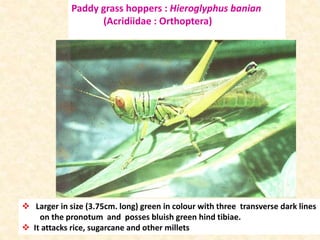
Paddy grass hoppers : Hieroglyphus banian
(Acridiidae : Orthoptera)
 Larger in size (3.75cm. long) green in colour with three transverse dark lines
on the pronotum and posses bluish green hind tibiae.
 It attacks rice, sugarcane and other millets
 Oxya nitidula : is smaller, about 2.5 cm long, green in colour
with longitudinal brown streak on either side of the thorax.
 It attacks rice and various grasses
longitudinal
brown streak
on either side
of the thorax
Eggs : are laid in soil on the field bunds
in batches of 30-40 i.e., eggs are
laid in the form of egg pod at a
depth of 4-5cm in the soil between
October- December in South India
Nymphs : The young ones emerge in
June- July after the first monsoon
rains and generally mature during
August – September N.P – 2.5 – 3.5 months
Symptom of damage
 Both nymphs and adults feed on the leaves leaving the midribs
and stalks in irregular manner and thus defoliating the plants
 Also feed on developing ear heads causing white ear
Grasshoppers in the field Irregular feeding of leaves at the margin `
 The adult is a small elongated bluish black beetle
 It causes more damage than hispa and nature of
damage is almost similar to hispa but feeding lines
are very narrow
Eggs: are laid on the leaves
Grubs: are yellow feed on green matter i.e.
both adults and grubs cause damage
to the crop
Nature and symptoms of damage
 Both adults and grubs feed on the leaf surface by scraping
green tissues causing longitudinal parallel streaks on the
leaf blade, and not close to each other
 The effected leaves roll up and larva, pupa and adults can
be seen inside the leaf roll
Paddy blue beetle : Leptispa pygmaea
(Chrysomelidae : Coleoptera)
Different instar grubs
Eggs
Adults
White streaks on the leaf
Infested field
Butter flies pests of Paddy
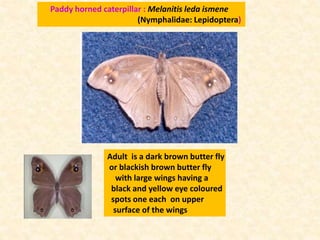
Paddy horned caterpillar : Melanitis leda ismene
(Nymphalidae: Lepidoptera)
Adult is a dark brown butter fly
or blackish brown butter fly
with large wings having a
black and yellow eye coloured
spots one each on upper
surface of the wings
It lays white round eggs singly on the leaves
I.P- 3-4 days
It pupates in a
greenish Chrysalis
which attached to
the leaf with cremaster.
P.P – 9-10 days
Caterpillar is green slightly
flattened with two red horn
like process on the head
and two yellow process in
the anal end
L.P – 21- 23 days
Irregular feeding by larva
Larva
Adult
Nature of Damage
 Larva feeds on the leaves , it damages entire leaf by
defoliation at night, larva remaining inactive during
day time
 Each larva is capable of defoliating a great quantity
of leaf tissue during its 3-week larval period
It is a minor pest of paddy
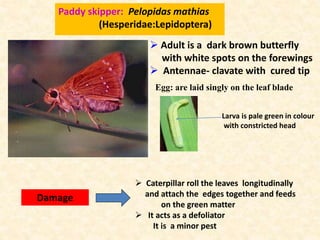
Paddy skipper: Pelopidas mathias
(Hesperidae:Lepidoptera)
 Adult is a dark brown butterfly
with white spots on the forewings
 Antennae- clavate with cured tip
Damage
 Caterpillar roll the leaves longitudinally
and attach the edges together and feeds
on the green matter
 It acts as a defoliator
It is a minor pest
Larva is pale green in colour
with constricted head
Egg: are laid singly on the leaf blade
Floating of tubular cases around the tillers Papery white leaves
Larva
Adult
Paddy cut worms
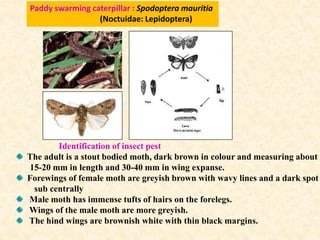
Paddy swarming caterpillar : Spodoptera mauritia
(Noctuidae: Lepidoptera)
Identification of insect pest
The adult is a stout bodied moth, dark brown in colour and measuring about
15-20 mm in length and 30-40 mm in wing expanse.
Forewings of female moth are greyish brown with wavy lines and a dark spot
sub centrally
Male moth has immense tufts of hairs on the forelegs.
Wings of the male moth are more greyish.
The hind wings are brownish white with thin black margins.
Egg - Laid in masses on
the tender leaves and
covered with buff
coloured hairs
Each female lays -
1800 -2000 eggs
2-5 days
Larva - Caterpillar have 6 instars,
The full grown larva is cylindrical,
dark to pale green with dull
coloured dorsal and sub dorsal
stripes on the body
Pupa - Pupates in an earthen
cocoon in soil
Spodoptera mauritia Caterpillar Damaged leaf blades
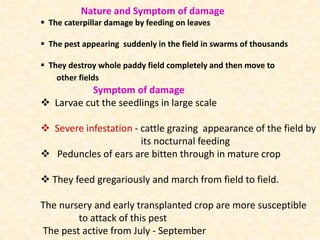
Nature and Symptom of damage
 The caterpillar damage by feeding on leaves
 The pest appearing suddenly in the field in swarms of thousands
 They destroy whole paddy field completely and then move to
other fields
Symptom of damage
 Larvae cut the seedlings in large scale
 Severe infestation - cattle grazing appearance of the field by
its nocturnal feeding
 Peduncles of ears are bitten through in mature crop
 They feed gregariously and march from field to field.
The nursery and early transplanted crop are more susceptible
to attack of this pest
The pest active from July - September
Closer view of paddy plants attacked by
S. mauritia
S. mauritia larvae feeding on paddy plants
Factors favouring population buildup
Prolonged dry condition followed by heavy rainfall favours
its outbreak.
Wind and rain storm helps in migration of moths to long
distances.
Pest occurs throughout the year on alternate hosts and move to
paddy in kharif season
Pest migrates from older rice to grassy areas for off season
survival
Climbing cut worm : Mythimna separata
(Noctuidae : Lepidoptera)
It is serious in heavy rainfall areas
 The adult is stout bodied, medium sized moth, greyish brown in colour
 On the fore wings we find 2 white spots and prominent veins in the wings
Eggs : are laid during night time on
the lower surface of the leaves in
overlapping rows
Each female lays 300-500 eggs
I.P- 2-4 days
Larva : The caterpillar have 6 instars,
The larvae long, stout, smooth greenish
black with longitudinal stripes on the body
and during day time hide in dark place along
with excreta
L.P – 25-30days
Pupa : Pupation takes place in soil
P.P – 9-10 days
Adults - will live for 20 days
During day time larvae hide in dark
place along with excreta
 It is a sporadic pest mainly causing damage to rice crop in coastal and
Northeastern states.
 Larvae are polyphagous - The newly hatched larva feed on epidermis of tender
leaves , 11 and 111 instars larva feed on entire leaves
and defoliate the plants, leaving only mid ribs during
vegetative stage.
During ear head stage –
The remaining larval Instars climb up the cut the
ear head stalk during night time and the bits of
ea head drop down
Yellow hairy caterpillar: Psalis pennatula
( Lymantriidae : Lepidoptera)
Adult is a stout bodied, straw coloured moth, with longitudinal dark band
on the fore wings and pale coloured hind wings
Damage : The yellowish brown caterpillar with tuft of hairs all over the body
and feed on leaves causes defoliation i.e.
it acts as a defoliators
It is a minor pest
Eupterotid Hairy caterpillar : 1. Nisaga simplex
( Eupterotidae : Lepidoptera )
Adults are brown coloured moths
They have sexual dimorphism
Males have short abdomen with well developed wings and they have bipectinate antennae
Females have elongated abdomen with short wings and they have filiform antennae
Eupterotid Hairy caterpillar : 2. Euproctis virguncula
( Eupterotidae : Lepidoptera )
 Milky white coloured body and wings
 Abdomen with yellow tuft of hairs
It acts as a defoliator
Hairy caterpillar
Abdomen with yellow tuft of hairs
Other minor pests
Whorl maggot : Hydrellia sasakii,
( Ephydridae : Diptera)
Nature and symptoms of damage
The maggot are found to feed on the unopened leaves and nibble
the inner margins of the leaves. Such leaves are yellowish white
and blotching with holes in few places on the freshly emerged
leaves and such leaves shriveled and plants stunted and maturity
may be delayed by a few days
 Adults are small, dull grey coloured fly
 Maggots are pale white, found inside the
central leaf whorl
 Maggots are pale white, found inside the central leaf whorl
Symptom of damage
 Maggot feeds on the tender tissue inside the leaf whorl
 Yellowish white longitudinal marginal blotching with holes
 Leaves shriveled plant stunted and maturity delayed.
 Drooping of young leaves near the tip
Yellowish white blotching
Mealybugs : Brevennia rehi
Pseudococcidae : Hemiptera
Damage
Large number of insects remains in leaf sheath and suck the sap.
Plants become week, yellowish and very much stunted in circular patches.
Presence of white waxy coating in the leaf sheaths
Adult - Small reddish white,
soft-bodied wingless insect
covered with filamentous
materials.
Symptom of Mealybug Infestation Mealybugs
 Large number of insects remains in leaf sheath and suck the sap.
 Plants become week, yellowish and very much stunted in circular patches.
 Presence of white waxy and powdery coating in leaf sheath and also
by presence of ants on the mealy bug infested plants
Paddy pests 11

Paddy pests 11

  • 1.
    Identification of MinorInsect Pests of PADDY (Continued) and their damage symptoms Dr. Thippaiah professor Dept. of Entomology College of Agriculture GKVK, UAS Bangalore- 65
  • 2.
    Paddy grass hoppers: Hieroglyphus banian (Acridiidae : Orthoptera)  Larger in size (3.75cm. long) green in colour with three transverse dark lines on the pronotum and posses bluish green hind tibiae.  It attacks rice, sugarcane and other millets
  • 3.
     Oxya nitidula: is smaller, about 2.5 cm long, green in colour with longitudinal brown streak on either side of the thorax.  It attacks rice and various grasses longitudinal brown streak on either side of the thorax Eggs : are laid in soil on the field bunds in batches of 30-40 i.e., eggs are laid in the form of egg pod at a depth of 4-5cm in the soil between October- December in South India Nymphs : The young ones emerge in June- July after the first monsoon rains and generally mature during August – September N.P – 2.5 – 3.5 months
  • 4.
    Symptom of damage Both nymphs and adults feed on the leaves leaving the midribs and stalks in irregular manner and thus defoliating the plants  Also feed on developing ear heads causing white ear
  • 5.
    Grasshoppers in thefield Irregular feeding of leaves at the margin `
  • 6.
     The adultis a small elongated bluish black beetle  It causes more damage than hispa and nature of damage is almost similar to hispa but feeding lines are very narrow Eggs: are laid on the leaves Grubs: are yellow feed on green matter i.e. both adults and grubs cause damage to the crop Nature and symptoms of damage  Both adults and grubs feed on the leaf surface by scraping green tissues causing longitudinal parallel streaks on the leaf blade, and not close to each other  The effected leaves roll up and larva, pupa and adults can be seen inside the leaf roll Paddy blue beetle : Leptispa pygmaea (Chrysomelidae : Coleoptera) Different instar grubs Eggs Adults
  • 7.
  • 8.
  • 9.
  • 10.
    Paddy horned caterpillar: Melanitis leda ismene (Nymphalidae: Lepidoptera) Adult is a dark brown butter fly or blackish brown butter fly with large wings having a black and yellow eye coloured spots one each on upper surface of the wings
  • 11.
    It lays whiteround eggs singly on the leaves I.P- 3-4 days It pupates in a greenish Chrysalis which attached to the leaf with cremaster. P.P – 9-10 days Caterpillar is green slightly flattened with two red horn like process on the head and two yellow process in the anal end L.P – 21- 23 days
  • 12.
    Irregular feeding bylarva Larva Adult
  • 13.
    Nature of Damage Larva feeds on the leaves , it damages entire leaf by defoliation at night, larva remaining inactive during day time  Each larva is capable of defoliating a great quantity of leaf tissue during its 3-week larval period It is a minor pest of paddy
  • 14.
    Paddy skipper: Pelopidasmathias (Hesperidae:Lepidoptera)  Adult is a dark brown butterfly with white spots on the forewings  Antennae- clavate with cured tip Damage  Caterpillar roll the leaves longitudinally and attach the edges together and feeds on the green matter  It acts as a defoliator It is a minor pest Larva is pale green in colour with constricted head Egg: are laid singly on the leaf blade
  • 15.
    Floating of tubularcases around the tillers Papery white leaves Larva Adult
  • 16.
  • 17.
    Paddy swarming caterpillar: Spodoptera mauritia (Noctuidae: Lepidoptera) Identification of insect pest The adult is a stout bodied moth, dark brown in colour and measuring about 15-20 mm in length and 30-40 mm in wing expanse. Forewings of female moth are greyish brown with wavy lines and a dark spot sub centrally Male moth has immense tufts of hairs on the forelegs. Wings of the male moth are more greyish. The hind wings are brownish white with thin black margins.
  • 18.
    Egg - Laidin masses on the tender leaves and covered with buff coloured hairs Each female lays - 1800 -2000 eggs 2-5 days Larva - Caterpillar have 6 instars, The full grown larva is cylindrical, dark to pale green with dull coloured dorsal and sub dorsal stripes on the body Pupa - Pupates in an earthen cocoon in soil
  • 19.
  • 20.
    Nature and Symptomof damage  The caterpillar damage by feeding on leaves  The pest appearing suddenly in the field in swarms of thousands  They destroy whole paddy field completely and then move to other fields Symptom of damage  Larvae cut the seedlings in large scale  Severe infestation - cattle grazing appearance of the field by its nocturnal feeding  Peduncles of ears are bitten through in mature crop  They feed gregariously and march from field to field. The nursery and early transplanted crop are more susceptible to attack of this pest The pest active from July - September
  • 21.
    Closer view ofpaddy plants attacked by S. mauritia S. mauritia larvae feeding on paddy plants
  • 22.
    Factors favouring populationbuildup Prolonged dry condition followed by heavy rainfall favours its outbreak. Wind and rain storm helps in migration of moths to long distances. Pest occurs throughout the year on alternate hosts and move to paddy in kharif season Pest migrates from older rice to grassy areas for off season survival
  • 23.
    Climbing cut worm: Mythimna separata (Noctuidae : Lepidoptera) It is serious in heavy rainfall areas  The adult is stout bodied, medium sized moth, greyish brown in colour  On the fore wings we find 2 white spots and prominent veins in the wings
  • 24.
    Eggs : arelaid during night time on the lower surface of the leaves in overlapping rows Each female lays 300-500 eggs I.P- 2-4 days Larva : The caterpillar have 6 instars, The larvae long, stout, smooth greenish black with longitudinal stripes on the body and during day time hide in dark place along with excreta L.P – 25-30days Pupa : Pupation takes place in soil P.P – 9-10 days Adults - will live for 20 days
  • 25.
    During day timelarvae hide in dark place along with excreta
  • 26.
     It isa sporadic pest mainly causing damage to rice crop in coastal and Northeastern states.  Larvae are polyphagous - The newly hatched larva feed on epidermis of tender leaves , 11 and 111 instars larva feed on entire leaves and defoliate the plants, leaving only mid ribs during vegetative stage.
  • 27.
    During ear headstage – The remaining larval Instars climb up the cut the ear head stalk during night time and the bits of ea head drop down
  • 28.
    Yellow hairy caterpillar:Psalis pennatula ( Lymantriidae : Lepidoptera) Adult is a stout bodied, straw coloured moth, with longitudinal dark band on the fore wings and pale coloured hind wings Damage : The yellowish brown caterpillar with tuft of hairs all over the body and feed on leaves causes defoliation i.e. it acts as a defoliators It is a minor pest
  • 29.
    Eupterotid Hairy caterpillar: 1. Nisaga simplex ( Eupterotidae : Lepidoptera ) Adults are brown coloured moths They have sexual dimorphism Males have short abdomen with well developed wings and they have bipectinate antennae Females have elongated abdomen with short wings and they have filiform antennae
  • 30.
    Eupterotid Hairy caterpillar: 2. Euproctis virguncula ( Eupterotidae : Lepidoptera )  Milky white coloured body and wings  Abdomen with yellow tuft of hairs It acts as a defoliator
  • 31.
    Hairy caterpillar Abdomen withyellow tuft of hairs
  • 32.
  • 33.
    Whorl maggot :Hydrellia sasakii, ( Ephydridae : Diptera) Nature and symptoms of damage The maggot are found to feed on the unopened leaves and nibble the inner margins of the leaves. Such leaves are yellowish white and blotching with holes in few places on the freshly emerged leaves and such leaves shriveled and plants stunted and maturity may be delayed by a few days  Adults are small, dull grey coloured fly  Maggots are pale white, found inside the central leaf whorl
  • 34.
     Maggots arepale white, found inside the central leaf whorl Symptom of damage  Maggot feeds on the tender tissue inside the leaf whorl  Yellowish white longitudinal marginal blotching with holes  Leaves shriveled plant stunted and maturity delayed.  Drooping of young leaves near the tip Yellowish white blotching
  • 35.
    Mealybugs : Brevenniarehi Pseudococcidae : Hemiptera Damage Large number of insects remains in leaf sheath and suck the sap. Plants become week, yellowish and very much stunted in circular patches. Presence of white waxy coating in the leaf sheaths Adult - Small reddish white, soft-bodied wingless insect covered with filamentous materials.
  • 36.
    Symptom of MealybugInfestation Mealybugs
  • 37.
     Large numberof insects remains in leaf sheath and suck the sap.  Plants become week, yellowish and very much stunted in circular patches.  Presence of white waxy and powdery coating in leaf sheath and also by presence of ants on the mealy bug infested plants