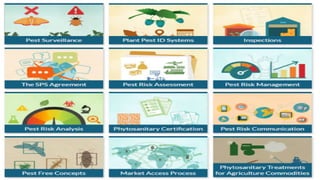
PEST RISK ANALYSIS
(PRA)
✩ By
✩ P.SRUTHIKA
Introduction:
✩ PRA is the process of evaluating biological or other scientific and
economic evidence to determine whether a pest should be regulated
and the strength of any phytosanitary measures to be taken against it.
Reason for doing PRA:
✩ To protect the country 's agriculture from damages that can be caused by
harmful pests which can be brought in along with imported commodities.
✩ To create lists of regulated pests and to produce lists of prohibited plants and
plant products.
✩ To assist in identifying appropriate management options.
PRA Process:
Stage 1 : INITIATION:
✩ New plant species imported for selection, scientific research purposes.
✩ Other pathways are natural spread,mail, garbage etc...
i) Identification of a pathway:
ii) Identification of a pest:
✩ Pest introduced or pest reported more damaging.
✩ Organism genetically altered in a way which clearly identifies its
potential as a plant pest.
iii) Review of existing policy:
✩ A national decision taken-review phytosanitary.
✩ A new treatment or loss of a treatment system,a new process,or new
information impacts on an earlier decision.
✩ Identify quarantine pests.
✩ Presence or absence in PRA area
✩ Regulatory status
✩ Categorise pests(do they occur in the pathway)
✩ Prepare data sheet.
Stage 2 :PEST RISK ASSESSMENT:
Step 1: Pest categorization:
Step 2: Assessment of Probability:
✩ Probability of survival during transport or storage.
✩ Probability of transfer to a suitable host
✩ Suitability of the environment for natural spread of pest
✩ Adaption, reproductive strategy, method of survival, previous establishment.
✩ Impact on productivity - quantitative and qualitative data (yield loss,increased
control cost).
✩ Impact on trade/market access(domestic, International).
✩ Analysis of economic consequences.
✩ Services of an Economist taken for estimating economic impact on a
hypothetical situation.
Step 3: Assessment of potential economic consequences:
Stage 3: PEST RISK MANAGEMENT:
✩ Assess the level of risk
✩ Collect technical information
✩ Acceptability of risk
✩ Identification and selection of appropriate risk management options
✩ Phytosanitary certificates.
Stage 4:DOCUMENTATION:
✩ Purpose of PRA:
❑ Pest,pest list, pathways ,PRA area, endangered area
❑ Sources of information
❑ Categorized pest list
✩ Conclusions of risk assessment:
❑ Probability
❑ Consequences
✩ Conclusion of risk management:
❑ Options identified
❑ Options selected
Conclusion:
✩ Quantitative or qualitative estimate of the probability of introduction
available and documented.
✩ Regional and International collaboration is vital to achieve reducing risk of
pest introduction and spread.
✩ GPS and GIS system
✩ Climate mapping
✩ Climographs
✩ Phenology factor
Risk Assessment modes:
THANK
YOU ...
Zoho Show
To create beautiful presentations, download Zoho Show from Play Store
https://zoho.to/cy7
Untitled Presentation.pdf
(This PDF has been generated using Zoho Show)

Presentation about pest risk analysis.pdf

  • 1.
  • 2.
    Introduction: ✩ PRA isthe process of evaluating biological or other scientific and economic evidence to determine whether a pest should be regulated and the strength of any phytosanitary measures to be taken against it. Reason for doing PRA: ✩ To protect the country 's agriculture from damages that can be caused by harmful pests which can be brought in along with imported commodities. ✩ To create lists of regulated pests and to produce lists of prohibited plants and plant products. ✩ To assist in identifying appropriate management options.
  • 3.
    PRA Process: Stage 1: INITIATION: ✩ New plant species imported for selection, scientific research purposes. ✩ Other pathways are natural spread,mail, garbage etc... i) Identification of a pathway: ii) Identification of a pest: ✩ Pest introduced or pest reported more damaging. ✩ Organism genetically altered in a way which clearly identifies its potential as a plant pest.
  • 4.
    iii) Review ofexisting policy: ✩ A national decision taken-review phytosanitary. ✩ A new treatment or loss of a treatment system,a new process,or new information impacts on an earlier decision. ✩ Identify quarantine pests. ✩ Presence or absence in PRA area ✩ Regulatory status ✩ Categorise pests(do they occur in the pathway) ✩ Prepare data sheet. Stage 2 :PEST RISK ASSESSMENT: Step 1: Pest categorization:
  • 5.
    Step 2: Assessmentof Probability: ✩ Probability of survival during transport or storage. ✩ Probability of transfer to a suitable host ✩ Suitability of the environment for natural spread of pest ✩ Adaption, reproductive strategy, method of survival, previous establishment. ✩ Impact on productivity - quantitative and qualitative data (yield loss,increased control cost). ✩ Impact on trade/market access(domestic, International). ✩ Analysis of economic consequences. ✩ Services of an Economist taken for estimating economic impact on a hypothetical situation. Step 3: Assessment of potential economic consequences:
  • 6.
    Stage 3: PESTRISK MANAGEMENT: ✩ Assess the level of risk ✩ Collect technical information ✩ Acceptability of risk ✩ Identification and selection of appropriate risk management options ✩ Phytosanitary certificates. Stage 4:DOCUMENTATION: ✩ Purpose of PRA: ❑ Pest,pest list, pathways ,PRA area, endangered area ❑ Sources of information ❑ Categorized pest list
  • 7.
    ✩ Conclusions ofrisk assessment: ❑ Probability ❑ Consequences ✩ Conclusion of risk management: ❑ Options identified ❑ Options selected
  • 9.
    Conclusion: ✩ Quantitative orqualitative estimate of the probability of introduction available and documented. ✩ Regional and International collaboration is vital to achieve reducing risk of pest introduction and spread. ✩ GPS and GIS system ✩ Climate mapping ✩ Climographs ✩ Phenology factor Risk Assessment modes:
  • 10.
  • 11.
    Zoho Show To createbeautiful presentations, download Zoho Show from Play Store https://zoho.to/cy7 Untitled Presentation.pdf (This PDF has been generated using Zoho Show)