Rhetoric: The Art of Persuasion (speaking and writing effectively)How much do you know?
Who persuades you?Television CommercialsRadio- “Don’t turn that dial”Presidential Election speechesBillboardsBumper StickersYou even use persuasion on your parents!
Who’s Aristotle?Aristotle : 384 BC- 322 BC	1. Greek Philosopher (a study concerned with ethics and reasoning among other things)	2. Student of Plato: another Greek philosopher“Rhetoric,” to Aristotle= “ability to see the available means of persuasion
Three Elements of Persuasion:	3 types of persuasive approaches1. Logos (Greek for “word”)- appeals to logic or reasoning provides evidence, statistics, proof2. Pathos (Greek for “suffering” or “experience”)- appeals to emotions3. Ethos (Greek for “character”)- proves you are reliable/credible source, proves you are someone worth listening to
3 Ways to Persuade!Using Logos (appealing to logic)- use facts/statistics/evidence to help support your argumentUsing Ethos (proves you are a reliable source)- try to find things you may have in common with your audience and build on themUsing Pathos (appealing to emotions)- use vivid words, figurative language, and imagery- make your audience feel what you are talking about
Relate & DevelopHow to RELATE to your audience & DEVELOP your argument further…Try using:ExamplesIllustrationsAnecdotes/short storiesQuotesComparisonsExpert opinions
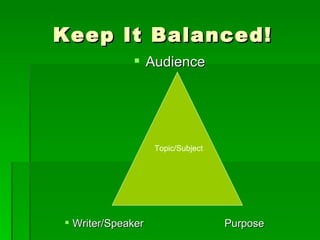
Keep It Balanced!AudienceWriter/Speaker			PurposeTopic/Subject
Know your audience!In order to be most effective, you must KNOW your audience.4 things you must know!1. Basic data: age, gender, education, occupation- How might these change your approach?2. Knowledge of the topic: Do your audience members already have knowledge about your topic?- How might this change your approach?3. Audience Attitude: Does your audience agree or oppose your topic?  Is the audience mixed or apathetic?- How might this change your approach?4. Audience Goal: What is the overall goal of your speech/writing? How might this change your approach?
Purpose StatementDecide your purpose in the beginning!Write a purpose statement which defines your main goal or objective for your speech/writing.This purpose statement will become your thesis statement!
ThesisThesis statement: the main point you are trying to make throughout your paper, it shows what you believe and where you stand on the topicAsk yourself… “What is the point of my work? What am I trying to prove?”Needs an implied “should,” ex: This novel needs to be carefully read for details about the author’s life.
Steps to writing a persuasive letterDetermine and define your audience  Define your purpose for writing  Decide what information to include  Outline how best to support your position & what reasons or benefits will the reader find convincing? Try to foresee the possible or potential objections of your readers  Discover if there are any special circumstances that you should keep in mind.
Then…Decide what you want your reader to do  Determine the objections that must be overcome  Make as strong a case as necessary  Use a direct request if your reader will have minimal objections  Ask immediately for the information or service you want  Give readers all the information they need  Tell readers what you want them to do  
Ways to prevent REJECTION!Catch the reader's interest by mentioning common ground  Define the problem you share  Explain the solution to the problem  Show that negative elements (cost, time) are outweighed by the benefits of acting  Summarize any additional benefits to acting  Tell readers exactly what you want them to do

Persuasive Writing

  • 1.
    Rhetoric: The Artof Persuasion (speaking and writing effectively)How much do you know?
  • 2.
    Who persuades you?TelevisionCommercialsRadio- “Don’t turn that dial”Presidential Election speechesBillboardsBumper StickersYou even use persuasion on your parents!
  • 3.
    Who’s Aristotle?Aristotle :384 BC- 322 BC 1. Greek Philosopher (a study concerned with ethics and reasoning among other things) 2. Student of Plato: another Greek philosopher“Rhetoric,” to Aristotle= “ability to see the available means of persuasion
  • 4.
    Three Elements ofPersuasion: 3 types of persuasive approaches1. Logos (Greek for “word”)- appeals to logic or reasoning provides evidence, statistics, proof2. Pathos (Greek for “suffering” or “experience”)- appeals to emotions3. Ethos (Greek for “character”)- proves you are reliable/credible source, proves you are someone worth listening to
  • 5.
    3 Ways toPersuade!Using Logos (appealing to logic)- use facts/statistics/evidence to help support your argumentUsing Ethos (proves you are a reliable source)- try to find things you may have in common with your audience and build on themUsing Pathos (appealing to emotions)- use vivid words, figurative language, and imagery- make your audience feel what you are talking about
  • 6.
    Relate & DevelopHowto RELATE to your audience & DEVELOP your argument further…Try using:ExamplesIllustrationsAnecdotes/short storiesQuotesComparisonsExpert opinions
  • 7.
  • 8.
    Know your audience!Inorder to be most effective, you must KNOW your audience.4 things you must know!1. Basic data: age, gender, education, occupation- How might these change your approach?2. Knowledge of the topic: Do your audience members already have knowledge about your topic?- How might this change your approach?3. Audience Attitude: Does your audience agree or oppose your topic? Is the audience mixed or apathetic?- How might this change your approach?4. Audience Goal: What is the overall goal of your speech/writing? How might this change your approach?
  • 9.
    Purpose StatementDecide yourpurpose in the beginning!Write a purpose statement which defines your main goal or objective for your speech/writing.This purpose statement will become your thesis statement!
  • 10.
    ThesisThesis statement: themain point you are trying to make throughout your paper, it shows what you believe and where you stand on the topicAsk yourself… “What is the point of my work? What am I trying to prove?”Needs an implied “should,” ex: This novel needs to be carefully read for details about the author’s life.
  • 11.
    Steps to writinga persuasive letterDetermine and define your audience  Define your purpose for writing  Decide what information to include  Outline how best to support your position & what reasons or benefits will the reader find convincing? Try to foresee the possible or potential objections of your readers  Discover if there are any special circumstances that you should keep in mind.
  • 12.
    Then…Decide what youwant your reader to do  Determine the objections that must be overcome  Make as strong a case as necessary  Use a direct request if your reader will have minimal objections  Ask immediately for the information or service you want  Give readers all the information they need  Tell readers what you want them to do  
  • 13.
    Ways to preventREJECTION!Catch the reader's interest by mentioning common ground  Define the problem you share  Explain the solution to the problem  Show that negative elements (cost, time) are outweighed by the benefits of acting  Summarize any additional benefits to acting  Tell readers exactly what you want them to do