By: Ade Tri Utami Kesumah Putri
Making Inferences
What is Inference?
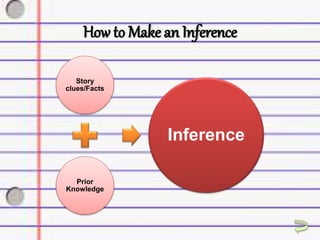
Howto Makean Inference
Example
The DifferencesbetweenPrediction
and Inference?
Conclusion
What is Inference?
• An inference is when we take clues from a
story plus what we already know from our
own experiences to decide what the author
means.
• Making inference is reading between a lines.
• Inference is reading all of the clues and
making your best guess.
• Inference is similar to prediction but they are
not the same.
• When inferring, you are using all clues to
draw conclusions about what is being read.
How to Make an Inference
Story
clues/Facts
Prior
Knowledge
Inference
Example
It was a lovely Sunday morning, and 10
year old David and 7 year old Mariah were
busy downstairs preparing breakfast for their
mother. They wanted to surprise her, so they
got up extra early to do this. On her plate
they put scrambled eggs, toast, bacon and
orange wedges. This was a lot of work,
thought Mariah. Good thing they only did
this once a year!
• Based on the information you’ve been given,
and your own prior knowledge, what can you
infer?
• Let’s look at the facts we’ve been given.
 It’s a Sunday morning.
 The children are making breakfast.
 They want to surprise her.
 They do this only once a year
• Based on these facts, what prior knowledge can
we apply?
• Think about what occurs only once a year, on a
Sunday, especially for mom, where her children
usually try to do something special for her.
• If you inferred that this special Sunday breakfast
event must be Mother’s Day, You’re correct!
The Differences between Prediction and Inference?
• When you make predictions, your prediction will
be proven by the end of the story. When inferring,
you may or may not know the answer to your
question by the end of the story.
• When predicting, you are focusing on what will
happen in the story. When inferring, you are
making a guess about what a character will do,
how a character feels, and other judgments.
• Prediction answered by the end of the story
• Inference may or may not be answered by the end
of the story
Conclusion
• An inference is a conclusion made by
connecting prior knowledge or known
information with new information when the
meaning is not obvious in the text, it is
sometimes reffered to as reading between line.
• When you make an inference, you need to do
more than gather the facts the author gives
you. You need to think about what those facts
mean. The author’s do not explain everything
in a story, so the reader must use the story
clues, their personal experience and their prior
knowledege to make inference.
Thanks For Your Attention


Making inference

  • 1.
    By: Ade TriUtami Kesumah Putri
  • 2.
    Making Inferences What isInference? Howto Makean Inference Example The DifferencesbetweenPrediction and Inference? Conclusion
  • 3.
    What is Inference? •An inference is when we take clues from a story plus what we already know from our own experiences to decide what the author means. • Making inference is reading between a lines. • Inference is reading all of the clues and making your best guess. • Inference is similar to prediction but they are not the same. • When inferring, you are using all clues to draw conclusions about what is being read.
  • 4.
    How to Makean Inference Story clues/Facts Prior Knowledge Inference
  • 5.
    Example It was alovely Sunday morning, and 10 year old David and 7 year old Mariah were busy downstairs preparing breakfast for their mother. They wanted to surprise her, so they got up extra early to do this. On her plate they put scrambled eggs, toast, bacon and orange wedges. This was a lot of work, thought Mariah. Good thing they only did this once a year!
  • 6.
    • Based onthe information you’ve been given, and your own prior knowledge, what can you infer? • Let’s look at the facts we’ve been given.  It’s a Sunday morning.  The children are making breakfast.  They want to surprise her.  They do this only once a year
  • 7.
    • Based onthese facts, what prior knowledge can we apply? • Think about what occurs only once a year, on a Sunday, especially for mom, where her children usually try to do something special for her. • If you inferred that this special Sunday breakfast event must be Mother’s Day, You’re correct!
  • 8.
    The Differences betweenPrediction and Inference? • When you make predictions, your prediction will be proven by the end of the story. When inferring, you may or may not know the answer to your question by the end of the story. • When predicting, you are focusing on what will happen in the story. When inferring, you are making a guess about what a character will do, how a character feels, and other judgments. • Prediction answered by the end of the story • Inference may or may not be answered by the end of the story
  • 9.
    Conclusion • An inferenceis a conclusion made by connecting prior knowledge or known information with new information when the meaning is not obvious in the text, it is sometimes reffered to as reading between line. • When you make an inference, you need to do more than gather the facts the author gives you. You need to think about what those facts mean. The author’s do not explain everything in a story, so the reader must use the story clues, their personal experience and their prior knowledege to make inference.
  • 10.
    Thanks For YourAttention 