The document provides guidelines for writing good paragraphs and essays, including the key components and structure. It explains that every paragraph should have an indented first line, a topic sentence, at least three pieces of supporting evidence, and a concluding sentence. Each body paragraph in an essay must also include a topic sentence, three supporting details and commentary, and a clincher sentence. Finally, the conclusion restates the thesis and offers additional insights or commentary.
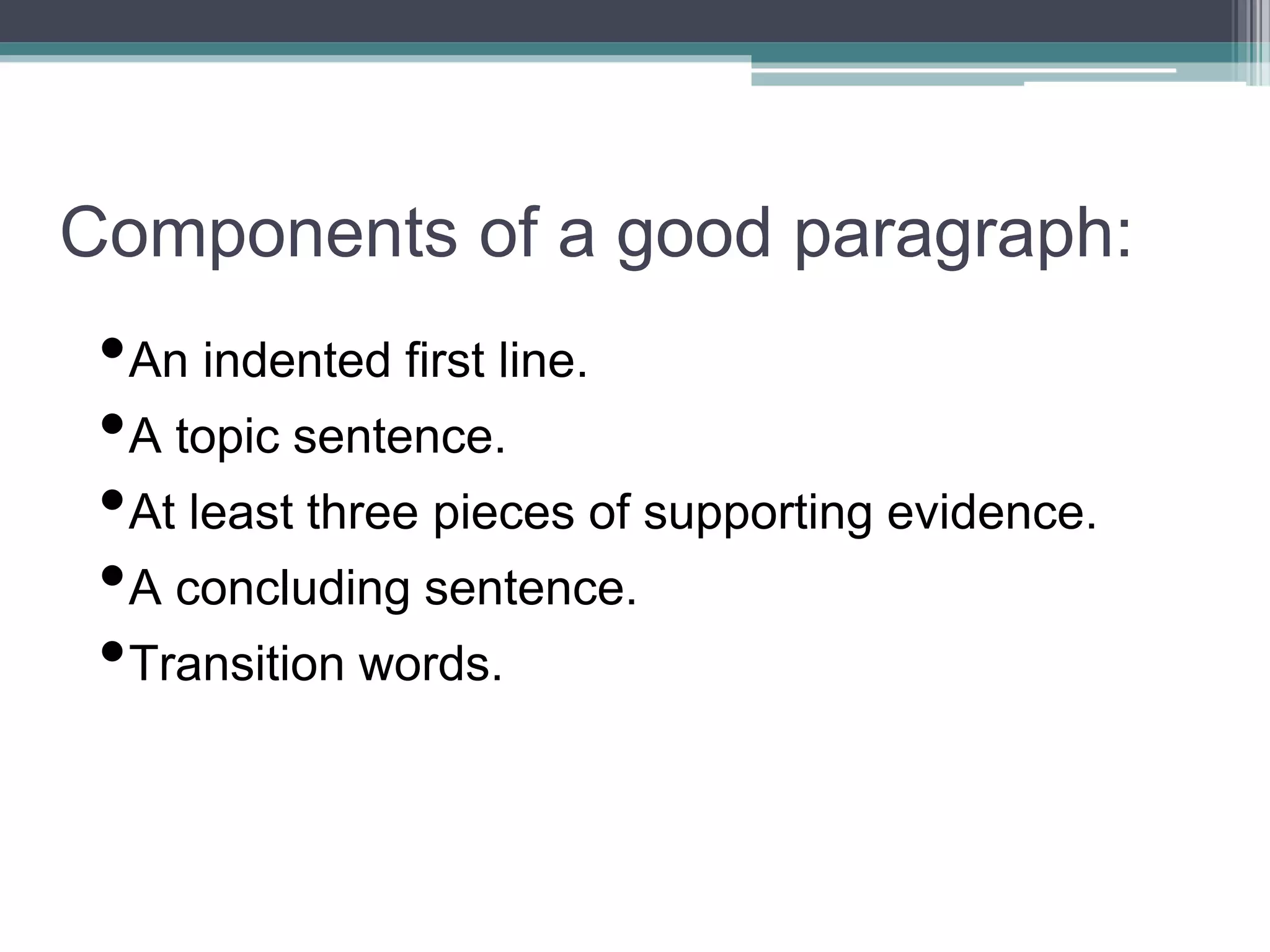
Components of agood paragraph:
•An indented first line.
•A topic sentence.
•At least three pieces of supporting evidence.
•A concluding sentence.
•Transition words.
3.
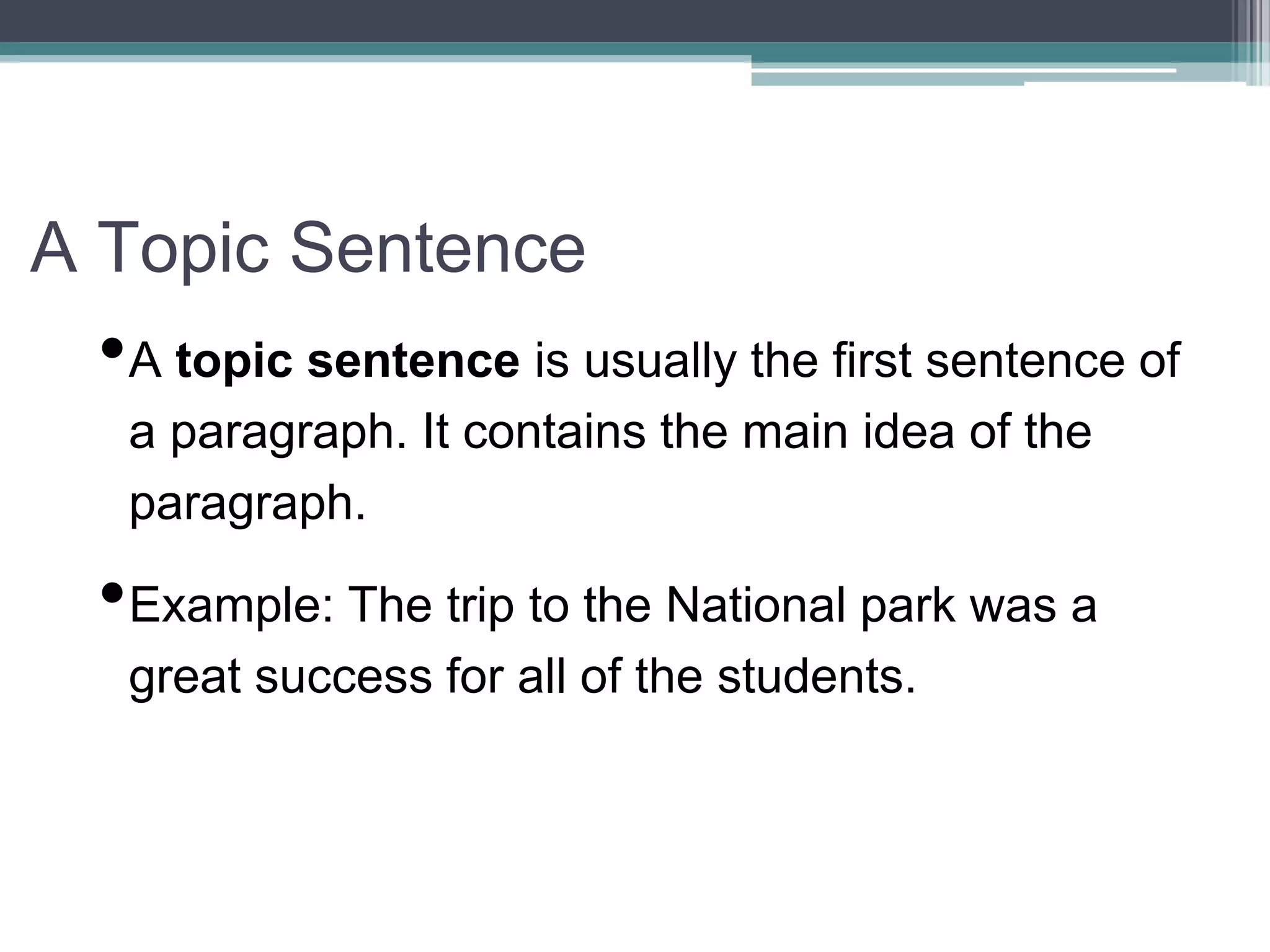
A Topic Sentence
•Atopic sentence is usually the first sentence of
a paragraph. It contains the main idea of the
paragraph.
•Example: The trip to the National park was a
great success for all of the students.
4.
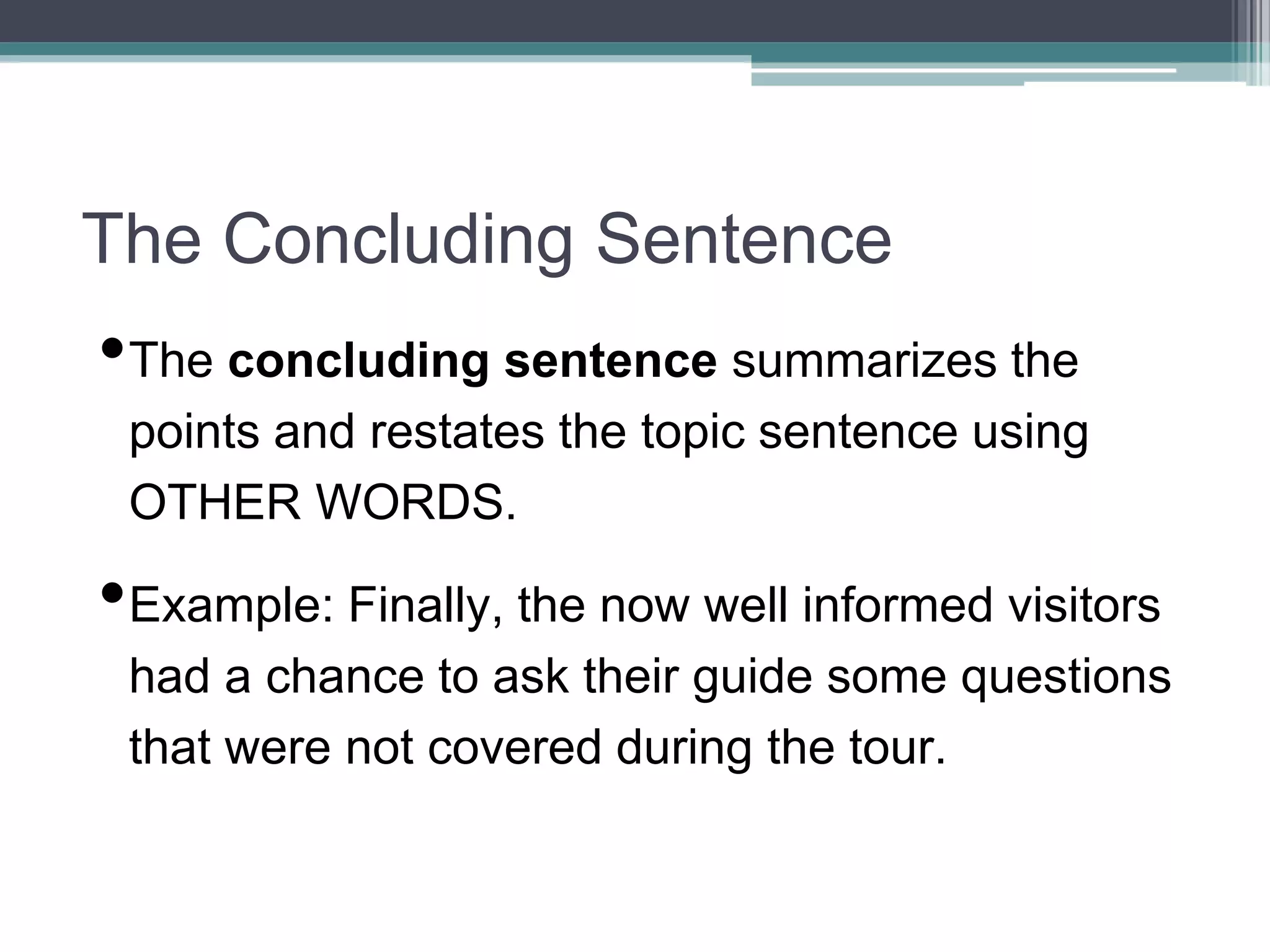
The Concluding Sentence
•Theconcluding sentence summarizes the
points and restates the topic sentence using
OTHER WORDS.
•Example: Finally, the now well informed visitors
had a chance to ask their guide some questions
that were not covered during the tour.
5.
Supporting Evidence
•Supporting evidenceincludes the facts,
examples, and reasons that support or prove the
topic sentence.
•Example: First, the visitors learned a lot from
their guide about the park. The guide informed
the group about how the park came to be named
the National park, the year it was named, and
how the land for the park was acquired.
6.
Transition Words
•Transition wordsare linking words that improve the
flow of the paragraph. Each sentence with
supporting evidence and the concluding sentence
will begin with the transition word.
•Example: First, second, third, also, however, as a
result, in conclusion, finally, then, after, meanwhile,
during, etc.
7.
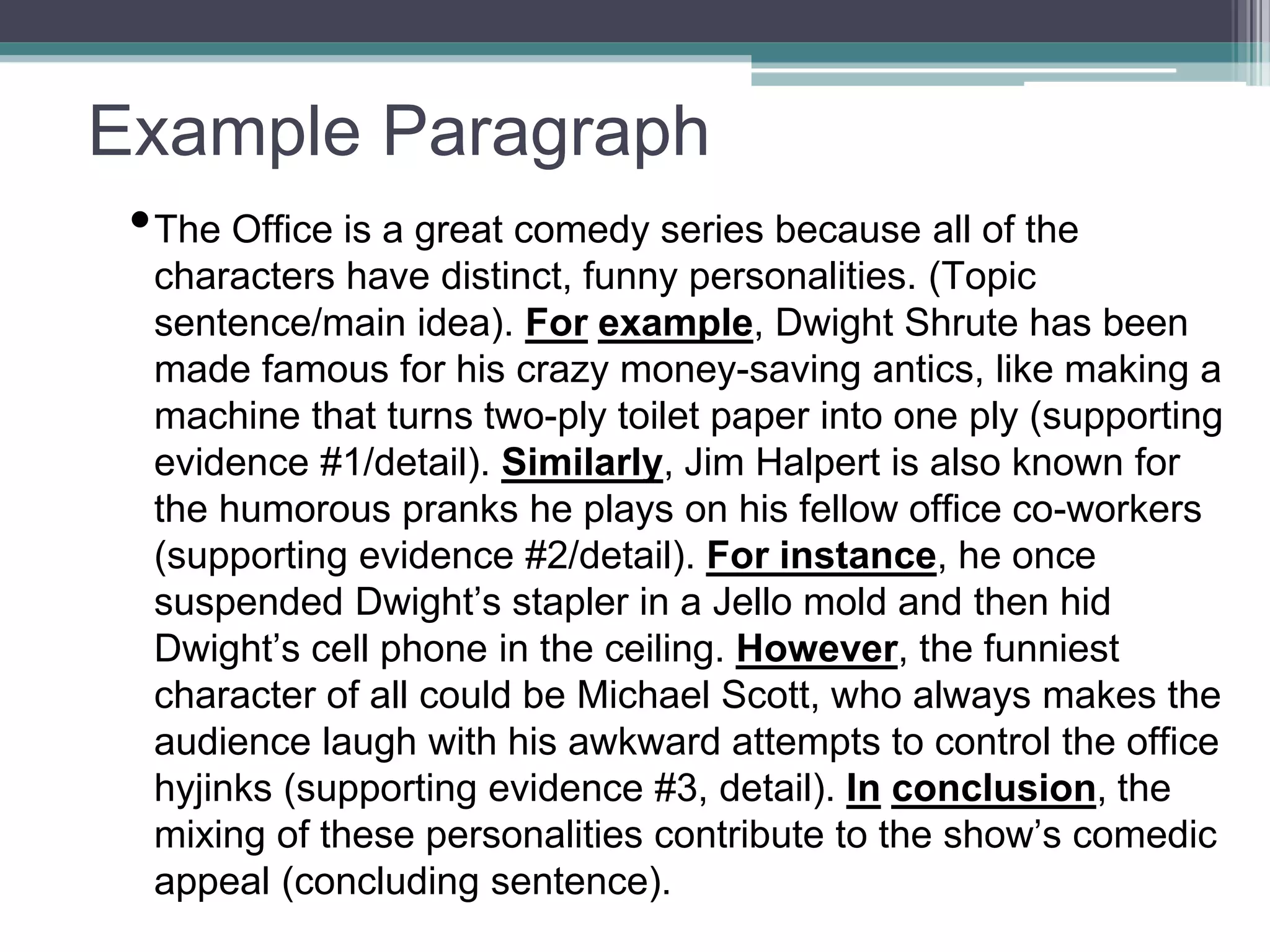
Example Paragraph
•The Officeis a great comedy series because all of the
characters have distinct, funny personalities. (Topic
sentence/main idea). For example, Dwight Shrute has been
made famous for his crazy money-saving antics, like making a
machine that turns two-ply toilet paper into one ply (supporting
evidence #1/detail). Similarly, Jim Halpert is also known for
the humorous pranks he plays on his fellow office co-workers
(supporting evidence #2/detail). For instance, he once
suspended Dwight’s stapler in a Jello mold and then hid
Dwight’s cell phone in the ceiling. However, the funniest
character of all could be Michael Scott, who always makes the
audience laugh with his awkward attempts to control the office
hyjinks (supporting evidence #3, detail). In conclusion, the
mixing of these personalities contribute to the show’s comedic
appeal (concluding sentence).
Introduction
•Gain the reader’sattention with a “hook”-some
effective “hooks” include interesting quotes,
description of a setting, or sensory detail.
•Provide background information on your topic;
e.g. the author, the title, a brief summary about
the topic.
•Write a thesis statement. A thesis statement is
like a roadmap for your audience. After reading it
your audience should have a good
10.
A Good ThesisStatement for A
Five Paragraph Essay Will:
•Address the prompt/idea that will make up your
paper.
•Has three parts, making clear what each body
paragraph will be about.
•Is well focused, concise, and specific.
11.
The Body Paragraphs
•Thebody of the essay is where the ideas that
were introduced in the thesis are developed.
Each of the three body paragraphs supports one
of the three parts of the thesis statements.
•Think of each paragraph as a “mini essay”. Each
one has a topic sentence (like the
introduction/thesis statement), three concrete
details with evidence to support that sentence
(like the three body paragraphs), and a “clincher”
like the conclusion.
12.
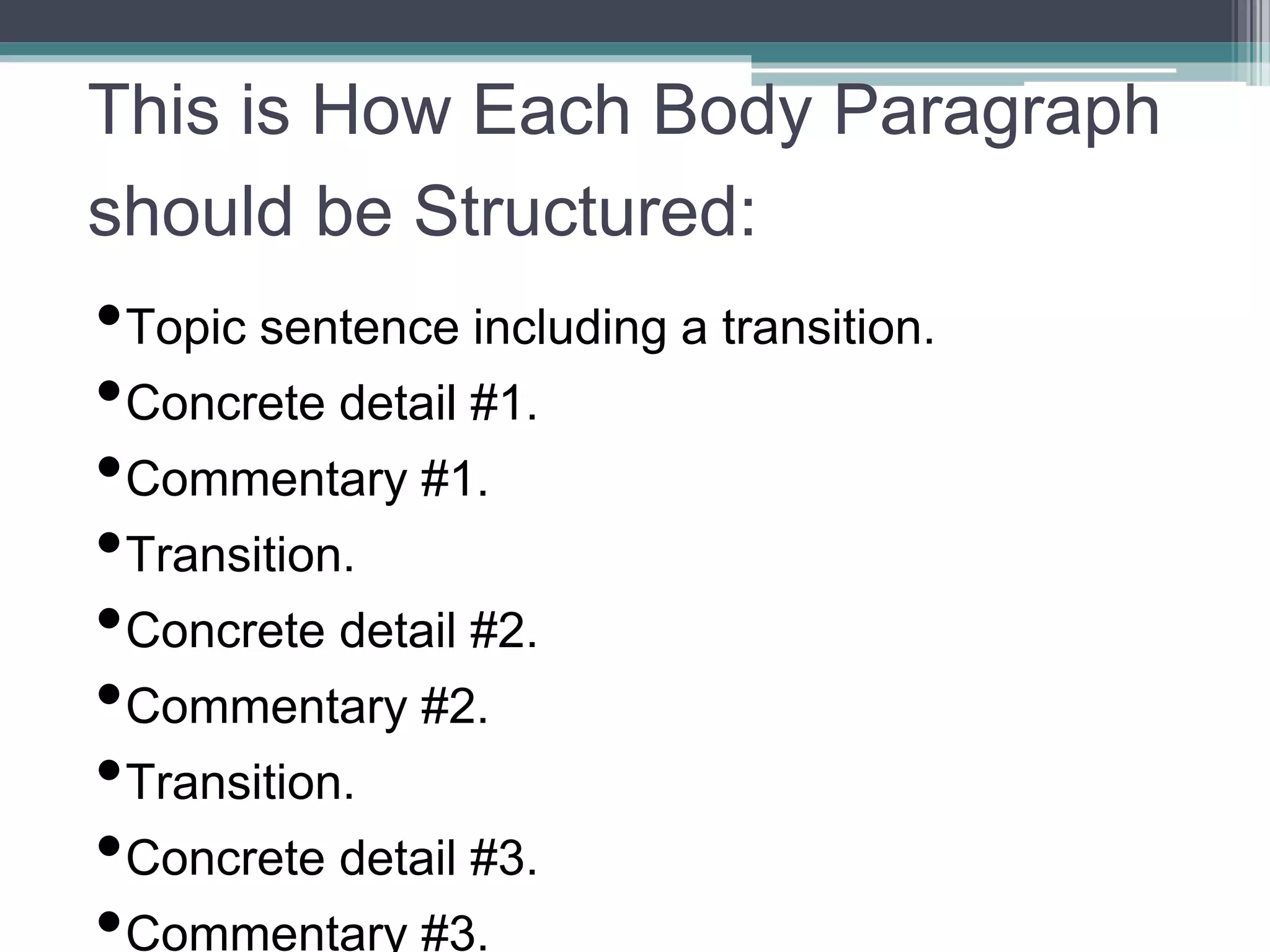
This is HowEach Body Paragraph
should be Structured:
•Topic sentence including a transition.
•Concrete detail #1.
•Commentary #1.
•Transition.
•Concrete detail #2.
•Commentary #2.
•Transition.
•Concrete detail #3.
•Commentary #3.
13.
Topic Sentence
•Usually thefirst sentence.
•Includes a transition.
•States the main idea and controls the focus of
the paragraph.
•Is more general than the concrete details that
follow.
14.
Commentary
•The analysis orinterpretation of the concrete
detail.
•Explains how or why the concrete detail supports
the topic sentence.
15.
Transition
•A word, phrase,or sentence that logically
connects the first concrete detail/commentary
pair to the next concrete detail/commentary pair.
•Should also be used in the topic sentences to
connect one body paragraph to the next.
Conclusion
•Restate the thesis.
•Gobeyond the thesis by adding something
worthwhile and creative. You could:
1.Reach a judgment.
2.Endorse or oppose an issue.
3.Discuss findings.
4.Offer an explanation or insight based on your
findings.
18.
Concrete Details:
•Evidence thatsupports the topic sentence’s
main idea.
•It can be an occurrence, description, definition,
exploration, or example.
•If the essay is about a literary work, the concrete
should include or be a direct quote from the
work.
•Either way the detail must be specific.