Persuasive Writing‘We want students to have opinions, to be passionate about these opinions, and to defend them with strong, well thought out and elaborated arguments’Lane and Bernabei
Persuasive WritingWriting that involves reasoning, evaluation and persuasion.
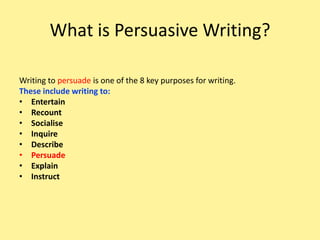
What is Persuasive Writing?Writing to persuade is one of the 8 key purposes for writing.These include writing to:EntertainRecountSocialiseInquireDescribePersuadeExplainInstruct
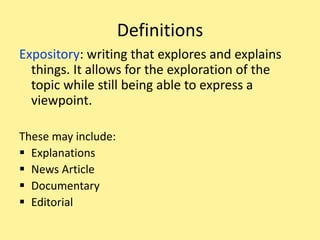
DefinitionsExpository: writing that explores and explains things. It allows for the exploration of the topic while still being able to express a viewpoint.These may include:Explanations
News Article
Documentary
EditorialDefinitionsPersuasive: writing in which the writer needs to convince someone of his or her view or opinion. It requires the use of a variety of persuasive language.The Exposition is an example of a persuasive text.
DefinitionsDiscussion: writing where both sides of a topic or issue are presented. An author position may or may not be stated.
Q: What is Persuasive Writing?    A: Persuasive writing is writing in which the writer needs to convince the reader of his or her point of view or opinion. For example, a student may be asked whether reading books or watching TV is better. The student’s answer would present his or her opinion on this topic and would include reasons for that opinion. In writing the text, the student is attempting to persuade the reader to agree with his or her opinion. http://www.naplan.edu.au/faqs/writing_2011_faqs.html#Whatisagenre
Arguing to PersuadeArguing to persuade another person to our point of view is a fundamental language process throughout all the years of schooling that was once delegated to secondary teachers to teach.If we accept this, what are the implications for  our teaching?
What is a Persuasive Text?Each time a child is asked to:Give an opinion of a story
Write about a topical issue and give a reason/s
Give a viewpoint...    he or she will be thinking, talking or writing a persuasive text.
Understanding Texts that Persuade.
Grammatical Features of Persuasive TextMental Verbs (Thinking Verbs)E.g.  I like swimming.We believe that canteens should sell junk food.
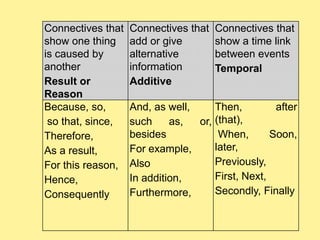
Grammatical Features cont.Connectives– used to link logical relationships.Temporal – used to order prepositions in the preview or at other stages in a more complex argument.E.g.Firstlymany people can suffer from shortness of breath due to smoking and secondly it can aggravate asthma.Grammatical Features contCausalConnectives… link points in the argumentThe birds died because they were covered in oil.One thing happened as a direct result of something else.
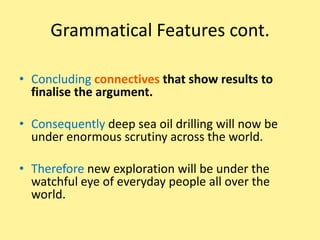
Grammatical Features cont.Concludingconnectives that show results to finalise the argument.
Consequently deep sea oil drilling will now be under enormous scrutiny across the world.
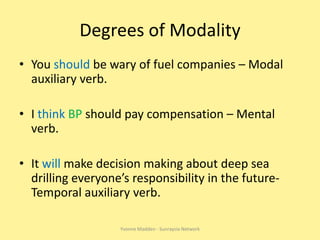
Therefore new exploration will be under the watchful eye of everyday people all over the world.You should be wary of fuel companies – Modal auxiliary verb.
I thinkBP should pay compensation – Mental verb.
It will make decision making about deep sea drilling everyone’s responsibility in the future- Temporal auxiliary verb.Degrees of ModalityYvonne Madden - Sunraysia Network
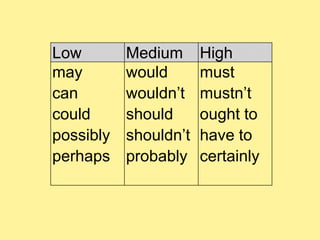
You could ride your bike across the country.Since all dogs are mammals, this golden retriever must be a mammal.You might consider finishing your degree.I will finish my essay tonight even if I have to forgo sleep.The puppy can sit on command.I would eat cereal every day as a child.You may encounter some difficult patrons on occasion.The train should arrive in a few minutes.The situation would not be so bad if we all remained calm.I will have earned enough to buy that bike next monthIdentify the modality words, change the low modality statements to high.
The process of nominalisation turns verbs (actions or events) into nouns (things, concepts or people).
The text is now no longer describing actions: it is focused on objects or concepts; for example:       We walked for charity.       The verb 'walked' has been nominalised to the noun 'walk'      The charity walk ..... NominalisationsYvonne Madden - Sunraysia Network
When a verb is nominalised, it becomes a concept rather than an action. As a consequence, the tone of  writing will sound more abstract and also more formal; for example: We walked for charity. We raised money for the Leukemia Foundation. The charity walk raised money for the Leukemia Foundation.
Crime was increasing rapidly and the police were becoming concerned. The rapid increase in crime was causing concern among the police. Germany invaded Poland in 1939. This was the immediate cause of the Second World War breaking out. Germany's invasion of Poland in 1939 was the immediate cause of the outbreak of the Second World War.
Grammatical Features cont.Movement from Personal to Impersonal Voice.Personal voice for a subjective opinion.E.g.I think deep sea oil drilling should be banned.Impersonal voice for an objective opinionE.g.People should all be very concerned.  Absolute statement.
It could take years for the oil spill to be cleaned up. Modalised statementStructure of a Persuasive Text (Exposition)1. Point of view is stated2. Justification of arguments in a logical order3. Summing up of argument and restating position
Where do we begin?
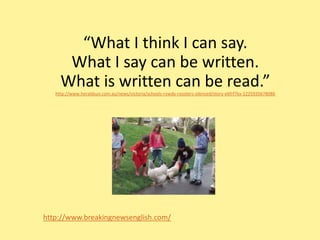
“What I think I can say.What I say can be written.What is written can be read.”http://www.heraldsun.com.au/news/victoria/schools-rowdy-roosters-silenced/story-e6frf7kx-1225935678086http://www.breakingnewsenglish.com/
The resources used in speech are a part of every day life. The resources used for effective spoken persuasive arguments need to be tapped and translated into the written word as well.The spoken skills therefore need to be applied to the written skills.The Link to Speaking and Listening Yvonne Madden - Sunraysia Network
Using fiction to help students understand point of view.Click Clack Moo‘You never really understand a person until you consider things from his point of view... Until you climb into his skin and walk around it.’ Atticus to Scout in To Kill a Mockingbird.
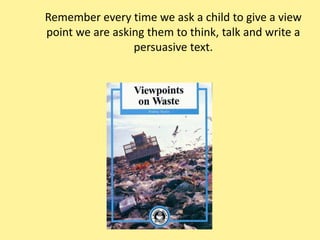
Remember every time we ask a child to give a view point we are asking them to think, talk and write a persuasive text.
If a students can express themselves and express their opinion they can argue in writing.   An early years example may be -“I did not like that movie because it is scary”.An initial understanding is the ability to understand the concept of causality by using words like ‘because’.Who can persuade?
At Prep level there is a sequence to encourageProposition followed by elaboration – I like ...because...
Description of a proposition.Think of where to start with early writersGather students opinions on multiple issuesAND ask “WHY do you think that way?”Early writingYvonne Madden - Sunraysia Network
I like elephants (proposition) because they protect their babies like humans. (elaboration).
Bike riders must wear light colours and use a helmet when riding their bikes (proposition) so that drivers can see them easily and so that their head is protected if they fall off. (two elaborations).
Kids should not smoke cigarettes (proposition) because the health hazards are too great.(elaboration)Examples of propositions followed by elaborationYvonne Madden - Sunraysia Network
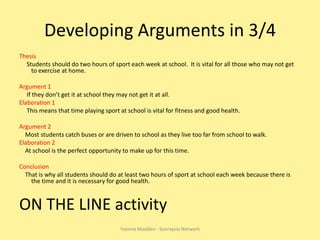
Thesis     Students should do two hours of sport each week at school.  It is vital for all those who may not get to exercise at home.Argument 1      If they don’t get it at school they may not get it at all.Elaboration 1     This means that time playing sport at school is vital for fitness and good health.Argument 2    Most students catch buses or are driven to school as they live too far from school to walk.Elaboration 2    At school is the perfect opportunity to make up for this time.Conclusion That is why all students should do at least two hours of sport at school each week because there is the time and it is necessary for good health.ON THE LINE activityDeveloping Arguments in 3/4Yvonne Madden - Sunraysia Network
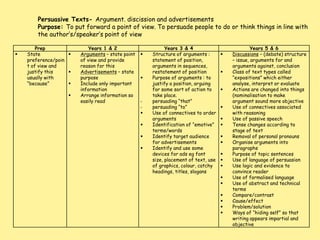
Persuasive Texts- Argument. discission and advertisementsPurpose: To put forward a point of view. To persuade people to do or think things in line with the author’s/speaker’s point of view
Scaffolding Persuasive Writing through the ‘Gradual Release of Responsibility’ Model
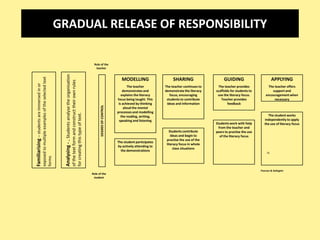
GRADUAL RELEASE OF RESPONSIBILITYRole of the teacherFamiliarising – students are immersed in or exposed to multiple examples of the selected text formsAnalysing - . Students analyse the organisation of the text form and construct their own rules for creating this type of text.MODELLINGThe teacher demonstrates and explains the literacy focus being taught. This is achieved by thinking aloud the mental processes and modelling the reading, writing, speaking and listeningSHARINGThe teacher continues to demonstrate the literacy focus, encouraging students to contribute ideas and informationGUIDINGThe teacher provides scaffolds for students to use the literacy focus. Teacher provides feedbackAPPLYINGThe teacher offers support and encouragement when necessaryThe student works independently to apply the use of literacy focusDEGREE OF CONTROLStudents work with help from the teacher and peers to practise the use of the literacy focusStudents contribute ideas and begin to practise the use of the literacy focus in whole class situationsThe student participates by actively attending to the demonstrations35Pearson & GallagherRole of the student
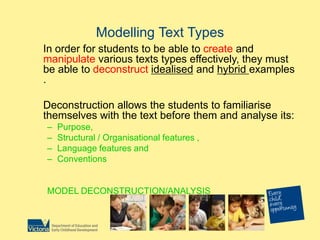
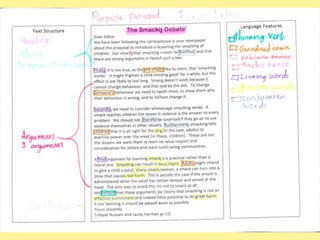
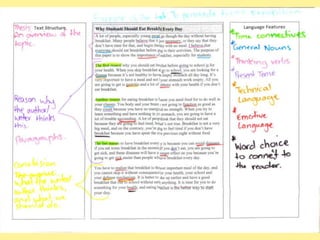
Modelling Text Types	In order for students to be able to create and manipulate various texts types effectively, they must be able to deconstructidealised and hybrid examples . 	Deconstruction allows the students to familiarise themselves with the text before them and analyse its:Purpose, Structural / Organisational features , Language features and Conventions   MODEL DECONSTRUCTION/ANALYSIS
Reading into writing(c) 2005, Rodney Martin37Writing is a more complex and sophisticated skill than reading. There are more proficient readers in the world than there are proficient writers.Children find it easier to unpack the trade secrets of writing if they can observe the techniques first in a simplified format.Therefore, use text models far simpler than children’s reading level to demonstrate the act and process of writing and the thinking behind it.
Reading into writing(c) 2005, Rodney Martin38Big Book text models give teachers  ways to show children how to write. In Shared or Modelled Writing, the teacher demonstrates how a writer thinks and acts in the process of writing. In this sense, the teacher is a model.Invite children to join in the process – in a sense, act like their editor.
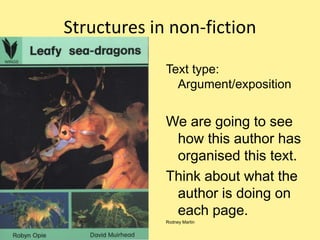
Structures in non-fictionText type: Argument/expositionWe are going to see how this author has organised this text.Think about what the author is doing on each page.Rodney Martin
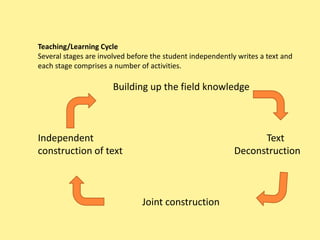
Genre Learning and Teaching cycle – used for any piece of writing related to any domain of the VELS, having three steps: joint deconstruction, joint construction and individual construction 	http://www.eduweb.vic.gov.au/edulibrary/public/teachlearn/student/keycharliteracyp6.pdf

Persuasive

  • 1.
    Persuasive Writing‘We wantstudents to have opinions, to be passionate about these opinions, and to defend them with strong, well thought out and elaborated arguments’Lane and Bernabei
  • 2.
    Persuasive WritingWriting thatinvolves reasoning, evaluation and persuasion.
  • 3.
    What is PersuasiveWriting?Writing to persuade is one of the 8 key purposes for writing.These include writing to:EntertainRecountSocialiseInquireDescribePersuadeExplainInstruct
  • 4.
    DefinitionsExpository: writing thatexplores and explains things. It allows for the exploration of the topic while still being able to express a viewpoint.These may include:Explanations
  • 5.
  • 6.
  • 7.
    EditorialDefinitionsPersuasive: writing inwhich the writer needs to convince someone of his or her view or opinion. It requires the use of a variety of persuasive language.The Exposition is an example of a persuasive text.
  • 8.
    DefinitionsDiscussion: writing whereboth sides of a topic or issue are presented. An author position may or may not be stated.
  • 9.
    Q: What isPersuasive Writing? A: Persuasive writing is writing in which the writer needs to convince the reader of his or her point of view or opinion. For example, a student may be asked whether reading books or watching TV is better. The student’s answer would present his or her opinion on this topic and would include reasons for that opinion. In writing the text, the student is attempting to persuade the reader to agree with his or her opinion. http://www.naplan.edu.au/faqs/writing_2011_faqs.html#Whatisagenre
  • 10.
    Arguing to PersuadeArguingto persuade another person to our point of view is a fundamental language process throughout all the years of schooling that was once delegated to secondary teachers to teach.If we accept this, what are the implications for our teaching?
  • 11.
    What is aPersuasive Text?Each time a child is asked to:Give an opinion of a story
  • 12.
    Write about atopical issue and give a reason/s
  • 13.
    Give a viewpoint... he or she will be thinking, talking or writing a persuasive text.
  • 14.
  • 15.
    Grammatical Features ofPersuasive TextMental Verbs (Thinking Verbs)E.g. I like swimming.We believe that canteens should sell junk food.
  • 16.
    Grammatical Features cont.Connectives–used to link logical relationships.Temporal – used to order prepositions in the preview or at other stages in a more complex argument.E.g.Firstlymany people can suffer from shortness of breath due to smoking and secondly it can aggravate asthma.Grammatical Features contCausalConnectives… link points in the argumentThe birds died because they were covered in oil.One thing happened as a direct result of something else.
  • 18.
    Grammatical Features cont.Concludingconnectivesthat show results to finalise the argument.
  • 19.
    Consequently deep seaoil drilling will now be under enormous scrutiny across the world.
  • 20.
    Therefore new explorationwill be under the watchful eye of everyday people all over the world.You should be wary of fuel companies – Modal auxiliary verb.
  • 21.
    I thinkBP shouldpay compensation – Mental verb.
  • 22.
    It will makedecision making about deep sea drilling everyone’s responsibility in the future- Temporal auxiliary verb.Degrees of ModalityYvonne Madden - Sunraysia Network
  • 24.
    You could rideyour bike across the country.Since all dogs are mammals, this golden retriever must be a mammal.You might consider finishing your degree.I will finish my essay tonight even if I have to forgo sleep.The puppy can sit on command.I would eat cereal every day as a child.You may encounter some difficult patrons on occasion.The train should arrive in a few minutes.The situation would not be so bad if we all remained calm.I will have earned enough to buy that bike next monthIdentify the modality words, change the low modality statements to high.
  • 25.
    The process ofnominalisation turns verbs (actions or events) into nouns (things, concepts or people).
  • 26.
    The text isnow no longer describing actions: it is focused on objects or concepts; for example: We walked for charity. The verb 'walked' has been nominalised to the noun 'walk' The charity walk ..... NominalisationsYvonne Madden - Sunraysia Network
  • 27.
    When a verbis nominalised, it becomes a concept rather than an action. As a consequence, the tone of writing will sound more abstract and also more formal; for example: We walked for charity. We raised money for the Leukemia Foundation. The charity walk raised money for the Leukemia Foundation.
  • 28.
    Crime was increasingrapidly and the police were becoming concerned. The rapid increase in crime was causing concern among the police. Germany invaded Poland in 1939. This was the immediate cause of the Second World War breaking out. Germany's invasion of Poland in 1939 was the immediate cause of the outbreak of the Second World War.
  • 29.
    Grammatical Features cont.Movementfrom Personal to Impersonal Voice.Personal voice for a subjective opinion.E.g.I think deep sea oil drilling should be banned.Impersonal voice for an objective opinionE.g.People should all be very concerned. Absolute statement.
  • 30.
    It could takeyears for the oil spill to be cleaned up. Modalised statementStructure of a Persuasive Text (Exposition)1. Point of view is stated2. Justification of arguments in a logical order3. Summing up of argument and restating position
  • 31.
  • 32.
    “What I thinkI can say.What I say can be written.What is written can be read.”http://www.heraldsun.com.au/news/victoria/schools-rowdy-roosters-silenced/story-e6frf7kx-1225935678086http://www.breakingnewsenglish.com/
  • 33.
    The resources usedin speech are a part of every day life. The resources used for effective spoken persuasive arguments need to be tapped and translated into the written word as well.The spoken skills therefore need to be applied to the written skills.The Link to Speaking and Listening Yvonne Madden - Sunraysia Network
  • 34.
    Using fiction tohelp students understand point of view.Click Clack Moo‘You never really understand a person until you consider things from his point of view... Until you climb into his skin and walk around it.’ Atticus to Scout in To Kill a Mockingbird.
  • 35.
    Remember every timewe ask a child to give a view point we are asking them to think, talk and write a persuasive text.
  • 36.
    If a studentscan express themselves and express their opinion they can argue in writing. An early years example may be -“I did not like that movie because it is scary”.An initial understanding is the ability to understand the concept of causality by using words like ‘because’.Who can persuade?
  • 37.
    At Prep levelthere is a sequence to encourageProposition followed by elaboration – I like ...because...
  • 38.
    Description of aproposition.Think of where to start with early writersGather students opinions on multiple issuesAND ask “WHY do you think that way?”Early writingYvonne Madden - Sunraysia Network
  • 39.
    I like elephants(proposition) because they protect their babies like humans. (elaboration).
  • 40.
    Bike riders mustwear light colours and use a helmet when riding their bikes (proposition) so that drivers can see them easily and so that their head is protected if they fall off. (two elaborations).
  • 41.
    Kids should notsmoke cigarettes (proposition) because the health hazards are too great.(elaboration)Examples of propositions followed by elaborationYvonne Madden - Sunraysia Network
  • 42.
    Thesis Students should do two hours of sport each week at school. It is vital for all those who may not get to exercise at home.Argument 1 If they don’t get it at school they may not get it at all.Elaboration 1 This means that time playing sport at school is vital for fitness and good health.Argument 2 Most students catch buses or are driven to school as they live too far from school to walk.Elaboration 2 At school is the perfect opportunity to make up for this time.Conclusion That is why all students should do at least two hours of sport at school each week because there is the time and it is necessary for good health.ON THE LINE activityDeveloping Arguments in 3/4Yvonne Madden - Sunraysia Network
  • 43.
    Persuasive Texts- Argument.discission and advertisementsPurpose: To put forward a point of view. To persuade people to do or think things in line with the author’s/speaker’s point of view
  • 44.
    Scaffolding Persuasive Writingthrough the ‘Gradual Release of Responsibility’ Model
  • 45.
    GRADUAL RELEASE OFRESPONSIBILITYRole of the teacherFamiliarising – students are immersed in or exposed to multiple examples of the selected text formsAnalysing - . Students analyse the organisation of the text form and construct their own rules for creating this type of text.MODELLINGThe teacher demonstrates and explains the literacy focus being taught. This is achieved by thinking aloud the mental processes and modelling the reading, writing, speaking and listeningSHARINGThe teacher continues to demonstrate the literacy focus, encouraging students to contribute ideas and informationGUIDINGThe teacher provides scaffolds for students to use the literacy focus. Teacher provides feedbackAPPLYINGThe teacher offers support and encouragement when necessaryThe student works independently to apply the use of literacy focusDEGREE OF CONTROLStudents work with help from the teacher and peers to practise the use of the literacy focusStudents contribute ideas and begin to practise the use of the literacy focus in whole class situationsThe student participates by actively attending to the demonstrations35Pearson & GallagherRole of the student
  • 46.
    Modelling Text Types Inorder for students to be able to create and manipulate various texts types effectively, they must be able to deconstructidealised and hybrid examples . Deconstruction allows the students to familiarise themselves with the text before them and analyse its:Purpose, Structural / Organisational features , Language features and Conventions MODEL DECONSTRUCTION/ANALYSIS
  • 47.
    Reading into writing(c)2005, Rodney Martin37Writing is a more complex and sophisticated skill than reading. There are more proficient readers in the world than there are proficient writers.Children find it easier to unpack the trade secrets of writing if they can observe the techniques first in a simplified format.Therefore, use text models far simpler than children’s reading level to demonstrate the act and process of writing and the thinking behind it.
  • 48.
    Reading into writing(c)2005, Rodney Martin38Big Book text models give teachers ways to show children how to write. In Shared or Modelled Writing, the teacher demonstrates how a writer thinks and acts in the process of writing. In this sense, the teacher is a model.Invite children to join in the process – in a sense, act like their editor.
  • 49.
    Structures in non-fictionTexttype: Argument/expositionWe are going to see how this author has organised this text.Think about what the author is doing on each page.Rodney Martin
  • 50.
    Genre Learning andTeaching cycle – used for any piece of writing related to any domain of the VELS, having three steps: joint deconstruction, joint construction and individual construction http://www.eduweb.vic.gov.au/edulibrary/public/teachlearn/student/keycharliteracyp6.pdf