New Skill
Summarize
Students will be ble to:
1- Define summarizing.
2- ummarize any paragraph they pass by.
Objectives
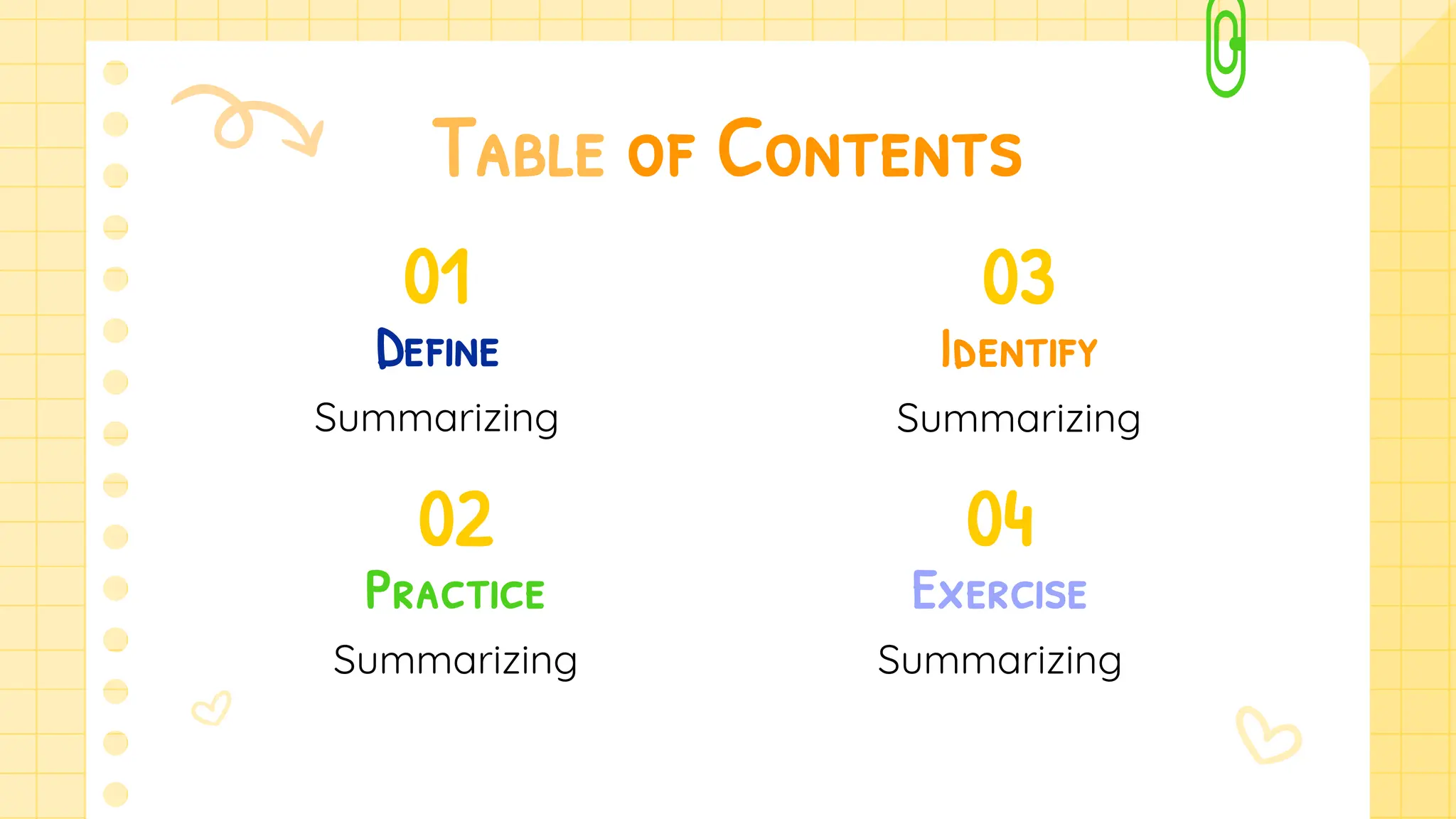
Table of Contents
01
Define
03
Identify
02
Practice
04
Exercise
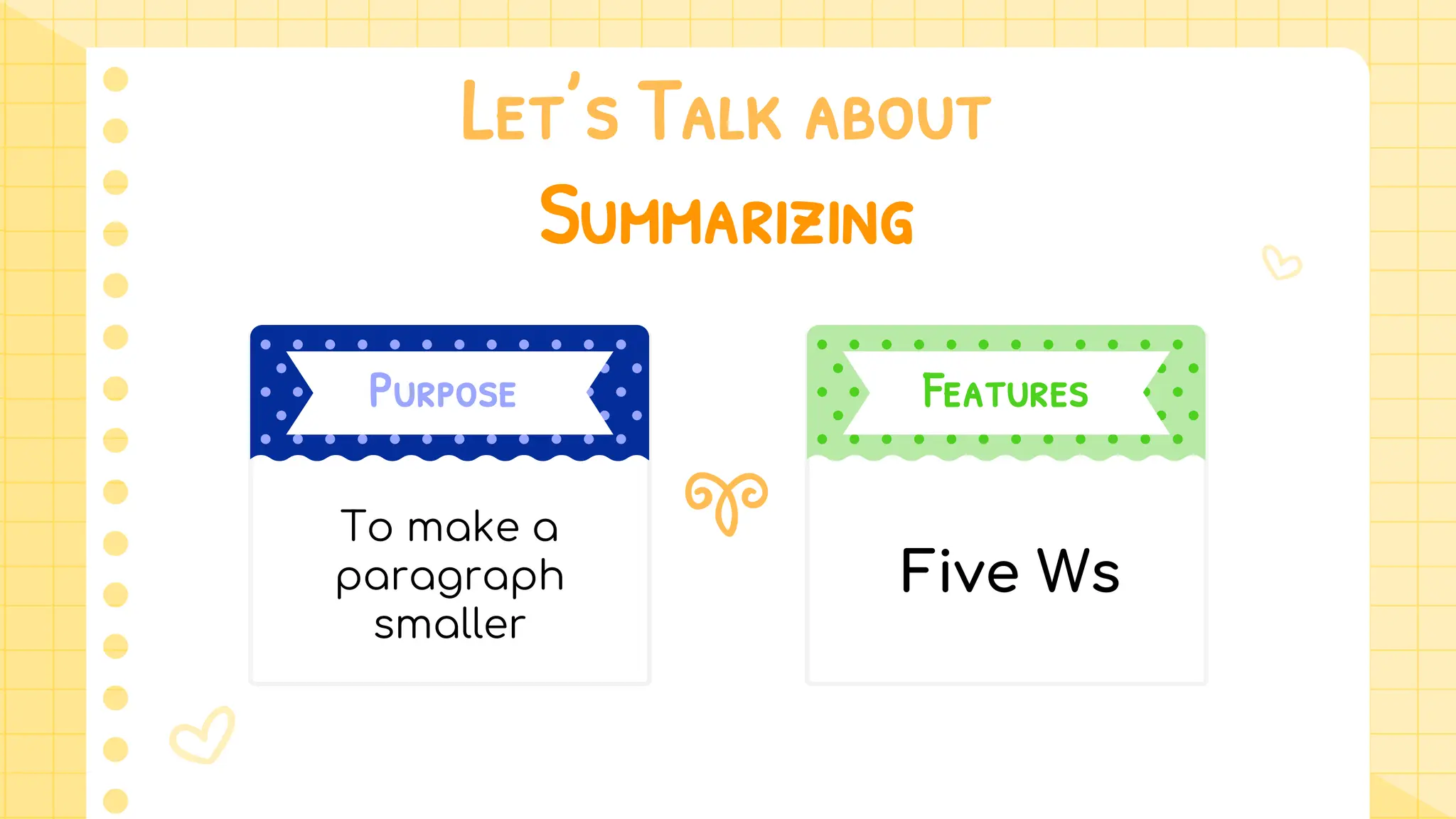
Let’s Talk about
Summarizing
To make a
paragraph
smaller
Purpose
Five Ws
Features
Define What is ?
01
Define Summarizing !
What is summarizing ?
Pay Attention :
Summaries are not a place for…
Short account of the central
ideas of a text
 Opinions
 Background knowledge
 Personal information
Identify Steps
02
How To Summarize ?
1- Read the text.
2- Don’t let big words scare you.
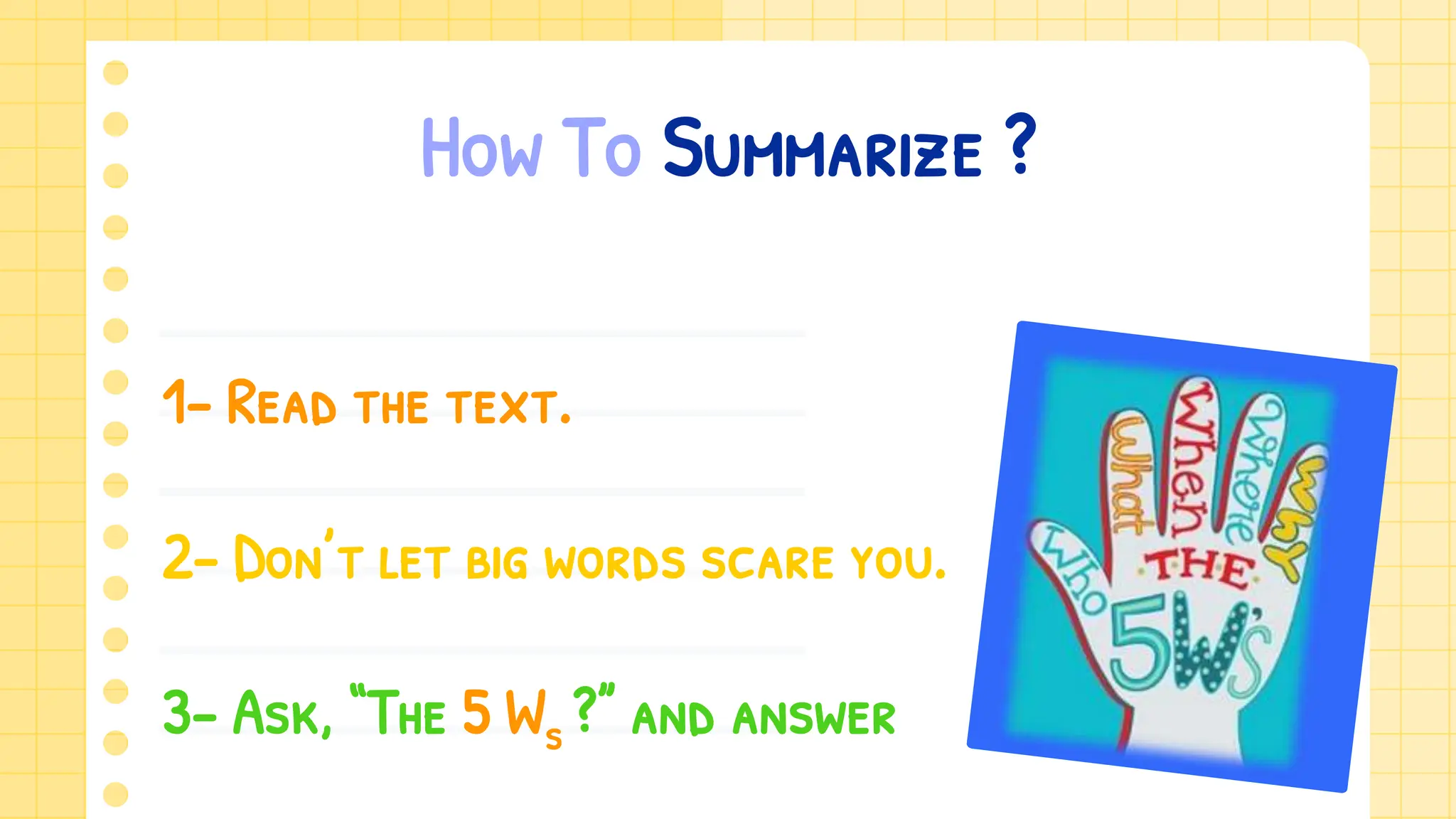
3- Ask, “The 5 Ws ?” and answer
How to Summarize ? 5 Ws
Start your
summarizing with:
Checking the characters
of the paragraph / text /
story you are reading.
Who
Ask about the
characters.
How to Summarize ?
Continue your
summarizing with:
Checking what
happened in the story:
The event
What
Ask about the
event.
How to Summarize ?
Continue your
summarizing with:
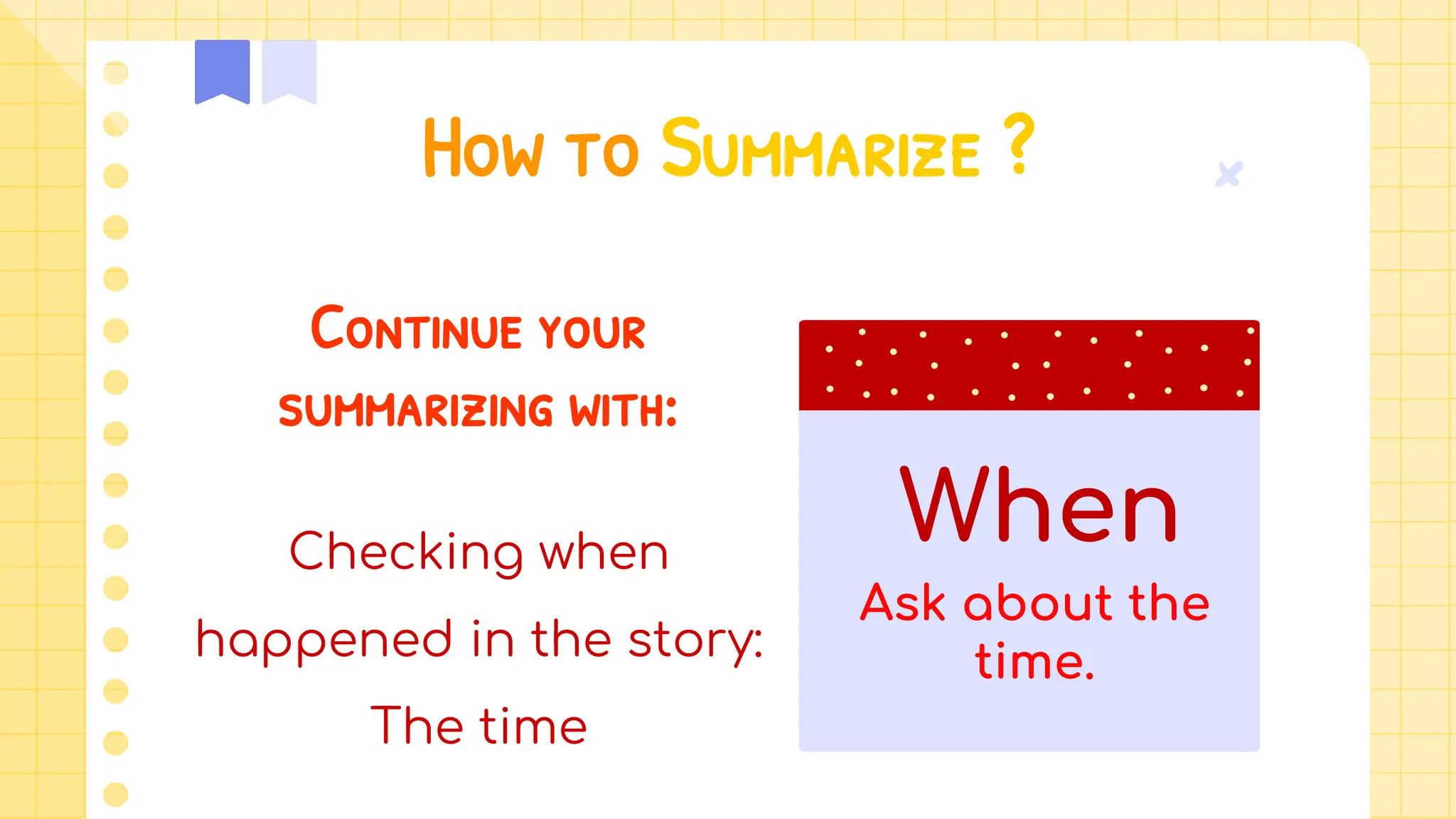
Checking when
happened in the story:
The time
When
Ask about the
time.
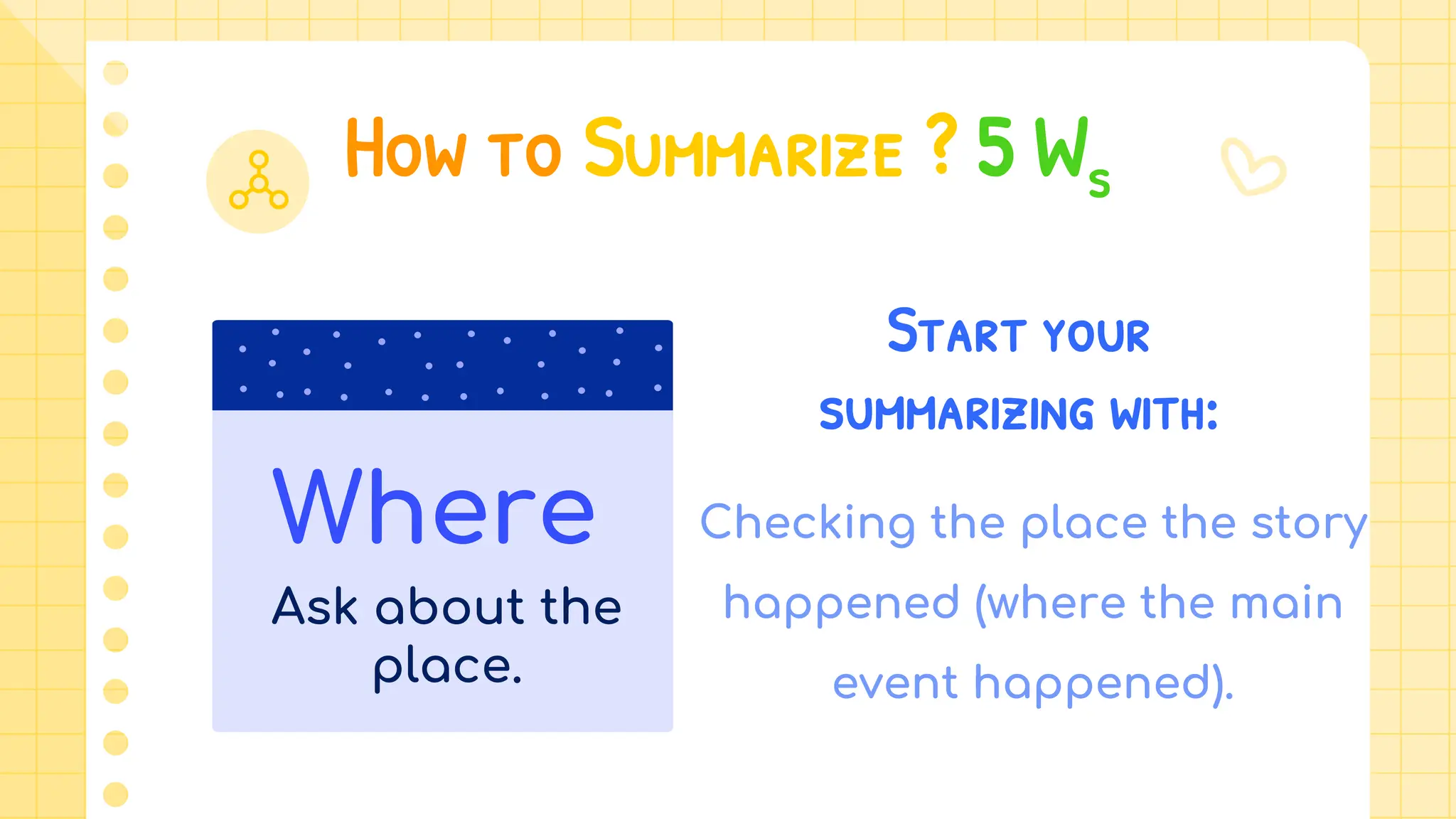
How to Summarize ? 5 Ws
Start your
summarizing with:
Checking the place the story
happened (where the main
event happened).
Where
Ask about the
place.
How to Summarize ?
Continue your
summarizing with:
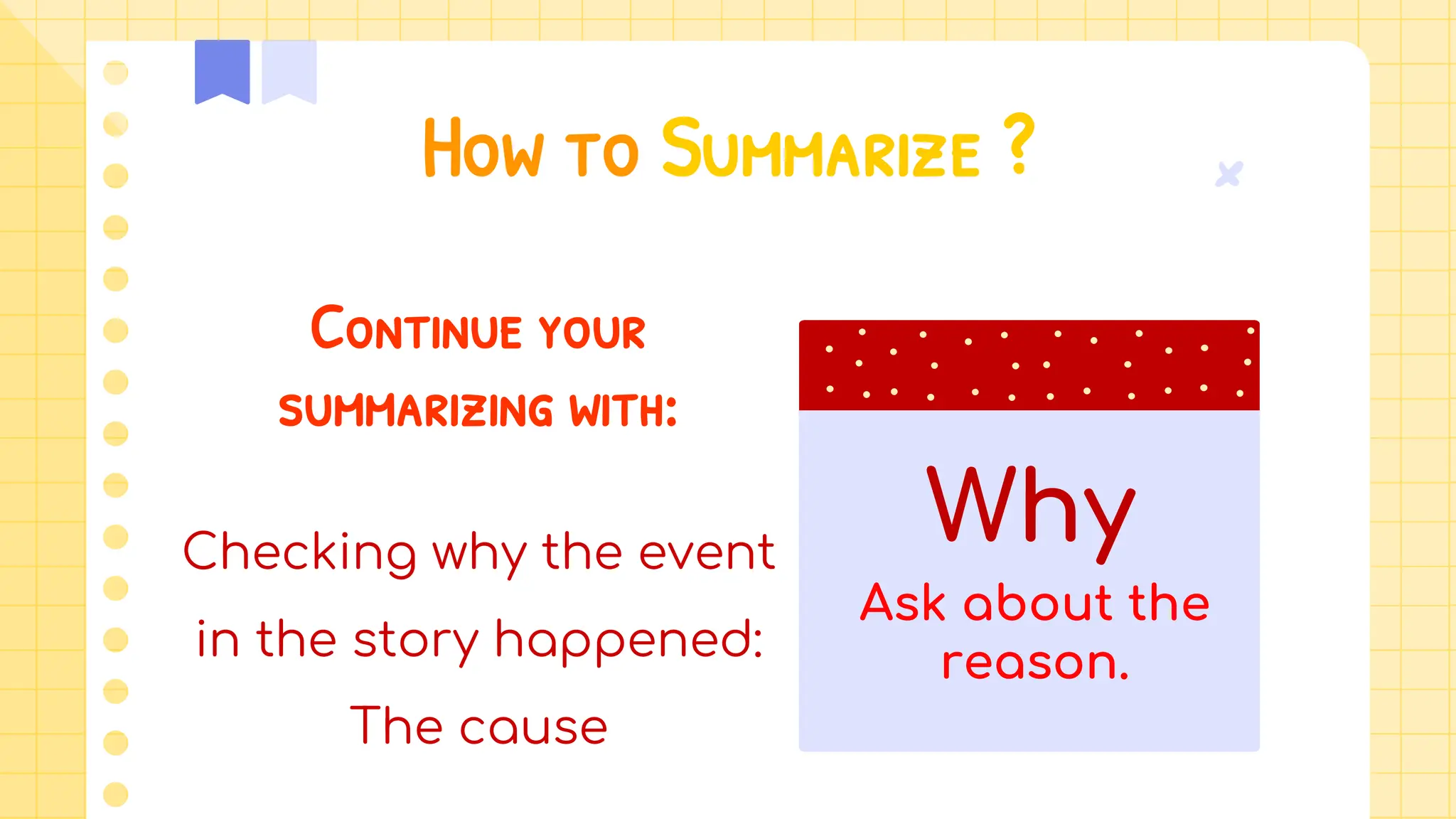
Checking why the event
in the story happened:
The cause
Why
Ask about the
reason.
Practice To 03
Practice – Summarize
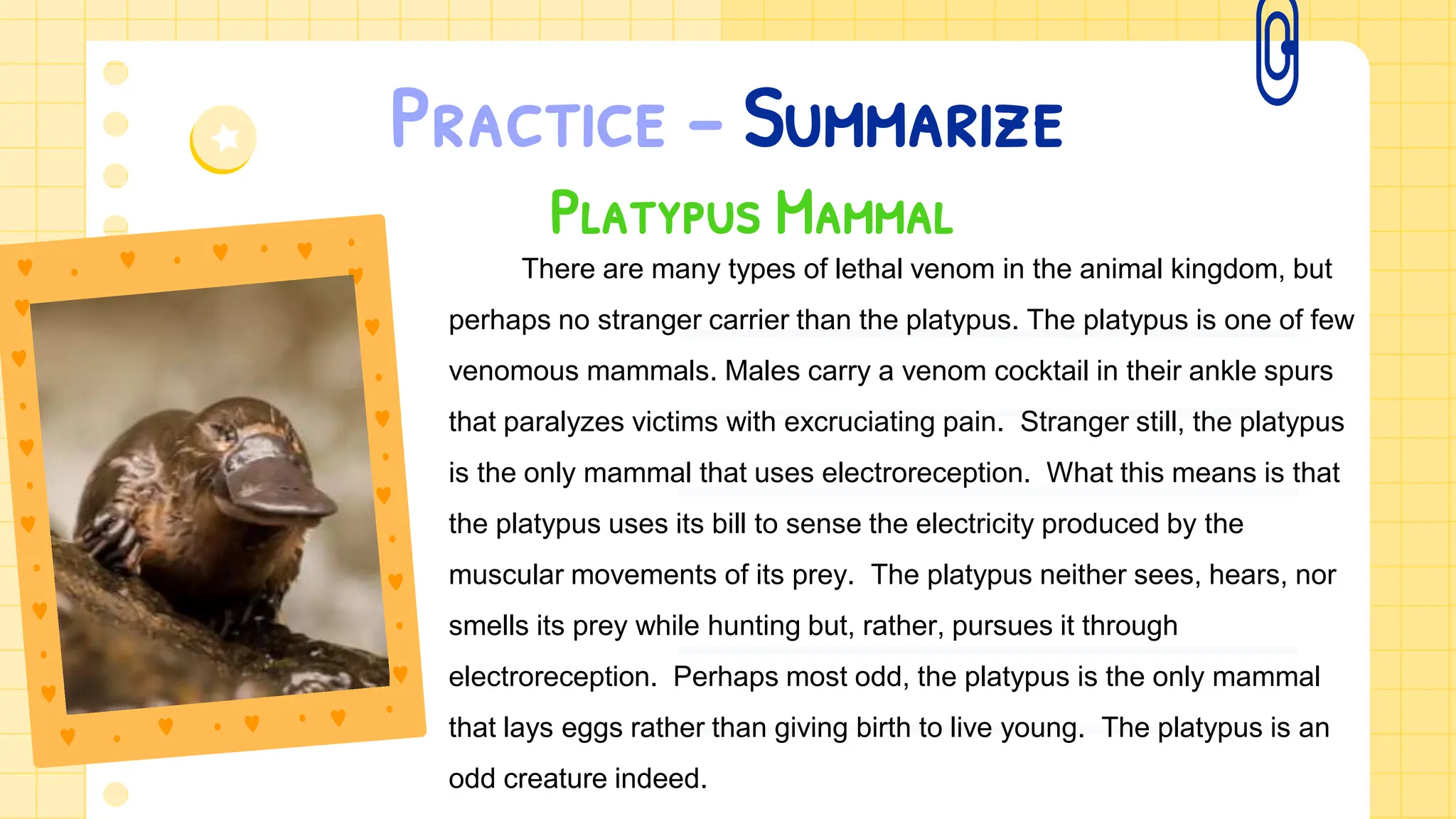
Platypus Mammal
There are many types of lethal venom in the animal kingdom, but
perhaps no stranger carrier than the platypus. The platypus is one of few
venomous mammals. Males carry a venom cocktail in their ankle spurs
that paralyzes victims with excruciating pain. Stranger still, the platypus
is the only mammal that uses electroreception. What this means is that
the platypus uses its bill to sense the electricity produced by the
muscular movements of its prey. The platypus neither sees, hears, nor
smells its prey while hunting but, rather, pursues it through
electroreception. Perhaps most odd, the platypus is the only mammal
that lays eggs rather than giving birth to live young. The platypus is an
odd creature indeed.
Practice – Summarize
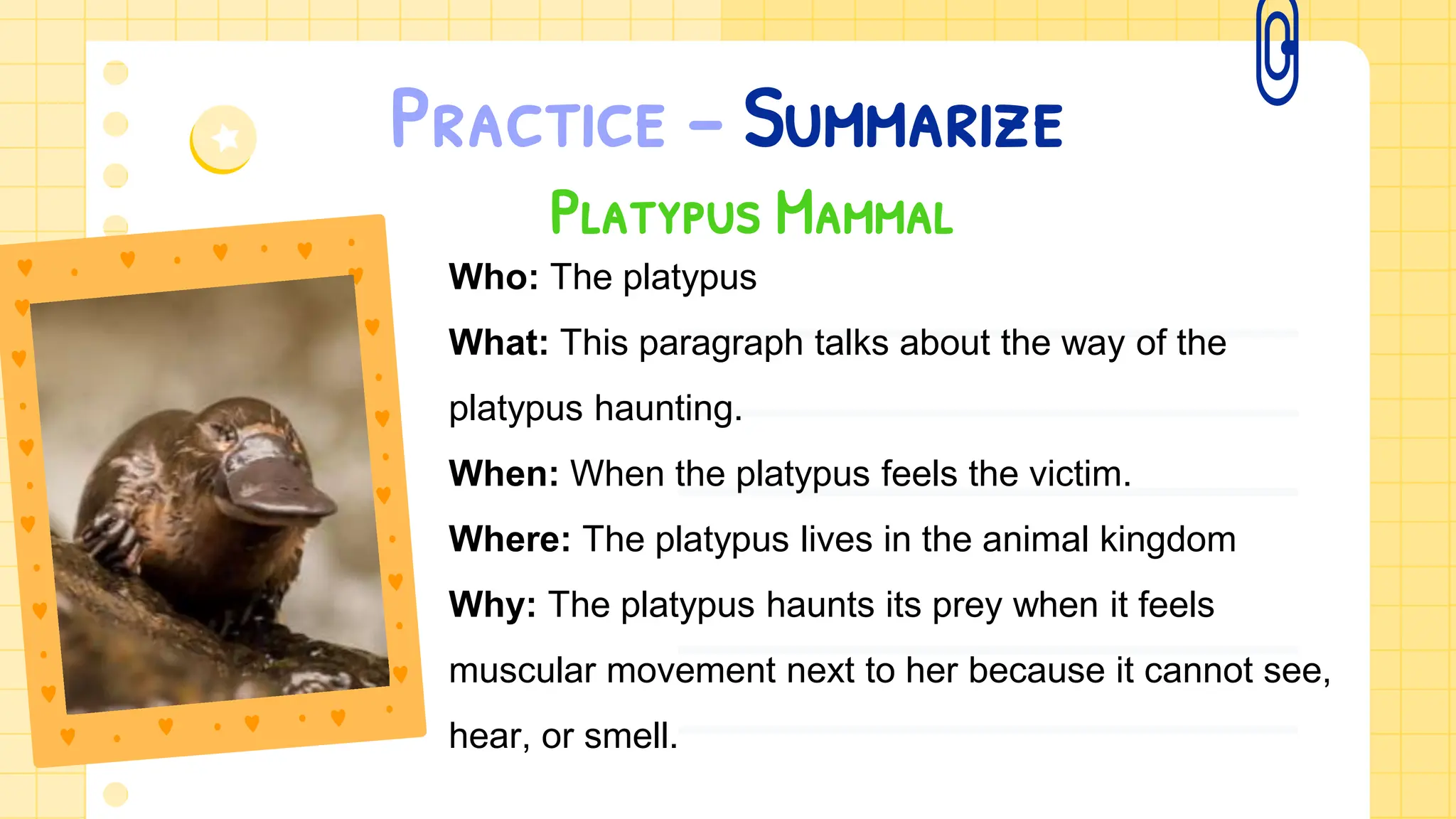
Platypus Mammal
Who: The platypus
What: This paragraph talks about the way of the
platypus haunting.
When: When the platypus feels the victim.
Where: The platypus lives in the animal kingdom
Why: The platypus haunts its prey when it feels
muscular movement next to her because it cannot see,
hear, or smell.
Practice – Summarize
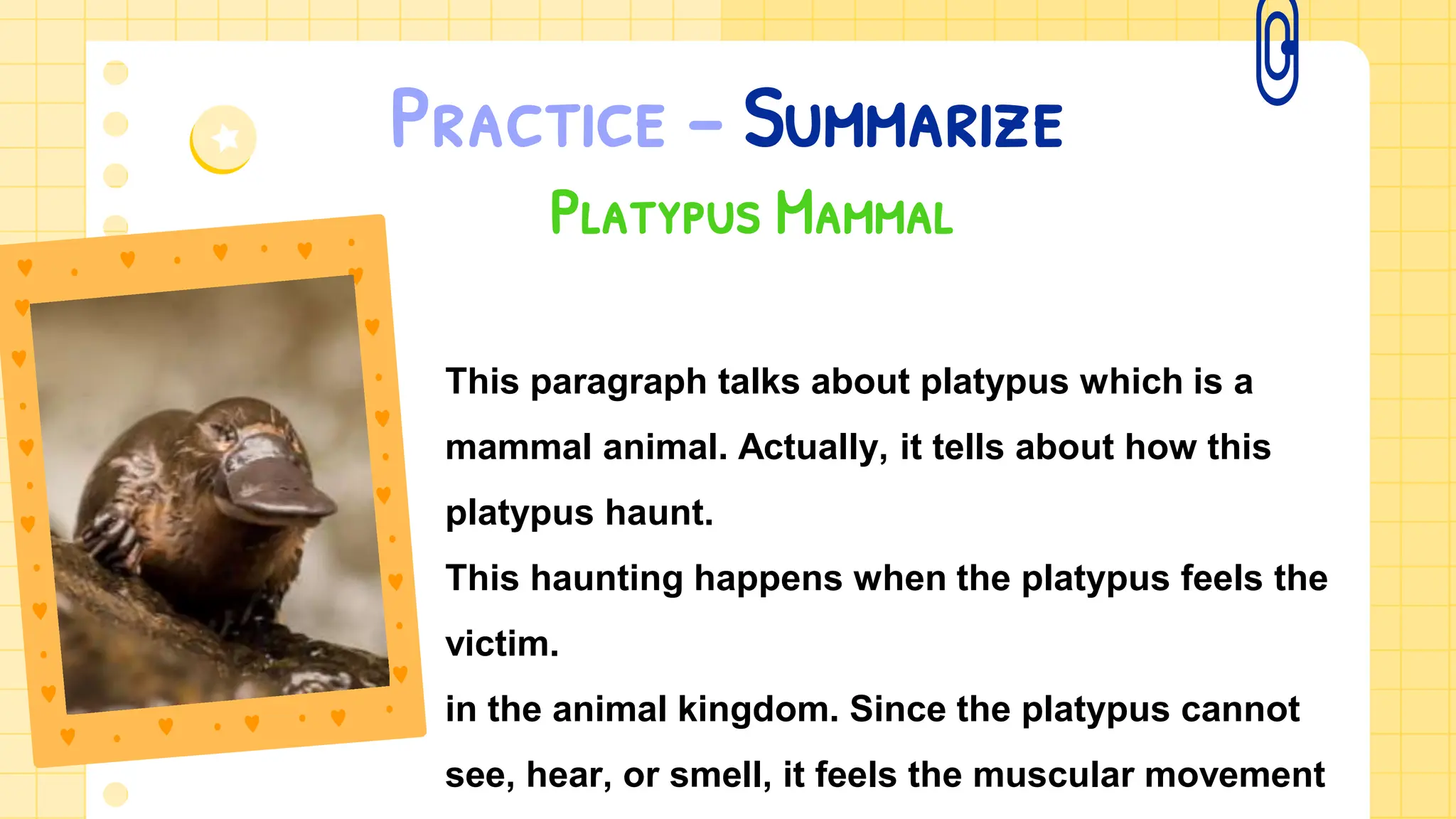
Platypus Mammal
This paragraph talks about platypus which is a
mammal animal. Actually, it tells about how this
platypus haunt.
This haunting happens when the platypus feels the
victim.
in the animal kingdom. Since the platypus cannot
see, hear, or smell, it feels the muscular movement
Practice – Summarize
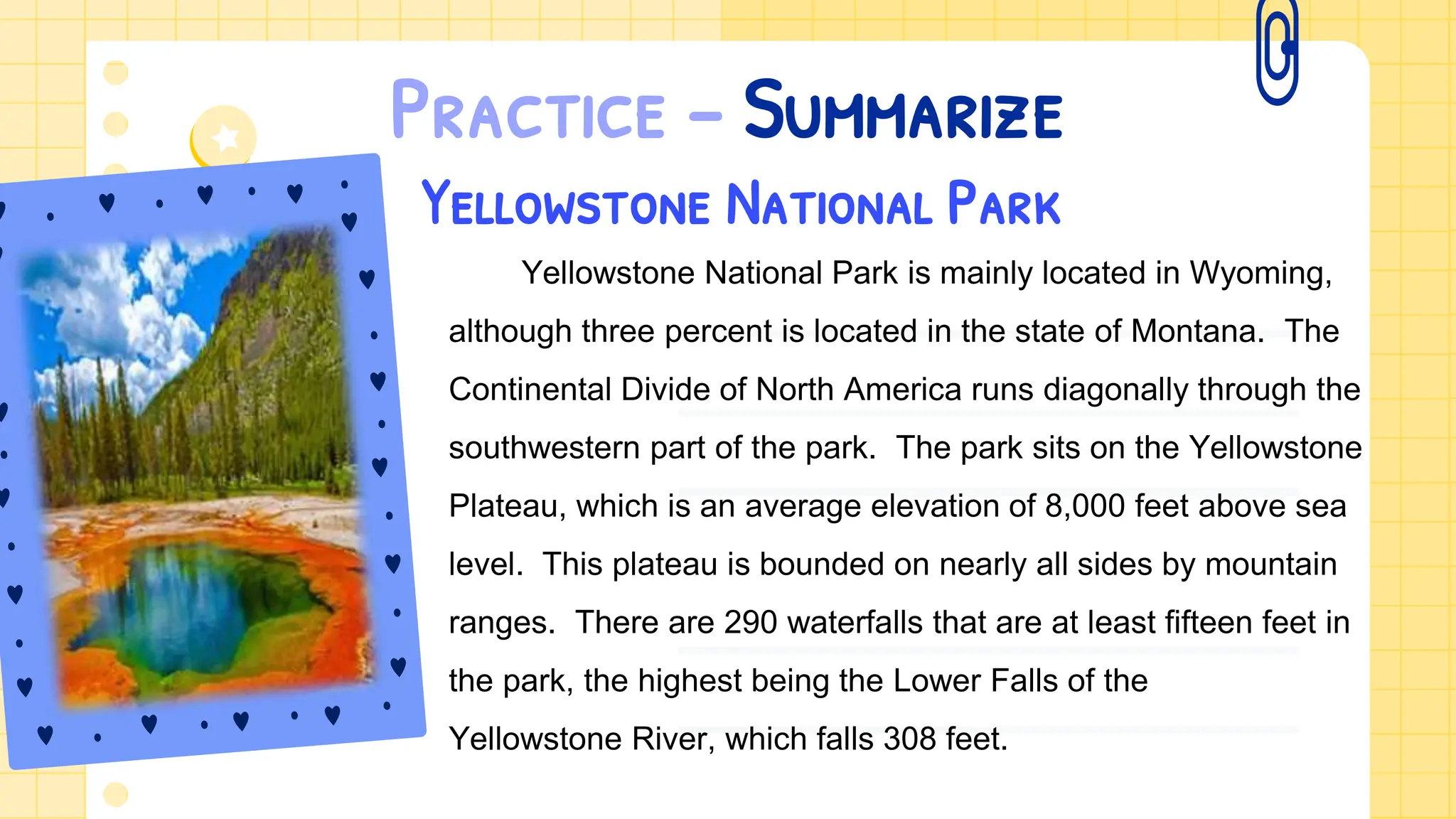
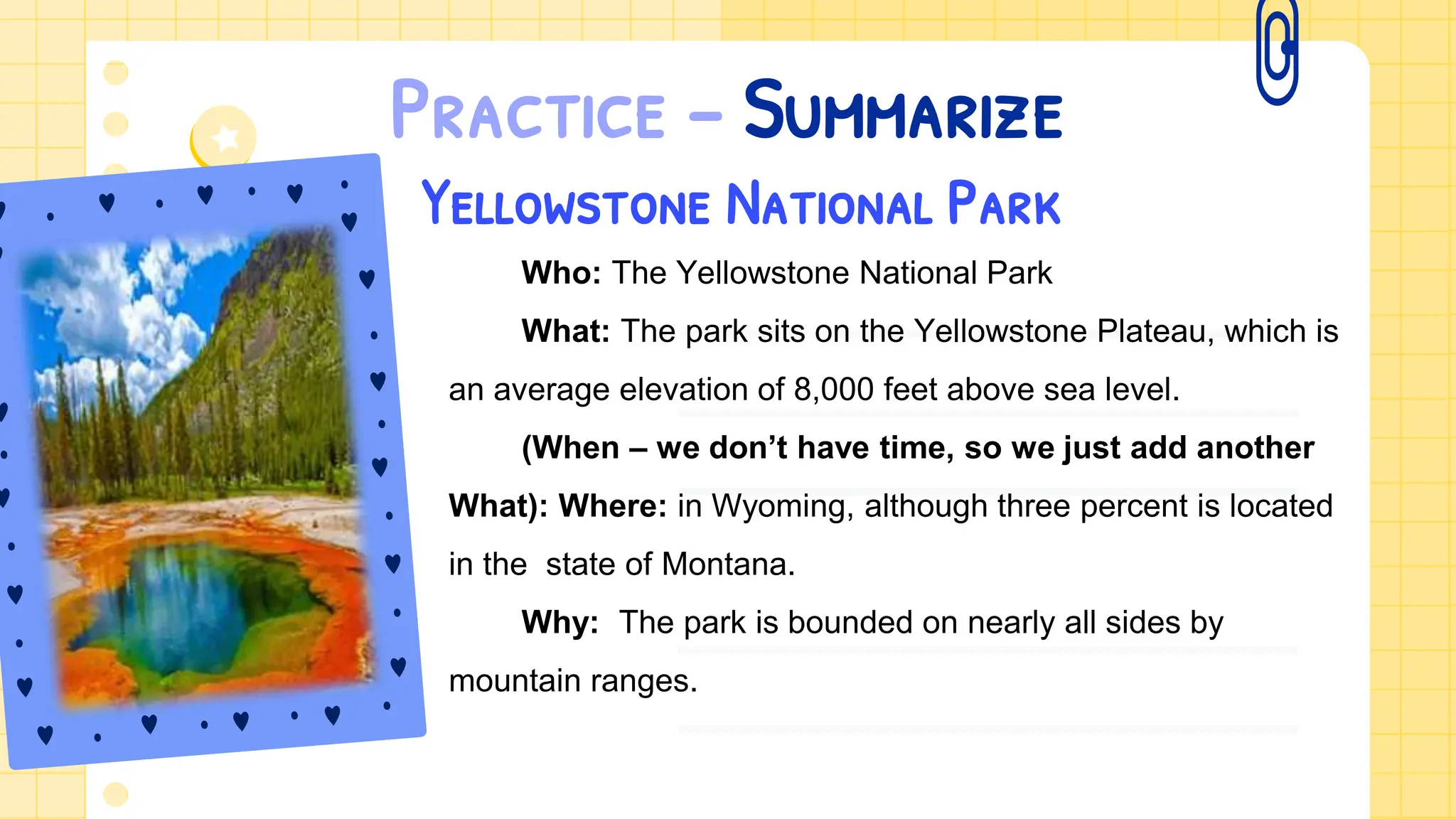
Yellowstone National Park
Yellowstone National Park is mainly located in Wyoming,
although three percent is located in the state of Montana. The
Continental Divide of North America runs diagonally through the
southwestern part of the park. The park sits on the Yellowstone
Plateau, which is an average elevation of 8,000 feet above sea
level. This plateau is bounded on nearly all sides by mountain
ranges. There are 290 waterfalls that are at least fifteen feet in
the park, the highest being the Lower Falls of the
Yellowstone River, which falls 308 feet.
Practice – Summarize
Yellowstone National Park
Who: The Yellowstone National Park
What: The park sits on the Yellowstone Plateau, which is
an average elevation of 8,000 feet above sea level.
(When – we don’t have time, so we just add another
What): Where: in Wyoming, although three percent is located
in the state of Montana.
Why: The park is bounded on nearly all sides by
mountain ranges.
Practice – Summarize
Yellowstone National Park
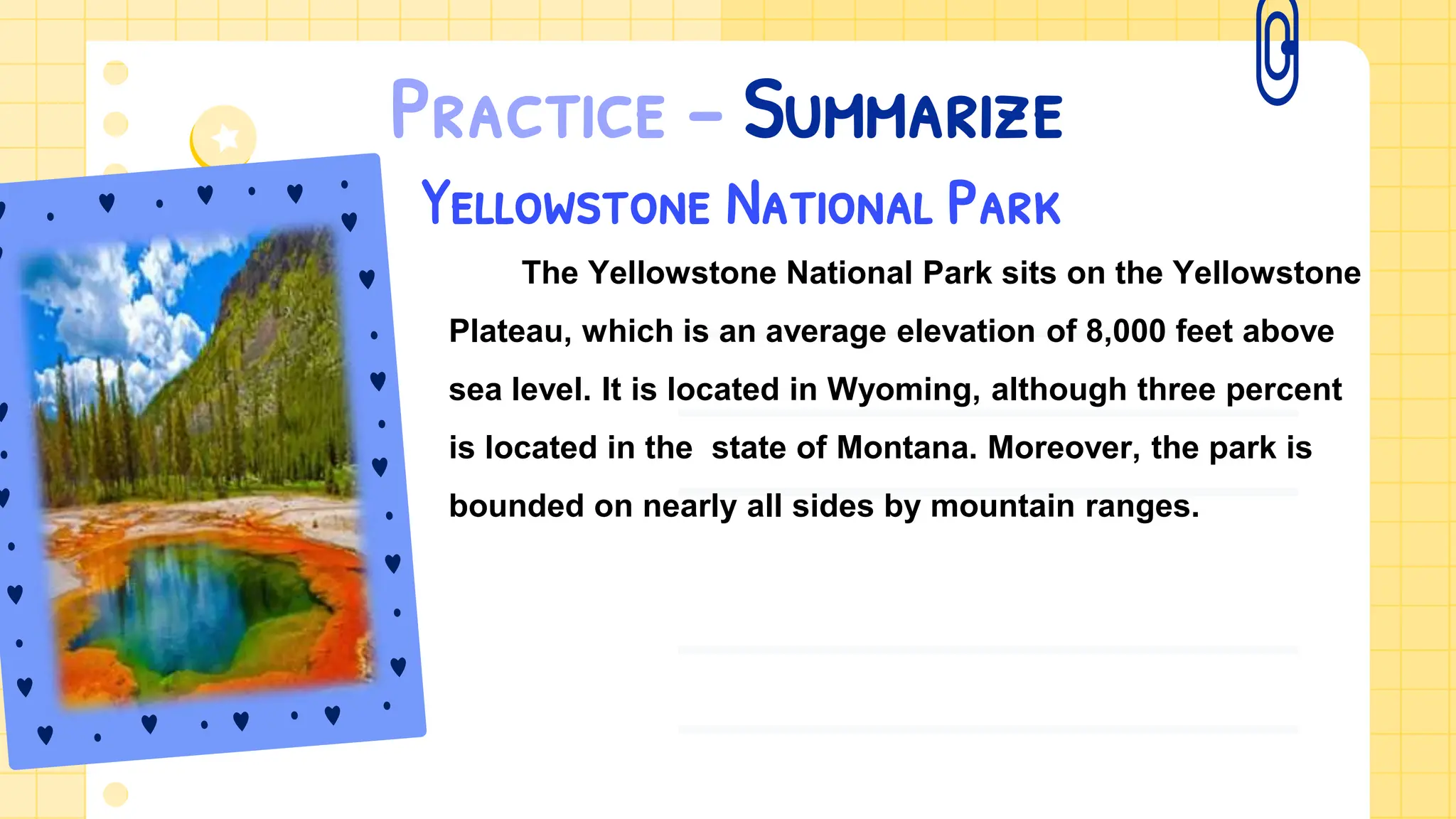
The Yellowstone National Park sits on the Yellowstone
Plateau, which is an average elevation of 8,000 feet above
sea level. It is located in Wyoming, although three percent
is located in the state of Montana. Moreover, the park is
bounded on nearly all sides by mountain ranges.
Practice – Summarize
How Does a Car stop ?
Screech! When a driver pushes on the brake pedal, it
starts a process that causes the vehicle to stop. You literally
trust braking systems with your life every time you get into a
vehicle or cross a busy intersection, but how does this process
work? It begins when the pedal is pushed. At this moment
brake fluid is released into the area where the braking
mechanisms are located. As the fluid collects, leverage is
created, which causes a friction to be applied. If the braking
system is functioning properly, this friction will create a force
that will cause the wheels to stop and allow you to reach your
Practice – Summarize
How Does a Car stops ?
Who: The car
What: How brakes work
When: While driving
Where: on the street / in the car
Why: to stop the car
Practice – Summarize
How Does a Car stops ?
This paragraph talks about the car. It actually tells
how brakes work while driving on the street to stop the car.
Exercise some paragraphs
04
Awesome
Work !
CREDITS: This presentation template was created by Slidesgo,
including icons by Flaticon, and infographics & images by
Freepik.
Stickers

Summarizing - Grade 6.pptx the power point presentation explains the skill of summarizing and provides many examples. suitable for grades 5, 6, and 7

  • 2.
  • 3.
    Students will beble to: 1- Define summarizing. 2- ummarize any paragraph they pass by. Objectives
  • 4.
  • 5.
    Let’s Talk about Summarizing Tomake a paragraph smaller Purpose Five Ws Features
  • 6.
  • 7.
    Define Summarizing ! Whatis summarizing ? Pay Attention : Summaries are not a place for… Short account of the central ideas of a text  Opinions  Background knowledge  Personal information
  • 8.
  • 9.
    How To Summarize? 1- Read the text. 2- Don’t let big words scare you. 3- Ask, “The 5 Ws ?” and answer
  • 10.
    How to Summarize? 5 Ws Start your summarizing with: Checking the characters of the paragraph / text / story you are reading. Who Ask about the characters.
  • 11.
    How to Summarize? Continue your summarizing with: Checking what happened in the story: The event What Ask about the event.
  • 12.
    How to Summarize? Continue your summarizing with: Checking when happened in the story: The time When Ask about the time.
  • 13.
    How to Summarize? 5 Ws Start your summarizing with: Checking the place the story happened (where the main event happened). Where Ask about the place.
  • 14.
    How to Summarize? Continue your summarizing with: Checking why the event in the story happened: The cause Why Ask about the reason.
  • 15.
  • 16.
    Practice – Summarize PlatypusMammal There are many types of lethal venom in the animal kingdom, but perhaps no stranger carrier than the platypus. The platypus is one of few venomous mammals. Males carry a venom cocktail in their ankle spurs that paralyzes victims with excruciating pain. Stranger still, the platypus is the only mammal that uses electroreception. What this means is that the platypus uses its bill to sense the electricity produced by the muscular movements of its prey. The platypus neither sees, hears, nor smells its prey while hunting but, rather, pursues it through electroreception. Perhaps most odd, the platypus is the only mammal that lays eggs rather than giving birth to live young. The platypus is an odd creature indeed.
  • 17.
    Practice – Summarize PlatypusMammal Who: The platypus What: This paragraph talks about the way of the platypus haunting. When: When the platypus feels the victim. Where: The platypus lives in the animal kingdom Why: The platypus haunts its prey when it feels muscular movement next to her because it cannot see, hear, or smell.
  • 18.
    Practice – Summarize PlatypusMammal This paragraph talks about platypus which is a mammal animal. Actually, it tells about how this platypus haunt. This haunting happens when the platypus feels the victim. in the animal kingdom. Since the platypus cannot see, hear, or smell, it feels the muscular movement
  • 19.
    Practice – Summarize YellowstoneNational Park Yellowstone National Park is mainly located in Wyoming, although three percent is located in the state of Montana. The Continental Divide of North America runs diagonally through the southwestern part of the park. The park sits on the Yellowstone Plateau, which is an average elevation of 8,000 feet above sea level. This plateau is bounded on nearly all sides by mountain ranges. There are 290 waterfalls that are at least fifteen feet in the park, the highest being the Lower Falls of the Yellowstone River, which falls 308 feet.
  • 20.
    Practice – Summarize YellowstoneNational Park Who: The Yellowstone National Park What: The park sits on the Yellowstone Plateau, which is an average elevation of 8,000 feet above sea level. (When – we don’t have time, so we just add another What): Where: in Wyoming, although three percent is located in the state of Montana. Why: The park is bounded on nearly all sides by mountain ranges.
  • 21.
    Practice – Summarize YellowstoneNational Park The Yellowstone National Park sits on the Yellowstone Plateau, which is an average elevation of 8,000 feet above sea level. It is located in Wyoming, although three percent is located in the state of Montana. Moreover, the park is bounded on nearly all sides by mountain ranges.
  • 22.
    Practice – Summarize HowDoes a Car stop ? Screech! When a driver pushes on the brake pedal, it starts a process that causes the vehicle to stop. You literally trust braking systems with your life every time you get into a vehicle or cross a busy intersection, but how does this process work? It begins when the pedal is pushed. At this moment brake fluid is released into the area where the braking mechanisms are located. As the fluid collects, leverage is created, which causes a friction to be applied. If the braking system is functioning properly, this friction will create a force that will cause the wheels to stop and allow you to reach your
  • 23.
    Practice – Summarize HowDoes a Car stops ? Who: The car What: How brakes work When: While driving Where: on the street / in the car Why: to stop the car
  • 24.
    Practice – Summarize HowDoes a Car stops ? This paragraph talks about the car. It actually tells how brakes work while driving on the street to stop the car.
  • 25.
  • 26.
  • 27.
    CREDITS: This presentationtemplate was created by Slidesgo, including icons by Flaticon, and infographics & images by Freepik.
  • 28.