Nicole Hennig, MLShennig@MIT.EDURebecca Jones, MLSrebecca@dysartjones.comPersuasion, Influence & Innovative Ideas
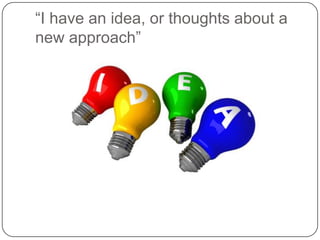
“I have an idea, or thoughts about a new approach”
Important to keep in mindAn idea or anything new  = changePeople don’t like change when it involves themGroup = individuals each with their own perspectives & preferences
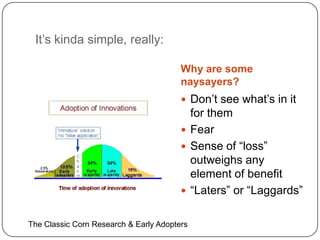
It’s kinda simple, really:Why are some naysayers?Don’t see what’s in it for themFearSense of “loss”  outweighs any element of benefit“Laters” or “Laggards”The Classic Corn Research & Early Adopters
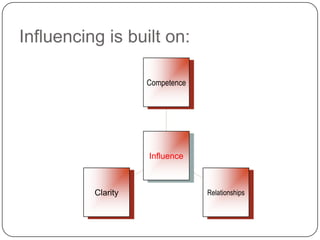
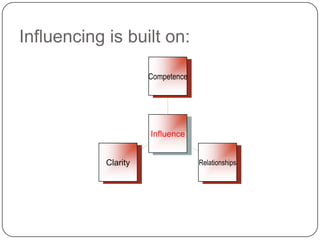
Influencing is built on:
We keep learning…Influence without Authority by Cohen and BradfordThe Art of Woo by Shell and MoussaInfluencer by Patterson & GrennyThe Influence Modelin Journal of Organizational Excellence, Winter 2005Situation Management Systems’ Positive Power and Influence Programs  www.smsinc.comDave Pollard’s How to Save the Worldblog
Influencing others starts with ourselvesWe have to see ourselves as influencersWe must be clear on what we want to see happenWe must learn new approaches“Influence may be the highest level of all human skills.”
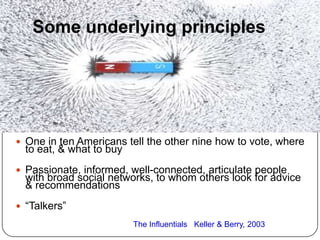
Some underlying principlesOne in ten Americans tell the other nine how to vote, where to eat, & what to buyPassionate, informed, well-connected, articulate people with broad social networks, to whom others look for advice & recommendations“Talkers”The InfluentialsKeller & Berry, 2003
Effective influencers tend to be:“Expert” in a specific domain “Early Adopters” or certainly know how to build relationships with early adopters to move change throughOpinion leadersKnowledgeable about the issues being dealt withViewed as trustworthyWith connectionsUse their knowledge & connections to help others
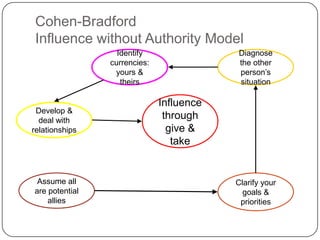
Cohen-Bradford Influence without Authority ModelIdentify currencies: yours & theirsDiagnose the other person’s situationInfluence through give & takeDevelop & deal with relationshipsAssume all are potential alliesClarify your goals & priorities
Influencing is built on:
Influencing skillsCompetenceKnow your strengths & weaknessesWork to your strengthsKeep the organizational perspectiveCritical success factor for credibility & expertise
Influencing skillsRelationshipsGet to know people, what they do, & keep in touch – regardless of levelBuild trust; it’s incremental & fragileMust understand your organization’s hidden yet important relationships & where the real power liesIts “organization quotient” differs from its formal structure	Forbes, July 23, 2007“You cannot antagonize and influence at the same time.” J.S. Knox
Influencing skillsClarityBe clear on what you want Be clear on what you’ve got, & where your lines will be drawnCommunicate clearly, in the style of the listener
Influencing skillsClarityCommunication styles:Pre-1965: prefer face-to-faceMotivator: I’m neededPre-1981: prefer e-mailMotivator: doing it my wayPost-1981: prefer IMMotivator: being part of creative teamHammil’s “Mixing & Managing Four Generations of Employees”, FDU Magazine Winter/Spring 2005
Being part of the quotientTo move to the decision-making table:Clear direction which can be articulatedCross-functional experienceFinancial understanding of ROI & investmentsPresence, confidence, clarityRebecca Jones research for SLA Executive Institute, Information Outlook
Influencing StylesInvolving – “pull” -communication style matches others’; building collaborationInquiring – “push” - listening carefully to identify others’ needs & ‘currencies’; to give & takeLeading – “pull” - engaging people to share stories & common groundsProposing – “push” - presenting possible solutions or a choice of options; structured & rational
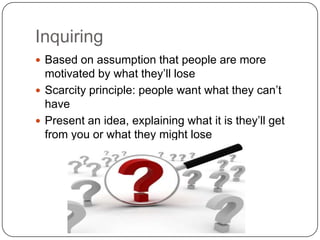
InquiringBased on assumption that people are more motivated by what they’ll lose Scarcity principle: people want what they can’t havePresent an idea, explaining what it is they’ll get from you or what they might lose
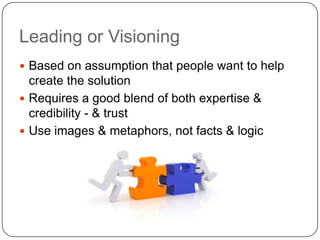
Leading or VisioningBased on assumption that people want to help create the solutionRequires a good blend of both expertise & credibility - & trustUse images & metaphors, not facts & logic
Proposing or PersuadingGoal is to gain real commitmentManage the credibility cardWhat do they want that you can give them?Why might they say no?Close the sale“Will you commit?”“When will you..”Not “We hope you will….”
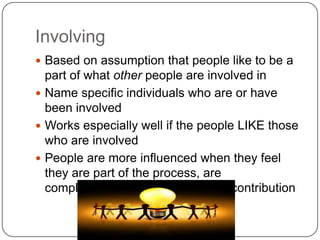
InvolvingBased on assumption that people like to be a part of what other people are involved inName specific individuals who are or have been involvedWorks especially well if the people LIKE those who are involvedPeople are more influenced when they feel they are part of the process, are complimented & thanked for their contribution
All stylesRequire:Clarity – communication skills are criticalCompetence – must know what you are doingRelationships – must know which style to pursue
Thank youLet us know how you are doing!rebecca@dysartjones.comhennig@MIT.EDU

Persuasion, Influence & Innovative Ideas

  • 1.
    Nicole Hennig, MLShennig@MIT.EDURebeccaJones, MLSrebecca@dysartjones.comPersuasion, Influence & Innovative Ideas
  • 2.
    “I have anidea, or thoughts about a new approach”
  • 3.
    Important to keepin mindAn idea or anything new = changePeople don’t like change when it involves themGroup = individuals each with their own perspectives & preferences
  • 5.
    It’s kinda simple,really:Why are some naysayers?Don’t see what’s in it for themFearSense of “loss” outweighs any element of benefit“Laters” or “Laggards”The Classic Corn Research & Early Adopters
  • 6.
  • 7.
    We keep learning…Influencewithout Authority by Cohen and BradfordThe Art of Woo by Shell and MoussaInfluencer by Patterson & GrennyThe Influence Modelin Journal of Organizational Excellence, Winter 2005Situation Management Systems’ Positive Power and Influence Programs www.smsinc.comDave Pollard’s How to Save the Worldblog
  • 8.
    Influencing others startswith ourselvesWe have to see ourselves as influencersWe must be clear on what we want to see happenWe must learn new approaches“Influence may be the highest level of all human skills.”
  • 9.
    Some underlying principlesOnein ten Americans tell the other nine how to vote, where to eat, & what to buyPassionate, informed, well-connected, articulate people with broad social networks, to whom others look for advice & recommendations“Talkers”The InfluentialsKeller & Berry, 2003
  • 10.
    Effective influencers tendto be:“Expert” in a specific domain “Early Adopters” or certainly know how to build relationships with early adopters to move change throughOpinion leadersKnowledgeable about the issues being dealt withViewed as trustworthyWith connectionsUse their knowledge & connections to help others
  • 11.
    Cohen-Bradford Influence withoutAuthority ModelIdentify currencies: yours & theirsDiagnose the other person’s situationInfluence through give & takeDevelop & deal with relationshipsAssume all are potential alliesClarify your goals & priorities
  • 12.
  • 13.
    Influencing skillsCompetenceKnow yourstrengths & weaknessesWork to your strengthsKeep the organizational perspectiveCritical success factor for credibility & expertise
  • 14.
    Influencing skillsRelationshipsGet toknow people, what they do, & keep in touch – regardless of levelBuild trust; it’s incremental & fragileMust understand your organization’s hidden yet important relationships & where the real power liesIts “organization quotient” differs from its formal structure Forbes, July 23, 2007“You cannot antagonize and influence at the same time.” J.S. Knox
  • 15.
    Influencing skillsClarityBe clearon what you want Be clear on what you’ve got, & where your lines will be drawnCommunicate clearly, in the style of the listener
  • 16.
    Influencing skillsClarityCommunication styles:Pre-1965:prefer face-to-faceMotivator: I’m neededPre-1981: prefer e-mailMotivator: doing it my wayPost-1981: prefer IMMotivator: being part of creative teamHammil’s “Mixing & Managing Four Generations of Employees”, FDU Magazine Winter/Spring 2005
  • 17.
    Being part ofthe quotientTo move to the decision-making table:Clear direction which can be articulatedCross-functional experienceFinancial understanding of ROI & investmentsPresence, confidence, clarityRebecca Jones research for SLA Executive Institute, Information Outlook
  • 18.
    Influencing StylesInvolving –“pull” -communication style matches others’; building collaborationInquiring – “push” - listening carefully to identify others’ needs & ‘currencies’; to give & takeLeading – “pull” - engaging people to share stories & common groundsProposing – “push” - presenting possible solutions or a choice of options; structured & rational
  • 19.
    InquiringBased on assumptionthat people are more motivated by what they’ll lose Scarcity principle: people want what they can’t havePresent an idea, explaining what it is they’ll get from you or what they might lose
  • 20.
    Leading or VisioningBasedon assumption that people want to help create the solutionRequires a good blend of both expertise & credibility - & trustUse images & metaphors, not facts & logic
  • 21.
    Proposing or PersuadingGoalis to gain real commitmentManage the credibility cardWhat do they want that you can give them?Why might they say no?Close the sale“Will you commit?”“When will you..”Not “We hope you will….”
  • 22.
    InvolvingBased on assumptionthat people like to be a part of what other people are involved inName specific individuals who are or have been involvedWorks especially well if the people LIKE those who are involvedPeople are more influenced when they feel they are part of the process, are complimented & thanked for their contribution
  • 23.
    All stylesRequire:Clarity –communication skills are criticalCompetence – must know what you are doingRelationships – must know which style to pursue
  • 24.
    Thank youLet usknow how you are doing!rebecca@dysartjones.comhennig@MIT.EDU

Editor's Notes

  • #3 Do you have an idea, or a new approach, that you’d like to pursue at work?Are you stalling because you worry about the response?Who has had an idea, or an new approach & you DID float the idea at work?& did the idea get moved forward?Did it get moved forward to a point & then stop?Or did it get “cut” before you had a chance to even let it “sprout” a bit?What we want to do is to explore how to get an idea off the ground to be explored, and if it’s good enough, to move forward to realization
  • #5 This conference is full of new – of ideas – So why, in a profession & in organizaitons based on creating “new” knowledge – based on sharing ideas – why is it so hard to move new ideas forward?Well….cuz…..Like all professions & organizaitons – there’s naysayers & there’s influencers
  • #6 Why are ppl
  • #24 Developing relationshipsMaintaining competency & credibilityBeing clear, with each new situation