Persuasion & Influence Welcome
Introduction Practice based application of theory About both the means and the product Be creative, there is no box! Link POP or Consumer Behaviour with your experiences and common sense
What’s it all about Brands (or all types) try to influence our decisions and persuade us to think and act in certain ways His unit explores Key theoretical principles General rules of social behaviour So informs you how to be persuasive and exert influence within an ethical framework
Assessment 1 Leading a debate (15%) Comprehend debates Critical analysis of issues and literature Understanding of theories Present and defend ideas
Assessment 1 – the ideal Show knowledge of theories Apply them to the real world Draw on examples from placement Be interactive Let me know if you want me to provide tasks
Assessment 2 Speech & Critique (35%) Use of techniques Understanding attitudes and routes to them Role of persuasion within a PR campaign Delivered 8 th  December Any topic – but think who your public is  5 minutes – beware the gong! You receive peer feedback to help critique
Assessment 3 Examination (50%) Critical analysis of one attempt at persuasion Understanding theories Understanding fit of ‘artefact’ within a campaign  Argument construction
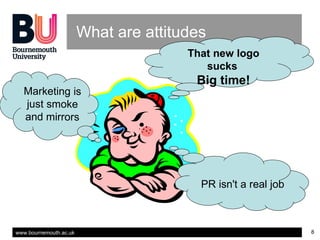
What are attitudes That new logo sucks   Big time! PR isn't a real job Marketing is just smoke and mirrors
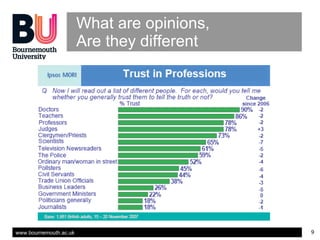
What are opinions, Are they different
Beliefs I believe all PROs/Marketers are liars I believe all doctors know what they are talking about I believe all Germans are sausage-eating fascists
How are B/O/A changed Key elements Source Narrative Strength of Argument Strength of Attitude of persuaded  Placing of persuasion (Context) Proximity of persuader
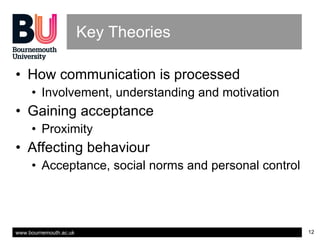
Key Theories How communication is processed Involvement, understanding and motivation Gaining acceptance Proximity Affecting behaviour Acceptance, social norms and personal control
Think of a change you caused One example each  How do the key elements fit together? Why was it successful?

Persuasion &Influence: Session 1

  • 1.
  • 2.
    Introduction Practice basedapplication of theory About both the means and the product Be creative, there is no box! Link POP or Consumer Behaviour with your experiences and common sense
  • 3.
    What’s it allabout Brands (or all types) try to influence our decisions and persuade us to think and act in certain ways His unit explores Key theoretical principles General rules of social behaviour So informs you how to be persuasive and exert influence within an ethical framework
  • 4.
    Assessment 1 Leadinga debate (15%) Comprehend debates Critical analysis of issues and literature Understanding of theories Present and defend ideas
  • 5.
    Assessment 1 –the ideal Show knowledge of theories Apply them to the real world Draw on examples from placement Be interactive Let me know if you want me to provide tasks
  • 6.
    Assessment 2 Speech& Critique (35%) Use of techniques Understanding attitudes and routes to them Role of persuasion within a PR campaign Delivered 8 th December Any topic – but think who your public is 5 minutes – beware the gong! You receive peer feedback to help critique
  • 7.
    Assessment 3 Examination(50%) Critical analysis of one attempt at persuasion Understanding theories Understanding fit of ‘artefact’ within a campaign Argument construction
  • 8.
    What are attitudesThat new logo sucks Big time! PR isn't a real job Marketing is just smoke and mirrors
  • 9.
    What are opinions,Are they different
  • 10.
    Beliefs I believeall PROs/Marketers are liars I believe all doctors know what they are talking about I believe all Germans are sausage-eating fascists
  • 11.
    How are B/O/Achanged Key elements Source Narrative Strength of Argument Strength of Attitude of persuaded Placing of persuasion (Context) Proximity of persuader
  • 12.
    Key Theories Howcommunication is processed Involvement, understanding and motivation Gaining acceptance Proximity Affecting behaviour Acceptance, social norms and personal control
  • 13.
    Think of achange you caused One example each How do the key elements fit together? Why was it successful?