
Click to edit Master text styles
 Objectives
 PWC Influencing model
 An effective Leader | Team, task and individual model
 Understanding your team | Belbin
 Ladder of perception
 Typical team behaviours
 Body language and verbal style
 Active Listening, feedback and GROW coaching model
 Reactions to change and how to support others
Contents
Objectives
 Team Development
• Understand your role in managing and participating in a team
• Be able to use group dynamics and team management principles to get higher performance
from your teams
 Internal Relationships
• Understand your leadership style and be able to adapt it to different individuals and tasks
• Be able to use your leadership skills to coach and develop junior members of staff
 Effective Communication
• Have practised your feedback and coaching skills and be able to use these to manage
assignment quality and to develop staff
• Be able to use basic influencing skills to get successful outcomes in work situations
3
Positive influence | A definition
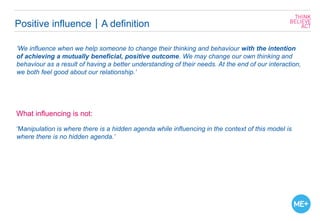
‘We influence when we help someone to change their thinking and behaviour with the intention
of achieving a mutually beneficial, positive outcome. We may change our own thinking and
behaviour as a result of having a better understanding of their needs. At the end of our interaction,
we both feel good about our relationship.’
‘Manipulation is where there is a hidden agenda while influencing in the context of this model is
where there is no hidden agenda.’
What influencing is not:
Influencing skills are vital for successful business relationships
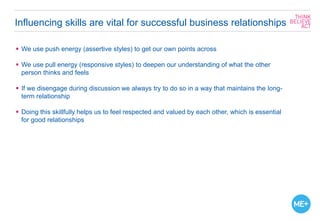
 We use push energy (assertive styles) to get our own points across
 We use pull energy (responsive styles) to deepen our understanding of what the other
person thinks and feels
 If we disengage during discussion we always try to do so in a way that maintains the long-
term relationship
 Doing this skillfully helps us to feel respected and valued by each other, which is essential
for good relationships
Convincing
Offering insights
Making suggestions
Giving reasons
Requiring
Disclosing feelings
Saying what you need
Describing the consequences
Connecting
Active listening
Questioning & exploring
Reflecting and summarizing
Building common ground
Inspiring
Creating a vision
Personal disclosure
Supporting
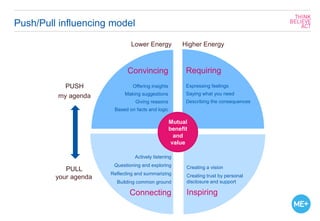
Convincing
Offering insights
Making suggestions
Giving reasons
Based on facts and logic
Requiring
Expressing feelings
Saying what you need
Describing the consequences
Actively listening
Questioning and exploring
Reflecting and summarizing
Building common ground
Connecting
Creating a vision
Creating trust by personal
disclosure and support
Inspiring
Mutual
benefit
and
value
Lower Energy Higher Energy
your agenda
my agenda
PUSH
PULL
Push/Pull influencing model
www.facebook.com/wearemeplus
@wearemeplus
http://http://bit.ly/1MWEiGW
www.me-plus.co.uk
THANK YOU

Supporting materials - PWC influencing model

  • 1.
    Click to editMaster text styles
  • 2.
     Objectives  PWCInfluencing model  An effective Leader | Team, task and individual model  Understanding your team | Belbin  Ladder of perception  Typical team behaviours  Body language and verbal style  Active Listening, feedback and GROW coaching model  Reactions to change and how to support others Contents
  • 3.
    Objectives  Team Development •Understand your role in managing and participating in a team • Be able to use group dynamics and team management principles to get higher performance from your teams  Internal Relationships • Understand your leadership style and be able to adapt it to different individuals and tasks • Be able to use your leadership skills to coach and develop junior members of staff  Effective Communication • Have practised your feedback and coaching skills and be able to use these to manage assignment quality and to develop staff • Be able to use basic influencing skills to get successful outcomes in work situations 3
  • 4.
    Positive influence |A definition ‘We influence when we help someone to change their thinking and behaviour with the intention of achieving a mutually beneficial, positive outcome. We may change our own thinking and behaviour as a result of having a better understanding of their needs. At the end of our interaction, we both feel good about our relationship.’ ‘Manipulation is where there is a hidden agenda while influencing in the context of this model is where there is no hidden agenda.’ What influencing is not:
  • 5.
    Influencing skills arevital for successful business relationships  We use push energy (assertive styles) to get our own points across  We use pull energy (responsive styles) to deepen our understanding of what the other person thinks and feels  If we disengage during discussion we always try to do so in a way that maintains the long- term relationship  Doing this skillfully helps us to feel respected and valued by each other, which is essential for good relationships
  • 6.
    Convincing Offering insights Making suggestions Givingreasons Requiring Disclosing feelings Saying what you need Describing the consequences Connecting Active listening Questioning & exploring Reflecting and summarizing Building common ground Inspiring Creating a vision Personal disclosure Supporting Convincing Offering insights Making suggestions Giving reasons Based on facts and logic Requiring Expressing feelings Saying what you need Describing the consequences Actively listening Questioning and exploring Reflecting and summarizing Building common ground Connecting Creating a vision Creating trust by personal disclosure and support Inspiring Mutual benefit and value Lower Energy Higher Energy your agenda my agenda PUSH PULL Push/Pull influencing model
  • 7.