What is
Psychology?
Defining Psychology
► Is the science of behavior and mental processes.
► Psychology is committed to: objectivity, accuracy
and maintaining a healty skepticism.
► Today, psychology study both mental processes
and behavior to see how organisms are affected
by, and in turn affect, the social, physical, and
biological world.
Aims and Scope of Psychology
►The goals of psychology are describe the
basic components of behavior, to explain
them, to predict them, and, potentially, to
manage them.
►Psychologists develop theories. A theory is
a collection of interrelated ideas and facts
put forward to explain and predict behavior
and mental processes.
A history os psychology: Schools of
Psychological thought, past and present
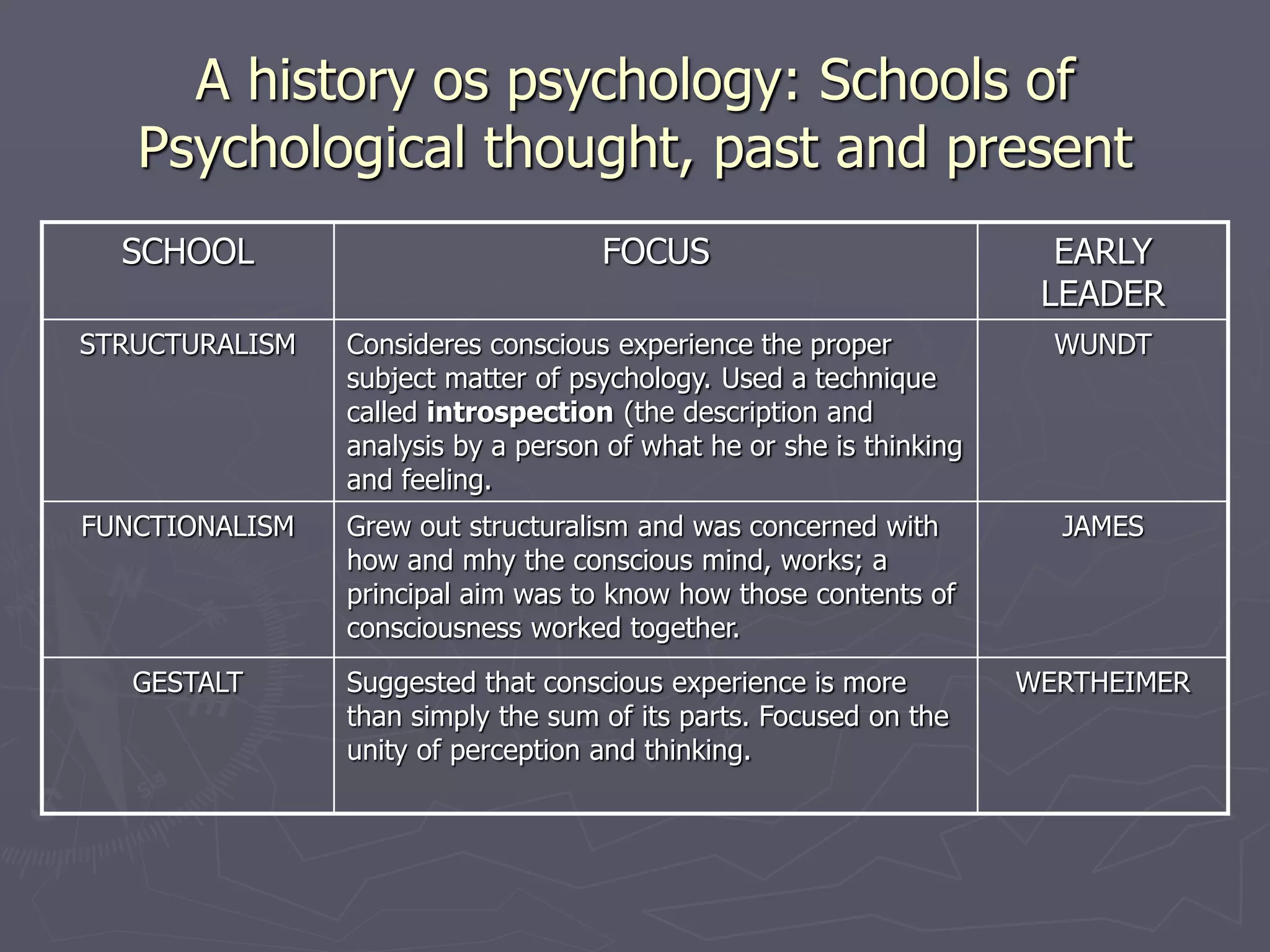
SCHOOL FOCUS EARLY
LEADER
STRUCTURALISM Consideres conscious experience the proper
subject matter of psychology. Used a technique
called introspection (the description and
analysis by a person of what he or she is thinking
and feeling.
WUNDT
FUNCTIONALISM Grew out structuralism and was concerned with
how and mhy the conscious mind, works; a
principal aim was to know how those contents of
consciousness worked together.
JAMES
GESTALT Suggested that conscious experience is more
than simply the sum of its parts. Focused on the
unity of perception and thinking.
WERTHEIMER
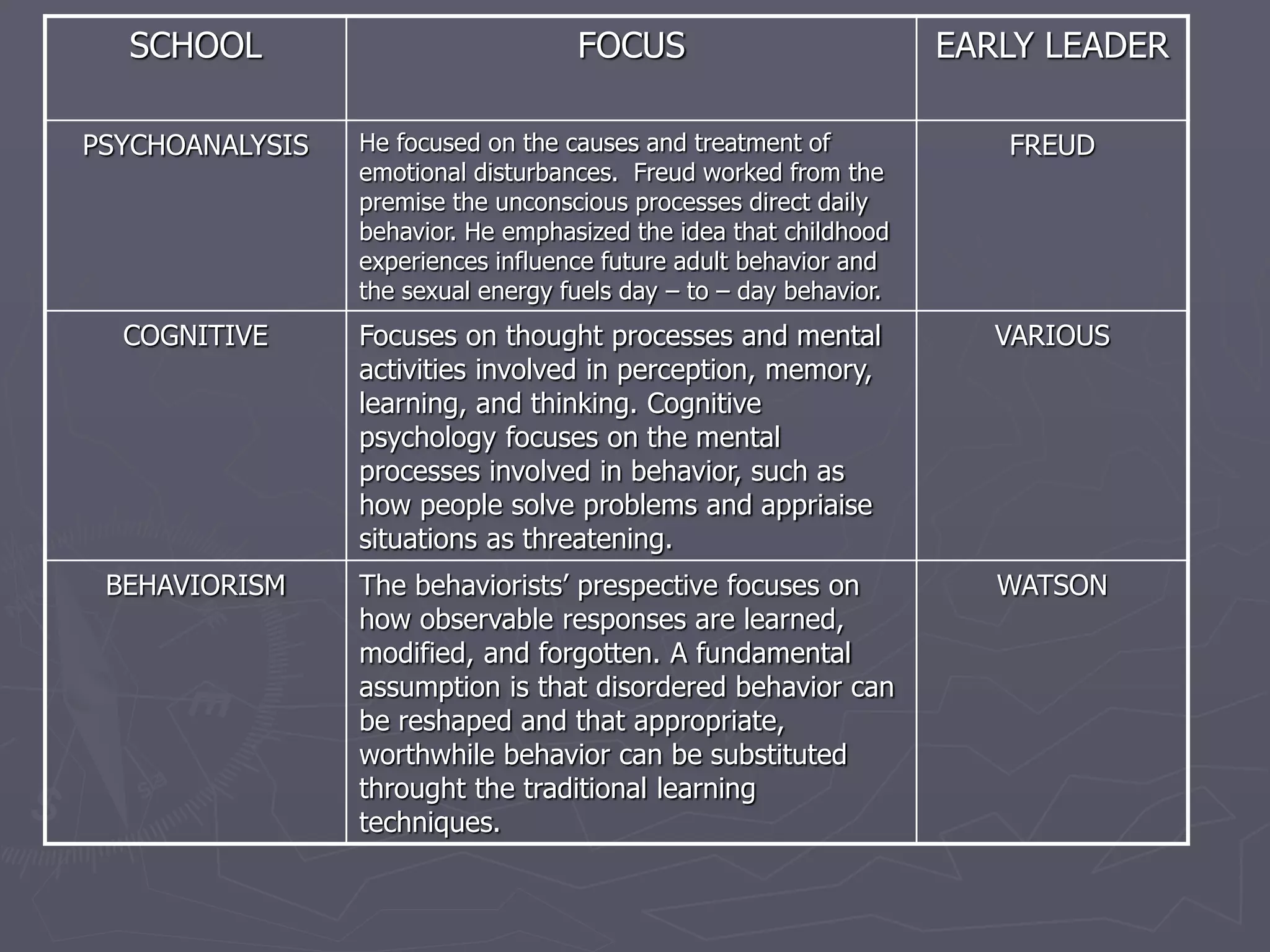
SCHOOL FOCUS EARLY LEADER
PSYCHOANALYSIS He focused on the causes and treatment of
emotional disturbances. Freud worked from the
premise the unconscious processes direct daily
behavior. He emphasized the idea that childhood
experiences influence future adult behavior and
the sexual energy fuels day – to – day behavior.
FREUD
COGNITIVE Focuses on thought processes and mental
activities involved in perception, memory,
learning, and thinking. Cognitive
psychology focuses on the mental
processes involved in behavior, such as
how people solve problems and appriaise
situations as threatening.
VARIOUS
BEHAVIORISM The behaviorists’ prespective focuses on
how observable responses are learned,
modified, and forgotten. A fundamental
assumption is that disordered behavior can
be reshaped and that appropriate,
worthwhile behavior can be substituted
throught the traditional learning
techniques.
WATSON
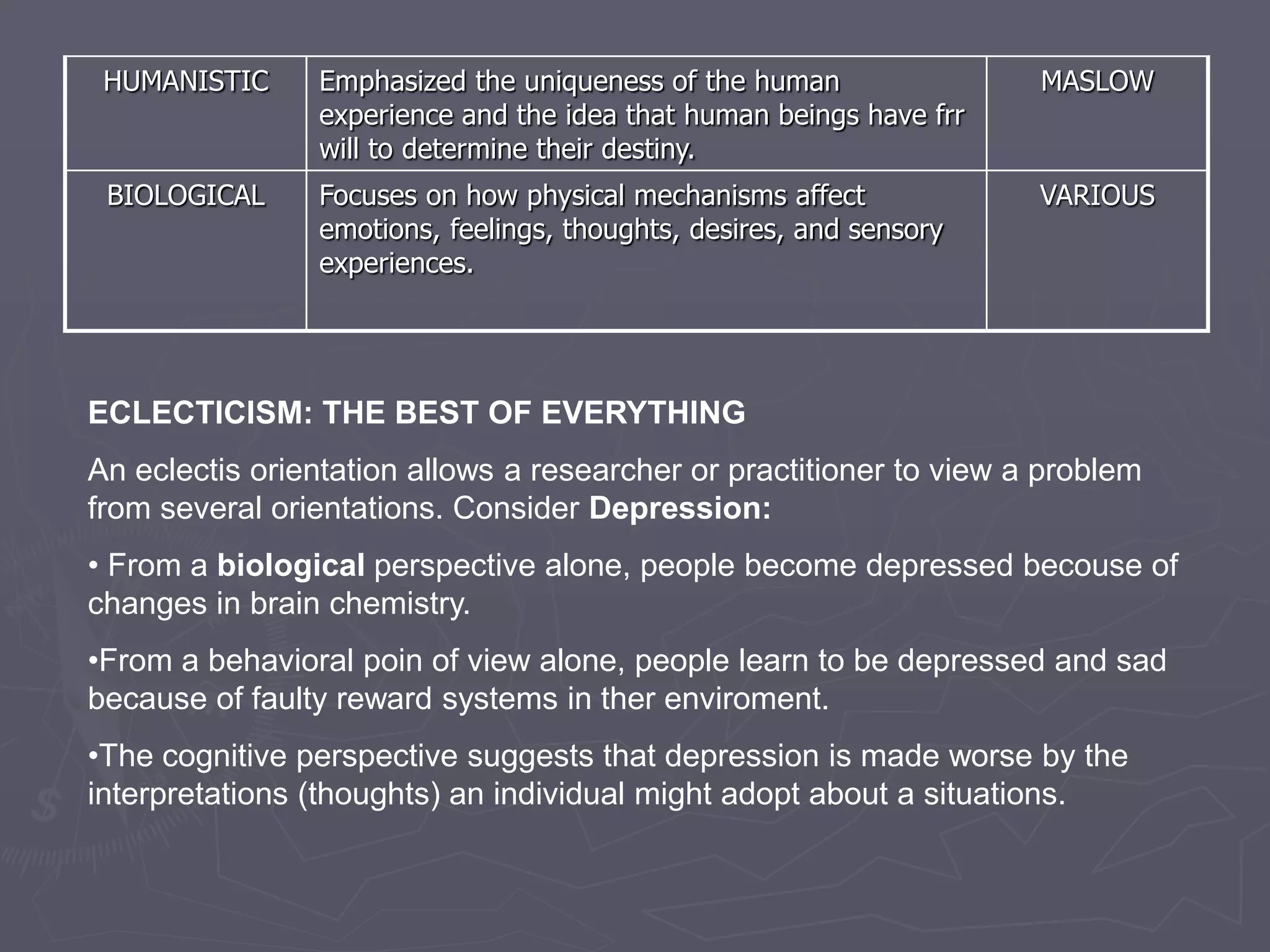
HUMANISTIC Emphasized the uniqueness of the human
experience and the idea that human beings have frr
will to determine their destiny.
MASLOW
BIOLOGICAL Focuses on how physical mechanisms affect
emotions, feelings, thoughts, desires, and sensory
experiences.
VARIOUS
ECLECTICISM: THE BEST OF EVERYTHING
An eclectis orientation allows a researcher or practitioner to view a problem
from several orientations. Consider Depression:
• From a biological perspective alone, people become depressed becouse of
changes in brain chemistry.
•From a behavioral poin of view alone, people learn to be depressed and sad
because of faulty reward systems in ther enviroment.
•The cognitive perspective suggests that depression is made worse by the
interpretations (thoughts) an individual might adopt about a situations.
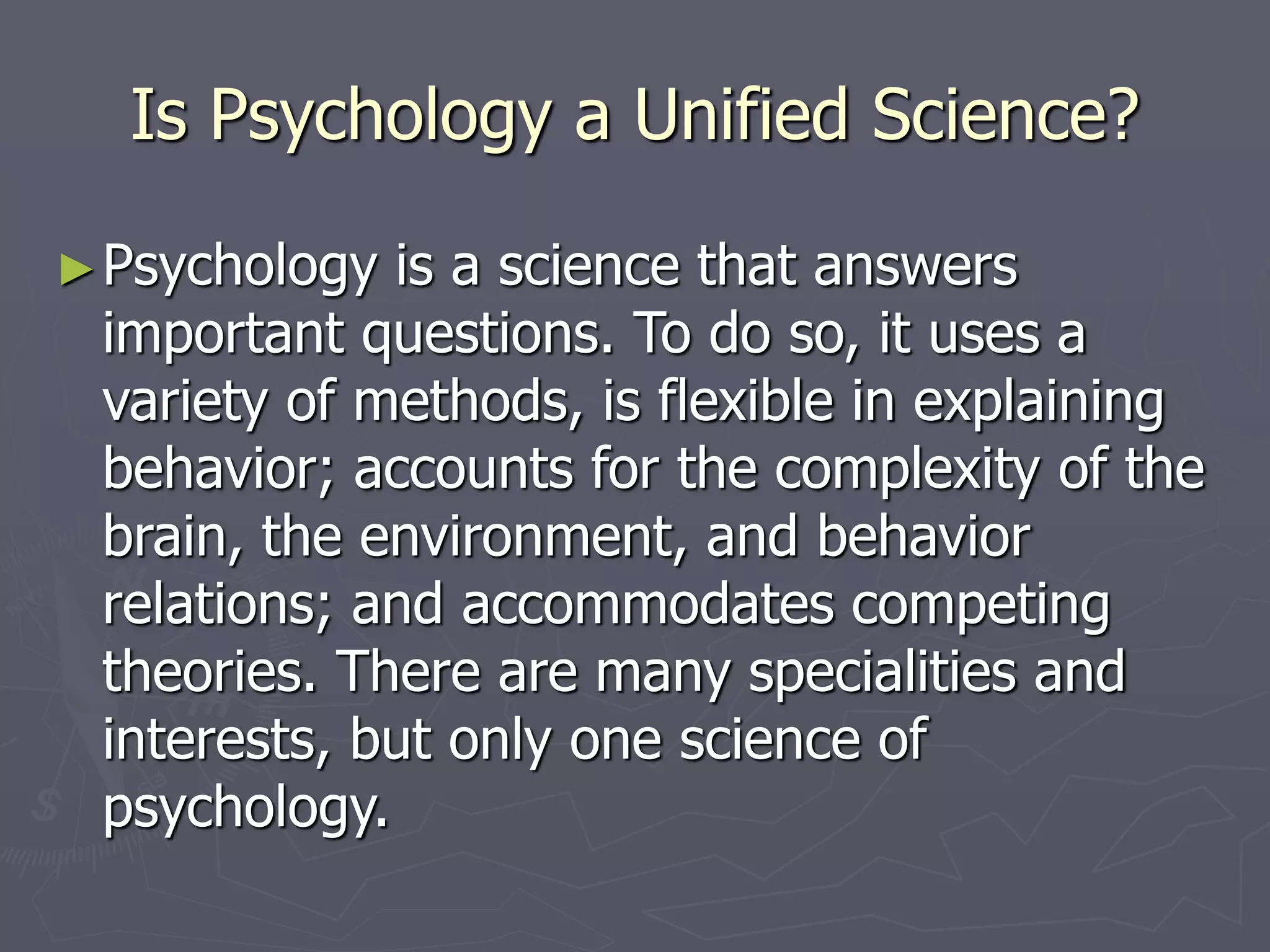
Is Psychology a Unified Science?
►Psychology is a science that answers
important questions. To do so, it uses a
variety of methods, is flexible in explaining
behavior; accounts for the complexity of the
brain, the environment, and behavior
relations; and accommodates competing
theories. There are many specialities and
interests, but only one science of
psychology.
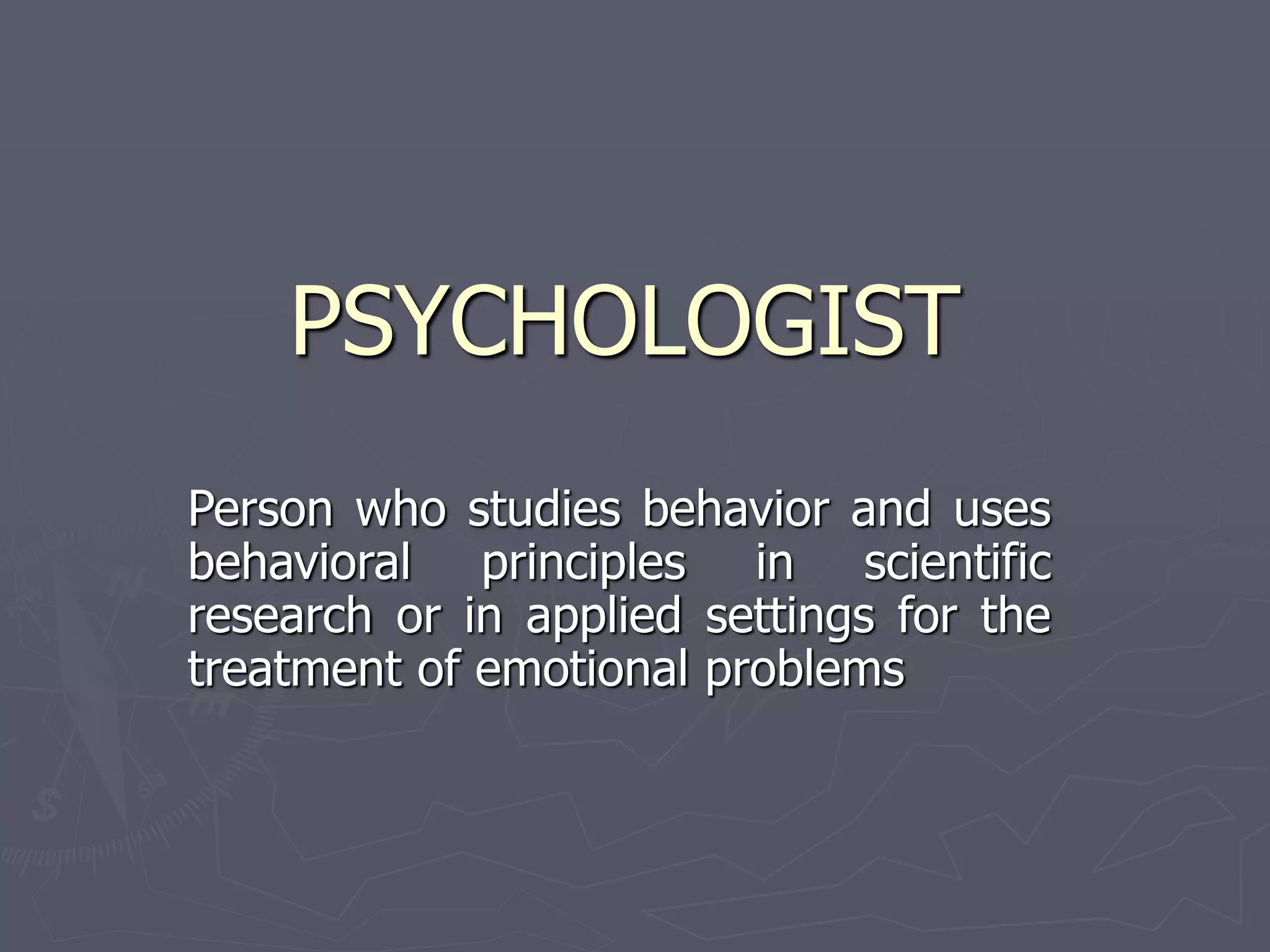
PSYCHOLOGIST
Person who studies behavior and uses
behavioral principles in scientific
research or in applied settings for the
treatment of emotional problems
PSYCHIATRIST
Medical doctor who has completed a
residency specializing in the study of
behavior and the treatment of patients
with emotional and physical disorders
CLINICAL PSYCHOLOGISTS
generally have extensive training in
assessment, research, and psychological
treatment of emotional problems.
PSYCHOANALYST
has estudied the technique of
psychoanalysis and uses it in treating
people with emotional problems
A psychologist Ph. D. will have a wide
variety of job opportunities available in
both the private and the public sectors.
Master´s degrees can function in a wide
variety of settings, even those with
bachelor´s degrees can take an important
role in the delivery of psychological
services.
What psychologists do
►Human service fields
They teach people to cope more effectively
by applying behavioral principles. Ther aim
is to help people solve problems and the
promote well-being. Within the human
service area are the subfields of clinical,
counseling, community and school
psychology.
Clinical psychologists
Specialize in helping clients with behavior
problems such as anger,shyness, deression
or marital discord.
They work either in private practice or at a
hospital, mental institution or social
service agency.
Counseling psychology
Work with people who have emotional problems
also help people with career and family
planning, marriage problems.
Community psychology
Work for mental health agencies, state
governments and private organizations.
they strengthen existing social support
networks and stimulate the formation of nwe
networks to meet a variety of challenges
School psychology
With the aim of implementing
comprehensive services. A lot of them see
their primary jobs has helping students,
teachers, parents and others understand
each other.
Applied psychology
Research and use that research to solve
every day practical problems.
Psychologists who treat people with
emotional problems function as one.
Engineering psychologists
Focus on how to use machines most efficiently
Educational Psychologist
Focus on how learning proceeds in the classroom, how
intelligence affects performance and the relationship
between personality and learning
Forensic psychologists
Focus on legal issues, the court, and
correctional systems.
Health psychologists
Focus on the way life-style changes con
facilitate health improvement.
Sports psychologists
Is an emerging field that focuses on brain
behavior interactions, the rol of sports in
healthful life-styles, ans the motivation and
preparation of athletes in sports-related
activities.
Industrial/organizational psychologists
Are concerned with the way employers
evaluate employees, they focus on personal
selection employee motivation, work
behavior and work appraisals.
EXPERIMENTAL PSYCHOLOGY
Focuses on identifying and understanding
the basics process involved in behavior and
thought.
The researcher uses a set of techniques, its
does not define the topics that a
psychologist examines.
The field of developmental psychology
focuses on the emotional, physical and
intellectual changes that take place over
the life span organism.
Social psychology studies how other
people affect individual behavior and
thoughts and specially how people interact
with one another.
Cognitive psychology focuses on thought
processes, especially the relationship of
learning, memory and perception.
Psychological psychology
Tries to understand the relationship of the
brain on its mechanism to behavior.
Techniques used to
study behavior
The psychologists study
behavior in both animals
and human beings
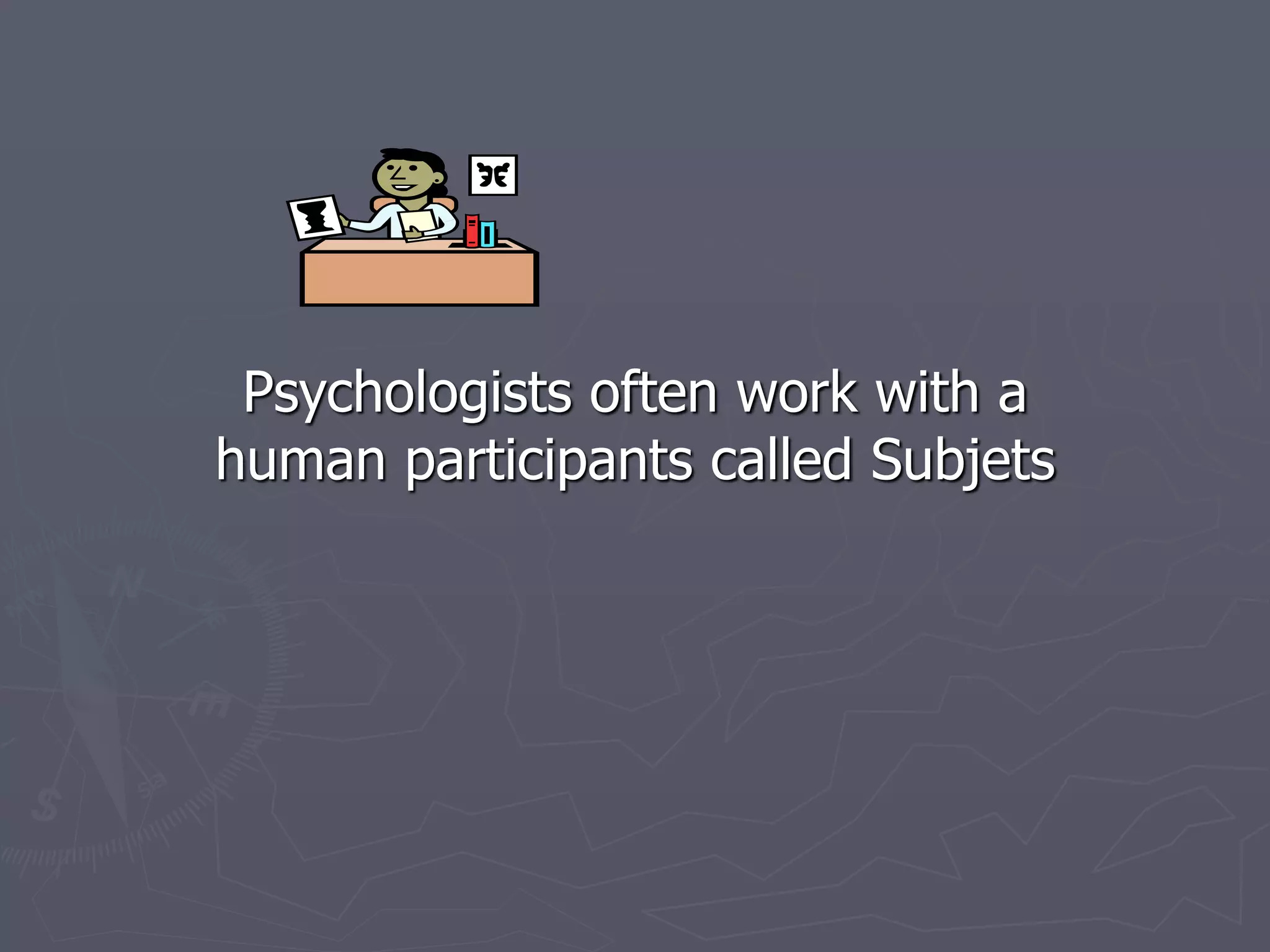
Psychologists often work with a
human participants called Subjets
The typical research
process is usually
systematic and begins
whit a specific question.
But sometimes
unexpectedly find an
answer to another
problem.
A hypothesis is a
tentative idea that
express a causal
relationship of two
events o variable.
Systematic explorations
The researchers follow up
systematically, that is they try to
consider all the aspects of a
situation that might cause an
organism to behave as it does.
Only controlled laboratory
experiments permit researches to
make cause-an effect-statements
Correllated events and causally
related events
►Two events are correlated when de
presence of a hi value of one variable o
situation is regulary asociated whit a hi, or
low value of another.
►In contrast:
►Events are causally related when one event
makes another event occur.
Significant differences: is
the statistically
determined likelihood
that a behavior not
occurred because of
chance alone
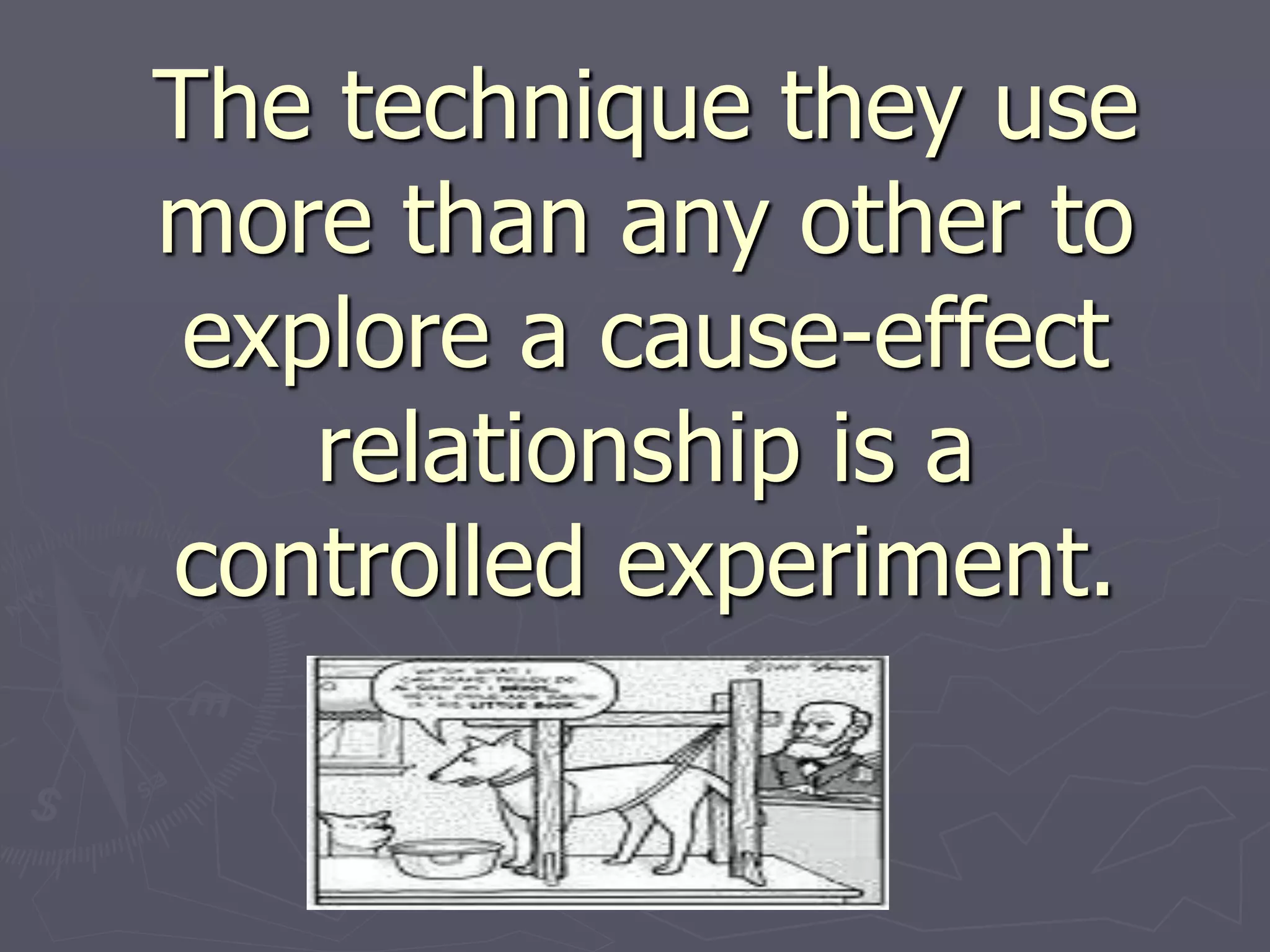
The technique they use
more than any other to
explore a cause-effect
relationship is a
controlled experiment.
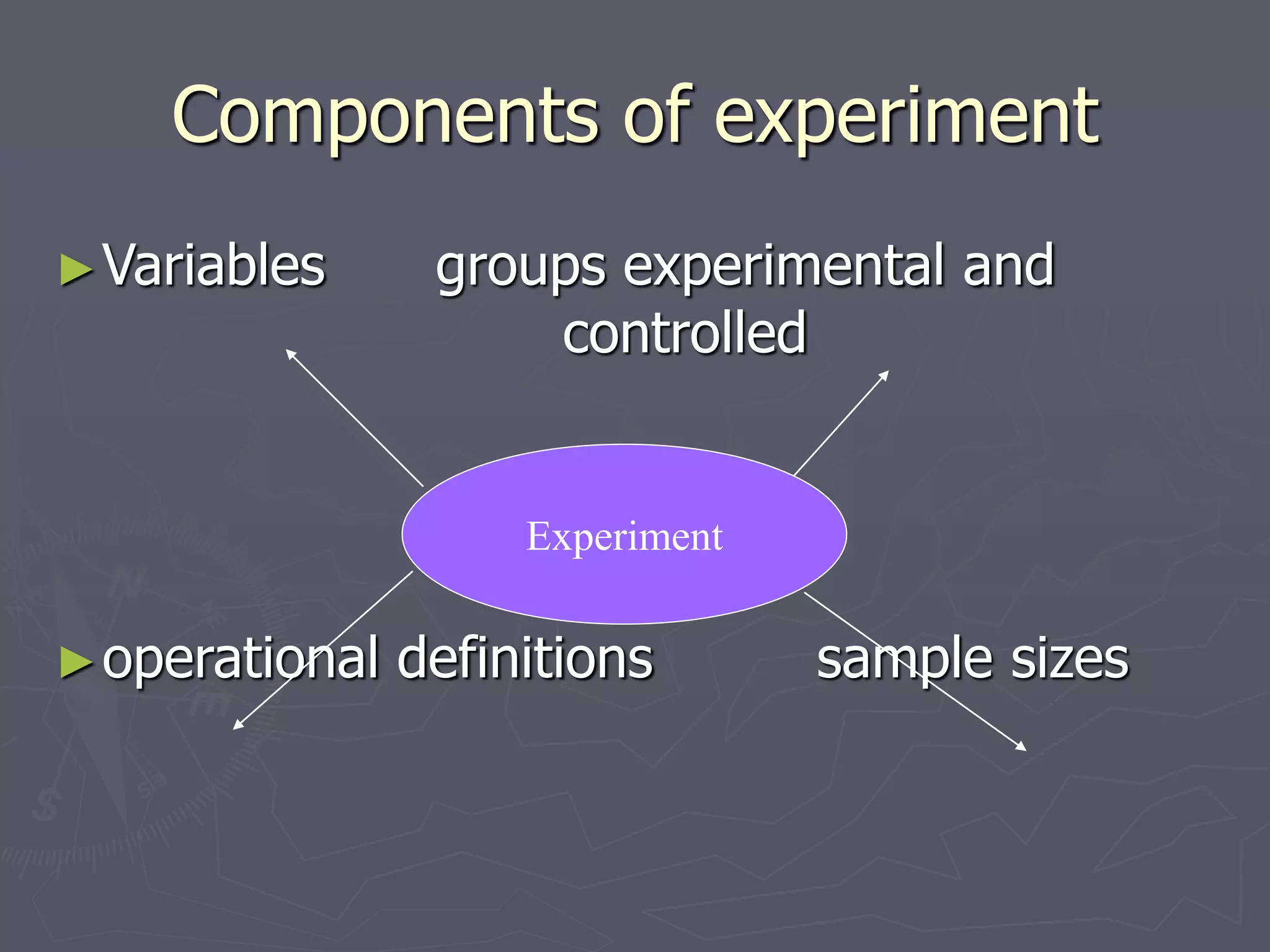
Components of experiment
►Variables groups experimental and
controlled
►operational definitions sample sizes
Experiment
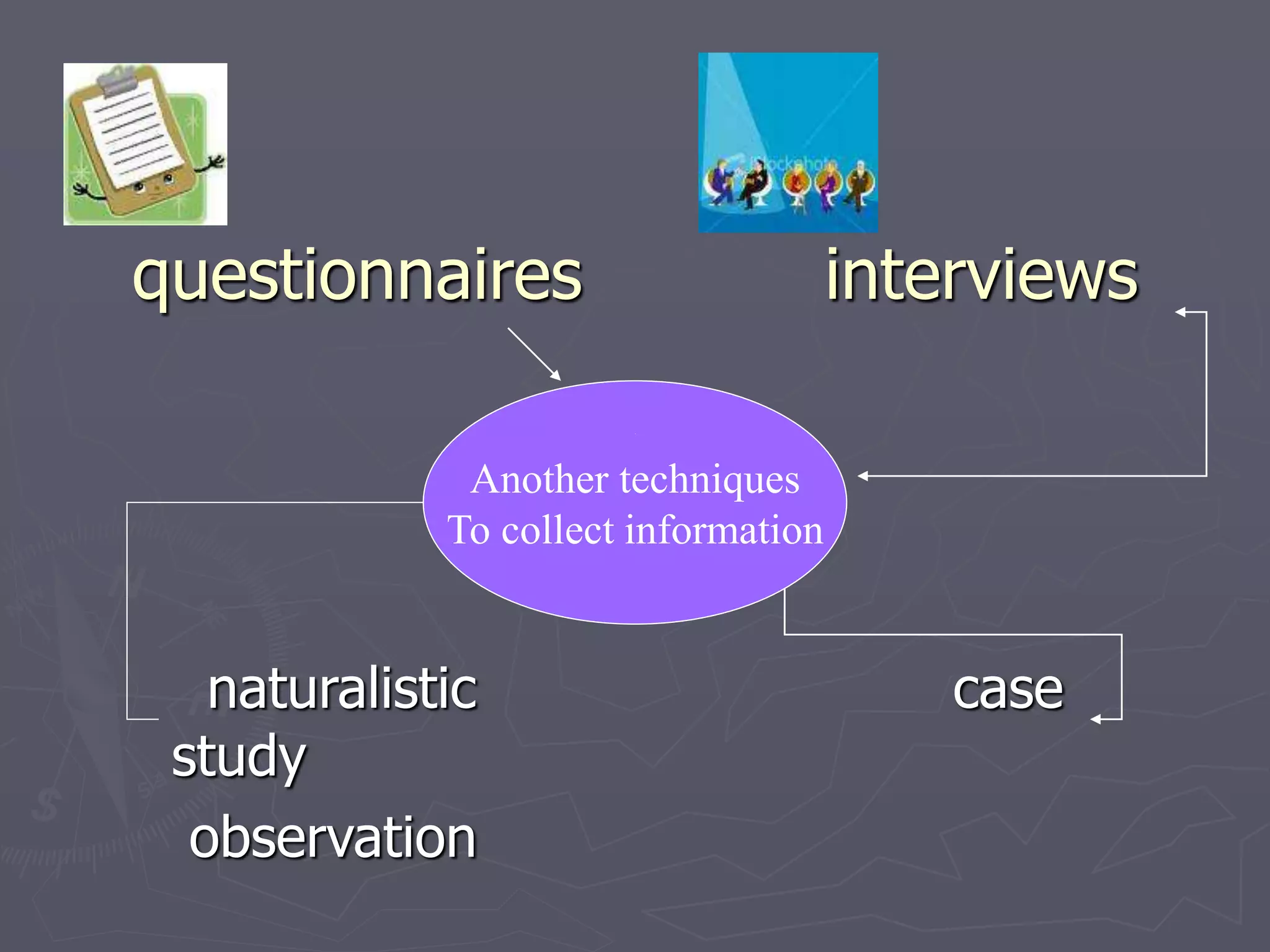
questionnaires interviews
naturalistic case
study
observation
Another techniques
To collect information
Strengths and weaknesses
of 5 approaches to research
Aproach Strengths Weaknesses
Experiment Manipulated the variable to
control the extraneus influences,
best method for identifying ausal
realtionships
Artificially or laboratory
envirotment, limited or
generalizability of findings,
manipulation of some variables
is unethical or impractical
Correlational study Measurement of degree of
asociation among variables;
good basis for predictions
Limited opportunity to controlled
third factors; unable to draw
conclusions about causal
relationships.
Questionarie Effective means of measuring
actions, attitudes, opinions,
preferences, and intentions of
large number of people.
Lack of explanatory power;
validity of findings may be
limitted by samples realibity
dificult to determine; self report
may be inaccurate or biased
Naturalistic observation Observation of behavior in its
natural context
Little opportunity to conrol
variables; time-consuming
Case study Study or rare events; extensive
evidence gathered on a single
person
Lack of generalizability of
findings time-consuming

Psychology

  • 1.
  • 2.
    Defining Psychology ► Isthe science of behavior and mental processes. ► Psychology is committed to: objectivity, accuracy and maintaining a healty skepticism. ► Today, psychology study both mental processes and behavior to see how organisms are affected by, and in turn affect, the social, physical, and biological world.
  • 3.
    Aims and Scopeof Psychology ►The goals of psychology are describe the basic components of behavior, to explain them, to predict them, and, potentially, to manage them. ►Psychologists develop theories. A theory is a collection of interrelated ideas and facts put forward to explain and predict behavior and mental processes.
  • 4.
    A history ospsychology: Schools of Psychological thought, past and present SCHOOL FOCUS EARLY LEADER STRUCTURALISM Consideres conscious experience the proper subject matter of psychology. Used a technique called introspection (the description and analysis by a person of what he or she is thinking and feeling. WUNDT FUNCTIONALISM Grew out structuralism and was concerned with how and mhy the conscious mind, works; a principal aim was to know how those contents of consciousness worked together. JAMES GESTALT Suggested that conscious experience is more than simply the sum of its parts. Focused on the unity of perception and thinking. WERTHEIMER
  • 5.
    SCHOOL FOCUS EARLYLEADER PSYCHOANALYSIS He focused on the causes and treatment of emotional disturbances. Freud worked from the premise the unconscious processes direct daily behavior. He emphasized the idea that childhood experiences influence future adult behavior and the sexual energy fuels day – to – day behavior. FREUD COGNITIVE Focuses on thought processes and mental activities involved in perception, memory, learning, and thinking. Cognitive psychology focuses on the mental processes involved in behavior, such as how people solve problems and appriaise situations as threatening. VARIOUS BEHAVIORISM The behaviorists’ prespective focuses on how observable responses are learned, modified, and forgotten. A fundamental assumption is that disordered behavior can be reshaped and that appropriate, worthwhile behavior can be substituted throught the traditional learning techniques. WATSON
  • 6.
    HUMANISTIC Emphasized theuniqueness of the human experience and the idea that human beings have frr will to determine their destiny. MASLOW BIOLOGICAL Focuses on how physical mechanisms affect emotions, feelings, thoughts, desires, and sensory experiences. VARIOUS ECLECTICISM: THE BEST OF EVERYTHING An eclectis orientation allows a researcher or practitioner to view a problem from several orientations. Consider Depression: • From a biological perspective alone, people become depressed becouse of changes in brain chemistry. •From a behavioral poin of view alone, people learn to be depressed and sad because of faulty reward systems in ther enviroment. •The cognitive perspective suggests that depression is made worse by the interpretations (thoughts) an individual might adopt about a situations.
  • 7.
    Is Psychology aUnified Science? ►Psychology is a science that answers important questions. To do so, it uses a variety of methods, is flexible in explaining behavior; accounts for the complexity of the brain, the environment, and behavior relations; and accommodates competing theories. There are many specialities and interests, but only one science of psychology.
  • 8.
    PSYCHOLOGIST Person who studiesbehavior and uses behavioral principles in scientific research or in applied settings for the treatment of emotional problems
  • 9.
    PSYCHIATRIST Medical doctor whohas completed a residency specializing in the study of behavior and the treatment of patients with emotional and physical disorders
  • 10.
    CLINICAL PSYCHOLOGISTS generally haveextensive training in assessment, research, and psychological treatment of emotional problems. PSYCHOANALYST has estudied the technique of psychoanalysis and uses it in treating people with emotional problems
  • 11.
    A psychologist Ph.D. will have a wide variety of job opportunities available in both the private and the public sectors. Master´s degrees can function in a wide variety of settings, even those with bachelor´s degrees can take an important role in the delivery of psychological services.
  • 12.
    What psychologists do ►Humanservice fields They teach people to cope more effectively by applying behavioral principles. Ther aim is to help people solve problems and the promote well-being. Within the human service area are the subfields of clinical, counseling, community and school psychology.
  • 13.
    Clinical psychologists Specialize inhelping clients with behavior problems such as anger,shyness, deression or marital discord. They work either in private practice or at a hospital, mental institution or social service agency.
  • 14.
    Counseling psychology Work withpeople who have emotional problems also help people with career and family planning, marriage problems. Community psychology Work for mental health agencies, state governments and private organizations. they strengthen existing social support networks and stimulate the formation of nwe networks to meet a variety of challenges
  • 15.
    School psychology With theaim of implementing comprehensive services. A lot of them see their primary jobs has helping students, teachers, parents and others understand each other.
  • 16.
    Applied psychology Research anduse that research to solve every day practical problems. Psychologists who treat people with emotional problems function as one.
  • 17.
    Engineering psychologists Focus onhow to use machines most efficiently Educational Psychologist Focus on how learning proceeds in the classroom, how intelligence affects performance and the relationship between personality and learning
  • 18.
    Forensic psychologists Focus onlegal issues, the court, and correctional systems. Health psychologists Focus on the way life-style changes con facilitate health improvement.
  • 19.
    Sports psychologists Is anemerging field that focuses on brain behavior interactions, the rol of sports in healthful life-styles, ans the motivation and preparation of athletes in sports-related activities.
  • 20.
    Industrial/organizational psychologists Are concernedwith the way employers evaluate employees, they focus on personal selection employee motivation, work behavior and work appraisals.
  • 21.
    EXPERIMENTAL PSYCHOLOGY Focuses onidentifying and understanding the basics process involved in behavior and thought. The researcher uses a set of techniques, its does not define the topics that a psychologist examines.
  • 22.
    The field ofdevelopmental psychology focuses on the emotional, physical and intellectual changes that take place over the life span organism. Social psychology studies how other people affect individual behavior and thoughts and specially how people interact with one another.
  • 23.
    Cognitive psychology focuseson thought processes, especially the relationship of learning, memory and perception. Psychological psychology Tries to understand the relationship of the brain on its mechanism to behavior.
  • 24.
  • 25.
    The psychologists study behaviorin both animals and human beings
  • 26.
    Psychologists often workwith a human participants called Subjets
  • 27.
    The typical research processis usually systematic and begins whit a specific question. But sometimes unexpectedly find an answer to another problem.
  • 28.
    A hypothesis isa tentative idea that express a causal relationship of two events o variable.
  • 29.
    Systematic explorations The researchersfollow up systematically, that is they try to consider all the aspects of a situation that might cause an organism to behave as it does. Only controlled laboratory experiments permit researches to make cause-an effect-statements
  • 30.
    Correllated events andcausally related events ►Two events are correlated when de presence of a hi value of one variable o situation is regulary asociated whit a hi, or low value of another. ►In contrast: ►Events are causally related when one event makes another event occur.
  • 31.
    Significant differences: is thestatistically determined likelihood that a behavior not occurred because of chance alone
  • 32.
    The technique theyuse more than any other to explore a cause-effect relationship is a controlled experiment.
  • 33.
    Components of experiment ►Variablesgroups experimental and controlled ►operational definitions sample sizes Experiment
  • 34.
  • 35.
    Strengths and weaknesses of5 approaches to research Aproach Strengths Weaknesses Experiment Manipulated the variable to control the extraneus influences, best method for identifying ausal realtionships Artificially or laboratory envirotment, limited or generalizability of findings, manipulation of some variables is unethical or impractical Correlational study Measurement of degree of asociation among variables; good basis for predictions Limited opportunity to controlled third factors; unable to draw conclusions about causal relationships. Questionarie Effective means of measuring actions, attitudes, opinions, preferences, and intentions of large number of people. Lack of explanatory power; validity of findings may be limitted by samples realibity dificult to determine; self report may be inaccurate or biased Naturalistic observation Observation of behavior in its natural context Little opportunity to conrol variables; time-consuming Case study Study or rare events; extensive evidence gathered on a single person Lack of generalizability of findings time-consuming