Capital Market Awareness
What is a Stock Market ?
 Bombay Stock Exchange (BSE)
 First and Oldest Stock Exchange in Asia –
 Founded as The Native Stocks & Share Brokers Association in 1875
 Largest number of listed companies - 5,249
 7th
largest exchange in Asia in terms of Market Capitalization
 8th
Largest Exchange in World – number of trades in Equity
Shares
 New Platform for trading in equities of SMEs
2
BSE Market Offerings
 Cash Market
 Derivatives
 Currency Derivatives
 Interest Rate Derivatives
 Debt Market segment
 ETFs/Mutual Funds
 BSE SME Platform
How the Capital Market Operates
Settlement System: T+2 Settlement System
Day Time Description of activity
T 9:15 a.m. – 3:30 p.m. Trade Day
T+1
By 11:00 a.m.
Confirmation of all trades (including custodial trades) Facility
of an exceptional window for late confirmations would be
made available by the exchanges
By 1:30 p.m.
Processing and downloading of obligation files to brokers /
custodians
T+2
By 11:00 a.m. Pay-in of securities and funds
By 1:30 p.m. Pay-out of securities and funds
www.lkwindia.com www.gurukshetra.com
How the Capital Market Operates
e-trading
 BOLT on-line Trading
System at BSE
 Benefits :
 Lower Transaction Costs
 Increased Liquidity &
Transparency
 Greater Competition
 Time Efficient & Automated
De-materialization (Demat)
 Shares held in electronic
format (Non-Physical)
 Facilitates electronic
settlement of trades
 Maintained & monitored
by Depository Participant
(DP)
e-trading Screen
1 6
Capital Market Regulator - SEBI
 Capital Market Watchdog
 Established under SEBI Act, 1992
 Promotes Investor Education
 Monitors Insider Trading
 Regulates
 Stock Exchanges
 Working of all Intermediaries, Stock Brokers
 Prohibits Fraudulent and Unfair Trade Practices
Asset Class Offerings
 Equity
 Direct Equity
 Equity Mutual Funds
 Debt
 Bank FDs
 Corporate FDs
 Debt Mutual Funds
 Government Instruments (PPF, NSC, Post Office Savings)
 Gold
 ETFs
 Fund of Funds
100 = 20 .…. How ?
Now that Rs. 100 has become 20, how will one make Rs. 20 work
optimally ???
Illustration Amount
Base Income 100
Less : Direct Tax 30
Post Direct Tax Income 70
Non - Discretionary Expenses 35
Indirect Taxes 5
Net Income 30
Net Investible Income 20
Demon of Inflation
1200.00
300.00
50.00
40.00
22.20
48.35
2008
830.85LPG Cylinder
2620.27Zodiac Men’s shirt
259.12Petrol (per litre)
224.00Masala Dosa
52.00Hamam Soap
104.0018.90Colgate toothpaste
(100 gm tube)
2017?Item 1987
8.05
3.05
3.50
7.99
56.15
225.00
7.85
14.00
25.48
137.85
510.00
1997
You Have to Invest to Beat Inflation
FD Returns = 9%
Interest is taxable
Clearly, ONLY Low Risk FDsClearly, ONLY Low Risk FDs
will erode your capitalwill erode your capital
More than ~70% of Investors Funds find their wayMore than ~70% of Investors Funds find their way
to FD’sto FD’s
Equity v/s Debt – Performance RecoEquity v/s Debt – Performance Recordrd
 Equity
Rs. 813 in August 2014 at a CAGR
Return of 20.1% After Tax
 Debt
Rs. 236 in August 2014 at a CAGR
Return of 6.2% After Tax**
Investment of Rs. 100 invested in March 2003 would have been
** assumed investor is in Highest Tax Bracket
BEATING INFLATION – Equity InvestingBEATING INFLATION – Equity Investing
 High Risk
 Two year Bull Run in a 7-8 years7-8 years
 Pulls up overall average returns
* Minimum period of remaining invested is 7-10 years
Returns Difference – Over the Longer TermReturns Difference – Over the Longer Term
HUGE
Scheme Category /
Benchmark Indices
CAGR % Returns (10th
October, 2014)
1 year 2 years 3 years 5 years 7 years 10 years
Large Cap Funds 53% 24% 22% 16% 13% 22%
Mid Cap Funds 94% 37% 33% 23% 20% 24%
Balanced Funds 64% 25% 23% 18% 15% 22%
Ways of Participating in the Equity
Market
 Direct Equity
 Through Mutual Funds
Selecting a Stock
 Management
 Business Model
 Numbers
 Story behind the Numbers
 Industry Outlook
 Annual Report
Investing v/s Trading
 Time Frame v/s Immediate
 Level of Market Expertise
 Long Term v/s Speculative
 Delivery v/s Square Off
 Returns v/s Zero Sum Game
Capital Markets – Road Ahead
 Current Participation – 2%; Year 2025 – 10-15%
participation
 Indian Equity Market - Strong Potential for Growth
 Investment Cycle has to re-start
 Sheer Size of Indian Economy
 Changing Demographics in India
InvestingInvesting in Mutual Fundsin Mutual Funds
What are Mutual Funds
 Pool of Money
 Professionally Managed
 Governed by AMFI and SEBI
 Sponsor / Trustee, AMC
Mutual Fund Terms
 AMC
 Corpus
 AUM
 NAV & Units
 Fund Factsheet
 Expense Ratio
 NFO
Types of Mutual Fund Schemes
 Equity Mutual Fund Schemes
 Large Cap / Multi Cap / Mid & Small cap / Sectoral Funds
 Debt Mutual Fund Schemes
 Liquid / Ultra Short Term / Dynamic Bond / Income / Gilt
 Balanced Funds
 Gold Fund of Funds
 Tax Saving Schemes
Advantages of Investing through MFs
 Wide choice of products
 Relatively easier to invest – in terms of operations
 Less Volatile
 Possible to invest small sums
 Facilitates disciplined investing
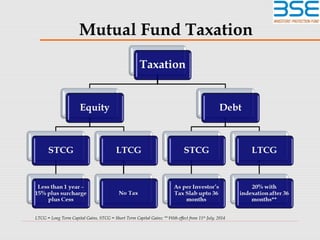
Mutual Fund Taxation
LTCG = Long Term Capital Gains, STCG = Short Term Capital Gains; ** With effect from 11th
July, 2014
Ways of Investing in Mutual Funds
 Systematic Investment Plan
 Systematic Transfer Plan
 Systematic Withdrawal Plan
 Lumpsum
 KYC & Procedures
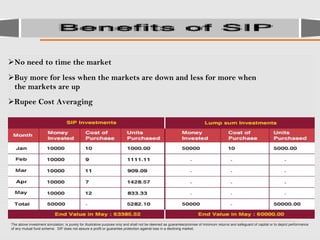
No need to time the market
Buy more for less when the markets are down and less for more when
the markets are up
Rupee Cost Averaging
   
  
The above investment simulation, is purely for illustrative purpose only and shall not be deemed as guarantee/promise of minimum returns and safeguard of capital or to depict performance 
of any mutual fund scheme.  SIP does not assure a profit or guarantee protection against loss in a declining market.
Mutual Fund Investment Options
 Growth
 Dividend
 Dividend Re-investment
MF Portfolio Creation – Key Parameters
 Goals & Objectives
 Risk Appetite
 Allocation & Diversification
 Consistent Performance Track Record
 Fund Manager Performance Record
 AMC Experience & Total Corpus
Measuring MF Performance
 Benchmarking
 Peer Group Performance Comparison
 Understanding Strategies
 Statistical Measures
Equity - Sharpe Ratio
Debt - Duration, Credit Quality
Financial Planning usingFinancial Planning using
Asset AllocationAsset Allocation
What is Financial Planning
 Achieving Financial Goals
 An Individual has to deal with
 Investments
 Insurance
 Taxes
 Retirement
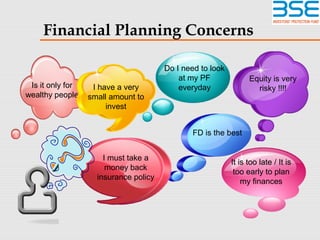
Financial Planning Concerns
Do I need to look 
at my PF 
everyday
Equity is very 
risky !!!!
FD is the best
I must take a 
money back 
insurance policy
It is too late / It is 
too early to plan 
my finances
Is it only for 
wealthy people
I have a very 
small amount to 
invest
Steps in Financial Planning
 Financial Goals
 Buying a house
 Children's Education
 Children’s Marriage
 Insurance Planning
 Tax Planning
 Retirement Planning
 Estate Planning
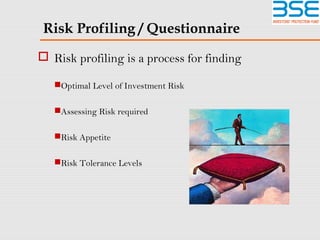
Risk Profiling / Questionnaire
 Risk profiling is a process for finding
Optimal Level of Investment Risk
Assessing Risk required
Risk Appetite
Risk Tolerance Levels
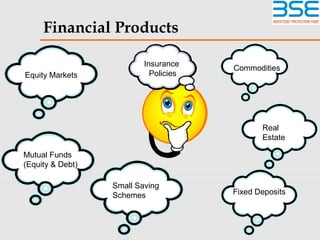
Financial Products
Equity Markets
Insurance
Policies
Mutual Funds
(Equity & Debt)
Fixed Deposits
Commodities
Small Saving
Schemes
Real
Estate
Financial Planning Life Cycle Stages
Wealth Creation Wealth Consolidation Wealth Protection
Power of Compounding
Monthly SIP
Amount (`)
Expected Rate of
Return
Estimated
Corpus over 10 years
2,0002,000 15%15% Rs. 5.6 lakhRs. 5.6 lakh
3,5003,500 15%15% Rs. 9.8 lakhRs. 9.8 lakh
5,0005,000 15%15% Rs. 13.9 lakhRs. 13.9 lakh
Bull Cycle once in 7-8 years pulls up Average ReturnsBull Cycle once in 7-8 years pulls up Average Returns
Power of Compounding
What you save
every day
How much it could
earn every year
...and after... You will have*
Rs. 30 10% 25 years Rs. 1,18,640
Rs. 30 12% 25 years Rs. 1,86,151
Rs. 30 15% 25 years Rs. 3,60,463
*(Compounded Annually)
Let us assume that instead of spending on coffee at the nearest café which
costs Rs. 30, you decide to forego the coffee and invest the amount, here is
what it could add up to after 25 years...
Clearly, the table shows that the longer you leave your money invested
and the higher the rate of return, the faster your wealth will grow.
Three Pillars of Investing
 Safety
 Liquidity
 Returns
Right Approach to Financial Planning
 Prepare Comprehensive Financial Plan
 List down all Assets
 List down all Liabilities
 Set Achievable Financial Goals
Asset Allocation- Importance
EQUITY if :
 Relatively High Risk Appetite
 Relatively longer time frame for
achieving goals
 Higher Investible Amount
 High Risk – High Reward
DEBT if :
 Non-Discretionary Nature of
Goals
 Diversification of Risks
 Low Risk – Low Returns
 Potential to provide Regular
Income
GOLD if :
 Asset Class of the Last
Resort
 Optimizes Portfolio Returns
 Traditional Hedge
CASH if :
 Foreseeable Near Term Goal
 Contingency Funds
Re-balancing Asset Allocation
 Allocate based on Economic & Market conditions
 Provide Weightages based on Outlook
 Create Asset Class Boundaries
 Rebalance based on
 Breaching Boundaries
 Changing Outlook
Portfolio Monitoring
 Periodically Monitor
 Adopt well defined strategy
 Review Annually
 Returns Consistency
Join - GURUKSHETRA Page on Facebook
 Benefits for Students
 Education & Career Counseling Tips
 Financial Discussion Forums
 Explore Job Opportunities
 Get Guidance from Finance Experts
 Interact with Students like yourself from different parts
of India
Come – Join by sending a Friend Request on Facebook to
Gurukshetra
ALL STUDENTS ARE WELCOME
THANK YOU !!!!
FINANCIAL PLANNING IS AFINANCIAL PLANNING IS A
FULL TIME ACTIVITYFULL TIME ACTIVITY
THERE IS NO SHORT CUTTHERE IS NO SHORT CUT
TO MAKING MONEYTO MAKING MONEY

BSE

  • 1.
  • 2.
    What is aStock Market ?  Bombay Stock Exchange (BSE)  First and Oldest Stock Exchange in Asia –  Founded as The Native Stocks & Share Brokers Association in 1875  Largest number of listed companies - 5,249  7th largest exchange in Asia in terms of Market Capitalization  8th Largest Exchange in World – number of trades in Equity Shares  New Platform for trading in equities of SMEs 2
  • 3.
    BSE Market Offerings Cash Market  Derivatives  Currency Derivatives  Interest Rate Derivatives  Debt Market segment  ETFs/Mutual Funds  BSE SME Platform
  • 4.
    How the CapitalMarket Operates Settlement System: T+2 Settlement System Day Time Description of activity T 9:15 a.m. – 3:30 p.m. Trade Day T+1 By 11:00 a.m. Confirmation of all trades (including custodial trades) Facility of an exceptional window for late confirmations would be made available by the exchanges By 1:30 p.m. Processing and downloading of obligation files to brokers / custodians T+2 By 11:00 a.m. Pay-in of securities and funds By 1:30 p.m. Pay-out of securities and funds
  • 5.
    www.lkwindia.com www.gurukshetra.com How theCapital Market Operates e-trading  BOLT on-line Trading System at BSE  Benefits :  Lower Transaction Costs  Increased Liquidity & Transparency  Greater Competition  Time Efficient & Automated De-materialization (Demat)  Shares held in electronic format (Non-Physical)  Facilitates electronic settlement of trades  Maintained & monitored by Depository Participant (DP)
  • 6.
  • 7.
    Capital Market Regulator- SEBI  Capital Market Watchdog  Established under SEBI Act, 1992  Promotes Investor Education  Monitors Insider Trading  Regulates  Stock Exchanges  Working of all Intermediaries, Stock Brokers  Prohibits Fraudulent and Unfair Trade Practices
  • 8.
    Asset Class Offerings Equity  Direct Equity  Equity Mutual Funds  Debt  Bank FDs  Corporate FDs  Debt Mutual Funds  Government Instruments (PPF, NSC, Post Office Savings)  Gold  ETFs  Fund of Funds
  • 9.
    100 = 20.…. How ? Now that Rs. 100 has become 20, how will one make Rs. 20 work optimally ??? Illustration Amount Base Income 100 Less : Direct Tax 30 Post Direct Tax Income 70 Non - Discretionary Expenses 35 Indirect Taxes 5 Net Income 30 Net Investible Income 20
  • 10.
    Demon of Inflation 1200.00 300.00 50.00 40.00 22.20 48.35 2008 830.85LPGCylinder 2620.27Zodiac Men’s shirt 259.12Petrol (per litre) 224.00Masala Dosa 52.00Hamam Soap 104.0018.90Colgate toothpaste (100 gm tube) 2017?Item 1987 8.05 3.05 3.50 7.99 56.15 225.00 7.85 14.00 25.48 137.85 510.00 1997
  • 11.
    You Have toInvest to Beat Inflation FD Returns = 9% Interest is taxable Clearly, ONLY Low Risk FDsClearly, ONLY Low Risk FDs will erode your capitalwill erode your capital More than ~70% of Investors Funds find their wayMore than ~70% of Investors Funds find their way to FD’sto FD’s
  • 12.
    Equity v/s Debt– Performance RecoEquity v/s Debt – Performance Recordrd  Equity Rs. 813 in August 2014 at a CAGR Return of 20.1% After Tax  Debt Rs. 236 in August 2014 at a CAGR Return of 6.2% After Tax** Investment of Rs. 100 invested in March 2003 would have been ** assumed investor is in Highest Tax Bracket
  • 13.
    BEATING INFLATION –Equity InvestingBEATING INFLATION – Equity Investing  High Risk  Two year Bull Run in a 7-8 years7-8 years  Pulls up overall average returns * Minimum period of remaining invested is 7-10 years Returns Difference – Over the Longer TermReturns Difference – Over the Longer Term HUGE Scheme Category / Benchmark Indices CAGR % Returns (10th October, 2014) 1 year 2 years 3 years 5 years 7 years 10 years Large Cap Funds 53% 24% 22% 16% 13% 22% Mid Cap Funds 94% 37% 33% 23% 20% 24% Balanced Funds 64% 25% 23% 18% 15% 22%
  • 14.
    Ways of Participatingin the Equity Market  Direct Equity  Through Mutual Funds
  • 15.
    Selecting a Stock Management  Business Model  Numbers  Story behind the Numbers  Industry Outlook  Annual Report
  • 16.
    Investing v/s Trading Time Frame v/s Immediate  Level of Market Expertise  Long Term v/s Speculative  Delivery v/s Square Off  Returns v/s Zero Sum Game
  • 17.
    Capital Markets –Road Ahead  Current Participation – 2%; Year 2025 – 10-15% participation  Indian Equity Market - Strong Potential for Growth  Investment Cycle has to re-start  Sheer Size of Indian Economy  Changing Demographics in India
  • 18.
    InvestingInvesting in MutualFundsin Mutual Funds
  • 19.
    What are MutualFunds  Pool of Money  Professionally Managed  Governed by AMFI and SEBI  Sponsor / Trustee, AMC
  • 20.
    Mutual Fund Terms AMC  Corpus  AUM  NAV & Units  Fund Factsheet  Expense Ratio  NFO
  • 21.
    Types of MutualFund Schemes  Equity Mutual Fund Schemes  Large Cap / Multi Cap / Mid & Small cap / Sectoral Funds  Debt Mutual Fund Schemes  Liquid / Ultra Short Term / Dynamic Bond / Income / Gilt  Balanced Funds  Gold Fund of Funds  Tax Saving Schemes
  • 22.
    Advantages of Investingthrough MFs  Wide choice of products  Relatively easier to invest – in terms of operations  Less Volatile  Possible to invest small sums  Facilitates disciplined investing
  • 23.
    Mutual Fund Taxation LTCG= Long Term Capital Gains, STCG = Short Term Capital Gains; ** With effect from 11th July, 2014
  • 24.
    Ways of Investingin Mutual Funds  Systematic Investment Plan  Systematic Transfer Plan  Systematic Withdrawal Plan  Lumpsum  KYC & Procedures
  • 25.
    No need totime the market Buy more for less when the markets are down and less for more when the markets are up Rupee Cost Averaging        The above investment simulation, is purely for illustrative purpose only and shall not be deemed as guarantee/promise of minimum returns and safeguard of capital or to depict performance  of any mutual fund scheme.  SIP does not assure a profit or guarantee protection against loss in a declining market.
  • 26.
    Mutual Fund InvestmentOptions  Growth  Dividend  Dividend Re-investment
  • 27.
    MF Portfolio Creation– Key Parameters  Goals & Objectives  Risk Appetite  Allocation & Diversification  Consistent Performance Track Record  Fund Manager Performance Record  AMC Experience & Total Corpus
  • 28.
    Measuring MF Performance Benchmarking  Peer Group Performance Comparison  Understanding Strategies  Statistical Measures Equity - Sharpe Ratio Debt - Duration, Credit Quality
  • 29.
    Financial Planning usingFinancialPlanning using Asset AllocationAsset Allocation
  • 30.
    What is FinancialPlanning  Achieving Financial Goals  An Individual has to deal with  Investments  Insurance  Taxes  Retirement
  • 31.
  • 32.
    Steps in FinancialPlanning  Financial Goals  Buying a house  Children's Education  Children’s Marriage  Insurance Planning  Tax Planning  Retirement Planning  Estate Planning
  • 33.
    Risk Profiling /Questionnaire  Risk profiling is a process for finding Optimal Level of Investment Risk Assessing Risk required Risk Appetite Risk Tolerance Levels
  • 34.
    Financial Products Equity Markets Insurance Policies MutualFunds (Equity & Debt) Fixed Deposits Commodities Small Saving Schemes Real Estate
  • 35.
    Financial Planning LifeCycle Stages Wealth Creation Wealth Consolidation Wealth Protection
  • 36.
    Power of Compounding MonthlySIP Amount (`) Expected Rate of Return Estimated Corpus over 10 years 2,0002,000 15%15% Rs. 5.6 lakhRs. 5.6 lakh 3,5003,500 15%15% Rs. 9.8 lakhRs. 9.8 lakh 5,0005,000 15%15% Rs. 13.9 lakhRs. 13.9 lakh Bull Cycle once in 7-8 years pulls up Average ReturnsBull Cycle once in 7-8 years pulls up Average Returns
  • 37.
    Power of Compounding Whatyou save every day How much it could earn every year ...and after... You will have* Rs. 30 10% 25 years Rs. 1,18,640 Rs. 30 12% 25 years Rs. 1,86,151 Rs. 30 15% 25 years Rs. 3,60,463 *(Compounded Annually) Let us assume that instead of spending on coffee at the nearest café which costs Rs. 30, you decide to forego the coffee and invest the amount, here is what it could add up to after 25 years... Clearly, the table shows that the longer you leave your money invested and the higher the rate of return, the faster your wealth will grow.
  • 38.
    Three Pillars ofInvesting  Safety  Liquidity  Returns
  • 39.
    Right Approach toFinancial Planning  Prepare Comprehensive Financial Plan  List down all Assets  List down all Liabilities  Set Achievable Financial Goals
  • 40.
    Asset Allocation- Importance EQUITYif :  Relatively High Risk Appetite  Relatively longer time frame for achieving goals  Higher Investible Amount  High Risk – High Reward DEBT if :  Non-Discretionary Nature of Goals  Diversification of Risks  Low Risk – Low Returns  Potential to provide Regular Income GOLD if :  Asset Class of the Last Resort  Optimizes Portfolio Returns  Traditional Hedge CASH if :  Foreseeable Near Term Goal  Contingency Funds
  • 41.
    Re-balancing Asset Allocation Allocate based on Economic & Market conditions  Provide Weightages based on Outlook  Create Asset Class Boundaries  Rebalance based on  Breaching Boundaries  Changing Outlook
  • 42.
    Portfolio Monitoring  PeriodicallyMonitor  Adopt well defined strategy  Review Annually  Returns Consistency
  • 43.
    Join - GURUKSHETRAPage on Facebook  Benefits for Students  Education & Career Counseling Tips  Financial Discussion Forums  Explore Job Opportunities  Get Guidance from Finance Experts  Interact with Students like yourself from different parts of India Come – Join by sending a Friend Request on Facebook to Gurukshetra ALL STUDENTS ARE WELCOME
  • 44.
    THANK YOU !!!! FINANCIALPLANNING IS AFINANCIAL PLANNING IS A FULL TIME ACTIVITYFULL TIME ACTIVITY THERE IS NO SHORT CUTTHERE IS NO SHORT CUT TO MAKING MONEYTO MAKING MONEY